

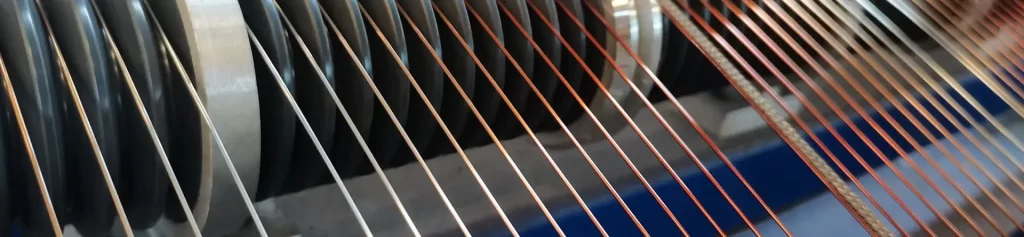
I. Introduction: Paper covered wire and polyester enameled wire – the “showdown” between the two major winding materials
In all electrical fields such as transformers, motors, home appliances, and power equipment, the selection of conductor insulation materials for windings directly determines the performance, lifespan, and cost of the equipment. Paper Covered WireandPolyester Insulated Wireare the two mainstream materials in the field of winding insulation, each with distinct advantages, disadvantages and applicable scenarios.
1.1 What is paper wrapped wire?Paper Covered Wire(Paper Covered Wire, PCW or PWC) is a winding wire withcopper wire or aluminum wire as the conductor, and the outer layer is multi-layer wound insulating paper(cable paper, telephone paper, polyester film paper, polyaramide paper, etc.).Main Types**:
- Cable paper covered wire
- Telephone paper wrapped wire
- Polyester film composite paper covered wire
-Polyaramide (Nomex) paper covered wire - Diamond dotted paper covered wire (DDP)
1.2 What is polyester enameled wire?
Polyester Insulated Wire/Polyester Enameled Wireis a winding wire that usescopper wire or aluminum wireas the conductor, and the outer layer is coated with a polyester resin paint film through a**painting process.
Main Types:
– Ordinary polyester (PE) enameled wire – 130°C (Grade B)
– Modified polyester enameled wire – 155°C (Grade F)
– Polyesterimide (PEI) enameled wire – 180°C (Class H)
– Polyesterimide/polyamideimide (PEI/PAI) composite enameled wire – 180°C (H class)
1.3 Comparison of the core values of the two major materials
| Dimensions | Paper covered wire | Polyester enameled wire |
|---|---|---|
| Insulation method | Multi-layer paper wrapping | Painted paint film |
| Insulation thickness | Thick (multi-layer paper) | Thin (30-80 μm paint film) |
| Slot Full Rate | Low | High |
| Temperature Resistance Level | 105-220°C | 130-220°C |
| Breakdown Voltage | High (multiple layers of paper stacked) | Medium (paint film thickness limit) |
| Cost | Medium (manual winding) | Low (automated painting) |
| Production efficiency | Low | High |
| Typical Applications | Oil-immersed transformers, dry-type transformers | General motors, transformers, home appliances |
II. Detailed explanation of paper wrapped wire
2.1 Core structure of paper covered wire
Paper covered wire is composed ofconductor + insulating paper, and the insulating paper is usually wrapped in 2-8 layers.
        ┌─────────────┐
        │ Insulating paper layer │ ← 2-8 layers
        │ ┌───────┐ │
        │ │ │ │
        │ │ Copper core │ │ ← Round copper wire / flat copper wire
        │ │ │ │
        │ └───────┘ │
        └─────────────┘
2.2 Detailed explanation of 5 large paper covered wire types
| Types | Insulation Materials | Temperature Resistance | Features | Applications |
|---|---|---|---|---|
| Cable paper covered wire | Cable paper | 105°C | Low cost | Oil-immersed transformer |
| Telephone paper covered wire | Telephone paper | 105°C | Thin and uniform | Small transformer |
| Polyester film composite paper | PET film | 130°C | High strength | General transformer |
| Polyaramid (Nomex) paper | Nomex 410 | 220°C | High temperature resistance | Dry-type transformer |
| diamond dispensing paper (DDP) | diamond coated paper | 130°C | self-adhesive | transformer winding |
2.3 Production process of paper wrapped wire
Copper/aluminum wire → annealing → cleaning → paper winding machine (multi-layer winding) → drying → finished product
Key process parameters:
– Number of paper wrapping layers: 2-8 layers
– Paper wrapping angle: 30-60°
– Paper wrapping overlap rate: 30-50%
– Drying temperature: 100-150°C
2.4 Breakdown voltage of paper covered wire
| Number of paper layers | Single layer breakdown voltage | Total breakdown voltage | Dielectric strength |
|---|---|---|---|
| 2 layers | 1.5-2.0 kV | 3-4 kV | 10-15 kV/mm |
| 3 layers | 1.5-2.0 kV | 4.5-6 kV | 10-15 kV/mm |
| 4 layers | 1.5-2.0 kV | 6-8 kV | 10-15 kV/mm |
| 6 layers | 1.5-2.0 kV | 9-12 kV | 10-15 kV/mm |
| 8 layers | 1.5-2.0 kV | 12-16 kV | 10-15 kV/mm |
Core Advantage: The total breakdown voltage of paper covered wire increases linearly with the number of paper layers, and high BDV can be easily achieved by increasing the number of layers.
2.5 Advantages and Disadvantages of Paper Covered Wire
Advantages:
– ✅ High breakdown voltage (multiple layers of paper superimposed)
– ✅ Good oil resistance (cable paper is stable in oil)
– ✅ Various temperature resistance levels (105-220°C)
– ✅ Moderate price
– ✅ Easy to repair locally
Disadvantages:
– ❌ The slot full rate is low (the paper layer is thick and takes up space)
– ❌ Low production efficiency (manual/semi-automatic paper winding)
– ❌ Poor paint film uniformity
– ❌ Not suitable for high-speed winding
– ❌ Not resistant to moisture (paper easily absorbs moisture)
2.6 The core advantages of paper covered wire in transformers
Advantage 1: Naturally suitable for oil-immersed environments- In oil-immersed transformers, paper has good compatibility with oil
– Oil-immersed insulation strength increased by 5-10 times
– Oil-paper insulation is the golden combination for transformersAdvantage 2: High breakdown voltage- Paper-covered wires are commonly used in 35 kV oil-immersed transformers
– 110 kV and 220 kV ultra-high voltage transformers use high-performance paper-covered wiresBenefit 3: Repairability- Partial damage can be repaired by re-wrapping it
– Unlike the paint film which must be replaced if damaged
III. Detailed explanation of polyester enameled wire
3.1 Core structure of polyester enameled wire
Polyester enameled wire is composed ofcopper/aluminum conductor + paint film. The paint film is coated on the surface of the conductor through a painting process.
        ┌─────────────┐
        │ Paint film (30-80 μm) │
        │ ┌───────┐ │
        │ │ │ │
        │ │ Copper core │ │ ← Round copper wire
        │ │ │ │
        │ └───────┘ │
        └─────────────┘
3.2 4 large polyester enameled wire types
| Type | Film Chemistry | Temperature Grade | Breakdown Voltage (Grade 2) |
|---|---|---|---|
| Ordinary polyester (PE) | PET | 130°C (B) | 5-7 kV |
| Modified polyester | Modified PET | 155°C (F) | 6-8 kV |
| Polyesterimide (PEI) | Contains imine rings | 180°C (H) | 8-11 kV |
| PEI/PAI composite | Double coated | 180°C (H) | 10-13 kV |
3.3 Production process of polyester enameled wire
Copper/aluminum wire → Annealing → Cleaning → Multiple painting + baking → Finished product
Key process parameters:
– Number of paint passes: 4-12 passes
– Baking temperature: 350-450°C
– Paint film thickness: 18-80 μm
– Paint film grade: Grade 1/2/3/4
3.4 Breakdown voltage of polyester enameled wire
| Paint film grade | Paint film thickness (PE) | Breakdown voltage |
|---|---|---|
| Grade 1 | 18-30 μm | 4-6 kV |
| Grade 2 | 30-50 μm | 5-7 kV |
| Grade 3 | 50-80 μm | 8-12 kV |
| Grade 4 | > 80 μm | > 12 kV |
3.4 Breakdown voltage of polyester enameled wire
| Paint film grade | Paint film thickness (PE) | Breakdown voltage |
|---|---|---|
| Grade 1 | 18-30 μm | 4-6 kV |
| Grade 2 | 30-50 μm | 5-7 kV |
| Grade 3 | 50-80 μm | 8-12 kV |
| Grade 4 | > 80 μm | > 12 kV |
Core Limitation: The increase in paint film thickness will reduce the tank full rate, and the breakdown voltage will be limited.
3.5 Advantages and disadvantages of polyester enameled wire
Advantages:
– ✅ High tank full rate (thin paint film)
– ✅ Automated production (high-speed winding)
– ✅ Good paint film uniformity
– ✅ Suitable for mass production
– ✅ Low cost
Disadvantages:
– ❌ Breakdown voltage is limited by paint film thickness
– ❌ Easily hydrolyzed at high temperatures (polyester)
– ❌ The entire piece must be replaced after the paint film is damaged
– ❌ High BDV applications require higher-grade paint films (PAI/PI), which are costly
IV. Paper covered wire vs polyester enameled wire: 18 key comparisons
4.1 Physical performance comparison
| Performance | Paper covered wire | Polyester enameled wire |
|---|---|---|
| Insulation method | Multi-layer paper wrapping | Paint film |
| Insulation thickness | Thick (0.10-0.30 mm) | Thin (0.02-0.08 mm) |
| Slot full rate | 60-70% | 75-80% |
| Breakdown voltage (Grade 2) | 4.5-6 kV | 5-7 kV |
| Breakdown voltage (6 layers/Grade 3) | 9-12 kV | 8-12 kV |
| Dielectric strength | 10-15 kV/mm | 100-150 kV/mm |
| Temperature resistance grade | 105-220°C | 130-220°C |
| Oil resistance | Excellent (for oil immersion only) | Good |
| Water resistance | Poor | Good |
| Chemical Resistance | Fair | Good |
| Moisture resistance | Poor | Good |
4.2 Mechanical performance comparison
| Performance | Paper covered wire | Polyester enameled wire |
|---|---|---|
| Flexibility | Good (the paper can be bent) | Excellent (the paint film is continuous) |
| Impact resistance | Good | Excellent |
| Scratch resistance | Poor (paper breaks easily) | Good |
| Vibration resistance | Average | Excellent |
| Compression resistance | Poor (paper is compressed) | Excellent |
4.3 Economic comparison
| Dimensions | Paper covered wire | Polyester enameled wire |
|---|---|---|
| Material Cost | Medium | Low |
| Processing cost | High (labor) | Low (automation) |
| Total Cost | Medium High | Low |
| Productivity | Low | High |
| Suitable for batches | Smaller batches | Large batches |
4.4 Manufacturing process comparison
| Dimensions | Paper covered wire | Polyester enameled wire |
|---|---|---|
| Technology | Paper wrapping + drying | Painting + baking |
| Automation level | Medium-low | High |
| Speed | 10-30 m/min | 50-200 m/min |
| Equipment investment | Medium | Medium to high |
| Process Maturity | Mature | Very Mature |
V. In-depth comparison of breakdown voltage
5.1 Relationship between breakdown voltage and insulation thickness
Paper covered wire: BDV ∝ Number of paper layers (linear relationship)
– Layer 2: 3-4 kV
– Layer 4: 6-8 kV
– 6 layers: 9-12 kV
– 8 layers: 12-16 kV
Polyester enameled wire: BDV ∝ Paint film thickness^0.7-0.9
– Grade 1 (18-30 μm): 4-6 kV
– Grade 2 (30-50 μm): 5-7 kV
– Grade 3 (50-80 μm): 8-12 kV
– Grade 4 (> 80 μm): > 12 kV
5.2 Engineering selection for high breakdown voltage
| Breakdown voltage requirements | Paper covered wire solution | Polyester enameled wire solution |
|---|---|---|
| < 5 kV | 2 ply paper | Grade 1-2 PEI |
| 5-10 kV | 3-4 layers of paper | Grade 3 PEI/PAI |
| 10-15 kV | 6 ply paper | Grade 4 PAI |
| > 15 kV | 8 ply paper | Grade 4 PAI/PI (high cost) |
Core Finding: In high BDV scenarios, Paper covered wire is more economical(6-layer paper costs less than Grade 4 PAI enameled wire).
5.3 Breakdown voltage in oil immersion environment
| Materials | Dry BDV | Oil-immersed BDV | Oil-immersed Gain |
|---|---|---|---|
| Paper covered wire (4 layers) | 6-8 kV | 30-50 kV | 5-8× |
| PE enameled wire | 5-7 kV | 3-5 kV | 30% drop |
| PEI enameled wire | 8-11 kV | 7-10 kV | Down 10% |
| PAI enameled wire | 10-13 kV | 9-12 kV | 10% decrease |
VI. Comparison of temperature levels
6.1 Temperature level quick check
| Temperature grade | Paper covered wire | Polyester enameled wire |
|---|---|---|
| 105°C (A) | Cable paper | – |
| 120°C (E) | Polyester film composite paper | – |
| 130°C (B) | Polyester film composite paper | PE (ordinary polyester) |
| 155°C (F) | Polyester film composite paper | Modified polyester / PEI |
| 180°C (H) | Nomex 410 | PEI / PEI+PAI |
| 200°C (R) | Nomex 410 (Special) | PAI |
| 220°C (N) | Nomex 410 (Special) | PI |
| 240°C (C) | – | PI (modified) |
6.2 Comparison of high temperature scenes
| Scene | Paper covered wire | Polyester enameled wire |
|---|---|---|
| < 105°C | ✅ Cable paper | – |
| 105-130°C | ✅ PET composite paper | ✅ PE |
| 130-155°C | ✅ PET composite paper | ✅ Modified PE / PEI |
| 155-180°C | ✅ Nomex | ✅ PEI |
| 180-200°C | ✅ Nomex Special | ✅ PAI |
| 200-220°C | ⚠️ Nomex Extreme | ✅ PAI / PI |
| > 220°C | ❌ Not applicable | ✅ PI |
Core findings: In >180°Chigh temperature scenarios,polyester enameled wire (PAI/PI) is better.
VII. Comparison of typical application scenarios
7.1 Transformer field
| Transformer Types | Recommended Materials | Reasons |
|---|---|---|
| Oil-immersed distribution transformer | Paper covered wire | Oil-paper insulation is the golden combination |
| 35 kV oil-immersed power transformer | Paper covered wire | High BDV, oil-immersed gain |
| 110 kV UHV transformer | High performance paper covered wire | Multi-layer paper high BDV |
| Dry-type transformer (small) | Polyester enameled wire | Low cost, automated |
| Dry-type transformer (high temperature) | Nomex paper covered wire | 180-220°C temperature resistance |
| Switching power supply high frequency transformer | Polyester enameled wire | Uniform paint film, good high frequency performance |
| Micro transformer | Polyester enameled wire | High slot filling rate, precise winding |
7.2 Motor field
| Motor type | Recommended materials | Reasons |
|---|---|---|
| General low voltage motor | Polyester enameled wire | High slot full rate, automation |
| Medium and high voltage motors | Polyester enameled wire (PEI/PAI) | Breakdown voltage meets |
| Traction motor | Polyester enameled wire (PAI/PI) | Temperature resistance, vibration resistance |
| Oil-immersed motor | Paper covered wire + enameled wire | Insulation in oil |
| Submersible motor | Enameled wire (PAI/PI) | Oil immersion + temperature resistance |
| Wind turbine | Enameled wire (PEI/PAI) | Temperature resistance, vibration resistance |
| New energy vehicle motor | Enameled wire (PAI) | High power density |
7.3 Home Appliances and Consumer Electronics
| Application | Recommended Materials | Rationale |
|---|---|---|
| Air conditioning compressor motor | Enameled wire (PEI/PAI) | High slot full rate, temperature resistance |
| Refrigerator compressor motor | Enameled wire (PEI/PAI) | Refrigerant resistant, temperature resistant |
| Washing machine motor | Enameled wire (PEI) | Low cost |
| Fan motor | Enameled wire (PE) | Low cost |
| Microwave oven transformer | Enameled wire (PEI) | Cost and performance balance |
| Power adapter | Enameled wire (PE/PEI) | High frequency, high slot full rate |
7.4 Electric Power and Transmission and Distribution
| Application | Recommended Materials | Rationale |
|---|---|---|
| 35 kV oil-immersed transformer | Paper covered wire | High BDV |
| 110 kV Oil-immersed Transformer | High Performance Paper Covered Wire | Extremely High BDV |
| 220 kV Oil-immersed Transformer | High Performance Paper Covered Wire | Extremely High BDV |
| 500 kV UHV transformer | Special paper covered wire | Ultimate BDV |
| Dry type transformer (H class) | Nomex paper covered wire | 180°C temperature resistant |
| Transformer | Enameled wire + paper covered wire | Comprehensive |
| Bushing | Paper covered wire | Oil-immersed insulation |
VIII. Special comparison of oil immersion environment
8.1 Insulation combination of oil-immersed transformer
The insulation of oil-immersed transformer is composite insulation of oil + paper (paint film).
| Insulating materials | Dry dielectric strength (kV/mm) | Oil immersed dielectric strength (kV/mm) | Gain |
|---|---|---|---|
| Transformer oil | – | 10-15 kV/mm | – |
| Cable paper | 10-15 kV/mm | 30-50 kV/mm | 3-5× |
| PE paint film | 100-150 kV/mm | 70-100 kV/mm | 30% reduction |
| PEI paint film | 150-200 kV/mm | 130-180 kV/mm | 10% decrease |
| PAI paint film | 200-260 kV/mm | 180-230 kV/mm | 10% reduction |
| PI paint film | 240-320 kV/mm | 220-290 kV/mm | 10% decrease |
8.2 Challenges of oil-impregnated enameled wire
| Challenge | Impact |
|---|---|
| Paint film swelling | Paint film thickness increased by 5-20% |
| Paint film softening | Oil as plasticizer |
| Paint film bubbling | Oil decomposes to produce gas |
| Paint film peeling | Loss of adhesion |
| Chemical corrosion | Acid, water, sulfur in oil |
8.3 Selection decision for oil immersed environment
| Oil immersed environment | Recommended materials |
|---|---|
| Distribution transformers (< 35 kV) | Paper covered wire (cable paper) |
| 35 kV oil-immersed transformer | Paper covered wire (high performance cable paper) |
| 110 kV oil-immersed transformer | Paper covered wire (Nomex composite) |
| 220 kV oil-immersed transformer | High performance paper covered wire (Nomex 410) |
| Oil-immersed motor | Enameled wire (PAI/PI) |
| Submersible motor | Enameled wire (PI) |
IX. Engineering selection of breakdown voltage
9.1 Select materials according to working voltage
| Working voltage | Paper covered wire | Polyester enameled wire |
|---|---|---|
| < 1 kV | 2 layers | Grade 1-2 PEI |
| 1-3.3 kV | 3-4 layers | Grade 2-3 PEI/PAI |
| 3.3-6.6 kV | 4-6 layers | Grade 3 PAI |
| 6.6-15 kV | 6-8 layers | Grade 3-4 PAI (high cost) |
| 15-35 kV | 8-10 layers (paper covered wire is optimal) | Not applicable |
| 35-110 kV | High performance paper covered wire | Not applicable |
| > 110 kV | Special Paper Covered Wire | Not applicable |
9.2 Cost comparison of breakdown voltage
| Breakdown voltage | Paper covered wire cost | Enameled wire cost | Who is more economical? |
|---|---|---|---|
| 5 kV | 2 layers of paper = $0.10/m | Grade 2 PEI = $0.08/m | Enameled wire |
| 10 kV | 4 layers of paper = $0.20/m | Grade 3 PAI = $0.40/m | Paper covered wire |
| 15 kV | 6 layers of paper = $0.30/m | Grade 4 PAI = $0.60/m | Paper covered wire |
| 20 kV | 8 layers of paper = $0.40/m | Not applicable | Paper covered wire |
| 30 kV | 10 layers of paper = $0.50/m | Not applicable | Paper covered wire |
X. Manufacturing process comparison
10.1 Paper covered wire manufacturing
Key Process:
1. Conductor preparation: copper/aluminum wire annealing and cleaning
2. Paper winding: Multi-layer winding by paper winding machine
3. Drying: Drying at 100-150°C
4. Quality inspection: Appearance, insulation, breakdown
Key Equipment:
– Paper winding machine (vertical/horizontal)
– Annealing furnace
– Drying oven
– Breakdown voltage tester
Production efficiency: 10-30 m/min
10.2 Polyester enameled wire manufacturing
Key Process:
1. Conductor preparation: copper/aluminum wire annealing and cleaning
2. Painting: Multiple coats of paint (4-12 passes)
3. Baking: Baking at 350-450°C
4. Quality inspection: Appearance, insulation, breakdown
Key Equipment:
– Vertical/Horizontal Painting Machine
– Baking oven (electric heating / catalytic combustion)
– Paint liquid circulation system
– Online detector (paint film thickness, pinhole, outer diameter)
Production efficiency: 50-200 m/min
10.3 Impact of process differences on selection
| Technology | Paper covered wire | Enameled wire |
|---|---|---|
| Automation | Medium Low | High |
| Suitable specifications | Large, medium | Full specifications |
| Suitable length | Medium short | Extremely long |
| Suitable for batches | Small and medium | Large |
Conclusion: Large batch, small size winding → enameled wire is excellent; High voltage, large size winding → Paper covered wire is excellent.
XI. Performance attenuation comparison
11.1 Thermal aging life
| Material | 130°C life | 155°C life | 180°C life |
|---|---|---|---|
| Cable paper covered wire | 30,000 h | 10,000 h | 3,000 h |
| Nomex Paper Covered Wire | 200,000 h | 100,000 h | 50,000 h |
| PE enameled wire | 5,000-10,000 h | – | – |
| PEI enameled wire | 20,000 h | 15,000-20,000 h | 5,000 h |
| PAI enameled wire | 40,000 h | 25,000-40,000 h | 8,000-12,000 h |
| PI enameled wire | 50,000 h | 30,000-50,000 h | 10,000-20,000 h |
11.2 Breakdown voltage attenuation
| Materials | Initial BDV | BDV after 1,000 h | BDV retention |
|---|---|---|---|
| Cable paper covered wire | 6 kV | 4.5 kV | 75% |
| Nomex Paper Covered Wire | 12 kV | 11.5 kV | 96% |
| PE enameled wire | 6 kV | 4.5 kV | 75% |
| PEI enameled wire | 9 kV | 8.8 kV | 98% |
| PAI enameled wire | 12 kV | 11.5 kV | 96% |
| PI enameled wire | 14 kV | 13.5 kV | 96% |
Core Findings: The BDV retention rates for both PI enameled wire and Nomex paper-covered wire are >96%.
XII. 5 typical application cases
12.1 Case 1: 35 kV oil-immersed distribution transformer
A 35 kV oil-immersed distribution transformer with a capacity of 5,000 kVA uses 4-layer cable paper-covered wire for the low-voltage winding and 6-layer paper-covered wire for the high-voltage winding. Good insulation and no breakdown after 25 years of operation.
Reason for selection:
– Oil immersed environment: Paper covered wire is the golden choice
– High BDV requirements: 4-6 paper stacks
– 25 years life: paper + oil composite insulation
12.2 Case 2: 220 kV UHV transformer
A 220 kV, 180 MVA UHV transformer uses Nomex 410 paper-covered wire, with 8-10 layers superimposed. 15 years of operation, insulation resistance > 10,000 MΩ.
Reason for selection:
– Extremely high BDV requirements: 110-220 kV
– High temperature: Nomex 220°C temperature resistant
– Long life: 30 years design life
12.3 Case 3: Household air conditioner compressor motor
A 1.5 HP household air conditioning compressor motor, using PEI enameled wire(180°C, Grade 2). 15 years of operation with 95% efficiency.Reason for selection:
– The slot full rate requirement is high: enameled wire dominates
– 180°C temperature resistance: PEI is sufficient
– Automated production: enameled wire is suitable for large quantities
– 15 years life: PEI meets
12.4 Case 4: Industrial 1000 kW high voltage motor
A 6 kV, 1,000 kW high voltage motor using PAI enameled wire (200°C, Grade 3). 10 years of operation with no breakdown.
Reason for selection:
– 6 kV operating voltage: PAI Grade 3 BDV meets
– 200°C temperature resistance: PAI sufficient
– High power density: high enameled wire trough full rate
12.5 Case 5: 110 kV Bushing
A 110 kV high-voltage bushing uses 10 layers of cable paper + oil-immersed insulation. BDV > 250 kV, 30 years of trouble-free operation.
Reason for selection:
– Extremely high BDV demand
– Oil immersion environment
– 30 years life
XIII. 5 Suggestions for Selection of Projects
13.1 Recommendation 1: Select materials according to working voltage
| Operating voltage | Recommended materials | Reasons |
|---|---|---|
| < 1 kV | Enameled wire | High slot full rate |
| 1-6.6 kV | Enameled wire | BDV meets |
| 6.6-15 kV | Enameled wire / Paper covered wire | Comprehensive consideration |
| 15-35 kV | Paper covered wire | BDV Advantages |
| > 35 kV | Paper covered wire | The only choice |
13.2 Recommendation 2: Select materials based on temperature
| Operating temperature | Recommended materials |
|---|---|
| < 105°C | Enameled wire (PE) |
| 105-130°C | Enameled wire (PE) |
| 130-155°C | Enameled wire (PEI) |
| 155-180°C | Enameled wire (PEI) |
| 180-200°C | Enameled wire (PAI)/Nomex paper covered wire |
| 200-220°C | PI enameled wire / Nomex paper covered wire |
| > 220°C | PI enameled wire |
13.3 Recommendation 3: Select materials according to the environment
| Environment | Recommended materials |
|---|---|
| Oil immersed | Paper covered wire(preferred)/PAI/PI enameled wire |
| Drying | Enameled wire |
| Outdoor | Enameled wire (weather resistant) |
| Chemical Industry | Enameled Wire (Chemical Resistant) |
| High Humidity | Enameled Wire (Hydrolysis Resistant) |
13.4 Recommendation 4: Select materials according to production scale
| Production scale | Recommended materials |
|---|---|
| Large batch | Enameled wire (automation) |
| Medium batch | Enameled wire / Paper covered wire |
| Small batch | Paper wrapped wire (semi-automatic) |
| Special specifications | Paper wrapped wire (handmade) |
13.5 Recommendation 5: Select materials based on economy
| Breakdown voltage | Recommended materials | Reasons |
|---|---|---|
| < 5 kV | Enameled wire | Low cost |
| 5-10 kV | Enameled wire | Acceptable cost |
| > 10 kV | Paper covered wire | Cost advantage |
XIV. FAQ: Paper covered wire vs enameled wire
14.1 Will paper covered wire be replaced by enameled wire?Answer: No. In the field of high voltage (>15 kV) and oil-immersed transformers, paper-covered wire remains an irreplaceable choice. The two are complementary, not substitutes.
14.2 Can enameled wire completely replace paper covered wire?
Answer: No. In oil-immersed transformers and UHV transformers, the BDV of enameled wires is limited by the thickness of the paint film and cannot reach the high BDV of paper-covered wires.
14.3 Do oil-immersed transformers have to use paper-wrapped wires?
Answer: It is not necessary, but paper wrapped wire is the best choice:
– Below 35 kV: PAI/PI enameled wire can be used
– Above 35 kV: Must use paper covered wire(or paper + enameled composite)
14.4 Is paper wrapped wire environmentally friendly?Answer: Paper is a degradable material and is more environmentally friendly than paint film. But Synthetic papers like Nomexare petroleum products.
14.5 Is paper covered wire more expensive or enameled wire more expensive?
| Type | Price (relative) |
|---|---|
| Enameled wire (PE) | 1.0 |
| Enameled wire (PEI) | 1.5 |
| Enameled wire (PAI) | 2.5 |
| Enameled Wire (PI) | 4.0 |
| Paper covered wire (2 layers of cable paper) | 1.2 |
| Paper covered wire (4 layers of cable paper) | 1.8 |
| Paper covered wire (6 layers of cable paper) | 2.5 |
| Paper covered wire (Nomex 4 layers) | 4.0 |
| Paper covered wire (Nomex 8 layers) | 7.0 |
14.6 Can paper covered wire be used in dry-type transformers?
Answer: Yes. Nomex paper covered wireis specially used for dry-type transformers and has a temperature resistance of 180-220°C.
14.7 Can enameled wire be used in oil-immersed environment?Answer: Yes. PAI/PI enameled wirecan be used in oil-immersed environments, but a 10-30% reduction in BDV must be considered.
14.8 Can paper covered wire and enameled wire be mixed?Answer: Yes. For example: paper-wrapped wire is used for high-voltage windings, and enameled wire is used for low-voltage windings.
14.9 How to determine which material should be used for a project?
Answer: Use the following decision tree:
Operating voltage > 15 kV?
  ├─ Yes → Paper covered wire
  └─ No → Oil immersion environment?
           ├─ Yes → Paper covered wire
           └─ No → High temperature > 200°C?
                    ├─ Yes → PI enameled wire
                    └─ No → Enameled wire
14.10 Will the trend of enameled wire replace paper covered wire?
Answer: No. Enameled wire has advantages in automation, slot fullness, and mass production; paper-covered wire has advantages in high pressure, oil immersion, and repairability. The two have coexisted for a long time.
XV. Future Trends
15.1 Enameled wire trend
- Automation upgrade: higher speed paint machine (>300 m/min)
- Film optimization: lower thickness, higher BDV
- Environmentally friendly paint film: water-based paint, UV curing paint
- Intelligent paint film: self-healing, stress luminous
15.2 Trend of paper covered wire
- NEW MATERIAL: High performance synthetic paper (Nomex replacement)
- Automation: Automatic paper winding machine
- Composite: paper + paint film composite insulation
- Lingge Dispensing: Self-adhesive winding
15.3 New materials
- Polyimide film (FPI): replaces some paper
- Aramide Paper: Nomex alternative
- Mica Tape: Ultra High Voltage Insulation
- Ceramic Coating: Ultra High Temperature Insulation
15.4 Industry Trends
- New energy: transformers, motors, charging piles
- UHV: 110 kV, 220 kV, 500 kV transmission
- Energy Saving: Reduce losses and improve efficiency
- Intelligent: online monitoring, predictive maintenance
XVI. Appendix: Quick Check of Key Parameters
16.1 Quick check on breakdown voltage
| Breakdown voltage | Paper covered wire | Enameled wire |
|---|---|---|
| < 5 kV | 2 layers | Grade 1-2 PE |
| 5-10 kV | 3-4 layers | Grade 2-3 PEI |
| 10-15 kV | 6 layers | Grade 3 PAI |
| 15-20 kV | 8 layers | Grade 4 PAI |
| 20-30 kV | 10 layers | Not applicable |
| > 30 kV | 12+ layers | Not applicable |
16.2 Temperature level quick check
| Temperature grade | Paper covered wire | Enameled wire |
|---|---|---|
| 105°C (A) | Cable paper | – |
| 120°C (E) | Polyester film | – |
| 130°C (B) | PET compound | PE |
| 155°C (F) | PET compound | Modified PE / PEI |
| 180°C (H) | Nomex 410 | PEI / PEI+PAI |
| 200°C (R) | Nomex 410 Special | PAI |
| 220°C (N) | – | PAI / PI |
| 240°C (C) | – | PI Modification |
16.3 Quick review of typical applications
| Application | Recommended Materials | Rationale |
|---|---|---|
| Oil-immersed transformer | Paper covered wire | Oil + paper golden combination |
| 35 kV oil-immersed transformer | Paper covered wire (4-6 layers) | High BDV |
| 110 kV oil-immersed transformer | Nomex paper covered wire (8-10 layers) | Very high BDV |
| Dry-type transformer (small) | Enameled wire (PEI) | Low cost |
| Dry type transformer (high temperature) | Nomex paper covered wire | 180-220°C |
| General motor | Enameled wire (PEI/PAI) | High slot full rate |
| Traction motor | Enameled wire (PAI/PI) | Temperature resistance, vibration resistance |
| Oil-immersed motor | Enameled wire (PAI/PI) | Oil-immersed + temperature resistant |
| Home appliances and motors | Enameled wire (PEI) | Low cost, automated |
| Power adapter | Enameled wire (PE/PEI) | High frequency, slot full rate |
16.4 Selection process
1.Determine the working voltage: Determine the insulation thickness
2. Determine the operating temperature: Determine the insulation material
3. Determine the working environment: Oil immersion? Dry? Chemical engineering?
4. Determine production scale: Large batches? Small to medium batch?
5. Determine certification standards: UL/VDE/CCC
6. Determine the material: paper covered wire vs enameled wire
7. Determine specifications: number of paper layers/paint film grade
8. Determine supplier: quality + test report
XVII. 20 Glossary of terms
| Chinese | English | Abbreviation | Definition |
|---|---|---|---|
| Paper Covered Wire | PCW / PWC | Copper/aluminum wire + multi-layer insulating paper | |
| Polyester Insulated Wire | Polyester Insulated Wire | PEW | Copper/Aluminum Wire + Polyester Paint Film |
| Cable paper | Kraft Paper | – | Special paper for oil-immersed transformers |
| Nomex Paper | Nomex Paper | – | Polyaramid high temperature resistant paper |
| Diamond Dotted Paper | DDP | Self-adhesive insulating paper | |
| Polyester Film | Polyester Film | PET | PET Insulating Film |
| Polyesterimide | Polyesterimide | PEI | 180°C paint film material |
| Polyamide-imide | Polyamide-imide | PAI | 200-220°C paint film materials |
| Polyimide | Polyimide | PI | 220-240°C paint film materials |
| Breakdown Voltage | Breakdown Voltage | BDV | Critical voltage at which insulation is broken down |
| Dielectric Strength | Dielectric Strength | – | Breakdown voltage per unit thickness |
| Film Grade | – | IEC 60317 Paint Film Thickness Grade | |
| Temperature Class | Temperature Class | – | Working temperature of enameled wire/paper covered wire |
| Slot Fill Factor | – | Conductor Area/Slot Area | |
| Oil-Immersed Transformer | – | Transformer with windings immersed in oil | |
| Dry-Type Transformer | Dry-Type Transformer | – | Transformer with windings in air |
| IEC 60317 | – | – | International standard for enameled wire |
| IEC 60851 | – | – | Standard for testing methods of enameled wires |
| GB/T 7673 | – | – | China Paper Covered Wire Standard |
| Nomex 410 | – | – | DuPont Nomex paper model |
XVIII. LP Winding Wire Company Introduction
LP Winding Wire is an international enterprise focusing on the research and development, production and sales of high-performance winding wires. Its main products cover two series of paper-covered wires and enameled wires**.
Full range of products:
– Paper covered wire series:
– Cable paper covered wire (105°C)
– Polyester film composite paper covered wire (130°C)
– Nomex 410 paper covered wire (180-220°C)
– Diamond Dispensing (DDP) Paper Covered Wire (130°C)
– Enameled wire series:
– Polyester (PE) enameled wire (130°C)
– Modified polyester enameled wire (155°C)
– Polyesterimide (PEI) enameled wire (180°C)
– PEI/PAI composite enameled wire (180°C)
– Polyamide-imide (PAI) enameled wire (200°C)
– Polyimide (PI) enameled wire (220-240°C)
Core Advantages:
– Full voltage level coverage (220 V – 500 kV)
– Full temperature class coverage (105°C – 240°C)
– Paper covered wire + enameled wire complementary
– Fully certified by UL, VDE, TÜV, CCC, and CSA
– Annual production capacity 50,000 tons
Contact Information:
– Official website: https://www.lpwindingwire.com
– Email: sales@lpwindingwire.com
XIX. Summary and Outlook
Paper covered wireandPolyester enameled wireare the two mainstream materials for winding insulation. With the advantages of multi-layer insulation superposition, high BDV, oil-immersed compatibility, and repairability, paper-covered wires occupy an irreplaceable position in the field of transformers above 35 kV and oil-immersed transformers. Polyester enameled wires, with their advantages of high slot fill rate, automation, mass production, and low cost, occupy the mainstream in the fields of general motors, home appliances, and consumer electronics.Core selection principles:
1. > 15 kV high voltage: paper covered wire
2. < 15 kV medium and low voltage: enameled wire
3. Oil immersed environment: paper covered wire (preferred)
4. High temperature > 180°C: Nomex paper covered wire / PI enameled wire
5. High-volume, low-voltage general purpose: enameled wire
6. Special specifications, high voltage: paper covered wire
Future Development Direction:
– Enameled wire: automation upgrade, nanocomposite, environmentally friendly paint film
– Paper covered wire: new materials, automated paper winding, composite insulation
– New materials: polyimide film, polyaramid paper, ceramic coating
LP Winding Wire is willing to work together with global electrical equipment manufacturers to provide a complete solution of paper covered wire + enameled wire, and contribute to global energy transformation and industrial development.
19.1 Selection decision tree
Determine the operating voltage
    ↓
Voltage > 15 kV?
  ├─ Yes → Paper covered wire
  └─ No → Oil immersion environment?
           ├─ Yes → Paper covered wire
           └─ No → High temperature > 200°C?
                    ├─ Yes → PI enameled wire / Nomex paper covered wire
                    └─ No → Enameled wire (select according to temperature)
19.2 5 Suggestions for Action
- Determine working voltage: Determine insulation thickness and material
- Clear the working temperature: Determine the temperature resistance level of the paint film/paper
- Clear the working environment: Oil immersion? Dry? Chemical engineering?
- Clear production scale: large batch → enameled wire; small and medium batch → paper covered wire is acceptable
- Comprehensive consideration of economy: high voltage → paper covered wire; low voltage → enameled wire