


Premium Quality Winding Wire Supplier: Selection Guide I. Core Definition of a “High-Quality Winding Wire Supplier”
1.1 Four Core Dimensions
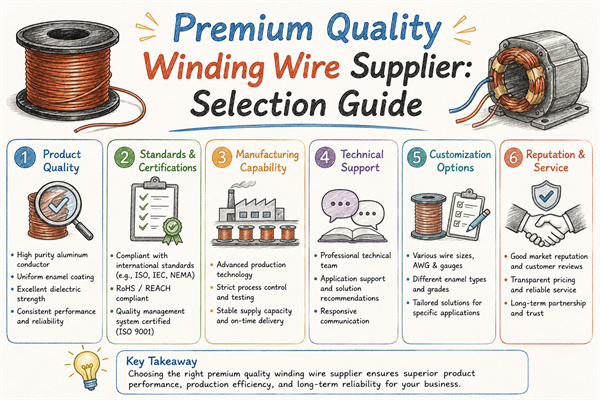
of a High-Quality Supplier Evaluating whether a winding wire supplier is “high-quality” requires a comprehensive assessment from the following four core dimensions: material purity and stability (conductor resistivity, enamel coating raw material grade), manufacturing process and precision (wire diameter tolerance, enamel coating thickness uniformity, thermal aging life), quality management and certification (ISO 9001,
IATF 16949, UL certification), and technical service and response (design support, sample delivery speed, documentation completeness). A significant weakness in any of these dimensions can have an irreversible impact on the long-term reliability of downstream products.
1.2 Differences from Ordinary Suppliers
The main differences between ordinary winding wire suppliers and high-quality suppliers are reflected in the following aspects: quality consistency (wire diameter tolerance ±0.005 mm vs ±0.02 mm, enamel coating thickness uniformity ±2 μm vs ±5 μm), batch stability (resistivity dispersion coefficient within the same batch < 0.5% vs < 2%), long-term supply capability (10 years of stable supply vs 3-5 years), certification completeness (complete UL/IEC report + test data vs only verbal commitment), and depth of technical service (full-chain support from selection to failure analysis vs only product sales). These differences may not be easily noticeable in the short term, but they will gradually become apparent throughout the product lifecycle—especially in high-reliability applications such as automotive, aerospace, and medical.
1.3 Long-Term Value of High-Quality Suppliers Choosing a high-qu
ality winding wire supplier is not only a guarantee of quality but also a strategic decision to reduce the total cost of ownership (TCO). High-quality suppliers reduce the buyer’s TCO through the following methods: reducing defect rate (PPM defect rate from 100 to below 10), reducing testing costs (suppliers have performed 100% factory testing), shortening development cycle (design support + rapid prototyping), reducing inventory pressure (VMI/JIT supply capability), and mitigating compliance risks (complete RoHS/REACH documentation + test reports). Over a 5-10 year product lifecycle, the TCO of high-quality suppliers is typically 15-30% lower than that of ordinary suppliers.
II. Seven Hard Indicators for Evaluating High-Quality Suppliers
2.1 Conductor Material Purity
The conductor material is the foundation of winding wire quality. High-quality suppliers should meet the following requirements: Pure aluminum conductors should be in the 1350-O state (aluminum content ≥ 99.5%, conductivity ≥ 61% IACS, according to ASTM B233 standard); pure copper conductors should be TU1/TU2 grade (copper content ≥ 99.95%, conductivity ≥ 101% IACS, according to ASTM B3/B49 standard); copper-clad aluminum conductors should use a metallurgical bonding process (copper layer thickness 10-15%); alloy wires should use precise alloy composition ratios (e.g., copper-nickel alloy with 0.6%-1.0% nickel content). High-quality suppliers should be able to provide material testing reports for each batch (including chemical composition, conductivity, and mechanical properties).
2.2 Wire Diameter Tolerance and Precision Wire diameter tolerance directly determines the slot fill factor and electrical performance of the winding.
High-quality suppliers should achieve the following precision: Fine wire (< 0.5 mm) – wire diameter tolerance ±0.003 mm, ellipticity < 0.002 mm; Medium wire (0.5-2.0 mm) – wire diameter tolerance ±0.005 mm, ellipticity < 0.003 mm; Heavy duty wire (> 2.0 mm) – wire diameter tolerance ±0.010 mm, ellipticity < 0.005 mm.
According to IEC 60317, winding wire tolerance grades are divided into Grade 1 (precision) and Grade 2 (standard). High-quality suppliers should be able to consistently achieve Grade 1 precision.
2.3 enamel coating thickness and uniformity.
The thickness and uniformity of the enamel coating determine the electrical insulation and mechanical protection of the winding wire. The enamel coating from a high-quality supplier should meet the following requirements: enamel coating thickness accuracy—Grade 1 (0.02-0.03 mm) / Grade 2 (0.03-0.04 mm) / Grade 3 (0.04-0.06 mm), with a single strand thickness variation < 5 μm; breakdown voltage—Grade 2 ≥ 4,200 V, Grade 3 ≥ 6,000 V (according to IEC 60317 standard); pinhole rate—no more than 1 pinhole per 30 m length (according to NEMA MW 1000 standard); enamel coating continuity—100% pass rate in spark tests, with no breakdown points at rated voltage.
2.4 Thermal Aging Life Thermal aging life is a key indicator of the long-term reliability of winding wires. A reputable supplier’s enamel coating should meet the following thermal life requirements (based on
UL 1446 and IEC 60172 standards): Class B (130°C) – Thermal life ≥ 20,000 hours; Class F (155°C) – Thermal life ≥ 20,000 hours; Class H (180°C) – Thermal life ≥ 20,000 hours; Class N (200°C) – Thermal life ≥ 20,000 hours. A reputable supplier should be able to provide thermal life test reports for the enamel coating (Arrhenius curves, accelerated aging data) and recommend an appropriate enamel coating grade based on the customer’s specific operating conditions.
2.5 Conductor Resistivity
Conductor resistivity directly determines winding losses. High-quality suppliers should meet the following conductor resistivity requirements: Pure aluminum – resistivity ≤ 0.02801 Ω·mm²/m at 20°C (according to IEC 60317-0-3 standard); Pure copper – resistivity ≤ 0.01724 Ω·mm²/m at 20°C (according to ASTM B3 standard); Copper-clad aluminum – effective resistivity calculated based on the volume percentage of the copper layer. High-quality suppliers should be able to provide batch resistivity test data and guarantee that the resistivity variation factor within the same batch is < 0.5%.
2.6 Tensile strength and elongation mechanical properties determine the machinability and reliability of the winding wire. High-quality suppliers’ winding wires should meet the following requirements:
Pure aluminum O temper – tensile strength 70-95 MPa, elongation ≥ 20%; Pure aluminum H temper – tensile strength 95-130 MPa, elongation ≥ 5%; Pure copper TU1 – tensile strength 220-260 MPa, elongation ≥ 25%; Pure copper TU2 – tensile strength 220-280 MPa, elongation ≥ 20%. According to ASTM B1/B2/B3 standards, high-quality suppliers should be able to provide batch mechanical performance data.
2.7 Certification Integrity Certification integrity is a “hard threshold” for high-quality suppliers. High-quality suppliers should possess at least the following certifications: Quality Management System –
ISO 9001:2015; Automotive Industry – IATF 16949:2016 (applicable to automotive applications); Aerospace Industry – AS9100D (applicable to aerospace applications); Product Safety – UL certification (North American market, based on UL 1446 standard), IEC 60317 compliance (EU market), CE marking; Environmental Compliance – RoHS 2.0 (2011/65/EU), REACH (EC 1907/2006), CBAM (Carbon Border Adjustment Mechanism, effective in 2026); Specific Industry – Medical ISO 13485, Explosion-proof ATEX/IECEx, Food FDA 21 CFR. High-quality suppliers should be able to provide complete certificates + reports + test data – not just scanned copies of certificates.
III. Five Soft Indicators for Evaluating High-Quality Suppliers
3.1 Technical Service Capabilities Technical service capabilitie
s are the core soft strength of high-quality suppliers. High-quality suppliers should be able to provide: design support (recommending appropriate enamel coating grades, wire diameters, and winding schemes based on customer operating conditions), process verification (providing welding processes, prototyping parameters, and best practices), failure analysis (assisting in analyzing the causes of customer failures and providing improvement suggestions), and joint development (jointly developing new materials and processes for specific needs). High-quality suppliers typically have 5-10 or more material engineers or process engineers with over 10 years of industry experience.
3.2 Response Speed Response speed determines the development c
ycle. High-quality suppliers should meet the following requirements: Inquiry response – providing a quotation within 24 hours; Sample delivery – within 7 days for standard specifications, and within 14-30 days for non-standard specifications; Technical issue response – providing a preliminary solution within 48 hours; Quality issue response – initiating the 8D reporting process within 4 hours. Response speed SLAs should be written into the procurement contract – serving as an important indicator for supplier performance evaluation.
3.3 Documentation Completeness Documentation completeness reflects the supplier’s system maturity. High-quality suppliers should be able to provide:
product specifications (detailed parameters, tolerances, test methods), Material Safety Data Sheets (MSDS), RoHS/REACH Declaration of Conformity, factory inspection reports (for each batch), third-party test reports (issued by
UL/IEC certification bodies), quality management system certificates, and production capacity and supply history. The documentation of high-quality suppliers should support both Chinese and English—meeting the needs of international customers.
3.4 Production Capacity and Stability Production capacity and supply stability are the foundation of supply chain security. High-quality suppliers should meet the following requirements: Annual production capacity –
Aluminum ≥ 5,000 tons/year, Copper ≥ 3,000 tons/year (to meet the needs of medium-sized customers); Number of production lines – At least 3 independent production lines (to avoid supply disruptions due to single-line failures); Multi-site layout – At least 2 production bases (to hedge against natural disasters/policy risks); Key equipment – Imported enameling machines (such as MAG from Germany, SICME from Italy), precision wire drawing machines (such as Niehoff); Raw material inventory – ≥ 30 days of raw materials on hand (to cope with fluctuations in aluminum/copper prices). High-quality suppliers should proactively disclose production capacity information and equipment lists to customers.
3.5 Industry Experience and Reputation Industry experience and reputation reflect a supplier’s historical accumulation. High-quality suppliers should possess the following characteristics:
Establishment period – ≥ 10 years (accumulated industry experience); Industry coverage – serving at least 3 sub-sectors (transformer, motor, home appliance, EV, etc.); Leading clients – having at least 5 well-known clients in the industry; Export experience – products sold to at least 20 countries (possessing international operational capabilities);
Continuous innovation – new processes/new products/new patents released within the past 5 years. High-quality suppliers typically have verifiable industry evaluations, client case studies, and media reports.
IV. Quality Control System of High-Quality Suppliers
4.1 ISO 9001 Quality Management System
ISO 9001:2015 is the basic threshold for high-quality suppliers. This system requires suppliers to establish a complete quality manual, procedure documents, and work instructions; implement the PDCA (Plan-Do-Check-Act) cycle; establish internal audit and management review mechanisms; and continuously improve quality performance. High-quality suppliers should be able to provide a valid ISO 9001 certificate + annual internal audit report – proving the continuous and effective operation of the system.
4.2 IATF 16949 Automotive Industry Quality System
IATF 16949:2016 is a key certification for winding wire suppliers in the automotive industry. This system adds automotive-specific requirements to ISO 9001: Product Safety (PSF), Production Part Approval Process (PPAP), Advanced Product Quality Planning (APQP), Failure Mode and Effects Analysis (FMEA), Statistical Process Control (SPC), and Measurement Systems Analysis (MSA). Winding wire suppliers for automotive applications (including EV drive motors) must be IATF 16949 certified.
4.3 Application of Key Quality Tools High-quality suppliers shou
ld systematically apply the following quality tools: SPC (Statistical Process Control) – real-time monitoring of key parameters such as wire diameter, enamel coating thickness, and resistivity, with a control chart Cpk ≥ 1.33; FMEA (Failure Mode Analysis) – identifying potential failure modes and developing preventative measures; 8D Reporting – initiating the 8D process within 24 hours of a quality issue occurring; PDCA Cycle – continuous improvement of quality performance. High-quality suppliers should proactively share this quality data with customers—rather than keeping it as an internal secret.
4.4 Key Process Capability Indicators High-quality suppliers should meet the following key process capability requirements:
wire diameter Cpk ≥ 1.67 (high precision), Cpk ≥ 1.33 (standard); enamel coating thickness Cpk ≥ 1.50; resistivity Cpk ≥ 1.50; breakdown voltage Cpk ≥ 1.33.
These Cpk values should be considered as mandatory indicators for supplier qualification audits.
V. Certification and Compliance System for High-Quality Suppliers
5.1 Product Safety Certification
As a key basic material for electrical products, winding wire needs to meet the product safety certifications required by the target market: UL (USA/Canada) – UL 1446 Insulation System Certification, UL 2353 Special Purpose Winding Wire Certification; VDE (Germany/Europe) – DIN EN 60317 Winding Wire Standard Compliance Certification; CCC (China) – CQC Mark Certification (for some products); PSE (Japan) – Japanese Electrical Appliance and Material Safety Law Certification. High-quality suppliers should at least have UL certification – this is a mandatory requirement for entering the North American market.
5.2 Environmental Compliance Environmental compliance is a cruci
al threshold for current international trade. High-quality suppliers should meet the following requirements: RoHS 2.0 (2011/65/EU) – restricting lead, mercury, cadmium, hexavalent chromium, PBB, PBDE, DEHP, BBP, DBP, and DIBP; REACH (EC 1907/2006) – registration, evaluation, authorization, and restriction of chemicals; CBAM (Carbon Border Adjustment Mechanism) – officially implemented on January 1, 2026, and carbon footprint reporting for aluminum conductors; Conflict Minerals – tungsten/tin/tantalum/gold should not originate from conflict regions. High-quality suppliers should proactively provide third-party testing reports and an EPD (Environmental Product Declaration).
5.3 Industry-Specific Certifications Different application scenarios require industry-specific certifications: Medical –
ISO 13485 Medical Device Quality Management System; Aviation – AS9100D Aerospace Quality Management System; Rail Transportation – IRIS (International Railway Industry Standard) certification; Nuclear Power – RCC-M Nuclear Island Mechanical Equipment Design and Construction Rules; Food Grade – FDA 21 CFR Food Contact Material Certification; Explosion-proof – ATEX (EU)/IECEx (International) Explosion-proof Certification. High-quality suppliers should clearly state their industry certification scope – facilitating customer selection.
VI. Production Capacity and Service Capabilities of High-Quality Suppliers
6.1 Production Capacity and Stability Production capacity direct
ly determines a supplier’s service capabilities. High-quality suppliers should possess: Annual aluminum production capacity ≥ 5,000 tons (for medium-sized customers); Annual copper production capacity ≥ 3,000 tons; Annual flat wire/special wire production capacity ≥ 500 tons; Annual CCA/CCAM production capacity ≥ 1,000 tons. Zhengzhou LP Industry has an annual production capacity of 8,000 tons of aluminum wire and 12,000 tons of copper wire, with ≥ 2,000 tons of flat wire/CCA/CCAM/specialty wire, covering the supply needs of medium to large-scale customers.
6.2 Global Delivery Capability Global delivery capability is a c
ore requirement for international customers. A high-quality supplier should possess: Multi-site production – at least two production bases (to address regional supply risks); International logistics – familiarity with FOB/CIF/DDP trade terms, and cooperation with international logistics providers such as DHL/FedEx/MSK/COSCO; Customs clearance – familiarity with HS Codes (copper 85441100, aluminum 85441900), certificates of origin, CE certificates, and RoHS certificates; Multi-currency settlement – support for major currencies such as USD/EUR/CNY; Multi-language support – a multilingual sales team in Chinese, English, German, French, Spanish, Russian, Japanese, and Korean.
6.3 Long-Term Cooperation and Agreements High-quality suppliers
should be able to provide long-term cooperation support: annual framework agreements (price lock-in + quantity guarantee); VMI (Vendor Managed Inventory) – reducing the buyer’s inventory pressure; JIT (Just-In-Time) – supplying on demand and shortening delivery cycles; joint development – joint R&D of new materials and processes; NDA (Non-Disclosure Agreement) – protecting customer technical information; long-term price protection – a price adjustment mechanism when aluminum/copper prices fluctuate significantly. High-quality suppliers should treat customers as long-term partners, not one-off transaction partners.
VII. 5 Common Pitfalls in Selecting High-Quality Suppliers
7.1 Pitfall 1: Focusing Only on Price, Ignoring Quality Consistency
Some buyers only look at the unit price when selecting suppliers, ignoring the hidden costs brought by quality consistency. A supplier with a 5% lower unit price will result in 10 times the after-sales costs if the PPM defect rate increases from 10 to 100. Recommendation: Comprehensively evaluate TCO (Total Cost of Ownership) rather than unit price.
7.2 Trap Two: Focusing Only on Certificates, Without Verifying Actual Capabilities
Some suppliers possess UL/IATF certifications, but their actual process technology and quality control are substandard. Recommendation: Conduct on-site audits of the supplier’s production lines, testing equipment, and process control data; request third-party test reports (not just scanned certificates); request recent PPM data and customer complaint records.
7.3 Trap Three: Ignoring Long-Term Supply Stability
Some small suppliers may cease production in 3-5 years due to poor management, rising raw material prices, policy changes, etc. Recommendation: Assess the supplier’s establishment year, production capacity, raw material inventory, multi-site layout, and financial health.
7.4 Trap Four: Ignoring the Depth of Technical Services
Some suppliers can only provide product sales and cannot offer design support, failure analysis, joint development, or other technical services. Recommendation: When selecting suppliers, request technical service case studies, introductions to their engineering teams, and application cases from typical clients.
7.5 Trap Five: Ignoring Environmental Compliance and Sustainable Development
Some suppliers have incomplete RoHS/REACH/CBAM compliance, and may face export restrictions in the future. Recommendations: Require suppliers to provide the latest RoHS/REACH declaration of compliance, third-party test reports, and carbon footprint reports (EPD); select suppliers with ISO 14001 environmental management system certification.
VIII. Conclusion
Selecting a high-quality winding wire supplier is a systematic project involving technology, quality, business, compliance, and supply chain. Four core dimensions (materials, process, quality, service) + seven hard indicators + five soft indicators + a complete ISO 9001/IATF 16949/UL/IEC/RoHS/REACH certification system constitute the complete framework for selecting a high-quality supplier. For procurement engineers: It is recommended to use the seven hard indicators in this article as entry thresholds and the five soft indicators as comprehensive scoring criteria during selection; conduct on-site audits of the supplier’s actual capabilities; and require third-party test reports and recent PPM data. For design engineers: It is recommended to involve the supplier in the design review during the selection stage—the technical services of a high-quality supplier can significantly improve the reliability and manufacturability of the product. For suppliers: The core competitiveness of high-quality suppliers lies in consistent quality, in-depth technical services, complete certifications, and long-term supply stability. Upgrading from “selling products” to “selling solutions” is an inevitable direction for winding wire suppliers. Winding wire is the “blood vessel” of all electrical products, including transformers, motors, home appliances, and EVs—its quality directly determines the reliability and lifespan of the end product. Choosing a high-quality winding wire supplier is the foundation for the long-term success of your product.