

The ignition coil is a core component of the ignition system in small engines. It uses electromagnetic induction to boost the 12V/24V primary voltage to a high voltage of 20-40kV, generating spark plug discharge for ignition. Enameled copper wire, as the conductive core of the primary and secondary windings of the ignition coil, directly determines the intensity of ignition energy, the reliability of spark plug discharge, and the engine’s operating efficiency. This article systematically describes the technical requirements, enamel coating system, specifications matching, reliability testing, and selection decisions for ignition coils in small engines.
Basic Principles of Small Engine Ignition Systems
Small engines typically refer to internal combustion engines with a power output of 1-30kW, widely used in motorcycles, lawnmowers, chainsaws, portable generators, outboard marine engines, and small general-purpose engines (go-karts, golf carts, snowplows, snow sweepers, pruning machines, brush cutters, etc.). The ignition system is a key subsystem of small engines, responsible for generating a spark within the cylinder to ignite the air-fuel mixture.
Based on the ignition method, small engine ignition systems mainly include three types: inductive discharge ignition (IDI), capacitor discharge ignition (CDI), and transistorized coil ignition (TCI). IDI is a traditional ignition method that generates high voltage by suddenly interrupting the current in the primary winding of the ignition coil; CDI is the mainstream ignition method for modern small engines, which generates high voltage by rapidly discharging a capacitor to the primary winding of the ignition coil; TCI is an inductive discharge ignition system based on transistor switching control, combining the maturity of IDI with the precision of electronic control.
Regardless of the ignition method, the ignition coil is the core component. Essentially, an ignition coil is a step-up transformer, consisting of a primary winding, a secondary winding, and a core. The primary winding typically has several hundred turns of thick wire (0.5-1.0mm in diameter), operating at 12V/24V and drawing 2-7A of current. The secondary winding typically has ten to twenty thousand turns of thin wire (0.05-0.10mm in diameter), operating at 20-40kV and drawing almost no current. When the primary current is suddenly interrupted (IDI) or the capacitor discharges (CDI), a high-voltage electromotive force is induced in the secondary winding, which is transmitted to the spark plug through the high-voltage wire.
Key Functions of Enameled Copper Wire in Ignition Coils
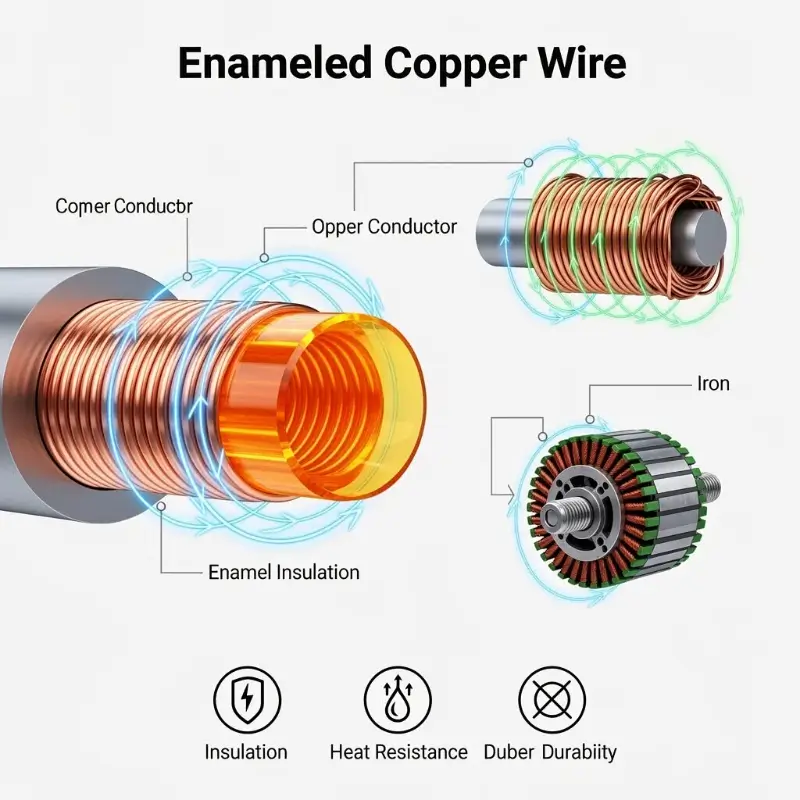
Enameled copper wire plays three key roles in ignition coils: conductive function, insulation function, and mechanical support function.
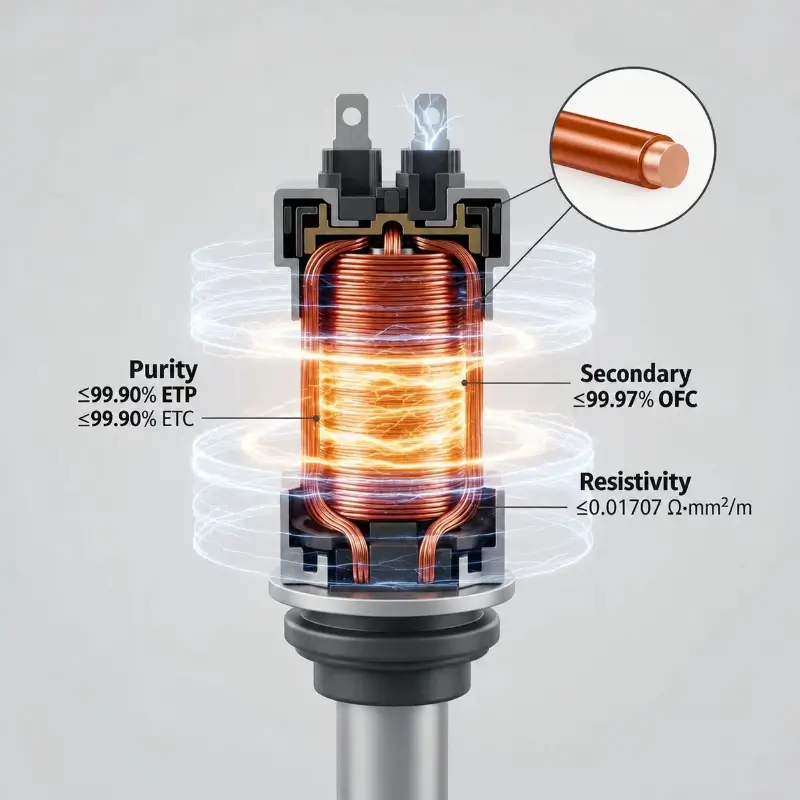
In terms of conductivity, the enameled copper wire is the only path for the ignition coil current. The high conductivity of copper (100% IACS) ensures that the current generates a strong magnetic field in the primary winding and induces a high voltage in the secondary winding. The purity (≥99.90% ETP or ≥99.97% OFC), resistivity (≤0.01707 Ω·mm²/m), and uniformity of the enameled copper wire thickness directly affect the electrical performance of the ignition coil.
In terms of insulation, the enameled copper wire withstands the following voltage stresses in the ignition coil: primary winding turn-to-turn voltage (several volts to tens of volts), primary winding-to-core voltage (hundreds of volts), secondary winding turn-to-turn voltage (hundreds of volts to thousands of volts), secondary winding-to-core voltage (tens of thousands of volts), and secondary winding layer-to-layer voltage (thousands of volts to tens of thousands of volts). The thickness, breakdown voltage, dielectric strength, and corona resistant properties of the enameled copper wire are the core guarantees for the insulation reliability of the ignition coil.
In terms of mechanical support, the enameled copper wire in the ignition coil needs to undergo high-speed winding, embedding, shaping, impregnation, and drying processes. The enameled coating must possess good scratch resistance, flexibility, and adhesion. During engine operation, the ignition coil windings are subjected to continuous vibration (5Hz-2000Hz), temperature cycling (-20°C to +180°C), and corrosion from engine oil and gasoline vapors. The enameled coating must maintain its integrity over long periods under these harsh conditions.
Enameled Wire Selection for Primary Winding
The primary winding is located on the low-voltage side of the ignition coil, operating at 12V/24V and with a current of 2-7A. The number of turns is typically 100-300. When selecting the primary winding, key considerations include current carrying capacity, mechanical strength, solderability, and thermal class.
Regarding wire diameter, the enameled copper wire diameter for the primary winding is typically 0.5-1.0 mm (AWG 20-24). Wire diameter selection is based on the operating current and allowable current density: for a continuous operating current of 5A and an allowable current density of 5-8A/mm², a wire diameter of 0.7-0.8 mm is a typical choice. For small engine ignition coils, the primary winding operating current is typically 2-5A, and 0.5-0.7 mm enameled wire is sufficient.
Regarding enamel coating materials, the most commonly used material for primary windings is 155-grade UEW (modified polyurethane, F-grade heat resistant). While maintaining the excellent solderability of polyurethane, 155-grade UEW enamel coating increases the long-term operating heat resistance temperature from 130°C to 155°C, significantly improving thermal shock resistance. It is a core enamel coating material for ignition coils in modern industry. The soldering temperature of 155-grade UEW enamel coating is approximately 380°C. The enamel coating automatically separates and falls off during soldering, eliminating the need for mechanical stripping, making it particularly suitable for automated terminal connections. 155-grade UEW enamel coating has a high breakdown voltage (≥3000V for stranded pairs) and good oil and chemical resistance.
Regarding enamel coating grades, the primary winding typically uses Grade 1 (thin enamel coating) because the primary winding operates at a low voltage (12V/24V), and a thin enamel coating provides sufficient insulation. Grade 1 enamel coating thickness is approximately 0.02-0.04mm, offering optimal slot fill factor and effectively utilizing winding space. For a few demanding applications (such as high operating temperatures and strong mechanical vibrations), Grade 2 thick enamel coating can be selected to improve reliability.
For thermal applications, the primary winding of the ignition coil in a small engine typically operates at 100-150°C, and a 155-class UEW enamel coating (155°C) meets B/F class insulation requirements. For high-temperature applications (such as lawnmower engine compartments where temperatures can reach 130°C), a Class H 180°C enamel coating (such as polyester PEI) is a safer choice.
Enameled Wire Selection for Secondary Winding
The secondary winding is located on the high-voltage side of the ignition coil, operating at 20-40kV with extremely low current (mA level). The number of turns is typically 10,000 to 20,000. Key considerations for selecting the secondary winding include high voltage withstand capability, enamel coating integrity, inter-turn insulation, and corona resistance.
Regarding wire diameter, the enameled copper wire diameter for secondary windings is typically 0.05-0.10 mm (AWG 38-44). The choice of a smaller wire diameter is to allow for winding more than 10,000 turns of secondary winding within a limited space, while simultaneously reducing distributed capacitance. Since the current density of the secondary winding is low (much lower than that of the primary winding), the current carrying capacity of the wire diameter is not a primary constraint.
Regarding enamel coating materials, polyurethane (UEW) enamel coating and polyester imide (PEI) enamel coating are most commonly used for secondary windings. Secondary windings operate at high voltages (thousands to tens of thousands of volts), requiring the enamel coating to possess excellent dielectric strength and corona resistance. The advantages of polyurethane (UEW) enamel coating in secondary windings are high solderability and easy lead wire soldering; the advantages of polyester imide (PEI) enamel coating are good heat resistance (180°C) and superior corona resistance compared to polyurethane. For high-voltage secondary windings (>30kV), polyamide-imide (PAI) enamel coating (200-220°C, softening breakdown temperature 330-350°C) is a more reliable choice.
Regarding the enamel coating grade, the secondary winding must use Grade 2 (thick enamel coating) or Grade 3 (extra thick enamel coating) to withstand high voltage stress of tens of thousands of volts. The breakdown voltage (stranded pair method) of Grade 1 enamel coating is typically ≥3000V, Grade 2 enamel coating can reach over 6000V, and Grade 3 enamel coating can reach over 10000V. The breakdown voltage of the secondary winding enamel coating needs to be selected based on the highest operating voltage multiplied by the full range rating (usually 1.5-2 times).
Regarding inter-turn insulation, the voltage between adjacent turns of the secondary winding can reach hundreds to thousands of volts. The pinhole density of the enamel coating is a key indicator of secondary winding reliability. NEMA MW 1000-2018 specifies the pinhole test method and acceptance criteria for the enamel coating. Table 38 specifies the test voltage (DC volts ± 5%) and the maximum number of failures per 100 feet, while Table 39 specifies the maximum number of failures for low-voltage continuity testing. The pinhole density of the secondary winding enamel coating should be less than 1 pinhole/30m (based on IEC 60851 standard).
For interlayer insulation, multi-layer winding of the secondary winding requires the addition of insulating paper (DMD, NMN, polyimide film) between layers to prevent interlayer breakdown. The dielectric strength of the interlayer insulation material must be higher than that of the enamel coating. Common choices include 0.05-0.13mm thick polyester film (PET), polyimide film (Kapton), and Nomex paper.
Enamel Material System in Detail
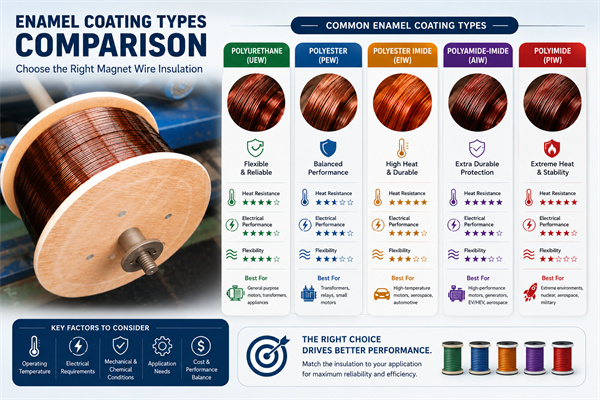
The choice of enameled copper wire material for ignition coils in small engines directly affects the coil’s lifespan, reliability, and operating temperature. The selection of enameled copper wire material should comprehensively consider thermal class, mechanical properties, electrical properties, solderability, and cost.
Polyurethane (UEW, 130°C) enamel coating offers excellent solderability, automatically decomposing and falling off at a welding temperature of 380°C, simplifying wiring. However, pure polyurethane enamel coating has limited heat resistance, with a long-term operating temperature of only 130°C, which cannot meet the application requirements of small high-temperature engines. 155-grade UEW (modified F-grade heat-resistant) uses modified resin to increase the long-term heat resistance temperature to 155°C, making it the mainstream choice for ignition coil primary windings.
Polyester (PEW, 130-155°C) with enamel coating boasts high mechanical strength, good scratch resistance, and a moderate price, making it the standard enamel coating for B/F class motor windings. Polyester enamel coating can replace polyurethane in the primary winding of ignition coils, but it lacks the solderability advantages of polyurethane and requires mechanical or chemical stripping.
Polyester imide (PEI, 180°C) enamel coating exhibits superior heat resistance compared to polyester, making it the preferred enamel coating for H-class motor windings. Polyester imide enamel coating possesses excellent chemical stability, exhibiting strong resistance to various solvents in insulating impregnating varnishes (such as xylene and styrene), while also demonstrating excellent resistance to transformer oils and chemical corrosion. Polyester imide enamel coating can withstand a long-term operating temperature of 180°C in the secondary windings of ignition coils.
Polyamide-imide (PAI/AIW, 200-220°C) enamel coating is the material with the best heat resistance. The softening breakdown temperature of polyamide-imide enamel coating can reach 330-350°C. When subjected to instantaneous thermal shock exceeding 200°C, the internal stress of the enamel coating is extremely low, and it will not crack. Therefore, it is the preferred enamel coating for the secondary winding of ignition coils in high-temperature small engines.
Composite coating combines the advantages of different enamel coating materials. The 200/220 grade EIW/PAIW composite wire uses a golden combination of “bottom EIW (approximately 70-80% of the enamel coating thickness) + top PAIW (approximately 20-30%)”. The bottom EIW provides mechanical strength and cost advantages, while the top PAIW provides heat resistance and corona resistant properties. Composite enamel coating is widely used in the secondary windings of ignition coils, especially in high-voltage, high-temperature, and harsh vibration environments.
Breakdown Voltage and Insulation Reliability
The insulation reliability of the ignition coil is one of the core elements of the reliability of a small engine. Dielectric breakdown voltage is a key indicator for evaluating the insulation performance of enameled copper wire, and NEMA MW 1000-2018 Part 1 specifies various breakdown voltage test methods.
The foil method tests the breakdown voltage of enamel coatings under a uniform electric field by winding a metal foil around the surface of the enameled wire as an electrode. Table 29 specifies the minimum breakdown voltage for the foil method. The foil breakdown voltage for Grade 1 enamel coatings is typically ≥2000V, Grade 2 ≥3000V, and Grade 3 ≥4000V.
The twisted pair method involves twisting two enameled wires together at a specified tension and testing the breakdown voltage of the enamel coating under a non-uniform electric field. Table 30 specifies the tension and number of rotations for the twisted pair method, and Table 31 specifies the minimum breakdown voltage. The twisted pair method is the standard method for evaluating the insulation performance of the enamel coating under actual winding operating conditions. The breakdown voltage of the twisted pair for Grade 1 enamel coating is typically ≥2500V, and for Grade 2 enamel coating it is ≥4000V.
The Cylinder Method measures the breakdown voltage by measuring the electric field between the enameled wire and a metal cylinder. Table 33 specifies the voltage growth rate, Table 34 specifies the test load, and Table 35 specifies the minimum breakdown voltage for the Cylinder Method. The Cylinder Method is suitable for testing the breakdown voltage of large-diameter enameled wires (≥1.6 mm).
The breakdown voltage of the rectangular/square enameled wire shall be tested according to Table 36. The breakdown voltage of the primary winding of the ignition coil shall be ≥500V (stranded wire method), and the breakdown voltage of the secondary winding shall be ≥3000V (stranded wire method).
The pinhole density of the enamel coating is a key indicator for evaluating its integrity. Pinholes are tiny defects in the enamel coating that can trigger partial discharge under high voltage, leading to coating breakdown. IEC 60851 specifies a pinhole test method for enamel coatings, using mercury electrodes or saline electrodes containing conductive liquid to test the continuity of the coating. The pinhole density of the ignition coil secondary winding enamel coating should be ≤1 pinhole/30m.
Corona resistance is a key indicator for high-voltage enameled wires. When the local electric field strength exceeds the breakdown electric field strength of air (≈3kV/mm), corona discharge occurs, generating ozone, ultraviolet radiation, and heat, leading to gradual aging and breakdown of the enameled wire coating. Polyamide-imide (PAI) enameled wire coatings exhibit significantly better corona resistance than polyurethane and polyester enameled wire coatings, making them the preferred enameled wire coating for high-voltage ignition coil secondary windings.
Special Environmental Requirements of Small Engines
The working environment of small engines places stringent requirements on enameled copper wires in multiple dimensions, which are significantly different from those of large industrial motors and transformers.
Regarding operating temperature, the operating temperature of the ignition coil in a small engine is directly affected by the temperature inside the engine compartment. The engine compartment temperature of small engines such as lawnmowers, chainsaws, and portable generators can reach 100-130°C, and in some extreme scenarios (such as engines under direct sunlight in summer), it can reach 150°C. The enameled copper wire of the ignition coil needs to operate continuously at 150-180°C; therefore, F-grade (155°C) or H-grade (180°C) materials should be selected for the enamel coating.
Regarding mechanical vibration, small engines typically vibrate at frequencies of 5Hz-2000Hz and accelerate at 10-30g. Ignition coils are usually bolted to the engine, and the windings are subjected to continuous vibration. The enameled copper wire must possess good vibration fatigue resistance to prevent cracking and peeling under long-term vibration. Elongation is a key indicator of vibration fatigue resistance: for polyester fiberglass windings, the elongation requirements are ≥15% for 0.630-1.250mm, ≥20% for 1.250-2.800mm, and ≥30% for 2.800-5.000mm.
In terms of chemical environment, small engine ignition coils are exposed to various chemical media such as gasoline, engine oil, coolant, and battery acid mist. The enameled copper wire coating needs to be resistant to oil, coolant, and acid/alkali corrosion, and should not swell, crack, or peel off after long-term contact. Polyurethane enameled coatings generally have moderate chemical resistance, while polyester imide enameled coatings have excellent chemical resistance (resistant to solvents such as xylene and styrene), and polyamide-imide enameled coatings have the best chemical resistance.
In terms of temperature cycling, small engines frequently start and stop, rapidly cycling between -20°C and +150°C. The enameled copper wire of the ignition coil must withstand thousands of thermal cycles without cracking or peeling. Polyamide-imide (PAI) coating does not crack under sudden temperature changes of 200°C, making it the preferred coating for harsh temperature cycling scenarios.
In outdoor environments, some small engines (outboard motors for ships, agricultural machinery, and portable tools) are exposed to rain, snow, salt spray, and ultraviolet radiation. The enameled copper wire of the ignition coil needs to be moisture-proof, salt-spray-proof, and UV-resistant. Polyimide (PI, 240°C) coating is the preferred coating for harsh outdoor environments.
Enameled Copper Wire Specifications and Standards
The enameled copper wire used for ignition coils in small engines must meet multiple international standards to ensure product quality and interchangeability.
The IEC 60317 series of standards are internationally recognized standards for enameled wire, specifying the product specifications, dimensions, electrical properties, mechanical properties, and chemical properties of enameled wire. IEC 60317-0-1 provides general specifications, while IEC 60317-XX specifies the product standards for particular enameled coating materials. Commonly referenced standards for ignition coil enameled wire include IEC 60317-1 (polyurethane enameled round copper wire), IEC 60317-2 (polyester enameled round copper wire), and IEC 60317-8 (polyester imide enameled round copper wire).
NEMA MW 1000-2018 is the standard for enameled wire from the National Electrical Manufacturers Association (NEMA). Part 1 contains general specifications and test methods, while Part 2 outlines the specific specifications for enameled wire (MW 1-C to MW 87-C). NEMA standards are widely used in the small engine market in the United States, Canada, and Mexico. Specifications such as MW 79-C (polyurethane enameled round copper wire, 130°C), MW 24-C (polyester imide enameled round copper wire, 180°C), and MW 77-C (polyester imide enameled round copper wire, 180°C) are common references for ignition coil enameled wire.
The GB/T 6109 series standards are Chinese national standards, equivalent to the IEC 60317 series. GB/T 6109.1-2008 is a general specification, GB/T 6109.2-2008 is for polyurethane enameled round copper wire, and GB/T 6109.10-2008 is for polyester imide enameled round copper wire. The GB/T 6109 standard is widely used by Chinese small engine manufacturers.
JIS C 3202 is a Japanese industrial standard that specifies the product requirements for enameled round copper wire. JIS C 3202 is widely used in the small engine market in Japan, South Korea, and Taiwan.
Regarding wire diameter specifications, the common wire diameter range for ignition coils is: primary winding 0.5-1.0mm (AWG 20-24), secondary winding 0.05-0.10mm (AWG 38-44). The accuracy and roundness of the wire diameter directly affect the electrical parameters and slot fill factor of the winding. IEC 60317 specifies that the outer diameter tolerance of the enameled wire is ±0.005-0.013mm (depending on the nominal diameter).
Regarding spool specifications, the PT4-PT200 series spools are the standard packaging for enameled wire. The specifications are as follows: PT4 (4kg wire weight, 0.04-0.13mm round wire diameter), PT10 (10kg, 0.10-0.19mm), PT15 (15kg, 0.18-4.50mm), PT25 (25kg, 0.18-5.00mm), PT60 (60kg, 0.18-5.00mm), PT100 (100kg, 1.50-7.00mm), and PT200 (200kg, 1.45-7.00mm). Ignition coils typically use PT15, PT25, and PT60 spools.
Quality Control and Reliability Testing
The enameled copper wire used for ignition coils in small engines must undergo rigorous quality control and reliability testing to ensure long-term reliable operation in harsh environments.
Pre-shipment inspections include: wire diameter and outer diameter measurement (tolerance ±0.005-0.013mm), enamel coating thickness measurement (Grade 1/2/3 standard thickness), breakdown voltage test (stranded wire method, foil electrode method, cylindrical method), pinhole test (continuity test), DC resistance measurement, elongation test, springback angle test, scratch resistance test, adhesion test, thermal shock test, softening breakdown test, solvent resistance test, and thermal aging test.
Incoming inspections are performed by small engine manufacturers or ignition coil manufacturers, with a focus on appearance (uniform enamel coating color, no bubbles, no impurities), wire diameter, outer diameter, breakdown voltage, and pinhole density.
Process testing is performed during the ignition coil winding process, including winding resistance measurement (bridge method, three-phase imbalance ≤5%), turns verification, enamel coating integrity sampling inspection, and winding insulation resistance test (megohmmeter, 500V).
Finished product testing is performed after the ignition coil is assembled, including insulation resistance testing (megohmmeter, 500V/1000V), withstand voltage testing (high voltage tester, 1.5-2 times rated voltage), spark testing (testing ignition energy under actual working conditions), vibration testing, temperature cycling testing, and long-term aging testing (1000-5000 working cycles).
Accelerated aging testing is a key method for evaluating the long-term reliability of enameled copper wires. Commonly used accelerated aging testing methods include: thermal aging test of enameled wire as specified in IEC 60172 standard (life estimated based on the Arrhenius equation), thermal shock cycling test (-40°C to +200°C cycling), vibration fatigue test (5Hz-2000Hz for 1000 hours), and salt spray test (simulated outdoor environment).
Selection Decision Recommendations
The selection of enameled copper wire for ignition coils in small engines should be based on a comprehensive judgment of engine type, ignition method, operating temperature, and reliability requirements.
Primary winding selection recommendations: For general-purpose small engines (lawn mowers, chainsaws, portable generators), choose 155 grade UEW enameled copper round wire (0.5-0.8mm diameter, Grade 1, F-grade heat resistance), which is solderable, has a long-term operating temperature of 150°C, and excellent thermal shock resistance; For high-temperature small engines (agricultural machinery in high-temperature summer environments), choose polyester imide (PEI) enameled copper round wire (0.5-0.8mm diameter, Grade 1, H-grade heat resistance), which has a long-term operating temperature of 180°C and excellent chemical resistance; For extreme high-temperature small engines (machinery operating in desert areas), choose polyamide imide (PAI) enameled copper round wire (0.5-0.8mm diameter, Grade 1, R-grade heat resistance), which has a long-term operating temperature of 220°C and optimal thermal shock resistance.
Secondary winding selection recommendations: For standard CDI ignition systems, choose polyurethane (UEW) enameled copper round wire (0.05-0.10mm diameter, Grade 2, Class B heat resistance), which is solderable and provides reliable insulation; for high-voltage secondary windings (>30kV), choose polyester imide (PEI) enameled copper round wire (0.05-0.10mm diameter, Grade 3, Class H heat resistance), which has a long-term operating temperature of 180°C and excellent corona resistant properties; for harsh high-temperature and high-pressure scenarios (racing engines, aero engines), choose composite enamel coating (EIW + PAIW) enameled copper round wire (0.05-0.10mm diameter, Grade 3, Class R heat resistance), which has a long-term operating temperature of 200-220°C and the best overall performance.
Not recommended options: Polyvinyl acetal (enameled wire, grade 120) is not recommended for use in ignition coils of modern small engines due to its low thermal class and mediocre mechanical properties. Pure polyurethane (enameled wire, grade 130°C) is not recommended for use in the primary winding of ignition coils in high-temperature environments due to its low thermal class.
Conclusion
Small engine ignition coils represent a high-end application for enameled copper wire, placing stringent requirements on the heat resistance, insulation, mechanical strength, and solderability of the enamel coating. The current mainstream selection is a primary winding with 155-grade UEW enameled copper round wire and a secondary winding with polyurethane/polyester imide/polyamide-imide enameled copper round wire.
The selection of enameled copper wire should comprehensively consider engine type, ignition method, operating temperature, reliability requirements, and working environment. International standards such as NEMA MW 1000-2018, IEC 60317, GB/T 6109, and JIS C 3202 serve as the technical basis for enameled wire selection. Breakdown voltage, pinhole density, elongation, scratch resistance, and thermal shock resistance are the core indicators for evaluating enameled wire quality.
As small engines evolve towards higher power density, higher efficiency, and longer lifespan, the requirements for enameled copper wire in ignition coils will continue to increase. Composite enamel coating (EIW + PAIW), ultra-fine enameled wire (<0.04mm), and high-temperature resistance enamel coating (PI 240°C) will become the core directions for future ignition coil enameled wire technology development. Engineers should fully leverage the advantages of 155-grade UEW, PEI, PAI, and composite enamel coatings, while rigorously evaluating their long-term reliability under harsh mechanical vibration, temperature cycling, and chemical environments.