


Introduction
The performance comparison between ECCA magnet wire and aluminum magnet wire is a topic of significant engineering and commercial value in the magnetic components industry. As lightweight alternatives to pure copper magnet wire, both types demonstrate irreplaceable engineering value across multiple electromagnetic applications. Pure aluminum magnet wire uses pure aluminum as the conductor material, whereas ECCA magnet wire employs a copper–aluminum bimetallic composite structure as the conductor material; systematic differences exist between the two in terms of conductor base, electrical properties, mechanical properties, thermal properties, long-term reliability, and typical applications. Understanding these differences constitutes a core knowledge requirement for motor manufacturers, transformer designers, magnetic component procurement engineers, and lightweight solution evaluation engineers.
Pure aluminum magnet wire offers advantages in cost, weight, and abundance of aluminum resources, but exhibits deficiencies in electrical conductivity, mechanical strength, and long-term reliability. ECCA (Electro-Clad Copper-Aluminum) magnet wire significantly enhances the electrical conductivity and mechanical properties of pure aluminum magnet wire via an outer copper layer, while retaining the lightweight and cost benefits of the aluminum core; however, its manufacturing process is more complex and its cost is higher than that of pure aluminum magnet wire. This engineered balance renders each type uniquely valuable for distinct application scenarios.
This article systematically outlines the performance differences between ECCA and aluminum enameled wire across eight dimensions—conductor fundamentals, electrical properties, mechanical properties, thermal properties, long-term reliability, cost and weight, typical application differences, and selection strategies—providing motor manufacturers, transformer designers, magnetic component manufacturers, and procurement engineers with a comprehensive engineering reference.
Conductor Base Comparison
The performance differences between ECCA magnet wire and pure aluminum magnet wire originate primarily from their conductor substrates.
Aluminum Conductor Basics
Pure aluminum magnet wire, with electrical-grade pure aluminum as the conductor material, is a key lightweight conductor choice in the magnetic components industry. Aluminum offers multiple engineering advantages as a conductor material. Its crustal abundance is significantly higher than that of copper, ensuring a stable supply chain. Its density is approximately one-third that of copper, making it an ideal conductor material for lightweighting magnetic components. The market price of aluminum is substantially lower than that of copper, rendering it the preferred conductor for cost-sensitive applications. Furthermore, aluminum’s thermal conductivity exceeds that of copper, facilitating thermal management design in magnetic components.
However, pure aluminum as a conductor material also presents engineering disadvantages. Its resistivity is higher than that of copper, resulting in a higher DC resistance for the same conductor outside diameter. The tensile strength, hardness, and ductility of pure aluminum are all lower than those of copper, increasing the difficulty of winding processing. Pure aluminum readily forms a dense aluminum oxide layer on its surface when exposed to air, and the high resistivity of aluminum oxide poses challenges to long-term electrical conductivity. Aluminum exhibits relatively high chemical reactivity and is prone to corrosion in acidic, alkaline, and saline media.
ECCA Conductor Fundamentals
ECCA magnet wire uses a copper-clad aluminum (CCA) bimetallic structure as the conductor material, where the outer copper layer and the inner aluminum core are metallurgically bonded to form a monolithic conductor. In magnetic component applications, this bimetallic structure exhibits distinctive engineering characteristics: the outer copper layer provides excellent surface conductivity, solderability, and corrosion resistance; the inner aluminum core delivers weight reduction, cost advantages, and contributes to the overall conductive path. The copper–aluminum interface achieves atomic-level bonding via metallurgical bonding technology, ensuring both structural stability and interfacial conductivity.
The engineering advantages of ECCA as a conductor material are primarily reflected in the following aspects: its surface copper layer provides electrical conductivity approaching that of pure copper—especially in high-frequency applications where the skin effect is pronounced; the presence of the copper layer significantly improves the mechanical strength and processability of ECCA magnet wire compared to pure aluminum magnet wire; the chemical stability of the surface copper layer is superior to that of pure aluminum, thereby enhancing corrosion resistance; and the connection performance of ECCA magnet wire is also significantly improved relative to pure aluminum magnet wire.
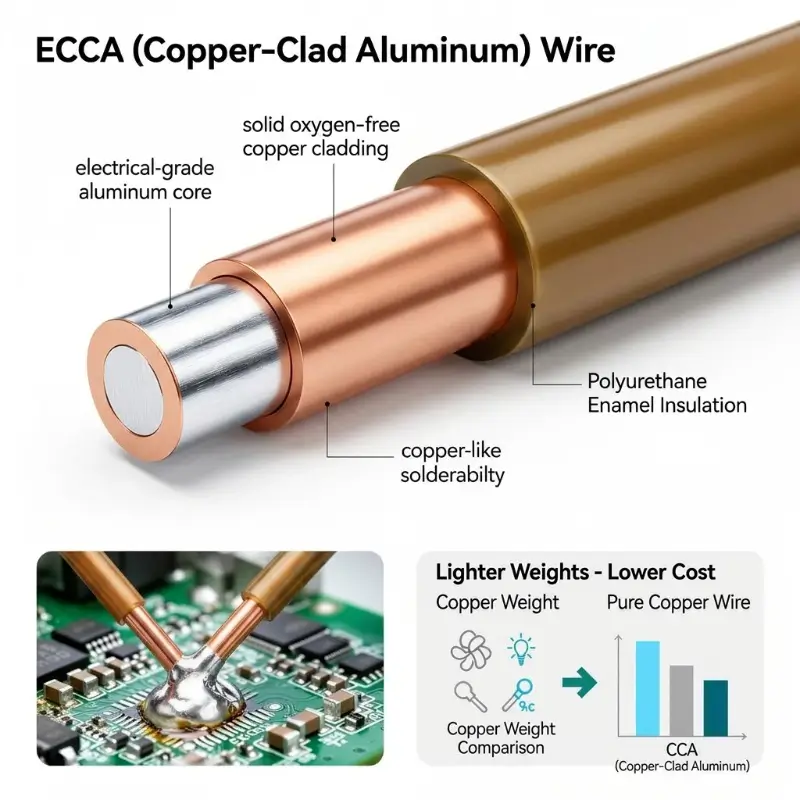
However, ECCA magnet wire also presents engineering disadvantages. The copper–aluminum bonding process imposes high technical requirements and is more complex to manufacture than pure aluminum magnet wire. The copper-layer material and bonding process increase manufacturing costs, resulting in higher pricing for ECCA magnet wire compared to pure aluminum magnet wire. Long-term stability of the copper–aluminum interface must be ensured through process optimization and quality control. The presence of the copper layer renders the overall weight of ECCA magnet wire slightly higher than that of pure aluminum magnet wire, yet still significantly lower than that of pure copper magnet wire.
Conductor Diameter Equivalence Principle
In magnetic component design, conductor diameter selection for ECCA (Electro-Composite Copper-Aluminum) magnet wire versus pure aluminum magnet wire must comprehensively consider electrical performance, mechanical performance, weight, cost, and application requirements. The equivalent DC resistance principle requires selecting an ECCA magnet wire with an appropriate copper-layer volume ratio so that its DC resistance approximates that of the pure aluminum magnet wire, facilitating replacement evaluation under identical electrical performance conditions. The equivalent overall diameter principle requires selecting both magnet wires with identical overall diameters; in this case, the ECCA magnet wire exhibits superior conductivity compared to the pure aluminum magnet wire, albeit at slightly higher cost and weight. The equivalent weight principle requires selecting both magnet wires with identical weights; under this condition, the ECCA magnet wire may have a slightly smaller overall diameter than the pure aluminum magnet wire, while demonstrating significantly superior conductivity.
Electrical Performance Comparison
Electrical performance is the most critical parameter for comparing ECCA magnet wire with pure aluminum magnet wire.
DC Resistance and Conductivity
DC resistance and conductivity are fundamental parameters in magnetic component design. Under identical conductor outer diameter conditions, ECCA enameled wire exhibits significantly lower DC resistance than pure aluminum enameled wire. The copper layer volume ratio is the critical parameter determining the DC conductivity performance of ECCA enameled wire. When the copper layer volume ratio ranges from 10% to 15%, the DC resistance is approximately 65% to 80% that of pure aluminum, resulting in a notable improvement in conductivity. When the copper layer volume ratio ranges from 20% to 30%, the DC resistance is approximately 50% to 65% that of pure aluminum, achieving a substantial enhancement in conductivity. When the copper layer volume ratio ranges from 30% to 40%, the DC resistance is approximately 40% to 50% that of pure aluminum, bringing conductivity performance close to that of pure copper. Selection of the copper layer volume ratio must comprehensively consider requirements for conductivity, mechanical properties, weight constraints, and cost limitations.
AC Resistance and Skin Effect
AC resistance is directly related to operating frequency. The skin effect describes the distribution characteristic of alternating current in a conductor, where current density decays exponentially from the conductor surface toward its center. Due to aluminum’s higher resistivity, pure aluminum magnet wire exhibits a relatively larger skin depth, resulting in a lower AC-to-DC resistance ratio at the same frequency. In contrast, ECCA magnet wire—featuring a surface copper layer—provides AC conductivity approaching that of pure copper in high-frequency applications where the skin depth is less than the copper layer thickness, significantly outperforming pure aluminum magnet wire.
In power-frequency applications at 50 or 60 Hz, the conductor diameter is typically smaller than the skin depth, so the skin effect has a relatively minor impact on AC resistance; thus, the difference in AC resistance between ECCA and pure aluminum magnet wire is primarily determined by the difference in DC resistance. In high-frequency applications above several kilohertz, the skin effect becomes significant, and the AC resistance advantage of ECCA magnet wire becomes pronounced—particularly for products with a high copper-layer volume ratio.
High-Frequency Performance
High-frequency performance is one of the core advantages of ECCA magnet wire over pure aluminum magnet wire. In high-frequency applications such as switch-mode power supplies, variable-frequency drives, induction heating, and wireless charging, ECCA magnet wire demonstrates advantages in multiple aspects: its AC resistance is significantly reduced, thereby decreasing conductor I²R losses; the low-resistance copper surface layer effectively reduces eddy current losses; the reduction in conductor losses improves system high-frequency efficiency; and the lower temperature rise of the conductor—resulting from reduced losses—enhances long-term reliability.
Mechanical Property Comparison
Mechanical properties are a critical comparative dimension between ECCA enamelled wire and pure aluminum enamelled wire in the manufacturing of magnetic components and long-term operation.
Strength and Hardness
The tensile strength of pure aluminum magnet wire is relatively low, whereas that of ECCA (Electroplated Copper-Clad Aluminum) magnet wire is significantly higher. Copper exhibits much greater tensile strength than aluminum; the presence of the copper layer substantially enhances the overall tensile strength of ECCA magnet wire. The surface hardness of ECCA magnet wire is also higher than that of pure aluminum magnet wire, improving resistance to mechanical damage and abrasion. Regarding ductility, pure aluminum outperforms copper; however, the ductility of ECCA magnet wire is influenced by its copper–aluminum composite structure and requires specific evaluation.
Flexibility and Bend Performance
Pure aluminum magnet wire exhibits superior flexibility compared to pure copper magnet wire, with excellent bendability. The flexibility of ECCA (Electro-Clad Copper-Aluminum) magnet wire lies between that of pure aluminum and pure copper; therefore, the bending radius must be carefully controlled to prevent cracking of the copper layer or interfacial delamination caused by excessive bending. The bending life of ECCA magnet wire depends on the coordinated deformation capability between the copper cladding and the aluminum core; high-performance products must be validated through repeated bending tests to confirm their bending life.
Winding Process Compatibility
Winding processing imposes multifaceted requirements on the mechanical properties of magnet wire. High-speed winding, coil insertion, shaping, and tying operations all demand appropriate flexibility, tensile strength, and surface quality from the enameled wire. ECCA enameled wire offers several advantages in winding processing: its higher tensile strength enables it to withstand elevated winding tension; its higher surface hardness provides resistance to mechanical damage during processing; and its excellent mechanical stability ensures compatibility with automated high-speed winding machines.
However, several critical points must be observed during the processing of ECCA magnet wire. Winding tension must be properly set to prevent damage to the enamel coating or conductor caused by excessive tension. Bend radius must be strictly controlled to avoid cracking of the copper layer due to excessively tight bending. Stability of the copper–aluminum interface requires special attention to prevent interfacial separation induced by processing stresses.
Vibration Resistance and Impact Resistance
Magnetic components are subjected to various dynamic stresses during operation, including electromagnetic vibration, mechanical vibration, start-up shock, and load shock. ECCA magnet wire exhibits superior vibration resistance compared to pure aluminum magnet wire; the presence of the copper layer enhances its fatigue resistance under prolonged vibration. However, the stability of the copper–aluminum interface in ECCA magnet wire under long-term vibration requires special attention, and high-quality products must demonstrate long-term reliability through vibration testing.
Thermal Performance Comparison
Thermal performance is a key comparative dimension between ECCA magnet wire and pure aluminum magnet wire in magnetic component applications.
Heat Generation
Under the same conductor outer diameter, ECCA magnet wire exhibits lower DC and AC resistance than pure aluminum magnet wire, resulting in reduced heat generation at the same current. The reduced heating of ECCA magnet wire delivers multiple benefits to magnetic components, including decreased winding temperature rise, reduced thermal stress on the insulation system, extended insulation life, and enhanced long-term reliability of magnetic components.
Heat Dissipation
The difference in heat dissipation performance between ECCA magnet wire and pure aluminum magnet wire is relatively small. Heat dissipation is primarily influenced by factors such as enamel coating thermal resistance, thermal conductivity of the insulation material, winding structure, and ambient conditions; the difference in thermal conductivity of the conductor material has a comparatively limited impact on overall heat dissipation. The aluminum core exhibits a higher thermal conductivity (aluminum’s thermal conductivity exceeds that of copper), potentially giving ECCA magnet wire superior internal heat conduction performance compared to pure copper magnet wire; however, enamel coating thermal resistance remains the primary bottleneck for heat dissipation.
Thermal Expansion Behavior
Aluminum has a higher coefficient of thermal expansion than copper. The overall thermal expansion behavior of ECCA magnet wire is influenced by the combined effect of the copper layer and the aluminum core, resulting in a value slightly lower than that of pure aluminum magnet wire but still higher than that of pure copper magnet wire. Magnetic components undergo temperature cycling—comprising startup, operation, and shutdown—during long-term operation; differential thermal expansion may induce interfacial stress. Special attention must be paid to the stability of the copper–aluminum interface in ECCA magnet wire under thermal cycling, and high-performance products shall be verified for reliability via accelerated thermal cycling tests.
High-Temperature Performance
Aluminum has a lower softening temperature (significantly lower than copper), and the mechanical properties of pure aluminum magnet wire may deteriorate substantially at elevated temperatures. The mechanical properties of ECCA magnet wire remain relatively stable at high temperatures due to support from the copper layer; however, intermetallic compound growth at the copper–aluminum interface may accelerate under high-temperature conditions. ECCA magnet wire and pure aluminum magnet wire can employ identical insulation coating systems to achieve equivalent thermal classes (Class 130 to Class 220). Nevertheless, the differences in high-temperature performance of the conductor materials must still be specifically evaluated under the long-term operating temperature of the insulation coating.
Long-term Reliability Comparison
Long-term reliability is the key comparative dimension between ECCA enameled wire and pure aluminum enameled wire in magnetic component applications.
Galvanic Corrosion
Galvanic corrosion refers to the corrosion phenomenon occurring between dissimilar metals in an electrolyte environment due to their electrochemical potential difference. In ECCA magnet wire, galvanic corrosion may occur between the copper layer and the aluminum core under humid conditions, where copper acts as the cathode (protected) and aluminum as the anode (corroded). Galvanic corrosion in ECCA magnet wire primarily occurs at the copper–aluminum interface region, potentially leading to reduced interfacial bond strength and increased interfacial resistance, ultimately compromising the long-term reliability of magnetic components.
High-quality ECCA magnet wire products shall mitigate galvanic corrosion effects through interfacial treatment processes, surface protection processes, and enamel film isolation. In harsh environments—such as high humidity, salt fog, and chemical media—the risk of galvanic corrosion in ECCA magnet wire requires special evaluation.
Oxidation Behavior
The surface of pure aluminum magnet wire readily forms a dense aluminum oxide (Al₂O₃) layer in air. Aluminum oxide exhibits high resistivity and is an electrical insulator, posing challenges to the solderability and long-term conductivity of magnet wire. The surface of ECCA magnet wire is copper, which oxidizes at a slower rate; furthermore, copper oxides (Cu₂O, CuO) possess superior electrical conductivity compared to aluminum oxide. Consequently, the oxidation resistance of ECCA magnet wire is significantly superior to that of pure aluminum magnet wire.
ECCA Interface Stability
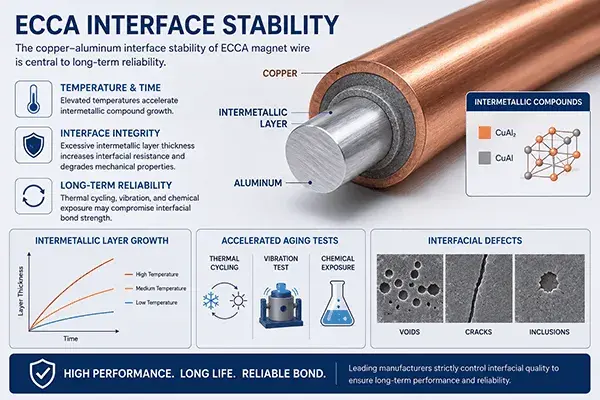
The copper–aluminum interface stability of ECCA magnet wire is central to long-term reliability. Intermetallic compounds such as CuAl₂ and CuAl may form at the copper–aluminum interface; their growth rate is influenced by temperature, time, and initial interfacial condition. Elevated temperatures accelerate intermetallic compound growth, and excessive intermetallic layer thickness increases interfacial resistance and degrades mechanical properties. Thermal cycling, vibration, and exposure to chemical media during long-term operation may compromise interfacial bond strength. High-performance ECCA magnet wire products must validate long-term interfacial bond strength stability via accelerated aging tests. Interfacial defects—including voids, cracks, and inclusions—accelerate interfacial aging and impair long-term reliability; leading manufacturers strictly control interfacial quality.
Standards and Test Methods
Long-term reliability testing of ECCA magnet wire and pure aluminum magnet wire complies with relevant international and national standards. ASTM B566 specifies dimensions, resistance, and mechanical properties for copper-clad aluminum (CCA) conductors. IEC 60317 series standards for winding wires apply to insulation film testing methods for ECCA magnet wire and pure aluminum magnet wire. GB/T 6109 magnet wire series national standards apply to the Chinese market. UL 1446 standard for insulating materials and systems for magnetic components applies to overall insulation reliability evaluation of magnetic components.
Cost and Weight Comparison
Cost and weight are key decision factors in selecting ECCA magnet wire versus pure aluminum magnet wire.
Weight Comparison
Under the same conductor outer diameter, ECCA magnet wire is slightly heavier than pure aluminum magnet wire (due to copper’s higher density than aluminum), yet both are significantly lighter than pure copper magnet wire. Pure aluminum magnet wire is the lightest magnet wire option; ECCA magnet wire is marginally heavier than pure aluminum but still substantially lighter than pure copper, while pure copper magnet wire is the heaviest magnet wire option. Lightweighting delivers engineering value for magnetic components across multiple dimensions, including extended driving range for magnetic components in new-energy vehicles, enhanced portability of portable magnetic components, increased payload capacity for magnetic components in aerospace applications, and improved dynamic performance of specialized magnetic components.
Cost Comparison
Under identical conductor outer diameter conditions, ECCA magnet wire incurs higher costs than pure aluminum magnet wire (due to copper layer material cost and bonding process cost), yet both are significantly less expensive than pure copper magnet wire. Pure aluminum magnet wire represents the lowest-cost magnet wire option; ECCA magnet wire costs fall between those of pure aluminum and pure copper magnet wire; pure copper magnet wire is the highest-cost magnet wire option. Cost savings deliver engineering value for magnetic components, including reduced overall material cost of magnetic components, enhanced market competitiveness, increased insensitivity to copper price volatility, and economies of scale in procurement.
Comprehensive Cost-Benefit Analysis
A comprehensive cost-benefit analysis of ECCA magnet wire versus pure aluminum magnet wire must consider multiple dimensions. Direct cost savings arise from reduced material costs relative to pure copper magnet wire. Indirect cost changes include potential increases in process adjustment costs, operational cost savings attributable to performance improvements, and maintenance cost variations resulting from differences in long-term reliability. Value at the magnetic component end manifests in application benefits derived from enhanced electrical performance (e.g., improved high-frequency efficiency), improved mechanical performance (e.g., enhanced winding processability), and improved long-term reliability (e.g., reduced maintenance costs).
Typical Application Areas
ECCA enameled wire and pure aluminum enameled wire each have their optimal application scenarios in magnetic components.
Typical Applications of Aluminum Magnet Wire
Pure aluminum magnet wire finds application in multiple scenarios: windings of low-frequency, high-power transformers—including power transformers and distribution transformers—large-scale power equipment; stator windings of medium- and low-frequency motors—including large industrial motors and wind turbine generators; low-frequency inductors—including line-frequency reactors and filter inductors; and cost-sensitive applications—including economy-grade household appliances and small power tools, where cost sensitivity is extremely high.
ECCA Enamelled Wire Typical Applications
ECCA magnet wire offers application value across multiple scenarios: high-frequency inductors—including switch-mode power supply inductors, wireless charging coils, and RF inductors; lightweight transformers—for aerospace, portable devices, and new-energy vehicle applications; high-frequency motor windings—including high-speed motors, variable-frequency motors, and auxiliary windings for new-energy vehicle traction motors; and high-frequency cables and wiring harnesses—including RF coaxial cables and automotive high-frequency wiring harnesses.
High-Frequency Application Fields
ECCA magnet wire offers significant advantages over pure aluminum magnet wire in high-frequency applications. In high-frequency inductors for switch-mode power supplies, operating from tens of kilohertz to several megahertz, ECCA magnet wire exhibits a pronounced advantage in AC resistance. For wireless charging coils operating at higher frequencies, ECCA magnet wire demonstrates clear advantages in high-frequency efficiency. In ultra-high-frequency RFID antenna coils, ECCA magnet wire shows outstanding high-frequency performance. In medium-frequency induction heating coils, ECCA magnet wire provides a marked advantage in AC resistance.
Low-Frequency Application Areas
Pure aluminum magnet wire offers a cost advantage in low-frequency applications. Power transformers operate at line frequency, where aluminum magnet wire exhibits a significant cost advantage. Distribution transformers operate at line frequency, and aluminum magnet wire is widely used. Large industrial motors operate at line frequency, where aluminum magnet wire demonstrates prominent advantages in both cost and weight. Wind turbine generators—large generators with windings operating at low frequencies—benefit from the application of aluminum magnet wire in large-scale units.
Special Application Scenarios
Specific application scenarios entail particular considerations for selecting ECCA magnet wire versus pure aluminum magnet wire. In new-energy vehicle magnetic components—including auxiliary inductors for traction motors, high-frequency inductors for DC-DC converters, and high-frequency transformers—ECCA magnet wire offers application value. In aerospace magnetic components—including high-frequency power supplies and lightweight transformers—ECCA magnet wire offers application value. For marine engineering magnetic components, which require salt-spray corrosion resistance, the galvanic corrosion risk of ECCA magnet wire must be specially evaluated. In special industrial magnetic components—including high-frequency power supplies and specialized inductors—selection must be based on specific requirements.
Selection Strategy Framework
The selection between ECCA magnet wire and pure aluminum magnet wire requires a comprehensive evaluation of application scenarios, performance requirements, cost constraints, and long-term reliability.
Application-Driven Selection
ECCA magnet wire is preferred for high-frequency applications due to its significantly superior high-frequency conductivity compared to pure aluminum magnet wire. Pure aluminum magnet wire is preferred for low-frequency applications owing to its substantial cost advantage. For weight reduction priority, pure aluminum magnet wire represents the lightest option, whereas ECCA magnet wire offers a balanced trade-off between electrical performance and weight. In scenarios with extreme cost sensitivity, pure aluminum magnet wire is preferred as it delivers the lowest cost. For applications requiring a balance between performance and cost, ECCA magnet wire is preferred, offering better performance than pure aluminum magnet wire while costing less than pure copper magnet wire.
Performance-Driven Selection
Select ECCA enameled wire when electrical performance—especially at high frequencies—is the priority. Select ECCA enameled wire when mechanical performance is the priority. Select ECCA enameled wire when corrosion resistance is the priority. Select ECCA enameled wire when long-term reliability is the priority. Select pure aluminum enameled wire when weight is the priority. Select pure aluminum enameled wire when cost is the priority.
Reliability-Driven Selection
Select ECCA enameled wire for applications requiring high long-term reliability, due to its oxidation resistance and galvanic corrosion control advantages. Select pure aluminum enameled wire for short-term or single-use applications to achieve cost savings. Select ECCA enameled wire for harsh environments (high humidity, salt fog) due to its superior corrosion resistance, though galvanic corrosion risk requires special evaluation. Both types are suitable for general environments; selection shall be based on other factors.
Future Development Trends
The future development of ECCA magnet wire and pure aluminum magnet wire will continue to advance along the directions of material innovation, process optimization, application expansion, and standardization.
Advanced ECCA Material Development
The R&D directions for the new ECCA magnet wire include products with a higher copper volume ratio (above 40%), improved Cu–Al interface bonding processes to reduce the thickness of the intermetallic compound layer at the interface, an optimized enamel coating system tailored to ECCA conductor characteristics, and more precise control of conductor diameter tolerances.
Advanced Aluminum Alloy Conductor Development
R&D directions for novel aluminum alloy conductors include high-performance aluminum alloys such as aluminum–magnesium–silicon (Al-Mg-Si) and aluminum–zirconium (Al-Zr), aimed at enhancing the mechanical and electrical conductivity properties of pure aluminum magnet wire. R&D directions for novel aluminum enamel systems focus on enamel systems compatible with the characteristics of pure aluminum conductors, to improve corrosion resistance, connection performance, and long-term reliability of pure aluminum magnet wire.
Application Expansion
Emerging industries offer broad application prospects for ECCA magnet wire and pure aluminum magnet wire. New energy vehicles, 5G communications, the Internet of Things (IoT), wearable devices, and intelligent manufacturing—all demand lightweight, low-cost, high-performance magnet wire, presenting extensive application opportunities for both types of magnet wire.
Standardization and Certification
Standardization and certification systems will continue to be refined. International standards (IEC, ASTM), national standardization organization standards (GB/T), and industry standards (UL, CSA, CE) will progressively establish or improve dedicated standards and certification requirements for ECCA magnet wire and pure aluminum magnet wire.
Conclusion
The engineering implications of ECCA versus aluminum magnet wire performance encompass multiple dimensions: conductor fundamentals comparison, electrical performance comparison, mechanical performance comparison, thermal performance comparison, long-term reliability comparison, cost and weight comparison, typical application differences, and selection strategy framework. In the conductor fundamentals comparison, pure aluminum offers advantages of abundant resources, low weight, low cost, and good heat dissipation, but suffers from disadvantages including low electrical conductivity, weak mechanical properties, susceptibility to oxidation, and high chemical reactivity; ECCA leverages a copper–aluminum bimetallic structure, wherein the outer copper layer provides superior surface conductivity, solderability/connectivity, and corrosion resistance, while retaining the lightweight and cost advantages of the aluminum core. In the electrical performance comparison, ECCA outperforms pure aluminum magnet wire in DC resistance, AC resistance, and high-frequency performance. In the mechanical performance comparison, ECCA exhibits higher tensile strength, hardness, and vibration resistance than pure aluminum, but comparatively lower flexibility and ductility. In the thermal performance comparison, ECCA generates less heat, yet its heat dissipation capability differs only marginally from that of pure aluminum; thermal expansion behavior and high-temperature performance require special attention. In the long-term reliability comparison, ECCA demonstrates significantly better oxidation resistance than pure aluminum, but galvanic corrosion and interface stability require particular attention. In the cost and weight comparison, pure aluminum magnet wire is the lightest and least expensive, ECCA magnet wire falls between pure aluminum and pure copper, and pure copper magnet wire is the heaviest and most expensive. In typical application differences, pure aluminum magnet wire is suitable for low-frequency, cost-sensitive applications, whereas ECCA magnet wire is suitable for high-frequency applications requiring higher performance.
ECCA magnet wire and pure aluminum magnet wire serve as lightweight alternatives to pure copper magnet wire, each offering distinct engineering value and application suitability. Pure aluminum magnet wire offers advantages in cost, weight, and resource availability, making it suitable for magnetic components operating at low frequencies, where cost sensitivity is high and performance requirements are moderate. ECCA magnet wire significantly enhances the electrical properties, mechanical properties, and corrosion resistance of pure aluminum magnet wire through an outer copper layer, while retaining the lightweight and cost benefits of the aluminum core; it is therefore suitable for high-frequency applications and magnetic components with higher performance requirements.
With the continuous development of emerging industries such as new-energy vehicles, 5G communications, the Internet of Things (IoT), and intelligent manufacturing, the magnetic components industry’s demand for lightweight, low-cost, high-performance magnet wire will continue to grow. ECCA magnet wire and pure aluminum magnet wire manufacturers shall continuously enhance material and process capabilities, deepen application research, expand product specification portfolios, and improve quality assurance systems to supply the global magnetic components industry with high-quality, high-performance, and highly reliable magnet wire products.
About the Author
Zhengzhou Lanpu Industry Co., Ltd. is a source manufacturer of magnet wire with 30 years of export experience, operating a modern production base spanning 60 mu. The company specializes in manufacturing copper/aluminum/copper-clad aluminum enameled round wire, flat wire, and square wire, covering the full range of thermal classes. Certified to ISO 9001/14001/45001, UL, REACH, and RoHS, its products are exported to over 50 countries.
Contact Information:
- 📧 Email: <office@cnlpzz.com>
- 📱 WhatsApp: 0086-19337889070
- 🌐 Website: <https://lpenamelwire.com/>