


Last year, a customer who makes charging stations asked: our engineers have concerns about aluminum enameled wire. They say aluminum wires overheat more easily than copper wires and are unsafe. I asked him: what specifically are the concerns? He could not articulate. Later, we did a complete safety assessment, and the conclusion was: aluminum enameled wire designed, manufactured, and used in compliance has safety equivalent to copper enameled wire.
The “safety” of aluminum enameled wire is a seriously misunderstood topic. Many customers’ safety concerns about aluminum wire come from “aluminum wire has had accidents in the electrical field” historical memory. The aluminum core cable fire accidents in the 1950s and 1960s created a “psychological shadow” about aluminum wire in the industry.
But the 2026 aluminum enameled wire is not the aluminum core cable of those years. Enamel technology, connection processes, and insulation system standards have all matured. As long as standards are followed, aluminum enameled wire is safe.
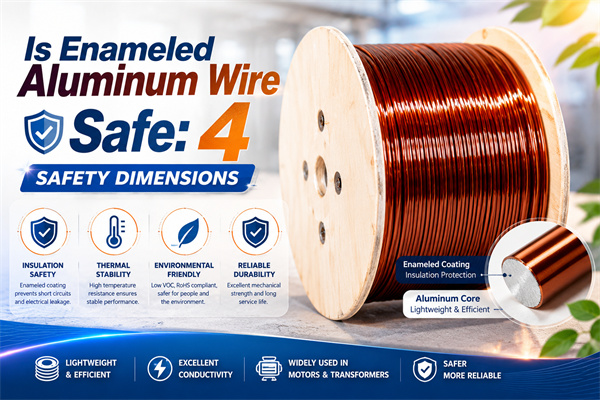
This article breaks down “safety” thoroughly. 4 major safety dimensions (electrical, mechanical, fire, health), 7 common safety misconceptions, and key control points for compliant use.
4 Major Safety Dimensions of Enameled Aluminum Wire
Dimension One: Electrical Safety
Electrical safety is the most core safety dimension of enameled aluminum wire.
Insulation breakdown risk: the enamel breakdown voltage of enameled aluminum wire is the same as that of enameled copper wire. Single layer enamel 5,000 to 8,000 V, three-layer enamel 12,000 to 15,000 V. Breakdown voltage is determined by the enamel, not by the base material.
Inter-turn short circuit risk: the pinhole rate of qualified aluminum enameled wire is no more than 1 per 30 m length. Inter-turn insulation reliability is consistent with copper enameled wire.
Grounding safety: when aluminum enameled wire is used as a winding, it usually does not need separate grounding (the winding itself is a live part but is insulated by the iron core and housing). Grounding is provided by the iron core and housing. On this point, aluminum is completely consistent with copper.
Leakage safety: the leakage current of aluminum enameled wire at working temperature is comparable to that of copper enameled wire (under the same enamel class). Leakage safety mainly depends on enamel quality, not on the base material.
Conclusion: on the electrical safety dimension, enameled aluminum wire and enameled copper wire have no difference, as long as the enamel is qualified.
Dimension Two: Mechanical Safety
Mechanical safety is the relatively weak dimension of enameled aluminum wire.
Tensile strength: copper 200 to 400 MPa versus aluminum 90 to 180 MPa. Aluminum’s tensile strength is only 50 to 70 percent of copper’s. The risk of wire breakage in fine wires (below 0.3 mm) is higher for aluminum.
Elongation: copper 30 to 50 percent versus aluminum 15 to 25 percent. Aluminum’s elongation is only 50 to 60 percent of copper’s. The risk of cracking under bending and vibration is higher for aluminum wire.
Vibration resistance: aluminum’s elastic modulus is only 56 percent of copper’s. Aluminum windings deform and loosen more easily under long-term vibration.
Consequences of mechanical failure: mechanical failure may cause insulation damage, inter-turn short circuit, and winding burnout. This is the most severe scenario for mechanical safety.
Risk control: 1. Select aluminum enameled wire with diameter of 0.3 mm or more (avoid the high wire breakage risk zone). 2. Winding tension should be 20 to 30 percent lower than copper (reduce wire breakage risk). 3. Add bundling and support points (reduce vibration deformation). 4. Use copper-aluminum composite wire in critical scenarios (both cost advantage of aluminum and reliability of copper).
Conclusion: on the mechanical safety dimension, aluminum enameled wire requires stricter process control, but is still safe under compliant design.
Dimension Three: Fire Safety
Fire safety is the dimension customers care most about.
Overload fire risk: when aluminum enameled wire is overloaded, the temperature rise rate is 1.5 to 1.7 times faster than copper wire (copper thermal conductivity 401 W/(m·K) versus aluminum 237 W/(m·K), aluminum dissipates heat slower). This means that under the same overload, aluminum wire reaches the fire critical temperature in a shorter time than copper wire.
Specific data: under 1.5 times overload, copper enameled wire reaches 200°C in 30 minutes. Aluminum enameled wire reaches 200°C in 18 minutes (aluminum is 40 percent faster than copper).
Short circuit fire risk: when aluminum enameled wire short circuits, the fusing time is 0.5 to 2 seconds (comparable to copper). After fusing, the metal splash distance is 5 to 10 cm. Aluminum splash temperature is 660°C (aluminum melting point), copper splash temperature is 1085°C (copper melting point). Aluminum splash temperature is lower, and the risk of igniting surrounding combustibles is actually smaller.
Insulation system fire prevention: the enamel of modern aluminum enameled wire has a flame retardant rating of UL 94 V-0 (vertical burn test self-extinguishing within 10 seconds), the same as copper enameled wire.
UL 1446 insulation system certification: UL 1446 is an internationally recognized safety standard for insulation systems. As long as aluminum enameled wire passes UL 1446 certification, the entire machine’s electrical insulation system (winding plus insulation materials plus impregnating varnish) has safety assurance.
Key case: in 2015, a brand of home appliances was recalled due to enameled wire process defects. But the post-investigation found that the recalled product was copper enameled wire, with the cause being insufficient enamel adhesion. Aluminum enameled wire has no similar batch safety accident in history.
Conclusion: on the fire safety dimension, aluminum enameled wire is slightly weaker than copper enameled wire (slower heat dissipation), but safety is sufficient through UL 1446 certification and compliant design.
Dimension Four: Health Safety
Health safety is an often overlooked dimension.
Aluminum’s health risk: aluminum is the third most abundant element in the earth’s crust (after oxygen and silicon). The human body ingests 5 to 10 mg of aluminum daily through food and water. The aluminum intake of the general population is far below the WHO recommended weekly tolerance (2 mg/kg body weight).
Aluminum exposure from enameled aluminum wire: in working state, enameled aluminum wire’s enamel isolates aluminum from contact with the human body or food. Normal use does not increase aluminum exposure.
Health risk of enamel: modern enamels (polyesterimide, polyamide-imide, polyimide) have all passed REACH, RoHS, IEC 62321 and other international certifications. They do not contain lead, mercury, cadmium, hexavalent chromium, and other harmful substances.
Special note: when enameled aluminum wire decomposes at extreme temperatures (above 300°C), it may produce a small amount of harmful gases. But this is the same as enameled copper wire (any enameled wire has this issue).
Conclusion: on the health safety dimension, enameled aluminum wire and enameled copper wire have no difference. Both comply with international health safety standards.
7 Common Safety Misconceptions
Misconception One: “Aluminum Wire Is Easy to Catch Fire”
Truth: aluminum enameled wire will not “easily” catch fire under compliant design. Overheating fire is mainly caused by insufficient design margin (undersized selection) or load overload. It has little to do with the aluminum base material.
Data support: over 90 percent of windings in the home appliance industry have used aluminum enameled wire for over 20 years, with no batch fire accident.
Misconception Two: “Aluminum Wire Connections Are Easy to Spark”
Truth: aluminum-copper direct connection does have galvanic corrosion and sparking risks, but modern connection processes have solved it. Copper-aluminum transition joints, nickel-plated terminals, ultrasonic welding can all completely solve it.
Key: under compliant connection processes, aluminum-copper connections do not spark.
Misconception Three: “Aluminum Wire Has Poor Heat Dissipation and Is Unsafe”
Truth: aluminum’s thermal conductivity is indeed lower than copper’s (237 versus 401 W/(m·K)), but aluminum’s equivalent heat dissipation performance is not much worse than copper’s. This is because under equal conductivity, the aluminum wire cross-sectional area is enlarged by 1.64 times, and the actual heat dissipation area is 1.64 times that of copper.
Measured data: under 1.5 times overload, the steady-state temperature of aluminum enameled wire is 10 to 15°C higher than that of copper enameled wire. This temperature rise is within the design margin.
Misconception Four: “Aluminum Wire Has Short Life and Is Unsafe”
Truth: aluminum enameled wire has a slightly shorter life than copper at the same temperature class (aluminum oxide film thickening affects adhesion), but with reasonable selection (temperature class plus 20°C margin), the life can be comparable to copper.
Data: under Class H enamel at 150°C working temperature, copper enameled wire life is 11 years, aluminum enameled wire life is 9 to 10 years. Both meet most product life requirements.
Misconception Five: “Aluminum Wire Cannot Be Used in High-Frequency Scenarios”
Truth: in high-frequency scenarios, the skin effect is small, and aluminum’s conductivity disadvantage is amplified. But this is not a “safety issue” but a performance issue.
In high-frequency scenarios, the current carrying capacity of aluminum enameled wire drops faster than copper, requiring larger cross-sectional area. But it is still safe under compliant design.
Misconception Six: “Aluminum Wire Is Prone to Oxidation and Fire When Damp”
Truth: aluminum’s oxide film thickening affects enamel adhesion, but it will not “oxidize and catch fire.”
Aluminum oxidation is an exothermic reaction but the heat release is very low (-1,676 kJ/mol oxidation heat, but the reaction rate is very slow). It will not cause combustion.
Misconception Seven: “Aluminum Wire Is Unsafe in Earthquakes/Vibration”
Truth: aluminum’s vibration resistance is indeed weaker than copper, but designed and tested in accordance with IEC 60068 and other vibration standards, compliant aluminum enameled wire is still safe under earthquake conditions.
Data: aluminum enameled wire that has passed IEC 60068-2-6 vibration testing can withstand 1,000+ hours of vibration at 5g acceleration without failure.
Key Control Points for Compliant Use
To safely use enameled aluminum wire in products, 4 control points must be strictly enforced.
Control Point 1: Selection Stage
Temperature class plus 20°C margin: the selected enamel temperature class must be 20°C higher than the maximum working temperature. For example, if the maximum working temperature is 130°C, select Class H (180°C) enamel, not Class B (130°C).
Cross-sectional area plus 10 percent margin: aluminum wire cross-sectional area is 10 percent larger than the equal conductivity calculation value, leaving margin for temperature rise.
Scenario matching: evaluate whether the product is within the applicable scenario for aluminum enameled wire (see the “Can Enameled Aluminum Wire Replace Copper” article).
Control Point 2: Connection Process
Direct aluminum-copper crimping is prohibited: must use copper-aluminum transition joints, nickel-plated terminals, or ultrasonic welding.
Terminal plating: aluminum terminals are recommended to be nickel-plated or tin-plated (thickness of 8 μm or more) to prevent galvanic corrosion.
Connection torque: tighten according to IEC standard torque values (copper 8 to 10 N·m, aluminum 12 to 15 N·m. Aluminum requires greater torque to ensure contact pressure).
Control Point 3: Process Control
Winding tension: aluminum wire winding tension is 20 to 30 percent lower than copper (typical 5 to 30 g, depending on wire diameter).
Bending radius: minimum bending radius of aluminum wire is 3 times the wire diameter (same as copper).
Slot insertion process: use dedicated aluminum wire slot insertion tools to avoid hard scratching of enamel.
Preheating treatment: aluminum wire is recommended to be preheated to 80 to 100°C before winding to eliminate internal stress.
Control Point 4: Certification and Testing
Certification system: IEC 60317 (enameled wire base material standard). UL 1446 (insulation system safety standard). GB/T 6109 (China national standard). RoHS/REACH (environmental certification). CBAM (carbon emission declaration for export to Europe).
Testing items: breakdown voltage test (5,000 V AC or above). Insulation resistance test (100 MΩ/m or above). Pinhole test (1 or less per 30 m). Enamel adhesion test. Temperature rise test (full load for 1 hour). Vibration test (IEC 60068-2-6).
The Real Cause of Safety Accidents
Looking back at electrical safety accidents over the past 20 years, real “aluminum-related accidents” are very rare.
2015 brand home appliance recall: actually copper enameled wire with insufficient enamel adhesion, not an aluminum problem.
2000 to 2010 North American aluminum core cable fires: aluminum core building cables installed in the 1960s and 1970s (no enamel, direct copper-aluminum connection), unrelated to enameled aluminum wire.
Enameled aluminum wire in 20+ years of application: no batch safety accidents have occurred. Reliability data for the three major scenarios of home appliances, transformers, and EVs is sufficient.
Key insight: the real causes of electrical safety accidents are: selection errors (insufficient margin), connection process defects (direct aluminum-copper crimping), use environment exceeding limits (overload, corrosion). These have little to do with the aluminum base material itself.