


Introduction
The electrical performance of ECCA wire is a core issue in the engineering applications of Electrical Copper Clad Aluminum Wire (ECCA Wire). ECCA is a bimetallic conductor material with an aluminum core and an outer layer of electrical-grade copper. It achieves atomic-level bonding at the copper-aluminum interface through metallurgical bonding processes, combining the surface conductivity of copper with the lightweight advantages of aluminum. In the field of electrical engineering, the engineering value of ECCA enameled wire is being widely recognized: its conductivity in certain frequency bands is close to that of pure copper enameled wire, but its weight and cost are significantly lower.
From an industrial practice perspective, the electrical performance of ECCA wire involves multiple engineering dimensions: DC resistance and conductivity, contact resistance and connection performance, skin effect and AC resistance, high-frequency characteristics and eddy current loss, dielectric properties, and long-term operational reliability. Understanding the electrical performance of ECCA enameled wire requires an interdisciplinary analysis from three disciplines: materials science (metallurgical bonding mechanism of copper-aluminum bimetals, influence of copper layer thickness on conductivity), electromagnetic field theory (skin effect, proximity effect, high-frequency eddy current), and engineering applications (differences in electrical performance requirements across different application scenarios).
ECCA (enameled wire) differs significantly from traditional pure copper and pure aluminum wires in terms of electrical performance. Pure copper wire offers the best conductivity and connection performance, but is expensive and heavy. Pure aluminum wire offers the best advantages in terms of lightweight and cost, but has lower conductivity and poorer connection performance. ECCA wire, on the other hand, achieves near-pure copper conductivity and connection performance through a copper layer surface, while achieving lightweight and cost advantages through an aluminum core body, representing an engineering balance between copper and aluminum.
The engineering implications of the Electrical Performance of ECCA Wire can be systematically explained from eight dimensions: material system, conductivity characteristics, frequency characteristics, connection characteristics, thermal performance, reliability, typical applications, and design selection. This article provides a systematic engineering reference for motor manufacturers, transformer designers, lightweight solution evaluation engineers, purchasing engineers, and inductor manufacturers.
ECCA Material Foundation
The electrical properties of ECCA (enameled wire) are primarily determined by its material system. Understanding the material basis of ECCA is a prerequisite for analyzing its electrical properties.
ECCA Conductor Structure
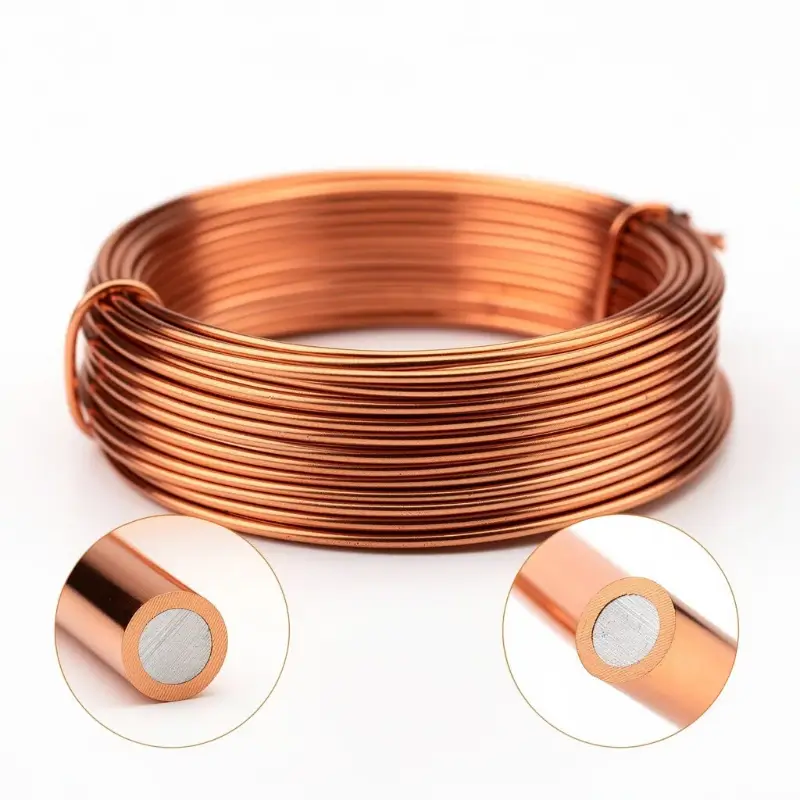
ECCA conductors are bimetallic composite structures formed by a metallurgical bonding process between an outer copper layer and an inner aluminum core. The volume ratio, mass ratio, and thickness ratio of the copper layer to the aluminum core are key structural parameters of ECCA conductors, directly affecting their electrical performance, mechanical properties, and cost.
The functions of the copper layer are: to provide good surface conductivity (current is concentrated on the conductor surface due to the skin effect), good connection performance (copper has better solderability than aluminum), and good corrosion resistance (copper has better chemical stability than aluminum).
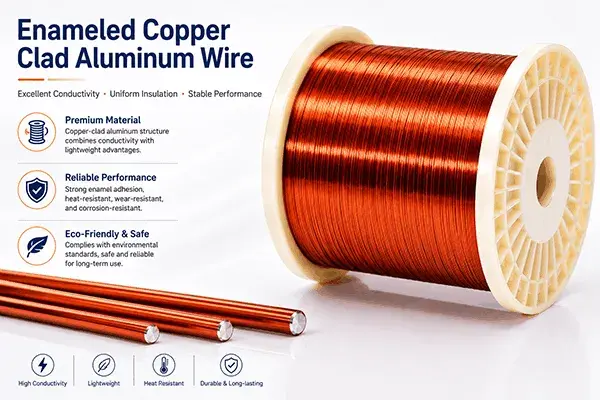
The functions of aluminum cores are: to provide a lightweight foundation (aluminum’s density is only about one-third that of copper), to provide cost advantages (aluminum is abundant and inexpensive), and to provide the main conductive channel (for more uniform current distribution in low-frequency applications).
Copper-Aluminum Bonding Process
Copper-aluminum bonding is a core technology in ECCA conductor manufacturing. Common copper-aluminum bonding processes include:
Cladding and Welding: Copper strips are wrapped around an aluminum core, and the copper strips are longitudinally welded into a complete copper layer by argon arc welding or plasma welding. Then, metallurgical bonding is achieved through a drawing process.
Hydrostatic extrusion: Copper and aluminum are extruded under high pressure through a mold to achieve metallurgical bonding at the copper-aluminum interface.
Continuous casting method: Molten aluminum is continuously poured into a copper tube, and a copper-aluminum bonding layer is formed through a metallurgical reaction.
Different bonding processes result in different copper-aluminum interface structures, and their performance indicators, such as interface bonding strength, thermal cycling resistance, and long-term reliability, also vary.
Copper Volume Ratio and Layer Thickness
The copper volume ratio is a key parameter for ECCA conductors, defined as the percentage of copper volume to the total conductor volume. Common ECCA conductors have copper volume ratios ranging from 10% to 40%, with some high-end products reaching over 50%.
Relationship between copper layer volume ratio and electrical performance: In low-frequency applications, the current distribution is relatively uniform, and the copper layer volume ratio has a significant impact on DC conductivity. In high-frequency applications, the current is highly concentrated in the skin layer, and the copper layer thickness becomes a key factor in the high-frequency conductivity. When the copper layer thickness is greater than or close to the high-frequency skin depth, the high-frequency conductivity of ECCA is close to that of pure copper.
Surface and Interface Quality
The surface quality of the copper layer and the copper-aluminum interface are crucial for ensuring the electrical performance of ECCA conductors. Surface quality includes surface smoothness, surface defects, and the state of the surface oxide layer. Interface quality includes interfacial bonding strength, the distribution and thickness of the intermetallic compound (IMC), and interfacial defects.
Excessively thick intermetallic compound layers can lead to increased interfacial resistance and decreased mechanical properties; interfacial defects can cause increased local resistance and reduced long-term reliability. Reputable ECCA manufacturers should strictly control the thickness of the intermetallic compound layer and the quality of the interfacial bonding.
DC Conduction Characteristics
DC conductivity is the most basic electrical performance indicator of ECCA enameled wire.
DC Resistance and Conductivity
The DC resistance of an ECCA conductor is formed by a copper layer and an aluminum core connected in parallel, following the parallel resistance law of bimetallic conductors. Since the resistivity of copper is much lower than that of aluminum, the DC current preferentially flows through the copper layer, and the contribution of the copper layer to the DC resistance is far greater than its volume ratio.
The DC conductivity of ECCA conductors is mainly determined by three parameters: the conductivity of the copper layer, the conductivity of the aluminum core, and the volume ratio of the copper layer. Common ECCA conductors (copper layer volume ratio 20%-30%) have a DC conductivity of approximately 50%-65% that of pure copper and approximately 130%-170% that of pure aluminum.
Conductivity Comparison with Pure Copper and Pure Aluminum
Compared to the conductivity of pure copper conductors: ECCA conductors typically have lower DC conductivity than pure copper conductors, but the magnitude of the difference depends on the copper volume ratio and the conductor diameter. ECCA conductors with a high copper volume ratio (above 40%) can achieve conductivity close to that of pure copper conductors in DC applications.
Compared to the conductivity of pure aluminum conductors: ECCA conductors typically have higher DC conductivity than pure aluminum conductors (under the same conductor outer diameter conditions), and ECCA conductors also have better mechanical strength and connection performance.
Conductor Diameter Selection Strategy
The selection strategy for ECCA conductor diameter needs to comprehensively consider conductivity, mechanical properties, weight, cost, and application scenarios.
In low-frequency DC applications (power transmission, winding coils, low-frequency inductors), ECCA conductors with the same conductivity as pure copper conductors can be selected (selected according to the principle of DC resistance equivalence).
In high-frequency AC applications (RF coils, high-frequency inductors, induction heating), the selection can be based on the principle of equivalent high-frequency AC resistance, and special attention should be paid to the selection of copper layer thickness.
In applications where lightweighting is a priority (aerospace, portable devices, rail transportation), ECCA conductors with conductivity slightly lower than that of pure copper (selected according to weight optimization principles) can be chosen to achieve the best lightweighting effect.
AC Conduction Characteristics
Alternating current conductivity is a core performance characteristic of ECCA enameled wire in magnetic component applications.
Skin Effect and Skin Depth
The skin effect is an important phenomenon in the distribution of alternating current in a conductor. When alternating current passes through a conductor, the current density decreases exponentially from the conductor surface to the center, with the current mainly concentrated within the “skin layer” on the conductor surface. Skin depth is a characteristic parameter that measures the degree of current concentration.
The relationship between skin depth and frequency, conductivity, and permeability: the higher the frequency, the higher the conductivity, and the greater the permeability, the smaller the skin depth. In power frequency (50/60 Hz) applications, the skin depth of copper and aluminum is on the order of several millimeters, much larger than the conductor diameter of a typical enameled wire (usually less than several millimeters), therefore the skin effect has a relatively small impact on power frequency applications. In high-frequency (kilohertz to megahertz) applications, the skin depth may be smaller than the conductor diameter, and the skin effect becomes significant.
AC Resistance of ECCA
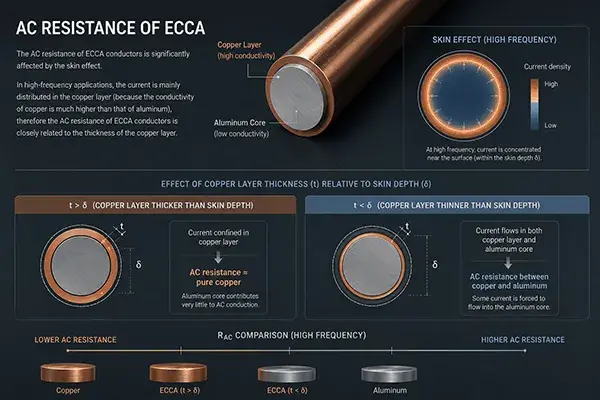
The AC resistance of ECCA conductors is significantly affected by the skin effect. In high-frequency applications, the current is mainly distributed in the copper layer (because the conductivity of copper is much higher than that of aluminum), therefore the AC resistance of ECCA conductors is closely related to the thickness of the copper layer.
When the copper layer thickness is greater than the high-frequency skin depth, the AC resistance of the ECCA conductor is close to that of a pure copper conductor, and the aluminum core contributes very little to AC conduction. When the copper layer thickness is less than the high-frequency skin depth, some current is forced to flow into the aluminum core, and the AC resistance of the ECCA conductor falls between that of pure copper and pure aluminum.
Proximity Effect and Eddy Current
The proximity effect is the phenomenon of alternating current affecting each other between adjacent conductors. In scenarios such as multi-turn coils or multiple parallel wires, the proximity effect leads to increased non-uniformity in current distribution, further increasing the AC resistance.
Eddy current loss is the energy loss caused by eddy currents induced in a conductor by an alternating magnetic field. In high-frequency magnetic components, induction heating, and transformers, eddy current loss is a significant component of total loss. The eddy current loss characteristics of ECCA conductors are closely related to the copper layer thickness; optimizing the copper layer thickness can significantly reduce eddy current loss.
High-Frequency Performance Optimization
High-frequency performance optimization directions for ECCA winding wire:
Copper layer thickness optimization: While ensuring mechanical strength and manufacturing feasibility, increase the copper layer thickness as much as possible to improve high-frequency performance.
Conductor diameter optimization: While meeting the current carrying capacity requirements, minimize the conductor diameter as much as possible to reduce the impact of the skin effect.
Applications of stranded and Litz wires: In ultra-high frequency applications, the Litz wire structure, which uses multiple thin ECCA wires stranded together, significantly reduces the effects of skin effect and proximity effect.
Conductor arrangement optimization: Optimize the conductor arrangement in the winding design to reduce the impact of proximity effect.
Connection and Contact Performance
Connection and contact performance are important properties of ECCA enameled wire in the manufacture of magnetic components.
Solderability and Brazing
Solderability is a core indicator of ECCA (enameled wire) connection performance. Because the outer layer of ECCA is copper, its solderability is close to that of pure copper and superior to that of pure aluminum. Both conventional tin-lead solder and lead-free solder can be used for soldering ECCA leads.
Solderability is an engineering requirement for higher strength connections. The presence of a copper layer allows ECCA enameled wire to achieve high-strength connections using copper-based solder, meeting the connection requirements of high-current and high-reliability scenarios.
Terminal Connection Methods
The connection methods for ECCA enameled wire leads include:
Tin-immersion soldering: The lead wire is immersed in molten solder to remove the enamel coating and achieve a metallurgical bond between the copper layer and the solder.
Mechanical crimping: Electrical connections are achieved through terminal crimping. It is necessary to ensure the long-term reliability of the crimped parts and the stability of the contact resistance.
Ultrasonic welding: It uses ultrasonic energy to achieve a metallurgical bond between the copper layer and the connecting wire, and is suitable for high reliability scenarios.
Laser welding: This method uses laser energy to achieve localized heating and welding, and is suitable for precision connection scenarios.
Contact Resistance Stability
The long-term stability of contact resistance is crucial to the reliability of ECCA (enameled wire) connections. The presence of a copper layer makes the contact resistance stability of ECCA superior to that of pure aluminum. During long-term operation, the copper layer exhibits good chemical stability and is less prone to forming a high-resistivity oxide layer.
However, attention must be paid to the stability of the copper-aluminum interface of ECCA enameled wire during long-term operation. Environmental factors such as high temperature, high humidity, and vibration may accelerate the growth of intermetallic compounds at the interface, affecting long-term reliability. High-quality ECCA enameled wire products should have their long-term reliability verified in standard environmental tests.
Thermal Performance
Thermal performance is an important factor related to the electrical performance of ECCA enameled wire.
Heat Generation and Dissipation
The heat generated by ECCA (enameled wire) originates from the Joule heat (I²R loss) of the conductor’s resistance. The heat generation power is proportional to the square of the current and the AC resistance of the conductor. The difference in heat generation between ECCA and pure copper or pure aluminum mainly depends on the difference in their AC resistances.
Heat dissipation performance is affected by factors such as the conductor’s surface area, surface emissivity, and the thermal conductivity of the surrounding medium. The heat dissipation performance of ECCA wire is relatively similar to that of pure copper and pure aluminum wire (heat dissipation is mainly affected by the enamel coating, insulation material, and winding structure).
Thermal Class Compatibility
The thermal rating of ECCA enameled wire is determined by its enamel coating system and is not directly related to the conductor material (copper, aluminum, copper-clad aluminum). ECCA enameled wire products from Class 130 to Class 220 are available, with enamel coating systems covering mainstream systems such as polyester, polyurethane, polyester imide, polyamide-imide, and polyimide.
Thermal Expansion Matching
The copper layer and aluminum core of ECCA (enameled wire) have different coefficients of thermal expansion (copper’s coefficient of thermal expansion is approximately 60% of aluminum’s), which may generate interfacial stress during temperature cycling. High-quality ECCA products should control interfacial stress through process optimization to ensure structural stability under thermal cycling.
The coefficient of thermal expansion of aluminum core is higher than that of copper. Therefore, the impact of the overall thermal expansion characteristics of the aluminum core on the stability of the winding structure must be considered when designing the winding.
Reliability and Long-Term Performance
Reliability and long-term performance are key considerations for ECCA enameled wire engineering applications.
Galvanic Corrosion Considerations
Galvanic corrosion is a corrosion phenomenon caused by the potential difference between dissimilar metals in an electrolyte environment. Copper and aluminum can form galvanic corrosion in an atmospheric environment, with copper acting as the cathode (protected) and aluminum as the anode (corroded). In ECCA (enameled wire) systems, the tight bonding between the copper layer and the aluminum core can accelerate galvanic corrosion at the interface.
High-quality ECCA (enameled wire) products should suppress the effects of galvanic corrosion through interface treatment processes, surface protection processes, and enamel coating isolation. In harsh environments such as high humidity, salt spray, and chemical media, the galvanic corrosion risk of ECCA wires needs to be specifically assessed.
Thermal Cycling Reliability
Thermal cycling reliability is critical for the long-term operation of ECCA enameled wire. During long-term operation, enameled wire is subjected to temperature cycling changes (start-up-operation-shutdown). The thermal stress at the copper-aluminum interface may lead to the growth of intermetallic compounds, a decrease in interfacial bonding strength, and ultimately, interface separation.
The growth of intermetallic compounds (IMCs) at the interface is the main mechanism of thermal cycling aging. Intermetallic compounds such as CuAl₂ and CuAl can form at the Cu-Al interface, and their growth rate is affected by factors such as temperature, time, and the initial state of the interface.
Excellent ECCA (enameled wire) products should control the initial thickness and distribution of intermetallic compounds at the interface through process optimization, and verify thermal cycling reliability through accelerated aging tests.
Standards and Test Methods
The electrical performance testing of ECCA enameled wire follows the testing methods of relevant international and national standards:
ASTM B566 Copper-Clad Aluminum Wire Standard: Specifies the dimensions, resistance, mechanical properties, etc. of ECCA conductors.
IEC 60317 Series Standards for Winding Wires: Test Methods for Enameled Wire Coating Applicable to ECCA.
GB/T 6109 series of national standards for enameled wire: ECCA enameled wire test methods applicable to the Chinese market.
UL Certification Requirements: The North American market has specific requirements for UL certification of ECCA enameled wire, which must meet standards such as UL 1446.
Typical Application Domains
ECCA enameled wire has wide applications in many industrial sectors.
High-Frequency Inductor Applications
High-frequency inductors are a typical application area for ECCA (enameled wire). High-frequency magnetic components such as RF inductors, power inductors, and filter inductors operate in frequency ranges from hundreds of kilohertz to tens of megahertz, exhibiting a significant skin effect. ECCA achieves near-pure copper high-frequency conductivity through a surface copper layer, while simultaneously achieving lightweight and cost advantages through an aluminum core.
Typical applications: high-frequency inductors for switching power supplies, wireless charging coils, radio frequency identification (RFID) antenna coils, and induction heating coils.
Lightweight Transformer Applications
Lightweight transformers are a key application area for ECCA (enameled wire). The demand for lightweight transformers is particularly prominent in portable transformers, aerospace transformers, and rail traction transformers. ECCA (enameled wire) provides electrical performance close to that of pure copper without significantly increasing transformer weight and cost.
Typical applications: DC-DC converters for new energy vehicles, portable power supplies, auxiliary power supplies for rail transit, and satellite power systems.
Motor Winding Applications
Motor windings are one of the application areas of ECCA (enameled wire). For small and medium-sized motors, household appliance motors, and power tool motors, where weight and cost are highly sensitive, ECCA can serve as an alternative to pure copper wire.
It should be noted that motor windings typically operate at relatively low frequencies (from power frequency to several kilohertz), and the advantages of ECCA (enameled wire) are less pronounced in low-frequency applications than in high-frequency applications. However, ECCA still has application value in specific scenarios where weight and cost are critical.
Cable and Wire Harness Applications
Cables and wire harnesses are traditional application areas for ECCA (enameled wire). High-frequency signal cables, radio frequency coaxial cables, and special cables can use ECCA as the inner conductor material. ECCA also has application value in automotive wiring harnesses and consumer electronics wiring harnesses.
Cost-Sensitive Engineering Applications
Cost-sensitive engineering is a key application area for ECCA (enameled wire). Under acceptable electrical performance conditions, ECCA can significantly reduce material costs (aluminum is abundant and inexpensive). Typical applications include: low-frequency inductors in consumer electronics, auxiliary windings for general-purpose transformers, and inductors for decorative lighting.
Design Selection Strategy
The design and selection of ECCA enameled wire requires comprehensive consideration of electrical performance, mechanical performance, thermal performance, cost, and application scenarios.
Electrical Performance Trade-off Analysis
Electrical performance comparison of ECCA wire with pure copper and pure aluminum:
Electrical conductivity: Pure copper > ECCA > Pure aluminum. Connectivity: Pure copper ≈ ECCA > Pure aluminum. Mechanical strength: Pure copper > ECCA > Pure aluminum. Weight: Pure copper > ECCA > Pure aluminum. Cost: Pure copper > ECCA > Pure aluminum.
Design selection should be based on the key performance indicators of the application scenario, and the best balance should be found between conductivity, connectivity, mechanical strength, weight, and cost.
Application-Driven Design Principles
ECCA enameled wire design principles for different application scenarios:
High-frequency inductors: Select ECCA (enameled wire) with a high copper layer volume ratio (above 30%), a fine conductor diameter (to reduce skin effect), and a high-quality enamel coating (excellent dielectric and mechanical properties).
Lightweight transformer: Select medium copper layer volume ratio (20%-30%), conductor diameter that meets current carrying capacity requirements, and lightweight target-driven ECCA enameled wire.
For cost-sensitive applications: Select ECCA enameled wire with a standard copper layer volume ratio (15%-25%) and a conductor diameter that meets basic electrical performance requirements.
Manufacturing Process Compatibility
The manufacturing process of ECCA (enameled wire) differs from that of pure copper and pure aluminum primarily in the conductor manufacturing stage (copper-aluminum bonding process). In downstream processes such as enamel coating, winding, and welding, ECCA and pure copper exhibit good process compatibility.
Special attention should be paid to the stability of the copper-aluminum interface of ECCA enameled wire during the manufacturing process. Winding tension, soldering temperature, and insulation impregnation processes can affect the interface structure and long-term reliability.
Future Development Trends
The future development of ECCA enameled wire will continue to advance in the directions of material innovation, process optimization, application expansion, and standardization.
Advanced Bonding Process Development
Continuous innovation in copper-aluminum bonding processes is a core technological direction for ECCA’s development. New bonding processes (such as laser welding, explosive welding, and electromagnetic pulse welding) promise to achieve more uniform interface bonding, more precise control of copper layer thickness, and smaller intermetallic compound layer thickness.
High-Copper-Ratio ECCA Products
High copper volume ratio ECCA products (copper volume ratio above 40%) represent the high-end development direction for ECCA (enameled wire). A high copper volume ratio can significantly improve the conductivity and high-frequency performance of ECCA, approaching or even reaching the performance level of pure copper.
Application Expansion in Emerging Industries
The expansion of applications in emerging industries presents a development opportunity for ECCA enameled wire. Emerging industries such as new energy vehicles (drive motors, inductors, transformers), 5G communications (RF devices, filters), the Internet of Things (sensors, energy harvesting), and wearable devices (flexible inductors, lightweight power supplies) have a strong demand for lightweight, low-cost, and high-performance enameled wire.
Standardization and Certification
The standardization and certification system for ECCA enameled wire will continue to improve. International standards (IEC, ASTM), national standardization organization standards (GB/T), and industry standards (UL, CSA, CE) will gradually establish or improve specific standards and certification requirements for ECCA enameled wire.
Conclusion
The engineering implications of the Electrical Performance of ECCA Wire encompass multiple engineering dimensions, including material systems (bimetallic structures, copper-aluminum bonding processes, copper layer volume ratio, interface quality), DC conductivity characteristics (conductivity comparison, conductor diameter selection), AC conductivity characteristics (skin effect, skin depth, AC resistance, proximity effect, eddy current loss, high-frequency optimization), connection and contact performance (solderability, connection methods, contact resistance stability), thermal performance (heat generation and dissipation, thermal level compatibility, thermal expansion matching), reliability (galvanic corrosion, thermal cycling reliability, standards and testing), typical applications (high-frequency inductors, lightweight transformers, motor windings, cables, cost-sensitive applications), and design selection strategies (performance trade-off analysis, application-driven design principles, manufacturing process compatibility).
ECCA (enameled wire) achieves near-pure copper conductivity and connectivity through a copper layer surface, while its aluminum core provides lightweight and cost advantages, representing a balanced engineering solution between copper and aluminum. The electrical performance of ECCA requires systematic optimization of conductor diameter, copper layer volume ratio, enamel coating system, manufacturing process, and application scenarios to achieve optimal engineering results.
With the continued development of industries such as high-frequency magnetic components, lightweight transformers, new energy vehicles, and consumer electronics, the market demand for ECCA (enameled wire) will continue to grow. Excellent ECCA suppliers should continuously improve their material processing capabilities, deepen interface technology research, expand their product portfolios, and perfect their quality assurance systems to provide global industrial customers with high-quality, high-performance, and highly reliable ECCA products.
About the Author
Zhengzhou LP Industry Co., Ltd. is a source manufacturer of enameled wire with 30 years of export experience. With a modern 60-acre production base, it specializes in manufacturing copper/aluminum/copper-clad aluminum enameled round wire, flat wire, and square wire, offering a full range of heat treatment grades. Certified by ISO 9001/14001/45001, UL, REACH, and RoHS, its products are exported to over 50 countries.
Contact Information: – 📧 Email:<office@cnlpzz.com> – 📱 WhatsApp: 0086-19337889070 – 🌐 Website:<https://lpenamelwire.com/>