

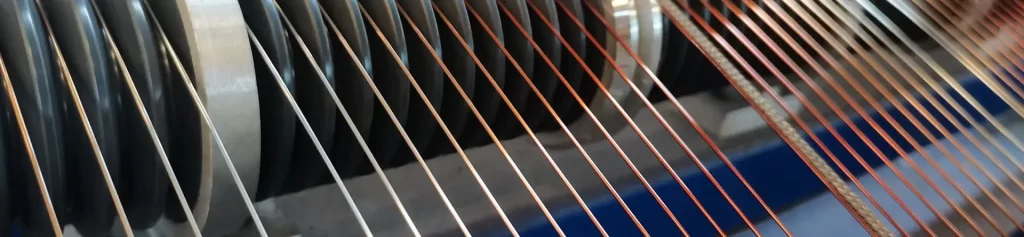
Enameled Copper Clad Aluminum Wire (ECCA wire) is a novel composite conductor material for automotive electrical systems. It uses electrical-grade aluminum as the core material, is clad in oxygen-free copper, and has an insulating enamel coating. ECCA wire combines the solderability of copper, the lightweight properties of aluminum, and a lower cost than pure copper, while providing reliable electrical insulation through the enamel coating. It demonstrates broad application potential in automotive electrical systems. This article systematically elaborates on ECCA wire from multiple dimensions, including its structural characteristics, automotive application scenarios, enamel coating system, mechanical vibration and temperature cycling reliability, high-frequency characteristics, lightweight benefits, and selection decisions.
Structure and Basic Properties of ECCA Wire
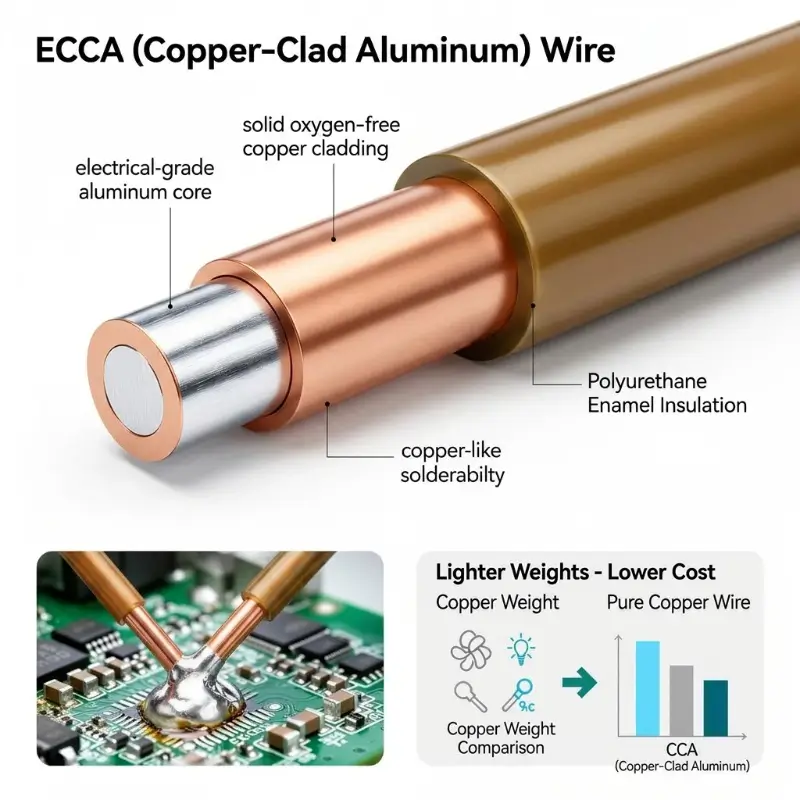
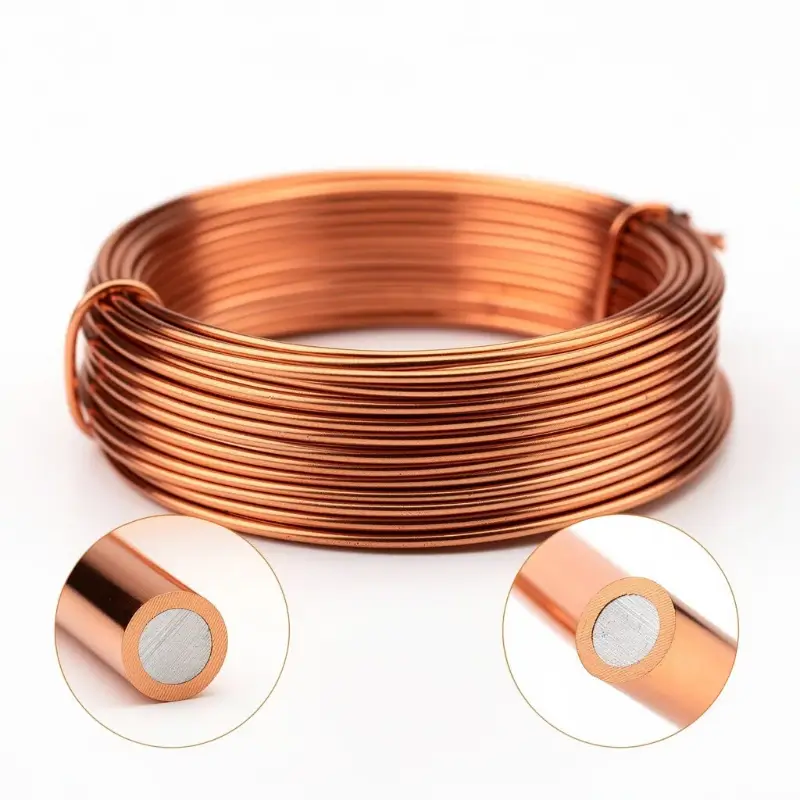
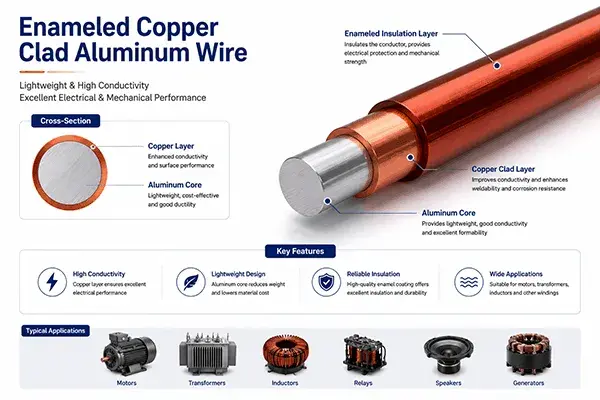
ECCA wires consist of three core components: an inner aluminum core, a middle copper cladding, and an outer enamel coating. The aluminum core uses electrical conductor-grade aluminum alloy, and the copper cladding uses oxygen-free copper (OFC). A permanent, continuous metallurgical weld is formed between the copper and aluminum through electroplating or metallurgical bonding processes. According to ASTM B566, the copper layer typically constitutes 10% or 15% of the conductor’s cross-sectional area by volume, corresponding to Class 10A/10H (annealed/hardened) and Class 15A/15H (annealed/hardened) grades.
ECCA wire enamel coatings typically use polyester, modified polyester, solderable polyurethane, or polyamide-imide. Polyamide-imide (PAI) enamel coatings have a softening breakdown temperature of 330-350°C and do not crack under rapid heating and cooling, making them the preferred enamel coating for high-temperature automotive applications. Solderable polyurethane enamel coatings are solderable and automatically decompose and peel off at welding temperatures, eliminating the need for mechanical stripping and making them suitable for automated terminal connections. The enamel coating grades are divided into Grade 1 (thin enamel coating), Grade 2 (thick enamel coating, the mainstream in industry), and Grade 3 (extra thick enamel coating) according to the IEC 60317 standard; the thermal class covers 130°C, 155°C, 180°C, 200°C, and 220°C, corresponding to the B/F/H/C/R grades of the IEC 60085 standard.
ECCA wire offers the following advantages over pure copper wire: it is 50-55% lighter (aluminum core density 2.70 g/cm³ vs. copper 8.96 g/cm³), has a lower cost (due to large copper price fluctuations), the same solderability as pure copper wire (copper outer layer), and superior high-frequency performance (AC conductivity equal to pure copper above 5MHz). ECCA wire also offers the following advantages over pure aluminum wire: significantly better solderability (pure aluminum wire has poor solderability and high contact resistance), higher termination reliability, and better long-term operating resistance stability.
Core Requirements of Automotive Electrical Systems for Winding Wire
Automotive electrical systems impose stringent requirements on winding wires in multiple dimensions, covering electrical performance, mechanical performance, thermal performance, chemical performance, reliability, and more.
Regarding temperature cycling, the car is used in different climate zones, with an operating temperature range typically from -40°C to +125°C (up to +150°C to +200°C inside the engine compartment). The winding wires must withstand thousands of thermal cycle shocks without cracking or peeling the enamel coating. When the car starts, the engine compartment temperature can rise from -30°C to +120°C within 30 seconds, and the winding wires must withstand more than 1000 thermal shock tests.
In terms of mechanical vibration, the vibration frequency of the engine, transmission, and chassis ranges from 5Hz to 2000Hz, with accelerations reaching up to 30g. Under long-term vibration, the winding wires must maintain the integrity of the enamel coating and the reliability of conductor connections to prevent fatigue cracking or loosening of the enamel coating. The winding wires also need to withstand continuous random vibration and impact in the high-temperature environment of the engine compartment.
In terms of chemical environment, the winding wires in the engine compartment come into contact with various chemical media such as gasoline, diesel, engine oil, transmission fluid, coolant, and battery acid mist. The enamel coating of the winding wires must be resistant to oil, coolant, and acid and alkali corrosion, and must not swell or crack after long-term contact. The winding wires in the chassis area come into contact with water, mud, and salt spray (especially de-icing agents in northern winters), and the enamel coating must be moisture-proof and salt spray corrosion-resistant.
In terms of electromagnetic compatibility (EMC), modern cars are equipped with a large number of electronic control units (ECUs), sensors, and actuators, resulting in a complex electromagnetic environment. As a core component of inductors, transformers, and sensors, the electromagnetic characteristics (inductance, capacitance, and losses) of the winding wires must meet EMC requirements. The dielectric properties of the winding wire’s enamel coating affect high-frequency losses, while the skin effect affects high-frequency impedance.
In terms of lightweighting, the pursuit of maximum driving range in new energy vehicles drives overall vehicle lightweighting. As a key material for motors, transformers, and inductors, every 1kg reduction in winding wire can increase the driving range by approximately 0.5-1km. The 50-55% weight reduction advantage of ECCA wire compared to pure copper wire has significant value in new energy vehicles.
Application Scenarios in Conventional Fuel Vehicles
The electrical system of a traditional fuel-powered vehicle (Internal Combustion Engine Vehicle, ICEV) includes multiple winding wire application scenarios, and the ECCA wire has application value in some of these scenarios.
The ignition system is the application scenario for high-voltage winding wires in traditional internal combustion engine vehicles. The ignition coil boosts the 12V voltage to 20-40kV to generate spark plug ignition. The primary winding of the ignition coil operates at a low voltage (12V) and a high current, and is typically made of PEW/PEI enameled wire with an enameled coating. The use of ECCA wire in the primary winding is limited by the increased DC resistance, but this can be compensated for by increasing the wire diameter in a 12V low-voltage, high-current system. The secondary winding of the ignition coil operates at a high voltage (20-40kV), requiring an extremely thick enameled coating and good insulation performance. It is typically made of Grade 3 enameled copper wire, and ECCA wire is used less frequently in the secondary winding.
The fuel injector in a fuel injection system uses a solenoid valve to control the fuel injection quantity. The winding of the solenoid valve needs to operate continuously in a fuel and engine oil environment. The operating temperature of the injector winding is 100-150°C, and the operating frequency is around 100Hz. The winding wire is usually made of PEW enameled copper wire or PAI enameled copper wire. The application of ECCA wire in the injector winding has the dual advantages of oil resistance and lightweight, and is one of the key applications listed in ECCAW-v2 Final.
Starter motors and alternators use high-power windings, operating currents of 100-300A and operating temperatures of 150-200°C. Starter motor windings typically use enameled copper flat wire (2×5mm to 5×10mm cross-section), while alternator windings use enameled copper round wire. The application of ECCA wire in high-power motors is limited by increased DC resistance and copper losses, which engineers compensate for by increasing the cross-sectional area (1-2 AWG grades). Considering the extreme reliability requirements of starter motors and alternators, traditional internal combustion engine vehicles typically still use pure copper enameled wire.
Regarding sensors and actuators, traditional gasoline vehicles are equipped with a large number of sensors (crankshaft position, camshaft position, oxygen sensor, knock sensor, oil pressure sensor) and actuators (throttle control valve, EGR valve, canister solenoid valve). These sensors and actuators have low winding current (mA-A level) and operating temperatures of 100-150°C. ECCA wire has a significant cost advantage in small windings and is an application scenario explicitly listed in ECCAW-v2 Final.
Application Scenarios in New Energy Vehicles
Electric vehicles (EVs/HEVs) use high-voltage electrical systems (400V/800V), and the operating frequency, power density, and thermal class of their windings are significantly higher than those of traditional fuel vehicles. ECCA lines have advantages in some application scenarios.
The drive motor (traction motor) is a core component of new energy vehicles, with a power density of 5-10 kW/kg, efficiency of 95-97%, operating frequency of 1kHz-10kHz, and peak temperature of 180-200°C. The stator windings of the drive motor typically use enameled copper flat wire (Hairpin process, Wave Winding process, Bar Winding process). While ECCA enameled flat wire offers advantages in weight reduction in drive motors, its increased DC resistance and stringent long-term reliability requirements mean that mainstream new energy vehicles currently still use pure copper enameled flat wire.
The on-board charger (OBC) converts alternating current (AC) into high-voltage direct current (DC) to charge the battery. The OBC’s high-frequency transformer operates at frequencies from 50kHz to 500kHz, with a power density of 3-5 kW/L. The high-voltage side winding, resonant inductor, and filter inductor of the OBC all utilize high-frequency winding wire. ECCA wire offers significant advantages in high-frequency OBC applications: its AC conductivity above 5MHz is equivalent to pure copper, allowing it to completely replace pure copper enameled wire; simultaneously, the lightweight advantage of ECCA wire aligns with the lightweight requirements of new energy vehicles. ECCA wire is a potential economical choice for the high-frequency transformer in OBCs.
A DC/DC converter transforms high-voltage battery voltage into 12V/48V low-voltage power for vehicle electronics. The transformer and inductor of a DC/DC converter operate at frequencies of 50kHz-300kHz and temperatures of 100-150°C. The application value of ECCA lines in the high-frequency windings of DC/DC converters is similar to that of OBCs, and it represents one of the most promising application scenarios for ECCA lines in new energy vehicles.
A Battery Management System (BMS) monitors the voltage, current, and temperature of a power battery. A BMS includes multiple current sensors, isolation transformers, and signal transformers. BMS operates at voltages from 5V to 1000V and frequencies from 10kHz to 100kHz. The winding wires typically use PEW/PAI enameled copper wire. ECCA wire offers a cost advantage in low-power BMS windings and can be used for non-critical current measurement and signal isolation applications.
Regarding charging infrastructure, the power of the external charging station (DC Fast Charger) ranges from 50kW to 350kW, with an operating frequency of 50kHz to 500kHz and a winding wire operating temperature of 100-180°C. The application of ECCA lines in high-frequency transformers within charging stations is a potential scenario, but charging stations have extremely high requirements for long-term reliability, requiring engineers to carefully evaluate the long-term performance of ECCA lines.
Automotive Wire Harness and Connector Applications
Automotive wire harnesses are the neural network of a vehicle’s electrical system, containing hundreds to thousands of wires and connectors. The total length of an automotive wire harness can reach 2-5 km, and its weight can reach 30-50 kg, accounting for a significant proportion of the total weight of the vehicle’s electrical system.
Low-voltage wiring harnesses (12V/48V systems) include applications such as dashboards, lights, sensors, and ECU connections. They operate at 12V or 48V, with a current rating of mA-A, and a temperature range of -40°C to +105°C. Low-voltage wiring harnesses typically use PVC-insulated copper or aluminum conductors. The application of ECCA wires in low-voltage wiring harnesses is less mature, primarily because the automotive wiring harness industry has a well-established copper conductor supply chain and standards. The termination process for ECCA wires (especially galvanic corrosion protection at the cut edges) requires additional handling.
High-voltage wiring harnesses (400V/800V systems) include connections for high-voltage components such as drive motors, power batteries, OBCs, DC/DC converters, and PTC heaters. They operate at 400V/800V and carry currents of 100A-600A. High-voltage wiring harnesses typically use cross-linked polyethylene (XLPE) or silicone rubber insulated copper wires, with copper braid or aluminum foil shielding. ECCA wires are primarily used as internal windings (enameled wires) within the OBC/DC/DC converter, rather than as external wiring harnesses.
Automotive connectors use copper alloy or pure copper terminals. Connection methods between terminals and wires include crimping, soldering, and puncture-insulation displacement (IDC) connections. The application of ECCA wires in connector terminal crimping is limited by the crimping reliability of the aluminum core. The copper outer layer provides a good foundation for crimping, but galvanic corrosion at the cut edge requires protection. Currently, the application of ECCA wires in automotive connectors is mainly in the form of enameled wire windings, with less use of non-enameled wire harnesses.
Enamel Coating and Insulation Class
The enamel coating system for automotive winding wires needs to meet multiple requirements regarding temperature, vibration, and chemical environment. The most widely used enamel coating materials in automotive applications include polyester (PEW), modified polyester, polyester-imide (PEI), and polyamide-imide (PAI).
PEW (enamel coating) (130-155°C) offers high mechanical strength and low price, making it the standard choice for winding wires in the engine compartment (body, chassis). Modified Polyester (enamel coating) improves upon PEW’s thermal shock resistance, operating at 155-180°C, making it the standard choice for medium-temperature areas within the engine compartment. PEI (enamel coating) (180°C) offers superior heat resistance compared to polyester, making it the choice for high-temperature areas within the engine compartment (such as near the turbocharger). PAI (enamel coating) (200-220°C) has a softening breakdown temperature of 330-350°C and does not crack under rapid cooling and heating, making it the preferred enamel coating for new energy vehicle drive motors, high-temperature sensors, and turbocharger sensors.
Regarding enamel coating grades, Grade 1 (thin enamel coating) is suitable for low-voltage, low-power windings; Grade 2 (thick enamel coating) is the mainstream choice for automotive applications, covering most sensor windings and relay windings; Grade 3 (extra thick enamel coating) is suitable for high-voltage, high-power windings, such as ignition coil secondary windings and OBC high-voltage windings. The thickness of the enamel coating directly affects the breakdown voltage. According to the PG1/PG2 standard, the breakdown voltage of a single layer of Grade 1 enamel coating is 1350V, and the breakdown voltage of a single layer of Grade 2 enamel coating is 2350V.
Thermal shock testing is a critical quality control item for automotive winding wires. NEMA MW 1000-2018 specifies the thermal shock test method for enamel coatings: the enameled wire is placed at a specified temperature for 30 minutes, then cooled to room temperature, and this cycle is repeated 5 times before checking for cracking of the enamel coating. Thermal shock testing for automotive winding wires typically requires more than 1000 cycles from -40°C to +200°C without cracking of the enamel coating.
Vibration and Temperature Cycling Reliability
Vibration and temperature cycling reliability of automotive winding wires are key indicators determining their feasibility for automotive applications. The reliability of ECCA wires in automotive environments requires focused evaluation of the following aspects.
Regarding vibration fatigue, the fatigue strength of aluminum cores is lower than that of copper cores, and microcracks may develop at the copper-aluminum interface of ECCA cables under long-term vibration. ASTM B566 specifies the copper-aluminum bond strength test for ECCA cables, including bending, torsion, and vibration tests. Automotive engineers should refer to ISO 16750-3 “Road vehicles – Environmental conditions and testing – Mechanical loads” and IEC 60068-2-6 “Environmental testing – Vibration” to assess the vibration reliability of ECCA cables.
Regarding temperature cycling, aluminum has a coefficient of thermal expansion of 23 × 10⁻⁶/°C, while copper has a coefficient of thermal expansion of 17 × 10⁻⁶/°C. The copper-aluminum interface experiences significant shear stress during cycling from -40°C to +200°C. Long-term temperature cycling may lead to microcracks and delamination at the copper-aluminum interface, affecting the reliability of electrical connections. ECCA lines should pass 1000 cycles in automotive temperature cycling testing according to IEC 60068-2-14 standards.
Regarding galvanic corrosion, the standard electrode potential difference between copper and aluminum is approximately 0.78V. In humid environments, galvanic pairs form, leading to anodic corrosion of the aluminum core. Galvanic corrosion can occur when the aluminum core at the ECCA cable cutout is exposed to humid air, resulting in increased contact resistance and termination failure. Automotive applications require waterproofing and moisture-proofing treatments for ECCA cable terminations (e.g., epoxy resin sealing, heat shrink tubing protection, and waterproof connectors).
Regarding the aging of the enamel coating, the high temperatures (150-200°C), ultraviolet radiation, and ozone environment of the engine compartment accelerate its aging. Under prolonged high temperatures, the enamel coating of the ECCA cable may undergo cross-linking reactions and oxidative degradation, leading to brittleness and cracking. Automotive engineers should refer to ISO 6722 “Road vehicles – 60V and 600V single-core cables” to assess the aging life of the ECCA cable’s enamel coating.
Advantages and Limitations
ECCA wires demonstrate significant advantages in automotive applications. In terms of weight, ECCA wires are 50-55% lighter than pure copper wires, and for new energy vehicles, every 1kg reduction in weight can increase the driving range by 0.5-1km. Regarding cost, copper prices fluctuate greatly, and ECCA wires are 20-40% cheaper than pure copper wires, which can reduce overall vehicle costs through large-scale applications. In terms of solderability, the copper outer layer of ECCA wires provides a good foundation for tin and silver soldering, and the soldering process is the same as for pure copper wires. In terms of high-frequency performance, the AC conductivity above 5MHz is equal to that of pure copper, making it suitable for OBC and DC/DC high-frequency transformer applications. Regarding lightweighting and electromagnetic compatibility, the low density of the aluminum core reduces the overall vehicle weight, while the copper outer layer provides excellent EMC shielding.
The limitations of ECCA wire in automotive applications include: DC resistance is 40-50% higher than pure copper wire; increased copper loss and reduced efficiency in low-frequency, high-current applications; the main winding of the drive motor has stringent requirements for power density and efficiency, and pure copper enameled flat wire is still the primary material; microcracks may develop at the copper-aluminum interface under long-term temperature cycling, affecting long-term reliability; galvanic corrosion at the cut requires additional protection; diffusion problems at the copper-aluminum interface in high-temperature scenarios above 200°C; and its recycling value is lower than that of pure copper.
Selection Decision Recommendations
The selection of ECCA lines in automotive applications should be based on a comprehensive judgment of the specific application scenario, thermal class, vibration conditions, and reliability requirements.
Suitable automotive applications for ECCA lines include: sensor windings outside the engine compartment (crankshaft position, camshaft position, oil pressure sensor), operating temperature -40 to +150°C; low-pressure actuator windings (throttle control valve, EGR valve, carbon canister solenoid valve), operating current mA-A level; high-frequency transformers for on-board chargers (OBC), operating frequency 50kHz-500kHz; high-frequency windings for DC/DC converters, operating frequency 50kHz-300kHz; current sensors and signal isolation transformers for the vehicle management system (BMS); and subwoofer speaker coils for car audio systems.
Automotive scenarios unsuitable for ECCA windings include: main windings of drive motors in new energy vehicles (with stringent power density and efficiency requirements); main windings of starters and generators in traditional fuel vehicles (high power, high peak current); secondary windings of ignition coils (high voltage, stringent insulation requirements); windings of critical safety systems (ABS, EPS, airbags); precision windings inside the engine control ECU (with extremely high reliability requirements); windings of high-temperature sensors (turbochargers, exhaust systems >200°C); and windings in water-crossing areas of the chassis (with stringent water, salt spray, and vibration requirements).
Conclusion
ECCA wire, as an enameled copper-clad aluminum composite conductor, has differentiated application roles in automotive electrical systems. In traditional gasoline vehicles, ECCA wire is suitable for sensor windings, low-voltage actuator windings, and car audio speaker coils outside the engine compartment. In new energy vehicles, ECCA wire has significant advantages in the high-frequency windings of on-board chargers (OBC) and DC/DC converters. However, in high-power applications such as drive motor main windings and starter/generator main windings, pure copper wire remains the dominant choice.
For automotive applications, the ECCA (Electronic Coating Aging and Calibration) line requires a focus on evaluating four reliability indicators: vibration fatigue, temperature cycling, galvanic corrosion, and enamel coating aging. The long-term stability of the copper-aluminum interface, galvanic corrosion protection at the cut edges, and the aging life of the enamel coating in the high-temperature environment of the engine compartment are key technical challenges for ECCA lines in automotive applications. Engineers should make a comprehensive selection based on the temperature, vibration, and reliability requirements of the specific application scenario, combined with electrical performance, mechanical performance, and cost budget.
With the development of lightweight new energy vehicles, 5G vehicle-to-everything (V2X) technology, and autonomous driving, the demand for higher frequency, lighter weight, and lower cost automotive winding wires will continue to increase. The application of ECCA wires in high-frequency scenarios such as on-board chargers, DC/DC converters, and BMS will continue to expand. In automotive applications, engineers should fully leverage the lightweight and high-frequency performance advantages of ECCA wires while rigorously evaluating their reliability under the special conditions of automobiles, such as long-term vibration, temperature cycling, and galvanic corrosion.