

1 Introduction
155-grade enameled copper wire is a core category in the internationally recognized temperature scale system, corresponding to Class F of the IEC temperature scale. It is one of the most widely used enameled wire categories in small and medium-sized motors, transformers, inductors, home appliances, and consumer electronics. Its core feature is that the enamel coating can maintain a design life of 20,000 hours at a continuous operating temperature of 155 degrees Celsius, and it also possesses multiple engineering properties such as solderability, thermal shock resistance, flexibility, and adhesion.
Based on international standards such as NEMA MW 1000-2018, IEC 60317 series, and JW1177 Federal Specification, this article systematically introduces 155-grade general-purpose heat-resistant enameled copper wire from seven dimensions: enamel coating system, technical specifications, mechanical properties, electrical properties, chemical properties, application scenarios, and selection evaluation. It provides a systematic technical reference for winding wire engineers, purchasers, and end users.
2 Classification of enamel coating systems
2.1 Chemical Composition of enamel coating
The chemical composition of 155-grade enameled copper wire varies, with common systems including polyurethane enameling, polyurethane-nylon composite enameling, polyester enameling, polyester-imide enameling, and polyester-glass fiber composite enameling. Different enameling systems have different performance characteristics and application scenarios.
Polyurethane enamel coating is the mainstream enamel coating system for 155-grade enameled copper wire. Polyurethane is formed by the reaction of polyols and isocyanates; the urethane groups in the molecular chain endow the enamel coating with excellent flexibility, solderability, and abrasion resistance. Polyurethane enamel coating enables low-temperature, rapid soldering, with a soldering temperature of approximately 380 degrees Celsius, making it the preferred choice for automated winding and soldering processes.
The polyurethane-nylon composite enamel coating incorporates a nylon layer on its surface, further enhancing its chemical resistance, abrasion resistance, and anti-winding properties. The introduction of the nylon layer significantly improves the enamel coating’s resistance to refrigerants, oils, and chemical media, but slightly reduces its solderability.
Polyester-glass fiber composite enamel coating uses enameled wire as the base material, with an outer layer of polyester and glass fiber woven together and then impregnated with heat-resistant varnish to form composite insulation. The heat resistance, mechanical strength, and insulation thickness of polyester-glass fiber composite enamel coating are significantly superior to those of single enamel coating, making it an important enamel coating system for large motors, transformers, and high-voltage windings.
2.2 Standard Number Comparison
Grade 155 enameled copper wire has a complete standard number family in the international standard system. According to NEMA MW 1000-2018 standard number, the main standard numbers for Grade 155 enameled copper wire include: MW 79, which is polyurethane enameled round copper wire, corresponding to IEC 60317-20; MW 80, which is polyurethane enameled round copper wire with added nylon, corresponding to IEC 60317-21; MW 131, which is polyurethane bonded enameled round copper wire, corresponding to IEC 60317-35; and MW 45, which is polyester glass fiber enameled round copper wire, corresponding to IEC 60317-60, suitable for flat wire applications.
According to the JW1177 Federal Standard, the standard numbers corresponding to 155 grade enameled copper wire include JW1177/41 (polyurethane 155), JW1177/42 (polyurethane plus nylon 155), JW1177/20 (polyurethane glass fiber 155 round wire), and JW1177/25 (polyurethane glass fiber 155 flat wire).
According to the national standard GB/T 6109, the equivalent 155 grade enameled copper wire of the IEC 60317 standard corresponds to the corresponding part in the GB/T 6109 series, including GB/T 6109.2 polyurethane enameled round copper wire, GB/T 6109.10 polyurethane enameled round copper wire with nylon, etc.
2.3 enamel coating thickness grades
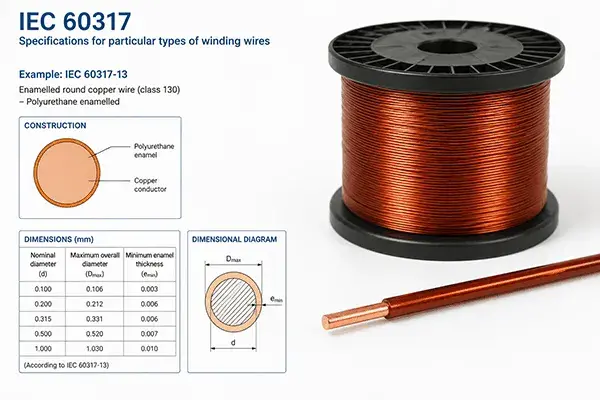
The enamel coating thickness of 155 grade copper wire is divided into three levels: Level 1 (thin), Level 2 (thick), and Level 3 (extra thick). The enamel coating thickness level directly affects key parameters such as dielectric strength, mechanical strength, and winding fill factor.
According to the IEC 60317 standard, the minimum breakdown voltage of Class 1 enamel coating is approximately 1500 to 7500 volts, Class 2 is approximately 2350 to 12000 volts, and Class 3 is approximately 3000 to 14000 volts, with the specific value depending on the conductor wire diameter. Increasing the thickness of the enamel coating significantly improves the dielectric strength, but at the same time reduces the winding fill factor and increases copper losses.
3 Technical Specifications Explained
3.1 Definition of Thermal Level
The thermal rating temperature refers to the temperature at which the enamel coating has a design life of 20,000 hours. The thermal rating temperature of 155 grade enameled copper wire is 155 degrees Celsius, meaning that the enamel coating has a design life of 20,000 hours under continuous operating temperature of 155 degrees Celsius.
According to Montsinger’s rule of thumb, for every 10 K increase in operating temperature of enameled wire, the insulation life is reduced by about half; for every 10 K decrease, the insulation life is approximately doubled. In practical applications, the selection of operating temperature should consider a safety margin, and enameled wire with a thermal rating 10 to 20 K higher than the actual operating temperature is usually selected to ensure long-term reliability.
The thermal shock temperature of 155-grade enameled copper wire is typically not lower than 175 degrees Celsius. The thermal shock test is a crucial test for evaluating the crack resistance of the enameled coating at high temperatures; the enameled coating is considered (qualified) if it does not crack after being wound at the specified temperature. According to IEC 60851-6 standard, the mandrel diameter for the thermal shock test is closely related to the thermal class.
3.2 Dielectric Properties
The dielectric performance indicators of 155-grade enameled copper wire include breakdown voltage, dielectric loss tangent, volume resistivity, and surface resistivity. Breakdown voltage is the core dielectric indicator, ranging from approximately 1500 to 7500 volts for Grade 1, approximately 2350 to 12000 volts for Grade 2, and approximately 3000 to 14000 volts for Grade 3.
The dielectric loss tangent is typically required to be no higher than 0.01, and the volume resistivity no lower than 1 × 10¹³ ohm-cm. Dielectric properties decrease with increasing temperature, with a temperature coefficient of approximately 0.5% to 1% decrease per 1 K increase.
3.3 Mechanical Properties
The mechanical properties of grade 155 enameled copper wire include flexibility, adhesion, abrasion resistance, tensile strength, and elongation. Flexibility, according to IEC 60851-3 standard, means the round wire will not crack when wound with a mandrel diameter of 1 d; the elongation is not less than 25% to 35%.
Abrasion resistance is a key mechanical indicator for enamel coatings. According to NEMA MW 1000-2018 Table 51, Grade 1 enamel coatings should withstand at least 5 to 40 scratches, Grade 2 at least 15 to 75 scratches, and Grade 3 at least 25 to 100 scratches, depending on the conductor wire diameter. Abrasion resistance directly affects the feasibility of winding manufacturing processes and the integrity of the enamel coating.
According to IEC 60851-3 standard, the enamel coating should not crack or peel after rapid stretching to the specified elongation. Adhesion is a key guarantee for maintaining the integrity of the enamel coating during winding and shaping processes.
3.4 Chemical Properties
The chemical properties of Grade 155 enameled copper wire include solvent resistance, chemical resistance, and hydrolysis resistance. Solvent resistance, according to IEC 60851-4 standard, means that the enamel coating should not soften, blister, or peel after immersion in a standard solvent.
Chemical resistance testing of enamel coatings in media such as acids, alkalis, salts, oils, and solvents. Polyurethane enamel coatings exhibit moderate chemical resistance, while polyurethane-nylon composite enamel coatings show significantly improved chemical resistance, making them the preferred choice for applications involving contact with oil, fuels, and cleaning agents, such as automotive and home appliance manufacturing.
Hydrolysis resistance test: The stability of the enamel coating under water vapor and humid heat environments. The polyurethane enamel coating exhibits moderate hydrolysis resistance, while the polyester glass fiber enamel coating shows better hydrolysis resistance due to the outer fiber protection.
4 Performance Comparison of Different enamel coating Systems
4.1 polyurethaneenamel coating
Polyurethane/enamel coating is the most mainstream enamel coating system for 155-grade enameled copper wire, corresponding to NEMA MW 79 and IEC 60317-20 standards. The core advantages of polyurethane/enamel coating include: excellent solderability (welding temperature approximately 380 degrees Celsius), fast welding speed, bright solder joints, and high reliability; good colorability, allowing for the production of various colors for easy phase sequence identification; and good high-frequency performance with low dielectric loss, making it suitable for high-frequency electronic transformers.
The limitations of polyurethane enamel coating include: moderate thermal shock resistance (temperature approximately 175 degrees Celsius); moderate chemical resistance, but sensitive to strong acids and alkalis; moderate mechanical strength, and slightly lower abrasion resistance than polyester imide enamel coating.
4.2 polyurethane plus nylon enamel coating
The polyurethane-enamel coating conforms to NEMA MW 80 and IEC 60317-21 standards. The composite enamel coating consists of a polyurethane base layer with a nylon top layer, approximately 5 to 15 micrometers thick. The core advantages of the composite enamel coating include: significantly improved chemical resistance, exhibiting excellent stability against oils, fuels, and cleaning agents; significantly improved abrasion resistance, with the enamel coating’s scratch resistance increasing by 30% to 50% compared to a single polyurethane-enamel coating; and excellent anti-winding properties, making it less prone to cracking during winding shaping.
The limitations of composite enamel coatings include: reduced solderability (the nylon layer needs to be removed with a soldering iron before soldering, increasing the number of process steps); slightly higher cost than single polyurethane enamel coatings; and slightly lower high-frequency performance than single polyurethane enamel coatings.
4.3 Polyester Glass Fiber enamel coating
Polyester glass fiber enamel coating conforms to NEMA MW 45 and IEC 60317-60 standards. The enamel coating structure consists of a base layer of enameled coating, an outer layer of polyester fiber and glass fiber braiding, and finally impregnation with heat-resistant varnish to form a composite insulation. The core advantages of polyester glass fiber enamel coating include: significantly improved heat resistance, with actual operating temperatures reaching 155 to 180 degrees Celsius; extremely high mechanical strength, capable of withstanding the stretching, bending, and shaping of large-size windings; large insulation thickness, significantly improved dielectric strength, suitable for high-voltage winding applications; and excellent weather resistance, suitable for outdoor, humid, and vibration-prone environments.
The limitations of polyester glass fiber enamel coating include: higher cost, which is 2 to 5 times that of single enameled wire; poor solderability, requiring special terminal connection technology; poor high-frequency performance, high dielectric loss, and unsuitability for high-frequency electronic transformers; and large enamel coating thickness, resulting in low winding fill factor and large winding volume.
4.4 polyesterimineenamel coating
Polyester imide enamel coating is a high-end enamel coating system for 155-grade enameled copper wire, corresponding to NEMA standards such as MW 26 and MW 27. The core advantages of polyester imide enamel coating include: excellent thermal shock resistance, with a thermal shock temperature exceeding 200 degrees Celsius; high mechanical strength, excellent abrasion resistance and winding resistance; and good chemical resistance, remaining stable to a variety of chemical media.
The limitations of polyester imine coatings include: higher cost than polyurethane coatings; poor solderability, requiring specialized soldering processes; and moderate high-frequency performance, making them unsuitable for ultra-high-frequency electronic transformers.
4.5 Selection Principles for enamel coating
The selection of enamel coating should be based on a comprehensive evaluation of multiple dimensions, including welding requirements, reliability requirements, electrical performance, mechanical strength, and cost budget. For small and medium-sized motors, home appliances, and consumer electronics applications requiring automatic welding, high-speed winding, and high-frequency performance, polyurethane enamel coating should be the preferred choice. For home appliances and automotive windings requiring resistance to chemicals, oils, outdoor use, and humidity, polyurethane-nylon composite enamel coating should be the preferred choice. For transformers, traction motors, and wind turbines requiring high voltage, large size, and high mechanical strength, polyester glass fiber enamel coating should be the preferred choice. For precision motors and special motors requiring thermal shock resistance, high reliability, and long lifespan, polyester imide enamel coating should be the preferred choice.
5 Detailed Explanation of Application Scenarios
5.1 Small and Medium-Sized Motors
Grade 155 enameled copper wire is the most widely used type of enameled wire in small and medium-sized motors. Small and medium-sized three-phase asynchronous motors, single-phase motors, and servo motors ranging from 1.1 to 75 kW commonly use Grade 155 polyurethane or polyurethane-nylon enameled round copper wire. The manufacturing processes of motor windings, such as winding, shaping, and binding, require the enameled coating to have good flexibility, adhesion, and abrasion resistance; Grade 155 enameled copper wire is the best match for these applications.
Typical specifications for 155 grade enameled copper wire in motor applications include: enameled round copper wire with a diameter of 0.40 to 2.50 mm; enameled coating thickness of grade 1 or 2; conductor purity of not less than 99.90%, i.e., TU1 oxygen-free copper; and solderability requirement of tinning within 2 seconds at a 380°C soldering iron.
5.2 Household Appliances
Household appliances are one of the largest application markets for 155-grade enameled copper wire. Motors, transformers, and inductors in appliances such as air conditioners, refrigerators, washing machines, electric fans, microwave ovens, induction cookers, and vacuum cleaners commonly use 155-grade enameled copper wire. The requirements for enameled wire in household appliance applications include: long-term operational reliability, low cost, solderability, chemical resistance, and oil resistance.
Air conditioner compressor motors, fan motors, and washing machine drive motors commonly use 155-grade polyurethane-coated nylon composite enameled round copper wire, with a thickness of 0.50 to 1.60 mm. Microwave oven transformers and induction cooker heating coils commonly use 155-grade polyurethane enameled round copper wire, with a thickness of 0.30 to 0.80 mm. Household appliance applications require high resistance to refrigerants, oils, and detergents in the enamel coating.
5.3 Consumer Electronics
Consumer electronics is a high-end application market for 155-grade enameled copper wire. Miniature transformers, inductors, and speaker coils in portable consumer electronics such as mobile phones, laptops, tablets, and smartwatches commonly use 155-grade polyurethane enameled round copper wire, with specifications ranging from 0.05 to 0.30 mm. The requirements for enameled wire in consumer electronics applications include: excellent high-frequency performance, low dielectric loss, high dimensional accuracy, and good solderability.
Wireless charging coils for consumer electronics utilize 155-grade polyurethane enameled round copper wire with a Litz wire structure, operating at frequencies from 100 to 205 kHz, requiring low high-frequency dielectric loss. Miniature coils for mobile phone vibration motors use 155-grade polyurethane enameled round copper wire, with specifications ranging from 0.08 to 0.20 mm, requiring excellent flexibility and high winding dimensional accuracy.
5.4 transformer
155-grade enameled copper wire is mainly used in small and medium-sized transformer applications. It is commonly used in electronic transformers, control transformers, low-voltage lighting transformers, and audio transformers. The requirements for enameled wire in transformer applications include: heat resistance, mechanical strength, solderability, and insulation strength.
High-frequency electronic transformers commonly use 155-grade polyurethane enameled round copper wire, with specifications ranging from 0.10 to 0.50 mm, requiring low high-frequency dielectric loss and good temperature stability. Audio transformers commonly use 155-grade polyurethane enameled round copper wire with a Litz wire structure, requiring good flexibility and low dielectric loss.
5.5 Other Applications
Grade 155 enameled copper wire also has wide applications in other fields. Automotive motors, starters, and generators use Grade 155 polyurethane-nylon composite enameled round copper wire, requiring resistance to refrigerants, oil, and vibration. Industrial control relays, contactors, and solenoid valves use Grade 155 polyurethane enameled round copper wire, with specifications ranging from 0.20 to 0.80 mm. Power tool motors use Grade 155 polyurethane-nylon composite enameled round copper wire, requiring impact and abrasion resistance. Micromotors and sensor coils in medical devices use Grade 155 polyurethane enameled round copper wire, with specifications ranging from 0.05 to 0.30 mm.
6 Key Points for Selection and Evaluation
The selection of 155 grade enameled copper wire should be comprehensively evaluated from six dimensions: conductor specifications, enameled coating system, enameled coating thickness, conductor purity, solderability, and reliability requirements.
Regarding conductor specifications, diameters of 0.05 to 0.50 mm are suitable for consumer electronics and micro motors; diameters of 0.50 to 2.50 mm are suitable for small and medium-sized motors and home appliances; and diameters of 2.50 to 6.00 mm are suitable for large motors and transformers. The selection of specifications should be based on a comprehensive consideration of winding design, current density, and mechanical strength.
In terms of the enamel coating system, polyurethane enamel coating is suitable for high-speed automatic welding and high-frequency applications; polyurethane plus nylon enamel coating is suitable for chemical and oil resistant applications; polyester glass fiber enamel coating is suitable for high-pressure, large-size, and high-mechanical-strength applications; and polyester imide enamel coating is suitable for thermal shock resistant and high-reliability applications.
Regarding enamel coating thickness, Grade 1 enamel coating is suitable for low-voltage applications with limited winding space; Grade 2 enamel coating is suitable for medium-voltage applications and is the standard choice for small and medium-sized motors; Grade 3 enamel coating is suitable for high-voltage applications with large dimensions. Increasing the enamel coating thickness improves dielectric strength but reduces the winding fill factor.
Regarding conductor purity, ordinary motors and transformers can use T2 (C11000) ordinary electrolytic copper with a copper content of not less than 99.90%; precision motors, special transformers, and high-frequency electronic transformers should use TU1 (C10100) oxygen-free copper with a copper content of not less than 99.97% to reduce the risk of hydrogen embrittlement and contact resistance.
Regarding weldability, polyurethane enamel coating should be selected for scenarios requiring high-speed automatic welding; polyester enamel coating, polyester glass fiber, etc., can be selected for scenarios requiring high contact reliability and not requiring welding.
Regarding reliability requirements, ordinary household appliances and consumer electronics can use Class 1 enamel coating; small and medium-sized motors and industrial control should use Class 2 enamel coating; high reliability, long life, medical, and military applications should use Class 2 or Class 3 enamel coating, with polyester imide enamel coating being the preferred choice.
At the testing and verification level, regardless of the enamel coating system selected, the supplier should be able to provide type test reports that comply with standards such as NEMA MW 1000, IEC 60317, and JW1177, and have specific test data for breakdown voltage, thermal shock, softening breakdown, refrigerant resistance, abrasion resistance, and chemical resistance.
7 Engineering Evolution Trends
Grade 155 enameled copper wire, as the mainstream category of general-purpose heat-resistant enameled copper wire, occupies a dominant position in fields such as motors, home appliances, and consumer electronics. In future development, the enamel coating system will evolve towards higher heat resistance, higher mechanical strength, and higher reliability.
Polyurethane enamel coatings will evolve towards low-temperature, rapid welding, environmentally friendly solvents, and high-frequency, low-loss processes. Polyurethane-plus-nylon enamel coatings will evolve towards thinner nylon layers, better chemical resistance, and higher mechanical strength. Polyester glass fiber enamel coatings will evolve towards higher heat resistance, higher dielectric strength, and better processability. Polyester imide enamel coatings will evolve towards higher thermal shock resistance, higher mechanical strength, and higher chemical resistance.
In terms of new materials, novel enameled coating systems such as nano-modified enameled coatings, ceramic-modified enameled coatings, and composite fiber enameled coatings are gradually maturing and may become high-end enameled coating options for 155-grade enameled copper wire within the next 5 to 10 years. Nano-modified enameled coatings show significantly improved corona resistance and abrasion resistance; ceramic-modified enameled coatings show significantly improved heat resistance; and composite fiber enameled coatings show significantly improved mechanical strength.
In terms of application scenarios, the drive motor, battery management transformer, and charging station of new energy vehicles place higher demands on 155-grade enameled copper wire, which will drive the continuous evolution of 155-grade enameled copper wire towards high temperature resistance, high frequency and low loss, and high reliability.
8 Conclusion
Grade 155 general-purpose heat-resistant enameled copper wire is a core category in the internationally recognized enameled wire temperature scale system, corresponding to Class F of the IEC temperature scale. Its enamel coating system is diverse, including polyurethane, polyurethane with nylon, polyester glass fiber, and polyester imide, each with unique performance characteristics and application scenarios. The enamel coating thickness is divided into three grades: Grade 1, Grade 2, and Grade 3, suitable for different dielectric strength and winding fill factor requirements.
Grade 155 enameled copper wire has a complete standard number system in the international standard system, including NEMA MW 1000-2018, IEC 60317 series, JW1177 federal specification, GB/T 6109 national standard, etc. The standard number correspondence provides engineers with a clear basis for global procurement and design selection.
Grade 155 enameled copper wire is widely used in small and medium-sized motors, home appliances, consumer electronics, transformers, automotive motors, power tools, medical devices, and other fields. Selection decisions should be based on a comprehensive evaluation of multiple dimensions, including conductor specifications, enameling system, enameling thickness, conductor purity, solderability, and reliability requirements.
With the continuous development of new materials, new processes, and new applications, 155-grade enameled copper wire will continue to evolve towards higher heat resistance, higher mechanical strength, higher reliability, and higher frequency performance, providing better conductor material solutions for industries such as motors, home appliances, consumer electronics, and new energy vehicles.
Contact information: E-mail office@cnlpzz.com, WhatsApp 0086-19337889070, Zhengzhou LP Industry Co., Ltd.
Contact Information:
- E-mail: office@cnlpzz.com
- WhatsApp: 0086-19337889070
- Zhengzhou LP Industry Co., Ltd.