

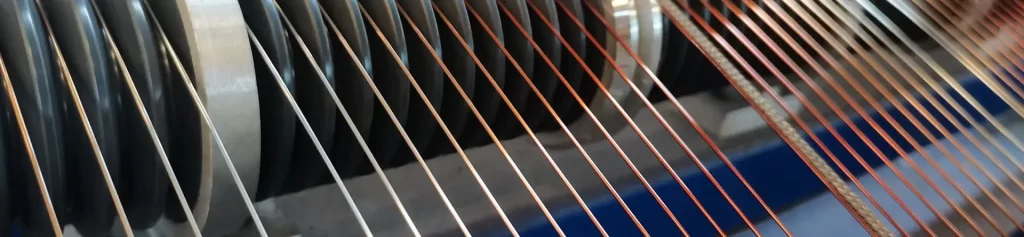
Copper-clad aluminum wire (CCA) is a bimetallic composite conductor with an electrical-grade aluminum core and an outer layer of oxygen-free copper. With its “copper surface + aluminum core” structure, CCA wire combines the solderability of copper, the lightweight properties of aluminum, and a lower cost than pure copper, making it increasingly popular in winding applications for transformers, motors, and inductors. This article systematically compares the applications of CCA wire in two major power equipment sectors: transformers and motors. It analyzes the applications from multiple dimensions, including structural characteristics, electrical performance, mechanical performance, termination processes, application compatibility, and selection decisions, providing engineers with selection guidance.
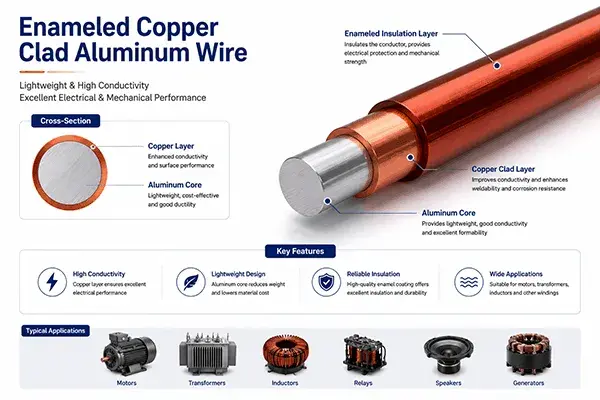
Structure and Grade System of CCA Wire
CCA wire is a bimetallic composite conductor formed by a metallurgical bonding process of two metals. The core material is electrical conductor-grade aluminum alloy, and the outer layer is oxygen-free copper (OFC). The coating process creates a permanent and continuous metallurgical weld between the copper and aluminum, ensuring long-term use without delamination or gaps. The copper layer typically accounts for 10% or 15% of the conductor’s cross-sectional area, corresponding to Class 10 and Class 15 series in the ASTM B566 standard.
According to ASTM B566, CCA wires are classified into four grades: Class 10A (nominal 10% volumetric copper, annealed), Class 15A (nominal 15% volumetric copper, annealed), Class 10H (nominal 10% volumetric copper, hard-drawn), and Class 15H (nominal 15% volumetric copper, hard-drawn). Annealed (Class 10A/15A) wires have good ductility and strong bending resistance, suitable for windings requiring complex forming. Hard-drawn (Class 10H/15H) wires have high mechanical strength and high tensile strength, suitable for windings with large spans or high stress. ASTM B566 stipulates that the copper layer and aluminum core must be completely metallurgically bonded, without seams, cracks, or delamination; finished wires must not have joints or splices.
Enameled Copper Clad Aluminum Wire (ECCAAW) is commonly available in round diameters of 0.19-4.0mm, and can be supplied in single-layer, heavy-layer, or custom-made versions. The enamel coating material is typically Modified Polyester, Solderable Polyurethane, or Polyamide-imide, corresponding to insulation classes F, H, and R/C+, respectively. Enameled CCA wire is usually packaged in 30kg-150kg wood-plastic composite spools (PT-25/PT-30), conforming to international standards such as IEC, NEMA, GB, and JIS.
Electrical Performance Comparison
CCA wires differ significantly from pure copper and pure aluminum wires in electrical performance, and engineers need to make a thorough evaluation when selecting them.
Regarding DC resistance, CCA wire has a higher DC resistance than pure copper wire for the same cross-sectional area. Pure copper has a conductivity of 100% IACS, aluminum has a conductivity of approximately 61% IACS, and the effective conductivity of CCA wire (15% copper + 85% aluminum) is approximately 65-70% of that of pure copper. This means that for the same outer diameter, the DC resistance of CCA wire is about 40-50% higher than that of pure copper wire. In low-frequency, high-current applications, the conductor loss of CCA wire is greater than that of pure copper wire, and engineers need to compensate by increasing the cross-sectional area (upgrading by 1-2 AWG grades).
Regarding AC resistance, CCA wires exhibit unique “high-frequency equivalent” characteristics. At ultra-high frequencies above 5MHz, due to the skin effect, high-frequency current flows only within a very thin skin depth on the conductor surface. The skin depth of pure copper is calculated as δ = √(ρ/(π·f·μ)), and at 5MHz, the skin depth of copper is approximately 0.93μm, less than 1% of the typical conductor radius. The copper outer layer thickness of CCA wires (approximately 0.05-0.15mm) is much greater than the high-frequency skin depth; therefore, high-frequency current flows entirely within the copper outer layer. Consequently, the AC conductivity of CCA wires at frequencies above 5MHz is equal to that of pure copper. This is the physical basis for CCA wires’ ability to replace pure copper wires in high-frequency applications such as transformers, RF inductors, and wireless charging.
Regarding contact resistance and solderability, CCA wires, due to their oxygen-free copper outer layer, exhibit the same solderability as pure copper wires. The copper outer layer provides excellent wetting properties for tin soldering, silver soldering, and copper soldering. In contrast, pure aluminum wires have poor solderability, high contact resistance, and are prone to oxidation. Therefore, CCA wires are significantly superior to pure aluminum wires in terms of termination reliability. CCA wires are also suitable for mechanical termination methods such as crimping, wire wrapping, and bolted connections.
Mechanical Performance Comparison
Mechanical properties directly affect the winding process and long-term reliability of CCA wires.
In terms of tensile strength, Class 10H/15H hard-drawn CCA wire can reach 200-280 MPa, comparable to pure copper wire (hard-drawn state 220-300 MPa) and significantly higher than pure aluminum wire (hard-drawn state 130-200 MPa). Class 10A/15A annealed CCA wire has a tensile strength of approximately 90-150 MPa, comparable to annealed pure aluminum wire but lower than annealed pure copper wire (200-260 MPa). Tensile strength affects the risk of breakage during winding; Class 15H hard-drawn CCA wire exhibits superior reliability in long-span windings (such as large transformer windings).
In terms of ductility, CCA wire is similar to pure aluminum wire, but superior to pure copper wire. Annealed CCA wire has an elongation of 25-35%, suitable for complex forming and small bending radius applications; hard-drawn CCA wire has an elongation of approximately 5-15%, suitable for straight winding and large span applications. The bending performance of CCA wire is between that of pure copper and pure aluminum wire, but care should be taken to avoid excessive bending which may cause microcracks at the copper-aluminum interface.
In terms of weight, CCA wire offers a significant weight reduction advantage compared to pure copper wire. Aluminum has a density of 2.70 g/cm³, copper 8.96 g/cm³, and CCA wire (15% copper + 85% aluminum) has a density of approximately 3.78-4.10 g/cm³, making it 50-55% lighter than pure copper. In weight-sensitive applications (such as aerospace, new energy vehicles, wind power generation, and portable devices), the weight reduction advantage of CCA wire can significantly reduce system weight and improve energy efficiency.
Regarding corrosion resistance, the outer layer of CCA wire is oxygen-free copper, but the aluminum core exposed at the termination cut may experience galvanic corrosion. In humid, salt spray, and chemically corrosive environments, the cut ends of CCA wire require waterproofing and moisture-proofing treatment (such as epoxy resin sealing and heat shrink tubing protection). In contrast, pure aluminum wire has better corrosion resistance (a dense alumina layer naturally forms on the surface), but it has higher contact resistance and poorer solderability.
Application of CCA Wire in Transformers
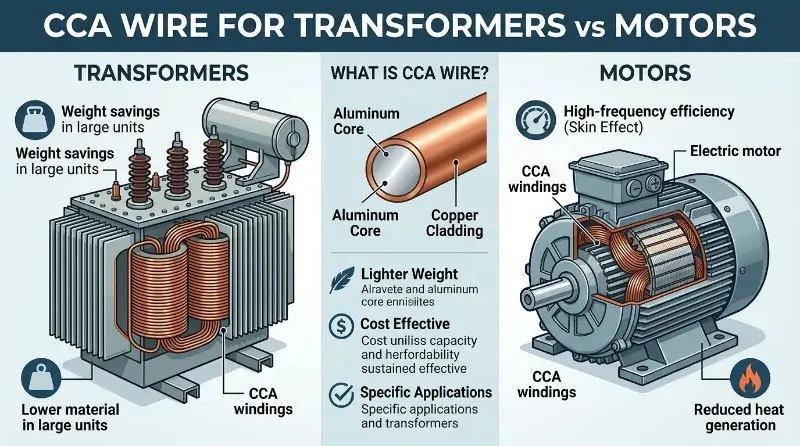
CCA wires offer advantages in various applications compared to pure copper and pure aluminum wires. CCA wires are suitable for the following transformer types: low-frequency power distribution, small control transformers, audio transformers, high-frequency switching power supplies, isolation transformers, and choke inductors.
Dry-type transformers use air or solid insulation as the cooling medium, and the windings typically use enameled copper or aluminum wire. CCA wire can be an economical alternative for medium-power dry-type transformers (e.g., 5kVA-500kVA). Considering that the conductivity of CCA wire is lower than that of pure copper, engineers need to select a CCA wire diameter 1-2 AWG larger than that of pure copper wire to ensure that copper losses are within design limits. Dry-type transformer windings typically use enameled wire; CCA enameled round wire (0.5-4.0mm) is an ideal choice.
Switch-mode power supply high-frequency transformers (SMPS transformers) operate in the 20kHz-1MHz high-frequency range, which is one of the most advantageous application scenarios for CCA wires. In SMPS high-frequency transformers, the skin effect concentrates high-frequency current on the conductor surface. The copper outer layer provides a low-resistance path for the high-frequency current, while the aluminum core only provides mechanical support. SMPS transformers typically use Litz wire or thin enamel-coated CCA wire, with the enamel coating material being modified polyester or polyamide-imide to withstand high-frequency eddy current losses.
A toroidal transformer is based on a toroidal core, with the windings evenly wound around it. The windings of a toroidal transformer need good flexibility and low bending stress. Class 15A annealed CCA wire (25-35% elongation) is ideal for tightly wound toroidal windings. Audio transformers operate at frequencies from 20Hz to 20kHz, and the windings typically use enameled copper wire to ensure low noise and low distortion. The application of CCA wire in audio transformers requires careful evaluation of its impact on sound quality.
Application of CCA Wire in Motors
The application of CCA wires in motors needs to be specifically evaluated based on the motor type and operating conditions. CCA wires are suitable for the following motor types: induction motors (especially squirrel-cage rotor motors), stepper motors, low-power brushless DC motors, household appliance motors, and small water pump motors.
The stator windings of induction motors typically use enameled copper (CCA) round wire, Class 2 or PEW/PEI. CCA enameled wire can be an economical alternative to induction motor stator windings, especially for one-time, low-cost, short-term motors (such as household appliances, fans, and water pumps). At 50/60Hz power frequencies, the skin effect is not significant, and the current is distributed across the entire cross-sectional area of the CCA wire. The resistance of CCA wire is greater than that of pure copper wire, leading to increased copper losses and higher temperature rise. Therefore, the application of CCA wire in power frequency motors requires careful evaluation of the impact of temperature rise on insulation life.
The rotor bars of a squirrel-cage rotor motor are typically made of pure aluminum (die-cast), but CCA wire can be used for the starting and auxiliary windings to reduce costs. Brushless DC motors (BLDC) typically use enameled copper wire for their windings, operating at frequencies from 1kHz to 100kHz. The use of CCA wire in BLDC motors offers a cost advantage. Small BLDC motors (such as hard drive motors and small fan motors) widely utilize CCA enameled round wire.
Stepper motors require precise control of inductance and resistance in their windings to achieve accurate step angles. The application of CCA wire in stepper motors necessitates evaluating the impact of increased resistance on torque characteristics. Household appliance motors, including those for small appliances such as air conditioners, washing machines, refrigerators, and range hoods, typically use PEW enameled copper wire in their windings. CCA enameled wire offers significant cost advantages in household appliance motors, making it one of the most common markets for CCA wire. EV (electric vehicle) drive motors operate at frequencies of 1kHz-10kHz, have high power density, and face stringent temperature rise requirements. Therefore, CCA wire is generally not used; pure copper enameled flat wire (Hairpin, Wave Winding) is the standard choice for EV drive motors.
Termination and Connection Processes
The termination process of CCA cables directly affects the reliability and long-term stability of the connection. The main termination methods for CCA cables include soldering (tin/silver soldering), crimping, wire wrapping, bolting, and mechanical winding.
Tin soldering is the most common termination method for CCA wires, and the process is the same as for pure copper wires. Using standard solder wire (Sn60Pb40 or SAC305 lead-free solder) and flux, at a soldering iron temperature of 350-400°C, the solder wets the outer copper layer, forming a reliable mechanical and electrical connection. Tin soldering results in minimal resistance increase at room temperature and high long-term reliability. Silver brazing is suitable for CCA wire connections in high-power, high-temperature applications. Silver solder (Ag-Cu-Zn alloy) has a melting point of 600-800°C, and its connection strength and conductivity are superior to tin soldering.
Crimping is another common termination method for CCA wires in power systems. The copper outer layer of the CCA wire ensures low contact resistance and good mechanical strength in the crimped connection, with reliability comparable to that of pure copper wire crimping. Wire wrapping is a common connection method in the electronics industry, particularly suitable for telecommunications and computer equipment. Due to the solderability and ductility of the copper outer layer, CCA wires can be wire wrapped using standard processes, achieving connection reliability identical to that of pure copper wire.
Precautions for CCA wire termination include: the copper layer and aluminum core are exposed at the termination cut, which may cause galvanic corrosion. Waterproof and moisture-proof treatment is required in humid environments; excessive bending may cause micro-cracks at the copper-aluminum interface, affecting long-term reliability; torque must be controlled for crimping and bolting connections to avoid overtightening that may cause the copper layer to crack.
Advantages and Limitations
Compared to pure copper and pure aluminum wires, CCA wires have the following advantages: lower cost than pure copper wires (copper prices fluctuate greatly, making copper-clad aluminum wires significantly more cost-effective), the same solderability as pure copper wires (the copper outer layer ensures excellent solderability), superior high-frequency performance (AC conductivity above 5MHz equals that of pure copper), approximately 50% lighter than pure copper wires (thanks to the aluminum core), mature termination technology (welding/crimping/winding are the same as for pure copper wires), and compliance with international standards such as ASTM B566, IEC, and NEMA.
The main limitations of CCA wires include: lower DC conductivity than pure copper (40-50% higher resistance for the same cross-sectional area), requiring a larger cross-sectional area (1-2 AWG grades) for the same current carrying capacity, unsuitable for core scenarios with high current and high power density (such as new energy vehicle drive motors and large power transformers), the need to assess the long-term reliability of the copper-aluminum interface (especially in thermal cycling and mechanical vibration scenarios), the galvanic corrosion that easily occurs at the termination cut (requiring waterproofing), unsuitable for high-temperature scenarios above 200°C (potential diffusion at the copper-aluminum interface), and lower recycling value than pure copper (aluminum has a lower recycling value than copper).
Selection Decision Recommendations
The selection of CCA lines in the transformer and motor should be based on a comprehensive judgment of the specific application scenario.
Suitable applications for CCA transformers include: secondary windings of low-frequency power distribution transformers (≤500kVA), high-frequency windings of switching power supply transformers (SMPS), primary or secondary windings of toroidal transformers, secondary windings of audio transformers (sound quality impact needs to be evaluated), windings of inductors and chokes with operating frequencies ≥100kHz, and low-voltage transformers for portable devices and power tools.
Suitable applications for motors using CCA wires include: small household appliance motors (fans, range hoods, air conditioner indoor units), auxiliary windings and starting windings of single-phase induction motors, small brushless DC motors (<100W), low-power windings of stepper motors, starting windings of squirrel-cage induction motors, and auxiliary windings of water pump motors and air compressors.
Scenarios unsuitable for using CCA lines include: main windings of new energy vehicle drive motors (with stringent power density and temperature requirements), main windings of large power transformers (>500kVA), main insulation windings of high-voltage transformers (>10kV), high-power motors operating continuously for extended periods (>10kW), motors operating in high-temperature environments (>180°C), motors in critical safety equipment (medical devices, aerospace, nuclear power), and high-current DC busbars and busbars.
Conclusion
As a bimetallic composite conductor, CCA wire has a significantly differentiated positioning in the applications of two major power equipment: transformers and motors. In high-frequency applications (>5MHz), CCA wire can completely replace pure copper wire due to the skin effect, making it an economical choice for high-frequency scenarios such as switching power supplies, transformers, and RF inductors. In low-frequency and low-to-medium power applications, CCA wire serves as an alternative for cost-sensitive scenarios, requiring increased cross-sectional area to compensate for the increased DC resistance.
In transformer applications, CCA wires are valuable in SMPS high-frequency transformers, dry transformers, toroidal transformers, and audio transformers. In motor applications, CCA wires offer cost advantages in household appliance motors, auxiliary windings, and small BLDC motors, but are not suitable for new energy vehicle drive motors, large motors, or high power density scenarios. Regarding termination technology, CCA wires are the same as pure copper wires, but attention must be paid to the long-term reliability of the copper-aluminum interface and the protection against galvanic corrosion at the cut.
With the rapid development of power electronics, new energy, 5G communications, and other fields, the application of CCA lines in high-frequency, low-cost, and lightweight scenarios will continue to expand. When selecting CCA lines, engineers should comprehensively consider five factors: electrical performance, mechanical performance, termination process, application environment, and cost budget, to ensure that the application of CCA lines in transformers and motors achieves the best balance of performance, reliability, and cost.