

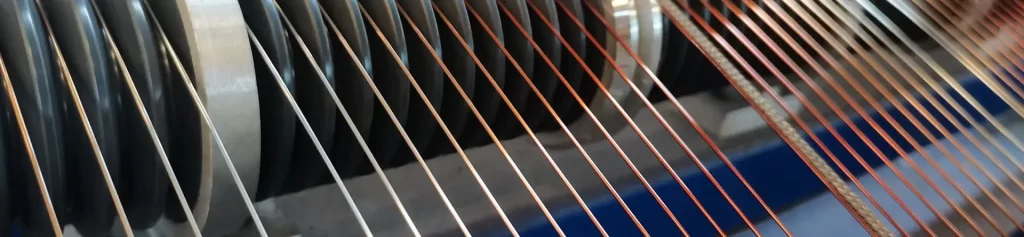
In the field of electrical and electronic engineering, copper wire is one of the most commonly used conductive materials. Based on the type of insulation, copper wire can be divided into two main categories: enameled wire and bare copper wire. Enameled wire has one or more layers of enamel coating on its surface, giving it excellent electrical insulation performance; bare copper wire, on the other hand, has no insulation layer and consists only of pure copper conductor. The two differ significantly in their application scenarios, performance characteristics, and design considerations. This article systematically compares the differences between enameled wire and bare copper wire from multiple dimensions, including structural composition, insulation performance, electrical performance, mechanical performance, thermal performance, manufacturing process, application areas, and selection decisions, providing engineers with selection guidance.
Structural Definitions of Enameled Wire and Bare Copper Wire
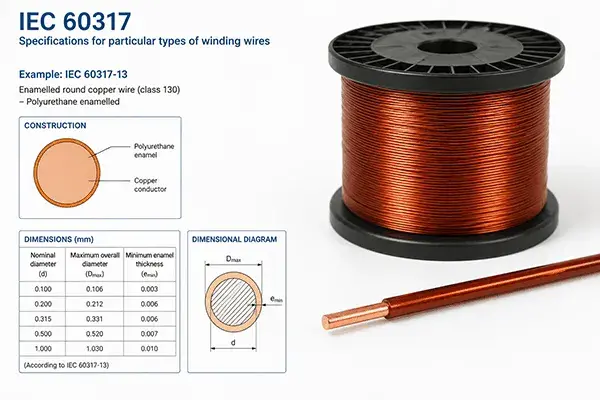
Enameled wire is a round or rectangular copper conductor with an insulating enamel coating. The insulating enamel coating acts as an electrical insulation layer, giving the enameled wire its “self-insulating” properties. The core structure of enameled wire consists of two parts: an inner conductive copper conductor (usually oxygen-free copper OFC or electrical copper ETP), and an outer insulating enamel coating (the base resin is a polymer material such as polyurethane, polyester, polyester imide, polyamide-imide, or polyimide). The thickness of enamel coating is typically in the range of 0.01-0.10 mm. According to the IEC 60317 standard, it is divided into three grades: Grade 1 (thin enamel coating), Grade 2 (thick enamel coating, the mainstream in industry), and Grade 3 (extra thick enamel coating). According to the NEMA MW 1000-2018 standard, it is divided into four grades: Single Build, Heavy Build, Triple Build, and Quadruple Build.
Bare copper wire is a pure copper conductor without any insulation layer. It consists of a single copper conductor and typically has only a slight oxide layer or anti-rust treatment on its surface. The copper purity of bare copper wire is usually ≥99.9%, and it is classified by purity grade as T1 (≥99.95%), T2 (≥99.90%), TU1 (oxygen-free copper, ≥99.97%), TU2 (oxygen-free copper, ≥99.95%), etc. In industry, bare copper wire is mainly used for grounding busbars, low-voltage electrical connections, transformer neutral point leads, cable shielding layers, and special coils (such as air-core coils and Litz wire for wireless charging)—applications requiring either “conductor + external insulation” or “no insulation.”
Structurally, enameled wire is a composite structure of “conductor + insulation layer”, while bare copper wire is a single conductor structure. This fundamental difference determines the stark differences between the two in terms of insulation performance, winding processing, and space utilization.
Insulation Performance Comparison
The core difference between enameled wire and bare copper wire lies in their insulation performance, which is also the fundamental reason for the divergence in their application scenarios.
Enameled wire, thanks to its enamel coating and insulation layer, possesses excellent electrical insulation capabilities. The insulation strength of enameled wire is typically measured by its dielectric breakdown voltage, tested using methods including the twisted pair method, the foil method, and the cylinder method. NEMA MW 1000-2018 Table 29 specifies the minimum breakdown voltage for the foil method, Table 31 for the twisted pair method, and Table 35 for the cylinder method. Grade 2 enameled copper round wire (1.0 mm diameter) typically has a breakdown voltage ≥3000V (twisted pair method), far exceeding the insulation requirements of ordinary electronic equipment. In transformers, inductors, and motor windings, the enamel coating of enameled wire can withstand interlayer and phase-to-phase voltage differences, eliminating the need for an additional insulation layer.
Bare copper wire has no insulation layer and its breakdown voltage is 0. When energized, any contact with bare copper wire will create a short circuit. Therefore, bare copper wire must rely on external insulation materials (such as insulating varnish, insulating sleeves, insulating paper, insulating boards, etc.) for safe use in electrical equipment. The “no insulation” characteristic of bare copper wire is both an advantage and a disadvantage: the advantages include excellent heat dissipation (no enamel coating thermal resistance), minimal resistance, and high current density; the disadvantages include the need for external insulation and complex winding processing.
The choice of enamel coating material has a decisive impact on the insulation performance of enameled wire. Polyurethane (UEW, 130°C) enamel coating is solderable, but automatically decomposes and falls off at welding temperatures; polyester (PEW, 130-155°C) enamel coating has high mechanical strength but moderate thermal shock resistance; polyester imide (PEI, 180°C) enamel coating has better heat resistance than polyester; polyamide-imide (PAI, 220°C) enamel coating has a softening breakdown temperature of up to 330-350°C and does not crack under rapid cooling and heating; polyimide (PI, 240°C) enamel coating has the best heat resistance and is the preferred enamel coating for high-temperature special motors and aerospace applications.
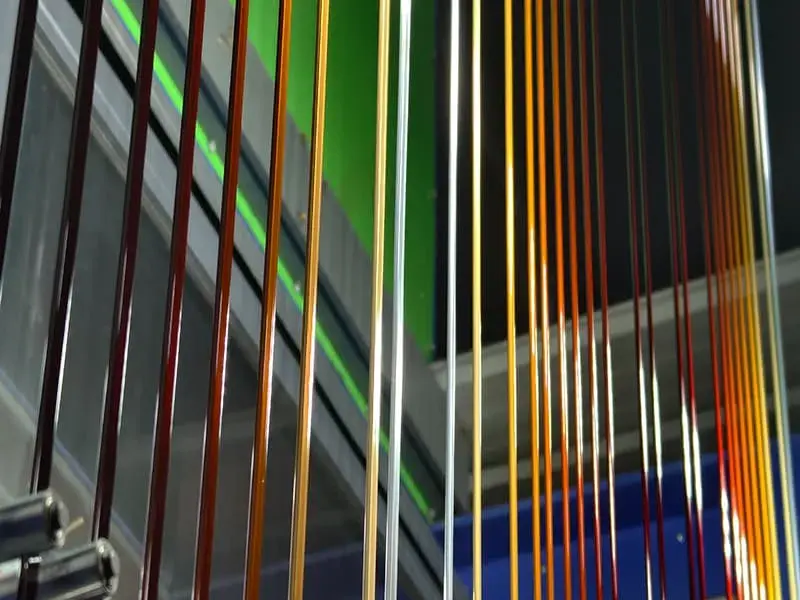
Electrical Performance Comparison
The main differences in electrical performance between enameled wire and bare copper wire lie in resistance, skin effect, proximity effect, and AC loss.
Regarding DC resistance, enameled wire and bare copper wire of the same conductor diameter have the same conductor resistance under DC conditions. The only difference lies in the conductor fill factor, which is reduced due to the space occupied by the enamel coating layer. The actual DC resistance of enameled wire is slightly higher than that of bare copper wire (because enameled wire has a smaller conductor cross-sectional area for the same outer diameter), but the difference is usually in the range of 1-3%, which is negligible for most applications.
In terms of AC performance, enameled wire and bare copper wire exhibit similar electrical properties at low frequencies. However, at high frequencies, the skin effect and proximity effect significantly influence the effective cross-sectional area of the conductor. The skin effect concentrates high-frequency current on the conductor surface. The skin depth (δ) is calculated as δ = √(ρ/(π·f·μ)), where ρ is the conductor resistivity, f is the frequency, and μ is the conductor permeability. At 100kHz, the skin depth of copper is approximately 0.21mm; at 1MHz, it is approximately 0.066mm; and at 10MHz, it is approximately 0.021mm. Enameled wire exhibits the same skin effect as bare copper wire because the skin effect depends on the conductor material itself rather than the insulation layer.
Regarding inductance and capacitance, the enamel coating of enameled wire introduces additional distributed capacitance in the winding as a dielectric layer. In high-frequency applications such as transformers and RF inductors, the dielectric constant (εr, typically 3-5) and dielectric loss factor (tan δ) of the enamel coating affect the coil’s self-resonant frequency (SRF) and high-frequency losses. In extremely high-frequency applications such as VHF/UHF, the dielectric loss of the enamel coating becomes a limiting factor, while bare copper wire does not have this problem (however, bare copper wire requires external insulation material, which also has dielectric loss issues).
Mechanical Performance Comparison
Mechanical properties directly affect the winding process and long-term reliability of enameled wire and bare copper wire.
In terms of flexibility, enameled wire, due to the protection of its enamel coating, exhibits significantly better mechanical abrasion resistance than bare copper wire. The scratch resistance and tensile strength of enameled wire on high-speed winding machines are key indicators; NEMA MW 1000-2018 specifies the scratch resistance test (Scrape Resistance, Table 49) for enamel coatings. Polyamide-imide (PAI) enamel coatings are unparalleled in scratch resistance, possessing an extremely hard and smooth surface, and far exceeding polyester and polyester imide enamel coatings in terms of scratch resistance and tensile adhesion. Bare copper wire is highly susceptible to surface scratches, oxidation, and copper shavings during winding, resulting in poor mechanical reliability.
Regarding bending performance, the bending performance of enameled wire depends on the flexibility and adhesion of the enamel coating. Grade 1 enamel coatings are thin and have good flexibility, preventing cracking at small bending radii; Grade 3 enamel coatings are thick and have poorer flexibility, requiring higher bending radii. NEMA MW 1000-2018 specifies a mandrel wrap test for enameled wires, which, upon passing, determines that the enamel coating does not crack under specified bending conditions. The bending performance of bare copper wire depends on the ductility of the copper conductor; OF (Oxygen-Free) grade copper has the best ductility, followed by ETP (Electrolytic Tough Pitch) grade electrical copper.
Regarding storage and transportation, enameled wire is sensitive to humidity, temperature, and ultraviolet radiation in the storage environment. Enameled wire may experience moisture absorption, aging, and cracking after long-term storage. NEMA specifies a shelf life of 1-2 years for enameled wire. Bare copper wire exhibits more stable storage performance, and the copper oxide layer has less impact on conductor properties.
Thermal Performance Comparison
Thermal performance is an important consideration for the application of enameled wire, and the heat resistance of enameled wire differs significantly from that of bare copper wire.
Regarding insulation class, the heat resistance of the enameled wire is determined by the thermal class of the enamel coating material. The insulation class specified in IEC 60085 directly corresponds to the thermal class of the enameled wire. Class E (120°C) uses polyurethane or polyvinyl alcohol acetal (enamel coating); Class B (130°C) uses polyester (enamel coating); Class F (155°C) uses modified polyester or polyester imide (enamel coating); Class H (180°C) uses polyester imide (enamel coating); Class C (200°C) uses polyester imide/PAI double coating (enamel coating); Class R (220°C) uses PAI (enamel coating); Class 240 uses PI (enamel coating). Bare copper wire has no insulation class concept, but the maximum operating temperature of the copper conductor itself depends on the insulation class.
In terms of heat dissipation performance, bare copper wire is significantly superior to enameled wire. The enamel coating of enameled copper wire is a poor conductor of heat (its thermal conductivity is approximately 0.2-0.3 W/(m·K)), and its thermal resistance hinders heat transfer to the environment. In high-power-density windings, this thermal resistance can cause the conductor temperature to rise by 5-15°C. Bare copper wire, lacking this thermal resistance, has a shorter heat dissipation path and a lower temperature rise. For specialized applications requiring high current, low voltage, and high power density (such as inductors, electromagnets, and resistors), bare copper wire may be a better choice.
Regarding thermal shock resistance, the integrity of the enamel coating in enameled wire under rapid temperature changes is evaluated by thermal shock testing, with IEC 60851-6 specifying the thermal shock test method. PAI enamel coatings maintain integrity even under rapid cooling and heating above 200°C, with a softening breakdown temperature of 330-350°C. PI enamel coatings exhibit the best thermal shock resistance, remaining crack-free at a test temperature of 240°C. Bare copper wires do not have a thermal shock concept (no enamel coating), but the copper conductor will experience thermal stress during rapid thermal cycling, potentially affecting the stability of its mechanical structure.
Manufacturing Process Comparison
The manufacturing processes of enameled wire and bare copper wire differ greatly, reflecting the fundamental difference in their product forms.
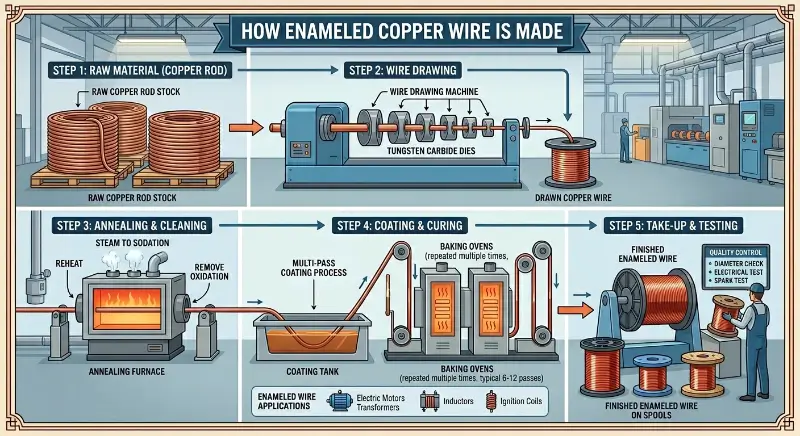
The manufacturing process of enameled wire mainly includes copper rod drawing, annealing, coating, baking, and winding. The coating process typically employs die coating or felt coating. The enamel is applied to the copper wire surface through a die or felt, and then baked in a vertical or horizontal oven for curing. The oven temperature is usually controlled within the range of 400-500°C, and the copper wire remains in the oven for 1-5 seconds. At high temperatures, the solvent evaporates, and the resin cross-links and cures. Grade 2 enameled wire typically requires 4-8 coating and baking cycles, Grade 3 requires 6-12 cycles, and Grade 1 requires 2-4 cycles. The process control of the coating (enamel viscosity, oven temperature, tension control, and number of cycles) directly affects the uniformity, adhesion, and breakdown voltage of the enameled wire.
The manufacturing process of bare copper wire is relatively simple, mainly including copper rod drawing, annealing, cleaning, surface treatment (anti-oxidation), and winding. Bare copper wire requires no painting or baking, resulting in low energy consumption, high production capacity, and low cost. However, bare copper wire has high requirements for surface finish (directly affecting conductivity and subsequent soldering performance), necessitating strict control over the wear of the drawing dies and the uniformity of the annealing process.
Application Scenario Comparison
The application scenarios for enameled wire versus bare copper wire are largely determined by insulation requirements.
Enameled wire is widely used in applications requiring self-insulating windings, including motor stator/rotor windings, transformer primary/secondary windings, inductor coils, relay coils, solenoid valve coils, ignition coils, Hall sensor coils, wireless charging transmitter/receiver coils, RFID antennas, and inductive ballasts. In these applications, the enamel coating of enameled wire replaces the external insulation layer, resulting in a compact winding structure, easy assembly, and high reliability. Enameled wire accounts for over 80% of the winding wire market and is a fundamental material in the electrical and electronic industries.
Bare copper wire is mainly used in the following scenarios: First, grounding and busbars, where bare copper wire serves as a grounding conductor, busbar, and low-voltage power distribution trunk line, requiring the use of insulators and insulating bushings; second, cable shielding, where bare copper wire is braided into copper mesh or copper tape as a shielding layer for cables; third, special coils, such as air-core RF coils, high-power inductors, and electromagnets requiring special heat dissipation; fourth, transformer neutral point leads, where bare copper wire serves as the external lead for the transformer neutral point; fifth, laboratories and testing equipment, where bare copper wire serves as the conductive part of test probes and connecting wires; and sixth, art and decoration, where bare copper wire, due to its conductivity, ductility, and aesthetics, is used in handicrafts and electronic art installations.
Selection Decision Recommendations
The selection of enameled wire and bare copper wire should be based on a comprehensive judgment of specific application requirements.
Scenarios where enameled wire is preferred include: windings requiring self-insulation (motors, transformers, inductors), space-constrained miniaturization designs (micromotors, chip inductors), high-voltage or high-frequency applications (switching power supplies, wireless charging coils), mass production requiring automated winding, and industrial/automotive/aerospace applications demanding high reliability. In these scenarios, the insulation performance, mechanical protection, and ease of winding of enameled wire are its core advantages.
Scenarios where bare copper wire is preferred include: high power density windings (high-current electromagnets, resistors), grounding and busbars (power distribution systems), cable shielding (high-frequency cables), applications requiring additional special insulation (high-temperature cables, radiation-resistant cables), purely conductive applications (test probes, grounding terminals), and cost-sensitive, simple applications. In these scenarios, the low resistance, high heat dissipation, low cost, and absence of dielectric loss (enamel coating) of bare copper wire are its core advantages.
In mixed application scenarios, enameled wire and bare copper wire can be used in combination. For example, the primary winding of a transformer uses enameled wire for insulation, while the secondary winding uses bare copper wire with mica and fiberglass insulation to provide high current capability; the stator winding of a motor uses enameled wire, while the neutral point lead uses bare copper wire; the wireless charging transmitter coil uses Litz wire (multi-strand enameled wire stranded), while the receiver coil can use bare copper wire with external insulation.
Conclusion
Enameled wire and bare copper wire are two main forms of copper conductors, differing in multiple dimensions such as structure, insulation, mechanical properties, and thermal performance. Enameled wire, with its composite structure of “conductor + enamel coating insulation,” provides self-insulation and is the mainstream product in the winding wire market. Bare copper wire, with its single conductor structure, provides the lowest resistance and highest heat dissipation, making it a key material for grounding, busbars, and special coils.
Engineers should make comprehensive judgments based on specific application requirements when selecting wire: enameled wire is suitable for self-insulated windings, space-constrained, high-voltage, high-frequency, and high-reliability scenarios; bare copper wire is suitable for high power density, grounding busbars, cable shielding, and purely conductive applications. With the continuous development of new enameled coating materials (nanomembrane coating, low-dielectric-loss enameled coating) and new insulation technologies (ceramic coating, plastic extrusion insulation), the application boundaries of enameled wire and bare copper wire will continue to expand, but their core positioning in the winding wire market will not change in the short term.