


Last year, a power transformer customer asked: our transformer is designed for 30 years of life. Will the magnet wire last 30 years? I replied: it depends on what temperature class you use, what environment it operates in, and whether it runs at full load long term. Until these three variables are determined, no one can give you a number.
Magnet wire life is not as simple as “how long can copper wire plus enamel last.” It is the combined result of temperature, mechanical stress, chemical erosion, and insulation aging. If any one fails prematurely, the entire magnet wire life ends.
This article focuses on life alone. It breaks down magnet wire failure mechanisms across four dimensions (thermal, mechanical, chemical, insulation), uses IEC standard data to give realistic life expectations, and provides buyers and engineers with a judgment table for predicting life.
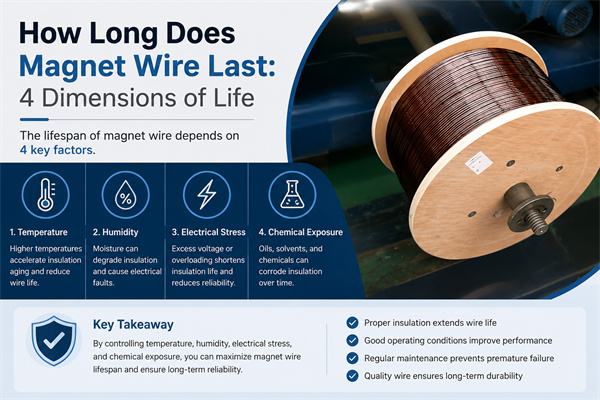
The Four Dimensions of Magnet Wire Life
Magnet wire works simultaneously under four types of stress in motors, transformers, and home appliance products.
Thermal stress: Joule heating from current passing through, ambient temperature conduction, and adjacent equipment radiation. The higher the temperature, the faster the enamel ages.
Mechanical stress: winding tension, bending during slot insertion, fretting wear from long-term vibration, and expansion-contraction from temperature cycles.
Chemical stress: moisture, oxygen, acids, alkalis, oil contamination, salt spray. These corrode enamel and accelerate insulation degradation.
Electrical stress: voltage, overvoltage surges, partial discharge. These break down enamel and produce electrical trees.
Magnet wire life equals the earliest failure point among the four types of stress above. Thermal may fail first, mechanical may fail first, or chemical may fail first, depending on the specific scenario.
Dimension One: Thermal Life (The Most Important Failure Mechanism)
Thermal life is the determining factor for magnet wire life.
Montgomery’s Rule
Magnet wire thermal life follows Montgomery’s rule: for every 10°C increase in temperature, enamel life is halved.
This is an empirical formula derived from IEC 60216 standard and applies to all magnet wire enamels.
Take an example. An 180°C class enamel (Class H) has a life of about 20,000 hours at 180°C. If the actual working temperature drops to 170°C, life doubles to 40,000 hours. If it rises to 190°C, life halves to 10,000 hours. Dropping to 150°C for use can give a life of 160,000 hours (about 18 years of continuous operation).
This is why the choice of temperature class is crucial. The same Class H enamel will be scrapped after 20,000 hours running at 180°C at full load, but can last 18 years running derated at 150°C. Choosing the wrong temperature class means product life ends 4 to 5 times earlier.
Real Life Expectations by Temperature Class
Below are the life expectations for each temperature class enamel under rated temperature and typical derated temperature in the IEC 60317 system.
105°C class (Class B): polyvinyl formal enamel. Rated temperature 105°C with life of about 20,000 hours. At 85°C working temperature, life is over 80,000 hours (about 9 years of continuous operation). Common applications are oil-immersed transformer windings and home appliance internal coils.
130°C class (Class B): modified polyester enamel. Rated temperature 130°C with life of about 20,000 hours. At 100°C working temperature, life is over 120,000 hours (about 14 years of continuous operation). Common applications are ordinary motors, home appliance motors, and transformer low-voltage windings.
155°C class (Class F): modified polyester enamel. Rated temperature 155°C with life of about 20,000 hours. At 130°C working temperature, life is over 80,000 hours (about 9 years of continuous operation). Common applications are industrial motors, transformer medium-voltage windings, and automotive motors.
180°C class (Class H): polyesterimide enamel. Rated temperature 180°C with life of about 20,000 hours. At 150°C working temperature, life is over 100,000 hours (about 11 years of continuous operation). This is the most commonly used temperature class in the motor industry. Most small and medium motors and transformers use Class H enamel.
200°C class (Class C): polyesterimide/polyamide-imide composite enamel. Rated temperature 200°C with life of about 20,000 hours. At 170°C working temperature, life is over 80,000 hours. Common applications are EV drive motors, dry-type transformers, and high power density motors.
220°C class (above Class C): polyimide enamel. Rated temperature 220°C with life of about 20,000 hours. Common applications are aviation motors, deep well motors, and high-temperature motors.
240°C class: special polyimide enamel. Rated temperature 240°C with life of about 20,000 hours. Common applications are military, aerospace, and nuclear industries.
Core insight: the higher the temperature class, the rated temperature life remains the same (all around 20,000 hours), but the life gap becomes enormous when actually used derated. Class H used at 150°C lasts 11 years. Class C used at 200°C only lasts 2.3 years, but Class C used at 170°C lasts 9 years, far exceeding Class H used at 180°C for 2.3 years. This is why high temperature scenarios must use high temperature class magnet wire.
Dimension Two: Mechanical Life
Mechanical life is determined by two variables: enamel tensile resistance and conductor material tensile resistance.
Tensile Failure Modes
Magnet wire endures three types of mechanical stress during winding, slot insertion, and operation.
Winding tension: automatic winding machine tension is 5 to 50 g. Enamel must withstand this tension without cracking.
Bending stress: during slot insertion, magnet wire must bend into the slot, with minimum bending radius of about 3 times the wire diameter. Enamel must withstand this bending without cracking.
Vibration stress: during motor operation, magnet wire experiences 2 to 3 g of vibration acceleration, and long-term accumulation leads to fretting wear.
Mechanical Life Expectations
The pinhole rate of enamel during winding is a key indicator. High-quality enamel has no more than 1 pinhole per 30 m length.
Typical scenarios for mechanical failure:
Fine wire (below 0.3 mm) breaks during winding: copper enameled wire has mature process below 0.3 mm. Aluminum enameled wire has greater process difficulty below 0.3 mm and breaks easily.
Special-shaped coil bending cracking: enameled flat wire cracks at overly small R angles.
Long-term vibration wear: after motor bearing loosens, vibration intensifies and enamel is worn away.
Typical data for mechanical life: high-quality magnet wire can withstand 1,000 to 5,000 cycles (winding plus slot insertion plus vibration cycles) under standard mechanical stress. This far exceeds the number of cycles needed within product life. Mechanical life is usually not the main cause of failure, but magnet wire with poor enamel quality will have premature mechanical life failure.
Dimension Three: Chemical Life
Chemical failure is the most overlooked failure mode of magnet wire in industrial environments.
Chemical Failure Modes
Oxidation failure: enamel slowly ages under long-term oxygen exposure. 130°C enamel in pure oxygen at 100°C ages 5 to 10 times faster than in air environment.
Hydrolysis failure: polyester and polyurethane enamels hydrolyze in humid environments. Relative humidity above 95 percent and long-term exposure cause enamel to become brittle and peel.
Acid-alkali failure: acid mist and alkali mist in industrial environments corrode enamel. Acidic substances in transformer oil slowly erode enamel.
Oil contamination failure: when transformer oil impregnates magnet wire, if the oil contains water or impurities, enamel degradation accelerates.
Chemical Life Expectations
Chemical life varies greatly, depending on the specific environment.
Laboratory conditions (25°C, 50 percent humidity, no contamination): magnet wire chemical life can reach over 30 years.
Industrial environment (40 to 60°C, 80 percent humidity, slight contamination): magnet wire chemical life is 15 to 20 years.
Harsh environment (high temperature, high humidity, acid-alkali, oil contamination): magnet wire chemical life is 5 to 10 years.
Special note: chemical life is not an independent dimension. It accelerates thermal failure and mechanical failure. Chemically eroded enamel becomes more brittle, more prone to cracking, and less heat resistant. This is why magnet wire life in industrial environments is 30 to 50 percent shorter than in the laboratory.
Dimension Four: Insulation Life
Insulation life refers to the failure time of magnet wire under voltage.
Electrical Failure Modes
Breakdown failure: when the voltage across the magnet wire exceeds the enamel breakdown voltage, breakdown occurs immediately. Conventional enamel breakdown voltage is about 5,000 to 8,000 V (single layer), and three-layer enamel can reach 12,000 to 15,000 V.
Partial discharge failure: under high voltage, air gaps in enamel generate partial discharge, and long-term accumulation leads to electrical treeing and enamel failure. This is the main cause of magnet wire failure in high-voltage motors and transformers.
Overvoltage surge: switching power supplies and inverters generate overvoltage surges that accelerate enamel aging.
Insulation Life Expectations
Insulation life depends on voltage class and enamel thickness.
Low voltage scenarios (below 1,000 V): single-layer enamel can withstand 20 to 30 years.
Medium voltage scenarios (1,000 to 10,000 V): double-layer or three-layer enamel can withstand 15 to 20 years.
High voltage scenarios (above 10,000 V): special corona-resistant enamel (such as nano-modified enamel) is required, and can withstand 10 to 15 years.
Special note: insulation life is strongly correlated with thermal life. Every 10°C increase in temperature reduces enamel insulation breakdown voltage by about 5 to 8 percent. Therefore, high voltage scenarios must strictly control working temperature.
Life Expectations for Different Application Scenarios
Industrial motor (continuous operation): Class H magnet wire, 150°C working temperature, 24 hours per day operation. Expected life 10 to 15 years.
Transformer (distribution transformer): Class H magnet wire, 130 to 150°C working temperature, continuous operation, oil-immersed or dry-type. Expected life 25 to 30 years.
EV drive motor (peak conditions): Class C magnet wire, 170 to 180°C peak working temperature, cyclic conditions, frequent start-stop. Expected life 8 to 10 years (corresponding to 200,000 to 300,000 km driving mileage).
Home appliance motor (intermittent duty): Class F or Class H magnet wire, 100 to 120°C working temperature, 8 to 16 hours per day operation. Expected life 10 to 12 years.
Aviation motor (extreme conditions): Class C or above magnet wire, 200 to 220°C peak working temperature, harsh environment. Expected life 5 to 8 years (but flight hours far exceed ground equipment).
Deep well motor (high temperature and high pressure): special polyimide magnet wire, 220 to 240°C working temperature, high pressure, corrosive environment. Expected life 3 to 5 years.
Engineering Variables That Affect Life
Buyers and engineers who want to accurately predict magnet wire life must clarify the following 7 engineering variables:
One: enamel temperature class. Class H or Class C? Is the enamel material polyester, polyesterimide, polyimide, or polyamide-imide?
Two: actual working temperature. Rated temperature? Peak temperature? Average temperature? Enamel life is about 20,000 hours at rated temperature, but life multiplies when used derated.
Three: number of temperature cycles. Each product start-stop and load change is a temperature cycle. The more temperature cycles, the greater the thermal fatigue accumulation.
Four: voltage class. Rated voltage? Peak voltage? Are there overvoltage surges?
Five: environmental humidity and chemistry. Relative humidity? Are there acids, alkalis, oil contamination, salt spray?
Six: mechanical stress. Winding tension, slot insertion bending radius, vibration acceleration.
Seven: conductor material. Copper enameled wire has better mechanical performance than aluminum enameled wire, and copper life is slightly longer under the same enamel.
Before these 7 variables are determined, any life expectation is an estimate.
How to Determine That Magnet Wire Is Approaching End of Life
There are 4 warning signs before magnet wire failure, and engineers should know how to identify them.
Warning one: insulation resistance decline. Normal magnet wire insulation resistance is above 100 MΩ/m. Dropping below 10 MΩ/m means enamel has begun to age.
Warning two: dielectric loss tangent value (tan δ) rises. Normal enamel tan δ is below 0.01. Rising above 0.05 means the enamel structure has deteriorated.
Warning three: breakdown voltage decline. New magnet wire breakdown voltage is 5,000 to 8,000 V. Dropping below 3,000 V means enamel is about to fail.
Warning four: appearance changes. Enamel color darkens, cracks appear, peeling, blistering. These are visible precursors to failure.
Monitoring recommendations: transformers and large motors are recommended to undergo insulation testing every 3 to 5 years. EV drive motors should be tested at 5 years or 150,000 km.