


LME aluminum price averaged 2,400 USD per ton in 2024. In 2025 it rose to 2,550 USD per ton. In the first half of 2026 it has already reached 2,700 USD per ton. That is a 12.5 percent increase in two and a half years, an annualized 5 to 8 percent trend, and there is no inflection point in sight.
For the magnet wire industry, the impact of rising aluminum prices goes far beyond the statement that “raw materials have become more expensive.” It affects buyer contract terms, supplier quotation strategies, end-user cost structures, and even the product mix of the entire industry. The tipping point for aluminum replacing copper is exactly at aluminum price and the copper-aluminum ratio.
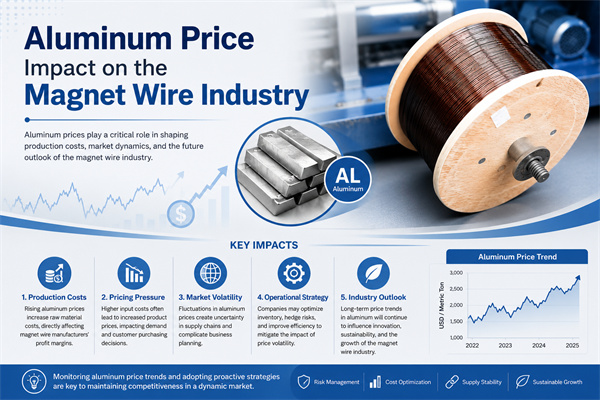
This article explains the transmission mechanism of aluminum prices on the magnet wire industry in detail. How prices transmit, who is affected first, who pays last, how buyers should respond, how suppliers should quote, and how end products absorb the cost.
Aluminum Price Market Structure: LME and SHFE Two Pricing Centers
Global aluminum prices are determined by two markets: LME (London Metal Exchange) and SHFE (Shanghai Futures Exchange).
LME aluminum price is the international benchmark. Over 70 percent of global aluminum spot contracts are priced at LME price plus premium. LME prices reflect global supply-demand balance, exchange rates, inventory, and macro sentiment. The characteristic of LME aluminum prices is high volatility, high attention, and global synchronization. The LME aluminum price range in 2024 was 2,200 to 2,800 USD per ton.
SHFE aluminum price is China’s domestic futures price. SHFE prices reflect China’s domestic supply-demand (China is the world’s largest aluminum producer and consumer, accounting for 60 percent of global production). The characteristic of SHFE prices is relative stability, linkage with domestic inventory and premiums, and basic consistency with LME after exchange rate conversion.
For Chinese exporters, LME price is the pricing basis and SHFE price is the domestic procurement basis. The difference between the two is mainly in premiums and exchange rate conversion. Enameled aluminum wire exported to North America is priced at LME, while exports to Southeast Asia can be priced at SHFE.
Impact on the magnet wire industry: when aluminum prices rise, raw material costs rise 100 percent, and the transmission to finished enameled wire price increases is about 60 to 70 percent (the remaining 30 to 40 percent is processing fees, enamel, labor, and other relatively fixed costs).
Three Transmission Paths for Aluminum Price Increases
The impact of aluminum prices on the magnet wire industry is not a single line of “raw materials are more expensive, products are more expensive,” but three transmission paths working simultaneously.
Path One: Raw Material Cost Transmission (Most Direct)
This is the most intuitive path. In the cost structure of enameled aluminum wire, raw material aluminum accounts for 70 to 75 percent, enamel accounts for 5 to 8 percent, labor accounts for 5 to 8 percent, energy accounts for 5 to 8 percent, and others account for 5 to 10 percent.
LME aluminum price rose from 2,400 USD per ton to 2,700 USD per ton, a 12.5 percent increase in raw material cost. Based on a 70 percent share, the cost of finished enameled aluminum wire rises by 8.75 percent. Actual transaction prices rise by 7 to 9 percent (suppliers absorb part, users absorb part).
The transmission speed of this path: usually 1 to 3 months. The raw material inventory cycle determines the transmission speed. Suppliers with high inventory and many orders transmit slowly. Those purchasing by order transmit quickly.
Path Two: Copper-Aluminum Ratio Transmission (Affecting Product Mix)
When aluminum prices rise, changes in the copper-aluminum ratio will affect the economic driver for “aluminum replacing copper.”
Copper-aluminum ratio equals LME copper price divided by LME aluminum price. In 2024, the copper-aluminum ratio was 3.83 times (copper 9,200, aluminum 2,400). In 2026, the copper-aluminum ratio is 3.63 times (copper 9,800, aluminum 2,700). The copper-aluminum ratio is narrowing. Aluminum’s cost advantage is being eroded by rising aluminum prices.
If aluminum prices rise to 3,000 USD per ton (copper 9,800 unchanged), the copper-aluminum ratio drops to 3.27 times. At this critical point, the “cost driver” for aluminum replacing copper will significantly weaken. Buyers will re-evaluate whether to use aluminum or copper.
The transmission speed of this path: 6 to 18 months. Changes in the copper-aluminum ratio affect buyers’ medium and long-term material decisions, but will not change existing orders in the short term.
Path Three: Substitute Competition Transmission (Affecting the Entire Industry Landscape)
Rising aluminum prices will affect substitutes beyond “copper vs aluminum,” such as copper-clad aluminum (CCA), aluminum-magnesium alloys, tinned copper, and aluminum alloys.
When aluminum prices rise to a certain extent, some buyers will: switch from enameled aluminum wire to copper-clad aluminum (CCA) as a compromise solution with higher conductivity than aluminum and lower price than copper. Switch from enameled aluminum wire to enameled copper wire, giving up the lightweight advantage and returning to copper. Switch from enameled aluminum wire to aluminum alloy enameled wire, with performance closer to copper but at a lower price.
The transmission speed of this path: 12 to 36 months. Changes in market share of substitutes are slow variables, but accumulated, they will reshape the product structure of the entire magnet wire industry.
Who Is Affected First, Who Pays Last
The transmission chain of aluminum price increases has 7 links: aluminum ore, alumina, electrolytic aluminum, aluminum rod, enameled aluminum wire, winding/transformer, end product.
The first to be affected: electrolytic aluminum plants and aluminum rod plants. They are the direct undertakers of aluminum prices, with short raw material inventory cycles (1 to 3 months), and price fluctuations are directly reflected in costs.
Middle link: enameled wire manufacturers. We buy aluminum rods, make enameled aluminum wire, and sell to motor factories or transformer factories. This layer has a 2 to 3 month raw material inventory buffer. When aluminum prices rise, we use inventory first, then restock, then raise prices. But we are also caught in the middle, as upstream price increases must be absorbed and downstream customers do not accept price increases too much.
Last to pay: end users. Whether EV vehicles, home appliances, transformers, or new energy, end product prices are relatively rigid. An air conditioner, an electric vehicle, a transformer will not raise prices by 10 percent just because aluminum prices rose 10 percent. The price difference is either absorbed by suppliers, absorbed by end users, or product downgrade (using cheaper copper-clad aluminum to replace pure aluminum).
How Buyers Should Respond: 4 Strategies
Strategy One: Long-Term Agreement Price Locking
Short-term procurement of enameled aluminum wire prices fluctuates with the market. Long-term agreements (half a year or one year) can lock in prices.
Long-term agreements are usually priced at “LME price plus processing fee” or “LME average price plus processing fee.” The average price model is more resistant to volatility than the spot price model. LME monthly average avoids the cost uncertainty brought by daily fluctuations.
Scenarios suitable for long-term agreements: large annual procurement volume, stable orders, sensitivity to raw material prices. Typical customers: large transformer factories, home appliance factories with annual capacity of millions of units.
Strategy Two: Portfolio Procurement
Do not put 100 percent into enameled aluminum wire. Maintaining a portfolio of 60 to 80 percent aluminum plus 20 to 40 percent copper-clad aluminum can balance cost and performance.
When aluminum prices rise, the relative advantage of copper-clad aluminum rises (better conductivity than aluminum, lower price than copper). When aluminum prices fall, the relative advantage of copper-clad aluminum falls. Portfolio procurement can smooth the cost fluctuation of the entire procurement portfolio.
Strategy Three: Inventory Optimization
When aluminum price rise expectations are strong, establish 2 to 3 months of raw material inventory. Enameled aluminum wire has a long shelf life (over 12 months in sealed storage), and inventory risk is small.
When aluminum price fall expectations are strong, reduce to 1 month of safety inventory. High inventory during raw material price downturns will result in “high-position takeover.”
Buyers should have dedicated personnel tracking LME and SHFE price trends, making inventory decisions based on 3 to 6 month order forecasts.
Strategy Four: Substitute Evaluation
Do not treat enameled aluminum wire as the only option. Evaluate the cost and performance changes of “copper, aluminum, CCA, aluminum alloy” every 1 to 2 years.
When aluminum prices rise above 3,000 USD per ton, the copper-aluminum ratio drops below 3.3 times, and aluminum’s cost advantage weakens. At this time, the feasibility of using copper or copper-clad aluminum can be re-evaluated.
How Suppliers Should Respond: 3 Quotation Strategies
Strategy One: LME Floating Quotation
Quoted at “LME monthly average price plus processing fee.” The raw material price part is adjusted monthly according to LME monthly average, and the processing fee part is locked for 3 to 6 months.
Advantages: raw material cost is transparent and traceable. Disadvantages: price fluctuations are directly transmitted to customers.
Suitable for: customers sensitive to raw material prices (such as large transformer factories).
Strategy Two: Fixed Price Long-Term Agreement
Quoted at “annual fixed total price.” Raw material price plus processing fee is locked once for half a year or one year.
Advantages: customer budget is controllable, orders are stable. Disadvantages: when raw material prices rise, suppliers bear the risk (profit declines or even loss).
Suitable for: periods when raw material prices are expected to be stable or falling, and when suppliers have the ability to hedge raw material price risks (using futures hedging).
Strategy Three: Tiered Quotation
Quoted in tiers by procurement volume. The larger the order volume, the more favorable the price.
100 to 500 kg per month: base price. 500 to 2,000 kg per month: 95 percent of price. Over 2,000 kg per month: 90 percent of price. This model provides preferential prices to large customers and locks capacity with large orders.
Suitable for: stable monthly or quarterly procurement customers.
How End Products Absorb Aluminum Prices
When end users (EV vehicle manufacturers, home appliance factories, transformer factories) face rising aluminum prices, they usually have three ways to absorb them.
Method One: Price Increase Transmission
Pass aluminum price increases on to end consumers. But this is only feasible for To C products (home appliances, consumer electronics). To B products (transformers, motor windings) require customer agreement to raise prices.
To C product price increases of 3 to 5 percent are usually acceptable to consumers (air conditioner up 50 USD, electric vehicle up 500 USD). But price increases cannot exceed 10 percent. Above 10 percent, consumers will turn to competitors.
Method Two: Cost Reduction Absorption
Through process improvement, yield rate improvement, and automation to reduce other costs, offset the impact of rising aluminum prices. Typical practices for home appliance factories: continuous annealing efficiency improvement, enamel utilization rate improvement, automated production lines reducing labor.
The difficulty of this approach: cost reduction space in other links is limited, and it is not sustainable in the long run.
Method Three: Material Substitution
From enameled aluminum wire to copper-clad aluminum or enameled copper wire. This is the most direct response, but it requires engineering changes, reliability verification, and customer education costs.
Scenarios suitable for material substitution: products not sensitive to weight reduction, large long-term procurement volume, and ability to bear short-term engineering change costs.
Our Experience and Recommendations
Zhengzhou LP Industry produces three product lines: copper enameled wire, aluminum enameled wire, and copper-clad aluminum enameled wire. Facing aluminum price fluctuations, our response experience:
One: 80 percent of orders use LME floating quotation. Raw material price is transparent, customer acceptance is high, and both parties share risk.
Two: 20 percent of long-term strategic customers use fixed price long-term agreements. Use futures hedging to lock costs, provide 5 to 10 percent price concessions in exchange for customers’ long-term commitments.
Three: when customers consult on aluminum prices, strongly recommend “portfolio procurement.” Do not put all eggs in one basket.
Four: publish a “Copper and Aluminum Price Trend Brief” quarterly, providing customers with LME plus SHFE price trends, industry supply-demand judgments, and procurement recommendations. This is the value-added service we provide to customers.
Five: do not bet on price direction. When aluminum prices rise, do not hoard. When they fall, do not panic. Purchase according to order demand. Use process and management to reduce costs, not rely on raw material price differences for profit.
Final Recommendations for Magnet Wire Industry Buyers
One: pay attention to both LME and SHFE markets, not just one. The two markets occasionally diverge (in November 2024, SHFE was 3 percent higher than LME), and arbitrage space can be used.
Two: “dual-track procurement” of long-term agreements plus short-term portfolios. 70 percent long-term agreements lock prices, 30 percent short-term market procurement adjusts costs.
Three: copper-aluminum ratio of 3.5 times is the critical point. Above 3.5 times, aluminum replacing copper is economically strong. Below 3.5 times, copper replacing aluminum is economically strong. Currently 3.63 times, close to the critical point.
Four: do not treat aluminum prices as short-term fluctuations. The current round of aluminum price increases is supported by structural factors (Russia aluminum sanctions, Guinea bauxite export restrictions, global energy transition) and will last at least 3 to 5 years.
Five: invest in raw material price tracking capability. It is recommended that the procurement department have dedicated personnel tracking LME, SHFE, industry supply-demand, and exchange rates, producing a price brief weekly.