

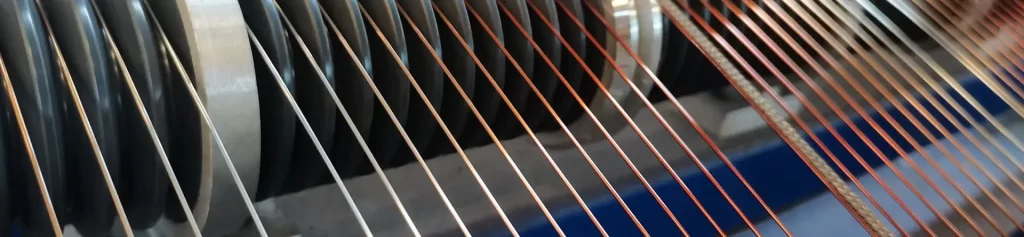
Paper-covered wire (PCW), as the core winding conductor in electromagnetic equipment such as transformers, instrument transformers, and reactors, has an insulation structure that is crucial in determining its electrical performance, mechanical strength, and service life. From a simple round copper wire to a seven-layer composite insulator, PCW integrates three major technical fields: conductor science, insulation materials science, and winding technology. This article systematically dissects PCW from the inside out and from the microscopic to the macroscopic perspective, breaking down its five structural levels, eight major components, three typical winding forms, and the technical details of the LNPU PCW product system. It provides transformer design engineers, enameled wire process engineers, and purchasers with a tangible and practical structural analysis guide.
I. Overview of Paper-Sheathed Wire Insulation Structure: 5 Major Levels and Core Positionin
1.1 5 Major Structural Levels (from inside to outside)
The insulation structure of paper-insulated wire is a multi-layered heterogeneous material composite, which can be divided into 5 main layers from the inside out:
| Layer | Name | Function | Key Parameters |
|---|---|---|---|
| L1 | Conductor | Conducts current, transfers heat, mechanical load bearing | Round wire 1.0–7.0 mm / Flat wire W 2.0–16.0 × T 0.8–5.6 mm |
| L2 | Enamel Film | Enhanced insulation, prevents copper ion migration, heat resistance | Thickness 0.02–0.06 mm (PEI / PAI / PI) |
| L3 | Inner Paper Tape | Basic insulation, turn-to-turn insulation, buffer layer | Thickness 0.05–0.13 mm, single or multiple layers |
| L4 | Outer Paper Tape | Main insulation, phase-to-phase insulation, ground insulation | Thickness 0.08–0.17 mm, single or multiple layers |
| L5 | End Treatment | Anti-loosening, stress release, creepage protection | Impregnating varnish / Insulating paint / Fiberglass binding |
1.2 Three Typical Winding Forms
Different transformer winding structures have different requirements for paper-insulated wire insulation:
- Layer Winding: Paper-insulated round copper wire, suitable for low-voltage windings ≤ 35 kV. – Disc Winding: Paper-insulated flat copper wire, suitable for high-voltage windings 35–500 kV. – Continuously Transposed Winding (CTC): Multi-strand enameled flat wire braid + integral paper sheath, suitable for high-current windings 110 kV and above.
1.3 Key Terminology Comparison
| Term | English | Explanation |
|---|---|---|
| Turn-to-turn Insulation | Turn-to-turn Insulation | Insulation between adjacent wire turns (thinnest) |
| Layer-to-layer Insulation | Layer-to-layer Insulation | Insulation between different winding layers |
| Ground Insulation | Ground Insulation | Insulation between winding and core/tank |
| Main Insulation | Main Insulation | Insulation between high and low voltage windings (thickest) |
| End Insulation | End Insulation | Anti-creepage, anti-corona at winding ends |
II. L1 Conductor Layer: round wire / flat wire / transposition / copper foil
2.1 Round Copper Conductor
- Diameter: 1.0–7.0 mm (commonly 1.5–4.0 mm) – Material: TU1 oxygen-free copper, purity ≥ 99.97% – Resistivity: ρ ≤ 0.017241 Ω·mm²/m (20°C) – Elongation: ≥ 25% (soft state) – Tensile Strength: 220–280 MPa – Applications: Low-voltage windings, layered windings, small-capacity transformers
2.2 Flat/Rectangular Copper Conductor
- Width W: 2.0–16.0 mm – Thickness T: 0.8–5.6 mm – Width/Thickness Ratio W/T: ≤ 8:1 (to prevent winding cracking) – Applications: Disc windings, high-current applications, 110 kV and above high-voltage windings – Advantages: 30–50% larger heat dissipation area than round wires for the same cross-sectional area
2.3 Round Aluminum Wire / Flat Aluminum Wire (Aluminum Conductor)
- Diameter/Specifications: Same as copper wire – Material: 1060/1350 pure aluminum – Resistivity: ρ ≤ 0.028264 Ω·mm²/m (20°C, approximately 1.65 times that of copper) – Advantages: Approximately 1/3 the weight and price of copper – Disadvantages: Low conductivity, requiring a larger cross-sectional area; low mechanical strength – Applications: Power distribution transformers, reactors, low-cost applications
2.4 Continuously Transposed Conductor (CTC)
CTC is a special conductor for high-current transformer windings:
- Structure: Precision braiding of multi-strand (typically 5–80 strands) enameled flat copper wire – Enamel coating per strand: 0.05–0.10 mm (PEI / PAI) – Inter-strand insulation: Enamel coating + partial insulation paper – Overall wrapping: 1–2 layers of 0.13 mm insulation paper – Advantages: – Significantly reduces eddy current losses (60–80%) – Improves winding space utilization (slot fill factor 80%+) – Strong short-circuit withstand capability – Applications: 500 kV and above ultra-high voltage power transformers, wind power transformers
2.5 Copper Foil
- Thickness: 0.10–0.50 mm – Width: 100–600 mm (depending on transformer capacity) – Insulation: Single/Double layer 0.10–0.13 mm cable paper – Advantages: Excellent heat dissipation, fast winding speed, high turn count accuracy – Applications: Low-voltage high-current windings, rectifier transformers, electric furnace transformers
III. L2 enamel coating layer: 5 major insulating varnish systems
3.1 The core function of enamel coating
enamel coating is the “second layer of defense” for paper-insulated thread:
- Enhanced Insulation: Fills tiny gaps at the paper tape overlaps. – Anti-Copper Ion Migration: Prevents copper ions from migrating and forming conductive channels under an electric field. – Paper Tape Bonding: Ensures a tight bond between the paper tape and the conductor. – Heat and Chemical Resistance: Depending on the enamel coating type, temperature resistance ranges from 105–220°C.
3.2 5 Commonly Used enamel coating Systems
| Enamel Type | Abbreviation | Temperature Class | Key Features | Application Scenarios |
|---|---|---|---|---|
| Polyvinyl Formal Enamel | PVF / Formvar | 105°C (A) | Easy to solder, good mechanical strength | General motors, transformers |
| Polyurethane Enamel | UEW | 130–155°C (B/F) | Direct solderable, low-temperature curing | Micro transformers, electronic transformers |
| Polyester Enamel | PEW | 155–180°C (F/H) | Heat-resistant, chemical-resistant | Medium-large motors, transformers |
| Polyesterimide Enamel | PEI | 180°C (H) | Thermal shock resistance, high mechanical strength | High-temperature motors, traction motors |
| Polyamide-imide Enamel | PAI / AIW | 200–220°C (C) | Softening breakdown resistance ≥ 330°C, radiation resistance, Freon resistance | Dry-type transformers, special motors |
| Polyimide Enamel | PI | 220–240°C (C+) | Ultimate high-temperature resistance, radiation resistance | Nuclear, military, aerospace |
3.3 enamel coating thickness and breakdown voltage
- 0.02 mm enamel coating: Breakdown voltage ≥ 800 V (single layer) – 0.04 mm enamel coating: Breakdown voltage ≥ 1500 V – 0.06 mm enamel coating: Breakdown voltage ≥ 2500 V – Double coating structure (e.g., PEI + PAI): Breakdown voltage can be stacked up to 4000 V+
3.4 Synergistic Effect of enamel coating and Paper Tape
- The enamel coating + paper tape composite structure increases the breakdown voltage from 1500 V for single materials to 5000–8000 V. – The enamel coating fills the tiny air gaps at the paper tape overlaps (preventing ionization). – The paper tape protects the enamel coating from mechanical damage during winding.
IV. L3 + L4 Paper Tape Layers: 4 Major Paper Patterns and Winding Process
4.1 Kraft Paper
4.1.1 Structure and Composition
- Raw Material: Sulfate-process softwood pulp – Thickness: 0.05 / 0.08 / 0.10 / 0.13 mm – Breakdown Voltage: 8–10 kV/mm – Temperature Resistance: 105°C (Grade A) – Moisture Content: ≤ 6% (at the time of manufacture) – Density: 0.7–0.9 g/cm³
4.1.2 Winding Method
- Overlap Rate: 30–50% (the percentage of overlapping portions between adjacent turns to the total width) – Wrapping Angle: Typically 80–90° (nearly perpendicular to the conductor axis) – Wrapping Tension: 0.5–2.0 N/cm – Wrapping Direction: Single-layer left-handed or multiple alternating layers
4.1.3 Typical Applications
- Low-voltage winding (≤ 1 kV): 1L 0.08 mm – Medium-voltage winding (10–35 kV): 2L 0.13 mm – Instrument transformer: 2L 0.05 mm Telephone paper
4.2 Cable Paper (High Voltage Cable Paper)
4.2.1 Structure and Composition
- Raw Material: 100% sulfate wood pulp + high-density pressing – Thickness: 0.08 / 0.13 / 0.17 mm – Breakdown Voltage: 10–14 kV/mm (increased to 14–18 kV/mm after oil impregnation) – Temperature Resistance: 105°C (Grade A) – Key Characteristics: High density (0.9–1.1 g/cm³), low permeability, no gas release in oil
4.2.2 Winding Method
- Overlap Rate: 40–60% (high voltage winding) – Wound Direction: Adjacent layers in opposite directions (odd layers left-handed, even layers right-handed) – Number of Layers: 2–4 layers for high voltage winding – Tension Control: 0.8–3.0 N/cm (high voltage requires tighter tension)
4.2.3 Typical Applications
- Oil-immersed transformer high-voltage windings (35 kV / 110 kV / 220 kV) – 35 kV: 2L 0.13 mm – 110 kV: 3L 0.13 mm – 220 kV: 3L 0.17 mm – 500 kV: 4L 0.17 mm
4.3 NOMEX Aramid Paper (DuPont T410 / T414)
4.3.1 Structure and Composition
- Chemical Structure: Poly(m-phenylene isophthalamide) (aromatic polyamide) – Thickness: 0.05 / 0.10 / 0.25 / 0.51 / 0.76 mm – Breakdown Voltage: 18–30 kV/mm – Temperature Resistance: 220°C (Class C, UL RTI 220) – Flame Retardancy Rating: UL 94 V-0 (self-extinguishing) – Key Properties: – Fully compatible with transformer oils, lubricants, and refrigerants – Radiation resistance (≥ 10⁶ Gy) – Tear and puncture resistance – Long-term thermal stability (≥ 20 years @ 220°C)
4.3.2 Winding Method
- Overlap Rate: 30–50% – Winding Tension: 1.0–3.0 N/cm – Special Treatment: NOMEX 410 is typically used with PI (enamel coating) or epoxy coating.
4.3.3 Typical Applications
- Dry-type transformers (SCB/SCR series) – Rail transit traction transformers – Wind power generation transformers – Explosion-proof transformers for mining – Nuclear power transformers
4.4 HPI-Green High-Power Insulation Paper
4.4.1 Structure and Composition
- Chemical Structure: Aromatic polyamide + mineral filler – Thickness: 0.25 / 0.50 / 0.76 mm – Temperature Resistance: 180–200°C (H/C grade) – Key Properties: High thermal conductivity (λ = 0.25 W/m·K), oil resistance, flame retardant
4.4.2 Typical Applications
- Dry-type transformer insulation cylinder – Dry-type transformer laminate – High power density reactor
4.5 Core Process Parameters for Paper Tape Winding
| Parameter | Meaning | Typical Value |
|---|---|---|
| Overlap Rate | Ratio of overlap between adjacent turns to paper tape width | 30–60% |
| Wrapping Angle | Angle between paper tape and conductor axis | 80–90° |
| Tension | Tension applied to paper tape during wrapping | 0.5–3.0 N/cm |
| End Fixation | Method of fixing paper tape ends | Adhesive / Heat sealing / Natural friction |
| Number of Layers | Number of paper tape layers | 1L / 2L / 3L / 4L |
4.6 Crepe Paper
- Structure: Cable paper mechanically pleated (30–50% elongation) – Characteristics: High elasticity, short-circuit impact resistance, and buffer against thermal expansion stress – Applications: End insulation of 110 kV and above oil-immersed transformer high and low voltage windings – Standard: T/CEC 202-2019
V. Composite Insulation Structures: 6 Typical Combinations
5.1 Paper-Insulated Bare Wire
- Structure: L1 conductor + L3 paper tape (without enamel coating) – Breakdown Voltage: 600–4500 V (depending on the number of paper layers) – Applications: Low-voltage oil-immersed transformer (≤ 1 kV), instrument transformer
5.2 Paper-Insulated Enameled Wire
- Structure: L1 conductor + L2 enamel coating + L3–L4 paper tape – Breakdown Voltage: 2000–8000 V – Applications: Medium-voltage oil-immersed transformer (10–35 kV), instrument transformer – LNPU Products: PCECW / PCEAW
5.3 Double Paper-Insulated
- Structure: L1 conductor + L3 inner paper layer + L4 outer paper layer – Breakdown Voltage: 3000–5000 V – Application: Medium and high voltage oil-immersed transformer (35 kV / 110 kV)
5.4 Triple Paper-Insulated
- Structure: L1 conductor + L3 inner layer + L4 middle layer + L4 outer layer – Breakdown Voltage: 4000–6000 V – Application: Ultra-high voltage oil-immersed transformer (220 kV / 500 kV)
5.5 NOMEX + enamel coating composite
- Structure: L1 conductor + L2 PI/PAI (enamel coating) + L3–L4 NOMEX 410 – Breakdown Voltage: 6000–12000 V – Applications: H/C class dry transformer, special transformers
5.6 Fiberglass + Paper Composite
- Structure: L1 conductor + L2 enamel coating + L3 fiberglass yarn + L4 insulating paper – Breakdown Voltage: 5000–10000 V – Applications: Class H 180°C dry-type transformer, wind power, traction
VI. L5 Endpoint Processing: 3 Key Technologies
6.1 The Core Role of End-Processing
- Prevents paper tape from fraying – Releases concentrated electric field at the ends (avoids creepage) – Improves mechanical strength (resistance to short-circuit electromagnetic forces) – Resistant to vibration and shock
6.2 Impregnating Varnish
- Common Types: Alkyd resin paint, epoxy resin paint, silicone paint, polyesterimide paint – Process: Vacuum pressure impregnation (VPI) → Drying and curing – Function: Fills the gaps between paper tapes, improving overall integrity and moisture resistance – Temperature Resistance: B / F / H grade (130 / 155 / 180°C)
6.3 End Binding
- Materials: Fiberglass tape / Polyester tape / Cotton tape – Process: 2–3 layers at the winding ends – Function: Resistant to short-circuit electromagnetic forces (radial force can reach 1000 N/cm² during a short circuit)
6.4 End Insulation Forming
- Process: Molded parts are made using NOMEX 410 / epoxy board / cardboard – Location: Winding end + support bar + electrostatic ring – Function: To uniformly distribute the electric field and prevent partial discharge
VII. Correspondence between Insulation Structures and transformer Types
7.1 Oil-immersed electric transformer
- Low-voltage winding: Paper-insulated enameled flat copper wire, 2L 0.13 mm cable paper – Medium-voltage winding: Paper-insulated enameled flat copper wire, 3L 0.13 mm cable paper – High-voltage winding: Paper-insulated enameled flat copper wire, 3L 0.17 mm high-voltage cable paper – Ends: Crepe paper + impregnation
7.2 Dry Transformer
- Low-voltage winding: NOMEX 410 paper-insulated flat copper wire, 1L 0.25 mm – High-voltage winding: NOMEX 410 + PI enamel coating, 2L 0.25 mm – Overall: VPI impregnation + resin casting
7.3 Current Inductors
- Primary Winding: Round copper wire + 2L 0.05 mm telephone paper – Secondary Winding: Round copper wire + 1L 0.08 mm cable paper – Overall: Vacuum drying + oil impregnation
7.4 Reactors
- Iron-core reactor: NOMEX 410 paper-insulated flat copper wire – Air-core reactor: NOMEX 410 + glass fiber composite – Shunt reactor: NOMEX 410 double-layer + resin casting
VIII. Key Performance Indicators of Insulation Structures
8.1 Electrical Performance
| Indicator | Single Paper | Double Paper | Triple Paper | NOMEX 410 |
|---|---|---|---|---|
| Breakdown Voltage | 600–1500 V | 2000–3000 V | 3500–4500 V | 5000+ V |
| Dielectric Loss tan δ | ≤ 0.005 | ≤ 0.003 | ≤ 0.002 | ≤ 0.002 |
| Partial Discharge | ≤ 10 pC | ≤ 5 pC | ≤ 3 pC | ≤ 3 pC |
8.2 Mechanical Properties
- Conductor Elongation: ≥ 25% (copper) / 15% (aluminum) – Tensile Strength: 220–280 MPa (copper soft state) – Paper Tape Peel Strength: ≥ 0.5 N/cm – Paper Tape Tensile Strength: ≥ 5 kN/m (transverse)
8.3 Aging Performance
- Thermal Aging Life: – Class A (105°C): ≥ 20 years – Class H (180°C): ≥ 15 years – Class C (220°C): ≥ 25 years – Aging Rate Rule: The aging rate doubles for every 6°C increase in hot spot temperature.
8.4 Geometric Dimensions
| Parameter | Round Wire | Flat Wire |
|---|---|---|
| Conductor Tolerance | ± 0.02 mm | ± 0.03 mm |
| Outer Diameter After Paper Wrapping | + 0.05 / – 0.02 mm | + 0.10 / – 0.05 mm |
| Roundness | ≤ 0.02 mm | – |
| Flatness | – | ≤ 0.05 mm / m |
IX. Key Processes and Quality Control
9.1 Wrapping Process
- Equipment: High-speed paper tape wrapping machine (2000–4000 rpm) – Environment: Temperature 20–28°C, Humidity ≤ 60% RH – Tension Control: Servo control 0.5–3.0 N/cm – Overlap Rate Control: Real-time monitoring by photoelectric sensors
9.2 Vacuum Pressure Impregnation (VPI)
- Pre-drying: 80–110°C / 100 Pa / 24–48 h – Vacuum impregnation: ≤ 50 Pa / 60–80°C / 6–12 h – Pressure impregnation: 0.5–0.8 MPa / 80–120°C / 2–4 h – Curing: 150–180°C / 8–16 h
9.3 Five Key Points of Quality Control
- Incoming Quality Control (IQC): Conductor diameter, tape thickness, moisture content, breakdown voltage. 2. In-Process Quality Control (IPQC): Tape overlap, tension, appearance, continuity. 3. Outgoing Quality Control (OQC): 100% inter-turn pulse test + sampling breakdown test. 4. Traceability: Each roll of wire includes batch number + furnace number + test report. 5. Third-Party Testing: UL / TÜV / Transformer Institute.
9.4 Typical Failure Modes
- Paper layer cracking/bubbling: Loose paper tape + insufficient drying before impregnation – Inter-turn short circuit: Damaged paper layer + accumulation of partial discharge – Insulation thermal aging: Hot spot temperature exceeds limit – Loose ends: Lack of end binding
X. Future Trends: Intelligentization and New Structures
10.1 Intelligent Structure
- Embedded Fiber Optic Temperature Measurement: Fiber optic cable is embedded within the paper-insulated wire to monitor hot spot temperatures in real time. – Stress Sensor Integration: Monitors the impact of short-circuit electromagnetic forces on the windings.
10.2 New Material Structures
- Nano-modified insulating paper: Adding SiO₂/TiO₂ nanoparticles increases breakdown voltage by 30–50%. – Bio-based insulating paper: Replacing traditional kraft paper, reducing carbon footprint by 30%. – Low dielectric loss polyimide film: Composite with NOMEX, tan δ ≤ 0.001.
10.3 Novel Structural Forms
- 3D Printed Continuously Transposed Conductors: Complex winding structures are formed in one step. – Pre-preg Paper Wire: Paper tape is pre-impregnated with resin, and then directly thermo-pressed after winding.
XI. Conclusion: The “Four-Dimensional Balance” of Paper-Sheathed Wire Insulation Structure
The design of paper-insulated wire is essentially a four-dimensional balance of “electrical + mechanical + thermal + economic”:
- Electrical Dimension: Breakdown voltage, PD, tanδ – Mechanical Dimension: Short circuit withstand, vibration withstand, shock withstand – Thermal Dimension: Thermal class, thermal aging life – Economic Dimension: Material cost, processing cost, operating cost
Different transformer types correspond to different structural combinations:
- Oil-immersed power transformer: Enamelled coating + multi-layer cable paper + impregnation (Class A) – Dry transformer: Enamelled PI coating + multi-layer NOMEX 410 + VPI (Class H/C) – Instrument transformer: Telephone paper + cable paper (Class A) – Special transformer: NOMEX + glass fiber + composite material (Class H/C)
Understanding the 5 main layers, 8 main components, and 3 winding types of paper-insulated wire is the first step in designing a reliable transformer.
XII. Detailed Explanation of LNPU Paper-Wrapped Wire Product Structure
12.1 LNPU 7 Large product line
| Product Line | Conductor | Enamel | Paper Tape | Breakdown Voltage | Temperature | Typical Application |
|---|---|---|---|---|---|---|
| PCECW (Paper-Covered Enameled Round Copper) | Round copper 1.0–7.0 mm | PEI / PAI | 1–3L 0.05–0.13 mm | 2000–8000 V | 180–220°C | Oil-immersed / dry-type transformer |
| PCEAW (Paper-Covered Enameled Round Aluminum) | Round aluminum 1.0–7.0 mm | PEI | 1–3L 0.05–0.13 mm | 2000–6000 V | 180°C | Distribution transformer |
| PCEFW (Paper-Covered Enameled Flat Copper) | Flat copper 2.0–16.0 mm | PEI / PAI | 1–3L 0.08–0.17 mm | 3000–12000 V | 180–220°C | High-voltage transformer |
| PCEFAW (Paper-Covered Enameled Flat Aluminum) | Flat aluminum 2.0–16.0 mm | PEI | 1–3L 0.08–0.17 mm | 3000–8000 V | 180°C | Low-cost transformer |
| NOMEX Paper-Covered Flat Copper | Flat copper 2.0–16.0 mm | PI | 1–2L 0.25 mm NOMEX | 6000–12000 V | 220°C | Dry-type transformer |
| Fiberglass Paper-Covered Flat Copper 180°C | Flat copper 2.0–16.0 mm | PEI + Fiberglass yarn | 1L 0.13 mm cable paper | 5000–10000 V | 180°C | H-class dry-type transformer |
| CTC Continuously Transposed Conductor | Multi-strand flat copper | PEI / PAI | Overall 1L 0.13 mm paper | 6000+ V | 180–220°C | 500 kV transformer |
12.2 LNPU Process Advantages
- Fully Automated Tape Wrapping: Overlap Accuracy ± 2% – Servo Tension Control: Continuously Adjustable from 0.5 to 3.0 N/cm – Vacuum Pressure Impregnation (VPI): Temperature Resistance Up to H/C Grade – 100% Inter-Turbocharged Pulse Test: 100% Factory Testing – Complete UL / TÜV / CE / RoHS Certifications
12.3 Selection Recommendations
- 35 kV Oil-Immersed Transformer: PCECW (Round Copper 1.5–3.0 mm + 2L 0.13 mm Cable Paper) – 110 kV Oil-Immersed Transformer: PCEFW (Flat Copper 2.0×5.0 mm + 3L 0.13 mm High-Voltage Cable Paper) – Dry-Type Distribution Transformer: NOMEX Paper-Sheathed Flat Copper (2.0×4.0 mm + 2L 0.25 mm NOMEX 410) – Rail Transformer: Fiberglass Paper-Sheathed Flat Copper Class 180 (2.0×6.3 mm + 1L 0.13 mm Paper + Fiberglass Yarn)
XIII. Typical Case Analysis: Disassembly of Insulation Structures in 3 Real-World Scenarios
13.1 Case 1: Disassembly of the insulation structure of a 110 kV oil-immersed transformer winding
Project Background: 50 MVA oil-immersed power transformer, 110 kV high-voltage side winding.
Overall Performance: – Total insulation thickness: 0.45 mm (enamel coating + 3 layers of paper) – Overall breakdown voltage: ≥ 6000 V – Design insulation level: LI 480 kV / AC 200 kV – Partial discharge: ≤ 10 pC (at 1.5 × 110 / √3 = 95.3 kV) – Expected life: ≥ 30 years
Why 3-layer paper wrapping? – Single-layer paper wrapping (0.13 mm): Breakdown voltage 1500 V, insufficient to withstand 110 kV. – Double-layer paper wrapping (0.26 mm): Breakdown voltage 3000 V, still insufficient. – Triple-layer paper wrapping (0.39 mm): Breakdown voltage 4500 V+, plus 1500 V from the enamel coating, totaling 6000 V+.
13.2 Case 2: Disassembly of the Insulation Structure of a 2.5 MVA Dry-Type Transformer Winding
Project Background: 2.5 MVA dry-type transformer for subway traction substation, 35 kV / 1.18 kV.
Insulation Structure Layers (High Voltage Side)
Overall Performance: – Total insulation thickness: 0.54 mm – Overall breakdown voltage: ≥ 8000 V – Thermal class: H (180°C) – Flame retardancy: UL 94 V-0 – Short circuit withstand: No deformation after 0.5 s of 8 times rated current.
Why choose PI (enamel coating) + NOMEX 410? – PI (enamel coating) has a temperature resistance of 220°C+, far exceeding the hotspot temperature of dry-type transformers. – NOMEX 410 is UL certified at 220°C and is flame-retardant. – The composite structure has a breakdown voltage of 8000 V+, 1.6 times that of single-layer NOMEX.
13.3 Case 3: Disassembly of the insulation structure of a 500 kV ultra-high voltage transformer CTC
Project Background: 1000 MVA ultra-high voltage power transformer, with CTC used in the low-voltage winding.
CTC insulation structure:
Overall Performance: – Single-strand breakdown voltage: ≥ 2500 V – Overall breakdown voltage: ≥ 6000 V – Eddy current loss reduction: 60–80% (compared to multiple independent flat wires) – Slot fill factor: ≥ 80% – Short circuit withstand: 15 times rated current peak at 0.25 s without deformation
Why use CTC? – High current applications (1000 MVA, low-voltage side current up to 10000 A) – Significantly reduces eddy current losses (at high frequencies) – Enhances winding mechanical strength (multi-strand braiding disperses stress)
XIV. Frequently Asked Questions (FAQ)
14.1 Paper-insulated wire vs. enameled wire: What are the differences in insulation structure?
| Dimension | Enameled Wire | Paper-Covered Wire |
|---|---|---|
| Insulation Layer | Single enamel film (0.02–0.06 mm) | Multi-layer paper tape (0.05–0.50 mm) |
| Breakdown Voltage | 600–2500 V | 600–6000 V |
| Temperature Resistance | 105–240°C (depends on enamel) | 105–220°C (depends on paper type) |
| Cost | Medium | Low–Medium |
| Typical Application | Motors, transformers, relays | Transformers, instrument transformers, reactors |
14.2 Why is paper-wrapped thread “wrapped” instead of “coated”?
Enamelled Coating vs. Paper Tape Coating: – Enamelled Coating: Liquid enamel is applied and then cured to form a continuous thin film (0.02–0.06 mm). – Paper Tape Coating: Solid paper tape is wound around to form a laminated structure (0.05–0.50 mm). – Advantages of Paper Tape Coating: – Breakdown voltage can be stacked (multi-layer) – Easy maintenance (single-layer damage can be replaced) – Better heat dissipation (air gaps between paper tapes) – Lower cost (especially in high-voltage applications)
14.3 Why do the paper tapes overlap instead of being side by side?
Advantages of overlapping winding (overlap rate 30–60%): – Avoids gaps: Side-by-side winding can create tiny air gaps, leading to ionization. – High breakdown voltage: Double layers at the overlap result in superimposed breakdown voltages. – Resistant to mechanical damage: Overlap provides redundant protection. – Moisture and oil resistant:** Double seal at the overlap.
14.4 Why should the paper tape winding direction be “odd and even opposite”?
Advantages of Odd/Even Reverse Wrapping: – Avoids Interlayer Slippage: Reverse wrapping increases friction, preventing interlayer misalignment. – Disperses Electric Field: Reverse paper tape forms an “S”-shaped electric field path, extending the creepage distance. – High Mechanical Strength: Reverse wrapping provides an “interlocking” structure. – Resistant to Short-Circuit Electromagnetic Force: Bidirectional frictional constraint.
14.5 Does paper-insulated wire breakdown occur between paper layers or between paper layers?
Breakdown typically occurs in: – Inside the paper layer: Pinholes, impurities, excessive moisture content – Between paper layers: Air gaps at overlaps, insufficient impregnation – At the paper ends: Concentrated electric field at the ends
Countermeasures: – 100% inter-turn pulse testing – Vacuum impregnation to eliminate air gaps – Dispersing the electric field through end-crease paper – Factory moisture content ≤ 6%
14.6 Can paper-wrapped thread be made into a circle?
Yes—Round wire is the most common form of paper-insulated wire: – Round copper wire 1.0–7.0 mm, wrapped with 1–3 layers of paper – Similar to round aluminum wire – Used in layered windings and low-voltage windings
14.7 Why are the breakdown voltages of paper-insulated wires superimposed?
Principle of Breakdown Voltage Superposition: – Paper tape breakdown voltage = 8–10 kV/mm – 3 layers of 0.13 mm paper = 0.39 mm thickness – Theoretical breakdown voltage = 8 × 0.39 = 3120 V – Actual breakdown voltage (including losses) = Theoretical × 0.5–0.7 = 1560–2184 V/layer – Superposition of multiple layers ≈ Sum of the independent breakdown voltages of each layer
Conditions: No air gaps between layers, and thorough impregnation.
14.8 Why can’t paper-wrapped thread be used in an environment with 100% humidity?
The Effects of Humidity on Paper-Wrapped Wire: – Increased moisture content in the paper layer → Reduced breakdown voltage by 30–50% – Moisture vaporization produces bubbles → Partial discharge – Long-term operation → Accelerated aging
Solutions: – Store in an environment with humidity ≤ 60% RH – Vacuum dry before use – For oil-immersed transformers, use transformer oil for direct isolation.
14.9 Can paper-insulated thread be used in environments above 200°C?
Can be used with NOMEX T410 aramid paper: – Temperature resistance 220°C (Class C) – UL certified 220°C RTI – Breakdown voltage 18–30 kV/mm – Flame retardant UL 94 V-0 – Fully compatible with transformer oil
14.10 How to choose between “double-layer” and “triple-layer” paper-wrapped thread?
Selection Rules: – ≤ 1 kV: Single-layer paper sheath (low voltage) – 10–35 kV: Double-layer paper sheath (medium voltage) – 110 kV: Triple-layer paper sheath (high voltage) – 220 kV: Triple-layer 0.17 mm high-voltage paper (ultra-high voltage) – 500 kV: Quadruple-layer 0.17 mm + crepe paper (extra-high voltage)
XVI. LNPU Process Details: Full-Process Quality Control from Conductor to Finished Product
16.1 Conductor Pretreatment
- Drawing: TU1 oxygen-free copper rod → round wire die drawing (single-pass diameter reduction 20–25%) – Annealing: Continuous annealing furnace, 450–600°C / 0.5–2 s, to eliminate work hardening – Surface Treatment: Micro-pickling (to remove oxide layer) + Lubricant application – Online Inspection: 100% diameter measurement (accuracy ± 0.001 mm) + resistivity sampling
16.2 enamel coating (enameled wire process)
- Coating Method: Mold or Felt coating – Coating Coats: 6–12 coats (each coat 0.005–0.010 mm thick) – Curing Temperature: 400–500°C (vertical or horizontal enameling machine) – Online Inspection: 100% pinhole test (≤ 5 pins/30 m)
16.3 Paper Tape Wrapping
- Equipment: High-speed vertical wrapping machine (2000–4000 rpm) – Paper tape width: 6–25 mm (depending on conductor specifications) – Overlap control: Servo motor + encoder, accuracy ± 2% – Tension control: Magnetic powder clutch/servo tensioner, 0.5–3.0 N/cm – End treatment: Automatic cutting + adhesive fixing/heat fusion
16.4 Impregnation and Curing (VPI / Immersion)
- Pre-drying: 80–110°C / 100 Pa / 24–48 h – Vacuum impregnation: ≤ 50 Pa / 60–80°C / 6–12 h – Pressure impregnation: 0.5–0.8 MPa / 80–120°C / 2–4 h – Curing: 150–180°C / 8–16 h (staged temperature increase) – Environmental cleanliness: Class 10,000 (requirements for some dry transformer processes)
16.5 100% Factory Inspection Items
- Conductor Diameter: 100% Laser Diameter Measurement – Paper Tape Outer Diameter: 100% Laser Diameter Measurement – Inter-turn Pulse: 100% (Standard 1500–3000 V) – Breakdown Voltage: Sampling (5–10% per batch) – Moisture Content: Sampling (≤ 6%) – Appearance: 100% Visual Inspection
16.6 Third-Party Authentication
- UL: UL 1446 / UL 94 V-0 (North American market) – TÜV: EN 61558 / EN 60950 (European market) – CE: EN standard compliance – RoHS / REACH: Environmental directive compliance – Transformer Research Institute: Shenyang Transformer Institute / Xi’an High Voltage Apparatus Research Institute / Electric Power Industry Electrical Equipment Quality Inspection and Testing Center
| Term | English | Explanation |
|---|---|---|
| PCW | Paper Covered Wire | Paper-covered winding wire |
| PCECW | Paper Covered Enameled Copper Wire | Paper-covered enameled copper wire |
| PCEAW | Paper Covered Enameled Aluminum Wire | Paper-covered enameled aluminum wire |
| PEI | Polyesterimide | Polyesterimide enamel film (H-class 180°C) |
| PAI / AIW | Polyamide-imide | Polyamide-imide enamel film (C-class 220°C) |
| PI | Polyimide | Polyimide enamel film (C+-class 220–240°C) |
| NOMEX | – | DuPont aramid paper trade name |
| CTC | Continuously Transposed Conductor | Continuously transposed conductor |
| VPI | Vacuum Pressure Impregnation | Vacuum pressure impregnation |
| tan δ | Dielectric Dissipation Factor | Dielectric loss tangent |
| PD | Partial Discharge | Partial discharge |
| LI | Lightning Impulse | Lightning impulse withstand voltage |
| AC | Alternating Current Withstand | AC withstand voltage |
| Kraft Paper | – | Kraft paper (sulfate pulp paper) |
| Cable Paper | – | Cable paper |
| DMD | Dacron-Mylar-Dacron | Polyester fiber + polyester film composite paper |
| NMN | Nomex-Mylar-Nomex | NOMEX + polyester film composite paper |
| Crepe Paper | – | Crepe paper (creped cable paper) |
About LP Winding Wire (LNPU)
LNPU boasts over 30 years of experience in transformer winding wire manufacturing, specializing in the research and production of paper-insulated wire, enameled wire, fiberglass-insulated wire, and continuously transposed conductors (CTC). The factory is equipped with imported German high-speed winding machines, servo tension control systems, and vacuum pressure impregnation (VPI) equipment, enabling the production of products meeting all standards including IEC 60317, NEMA MW 1000, and GB/T 7673. LNPU also provides one-stop services for customization and technical agreements.