

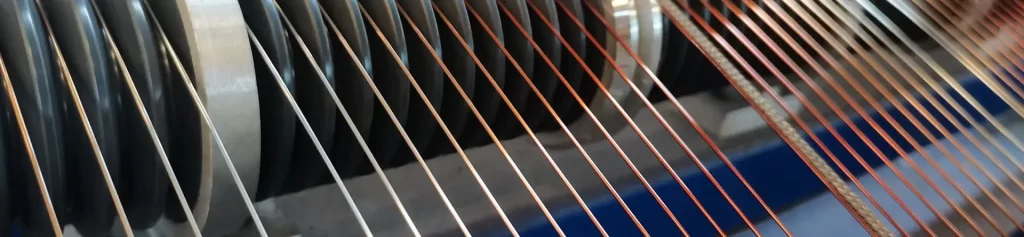
Transformers are the “heart” of power systems, and paper-covered wire (PCW) is one of the core insulation materials for both oil-immersed and dry-type transformer windings. From low-voltage distribution transformers (0.4 kV) to ultra-high-voltage power transformers (1000 kV), from residential power distribution to special transformers such as electric furnaces, traction, and rectification, paper-covered wire has long held a dominant position as the mainstream transformer winding insulation material due to its advantages such as oil-immersion compatibility, controllable cost, and selectable temperature resistance (105°C / 130°C / 155°C / 180°C / 200°C / 220°C).
I. Introduction: Why Paper-Insulated Wire Remains the Mainstream Insulation for Transformer Windings
1.1 The role of paper-insulated thread in transformer
In a transformer structure, the winding is the “heart of the heart”—directly responsible for the three core tasks of voltage establishment, energy transfer, and short-circuit withstand. The choice of insulated wire (magnet wire/winding wire) for the winding determines the transformer’s insulation class, life curve, overload capacity, and manufacturing cost. Paper-insulated wire is a winding wire made of round or flat copper wire as the conductor, wrapped with one or more layers of insulating paper tape. An enamel coating (enamel + paper composite structure) can be added to enhance overall performance.
1.2 Core Advantages of Paper-Insulated Wire Compared to Enameled Wire / Fiberglass-Insulated Wire
- Fully Transformer Oil Compatible: The kraft paper/cable paper/Nomex aramid paper used in paper-insulated wire does not precipitate or produce gas in Transformer oil, ensuring no oil contamination during long-term operation. – High and Stackable Breakdown Voltage: Single-layer 0.05–0.13 mm kraft paper has a breakdown voltage of 600–1500 V; multi-layer (double/triple) windings have linearly stacked breakdown voltages. – significantly Lower Price Than Enameled/Fiberglass: Under the same conductor specifications, paper-insulated wire costs 20–50% more than pure enameled wire but 30–60% less than fiberglass-insulated wire. – Mature Winding Technology: Continuous, spiral, disc, and layered windings can all be used.
1.3 Five Typical Application Scenarios
II. Core Structure and Material System of Paper-Insulated Wire
| No. | Application Scenario | Main Insulation Paper Type | Typical Temperature Resistance |
|---|---|---|---|
| 1 | Oil-immersed power transformer (10–500 kV) | Cable paper + High-voltage cable paper | 105°C (Class A) |
| 2 | Dry-type transformer (resin casting/impregnation) | NOMEX 410 / HPI-Green | 180–220°C (Class H / Class C) |
| 3 | Instrument transformer (CT / PT / CVT) | Telephone paper + Cable paper | 105–130°C |
| 4 | Reactor (current limiting / filtering / parallel connection) | NOMEX 410 / DuPont paper | 155–180°C |
| 5 | Special transformer (electric furnace / traction / rectification) | Composite paper + NOMEX | 155–220°C |
2.1 Conductors: round wire / flat wire / copper / aluminum
Paper-insulated wire conductors can be divided into two categories: round wire and flat wire.
- Round wire: Diameter 1.0–7.0 mm, suitable for layered windings, low-voltage windings, and small-capacity transformers. – Flat wire: Width 2.0–16.0 mm, thickness 0.8–5.6 mm, suitable for disc windings, high-voltage windings, and large-capacity transformers. – Materials: Oxygen-free copper rod (TU1 / TU2), electrical round aluminum rod (1060 / 1350). Aluminum wire costs approximately 1/3 the price of copper wire and weighs approximately 1/2 the weight.
Key Note: Flat wire windings offer significantly better heat dissipation performance than round wire windings in high-current applications, but require more sophisticated winding processes.
2.2 Insulation Structure: Three Typical Combinations
| Structure | Composition | Application Scenario | Breakdown Voltage |
|---|---|---|---|
| Paper-Insulated Bare Wire | Conductor + 1–3 layers of paper tape | Low-voltage winding | 600–4500 V |
| Paper-Insulated Enameled Wire | Conductor + enamel film + 1–2 layers of paper tape | Medium-voltage winding, instrument transformer | 2000–8000 V |
| Composite Insulation (paper + enamel + fiberglass) | Conductor + enamel film + paper tape + fiberglass | Dry-type transformer, special transformer | 5000–12000 V |
2.3 Insulating Paper Materials: Four Main Types
2.3.1 Kraft Paper
- Thickness: 0.05–0.13 mm – Breakdown Voltage: 8–10 kV/mm – Temperature Resistance: 105°C (Class A) – Price: Low (≈ 30–50 RMB/kg) – Applications: Oil-immersed power transformer low-voltage windings, instrument transformers
2.3.2 Cable Paper (High Voltage Cable Paper)
- Thickness: 0.08–0.17 mm – Breakdown Voltage: 10–14 kV/mm – Temperature Resistance: 105°C (Class A) – Features: High density, low permeability, minimal gas evolution in oil – Applications: Oil-immersed power high-voltage windings (35 kV / 110 kV / 220 kV)
2.3.3 NOMEX Aramid Paper (DuPont T410 / T414)
- Thickness: 0.05–0.76 mm – Breakdown Voltage: 18–30 kV/mm – Temperature Resistance: 220°C (Class C, UL certified up to 220°C) – Price: High (≈ 600–1200 RMB/kg) – Features: Oil resistant, radiation resistant, flame retardant (UL 94 V-0), fully compatible with transformer oil – Applications: Dry-type transformers, reactors, rail traction transformers, wind turbines
2.3.4 HPI-Green / Marker Paper
- HPI-Green: High-power insulating paper, 180–200°C, suitable for dry-type transformer insulation cylinders and laminates. – Mark Paper: Thin (0.05 mm) marking paper for marking the start and end points of windings.
2.4 Number of Paper Layers and Insulation Thickness
- Single-layer paper sheath: Insulation thickness 0.05–0.13 mm, breakdown voltage 600–1500 V (low voltage) – Double-layer paper sheath: Insulation thickness 0.16–0.30 mm, breakdown voltage 2000–3000 V (medium voltage) – Triple-layer paper sheath: Insulation thickness 0.24–0.50 mm, breakdown voltage 3500–4500 V (high voltage)
The dimensional increment (mm) caused by paper tape wrapping shall meet the requirements of IEC 60317: tolerance of -100% when single-layer increment is ≤ 0.50 mm; -7.5% when increment is 0.50–1.25 mm; and -50% when increment is > 1.25 mm.
III. transformer Classification and Paper Wire Selection Strategy
3.1 Oil-Immersed Power Transformer
Oil-immersed transformers are the mainstay of the power grid, with single-unit capacities ranging from 50 kVA to 1000 MVA, and voltage levels covering 10 kV – 1000 kV.
- Insulation Class: Class A (105°C), made of transformer oil with insulating paper. – Main Paper Types: Cable paper, high-voltage cable paper. – Typical Selections: – Low-voltage winding (≤ 1 kV): Paper-insulated enameled round copper wire, 1 layer of 0.08 mm cable paper. – Medium-voltage winding (10–35 kV): Paper-insulated enameled flat copper wire, 2 layers of 0.13 mm cable paper. – High-voltage winding (110–500 kV): Paper-insulated enameled flat copper wire, 3 layers of 0.13 mm high-voltage cable paper. – Key Standards: GB/T 1094.2 (Oil-immersed transformer temperature rise), IEC 60076-2, IEC 60317-27 (Aluminum wire) / IEC 60317-27-2 (Round aluminum).
3.2 Dry-Type Transformer
Dry transformers use air or solid resin as the insulating medium and are commonly found in high-fire-resistance environments such as buildings, subways, airports, and mines.
- Insulation Classes: Class F (155°C), Class H (180°C), Class C (200°C) – Main Paper Types: NOMEX 410/414, PI film – Typical Selections: – Distribution type (≤ 2500 kVA): NOMEX 410 single-layer paper-insulated round/flat copper wire – Power type (2500 kVA–10 MVA): NOMEX 410 double-layer paper-insulated flat copper wire – Special dry-type (e.g., tunnel boring machines, subways): NOMEX 410 + fiberglass composite insulation – Key Standards: IEC 60076-11, GB/T 1094.11, IEEE C57.12.01
3.3 Current Transformers (CT / PT / CVT)
Instrument transformers are key equipment for metering and protection in power systems, requiring high precision, high stability, and long lifespan.
- Insulation Class: Class A (Oil-Immersed CT/PT) / Class BE (Dry Type) – Dominant Paper Type: Telephone Paper + Cable Paper / NOMEX – Typical Selection: – Oil-immersed CT below 35 kV: 0.5–2.5 mm round copper wire, 2 layers of 0.05 mm telephone paper – 110 kV Oil-immersed CT: 1.6 × 4.0 mm flat copper wire, 2 layers of 0.08 mm cable paper – Dry-type CT/PT: NOMEX 410 single-layer paper sheath – Key Parameters: Turn-to-turn insulation, creepage distance, secondary impedance matching
3.4 Reactors (Current Limiting/Filtering/Parallel/Arc Suppression Coil)
Reactors operate under high current for extended periods, making heat dissipation a key challenge.
- Insulation Class: F / H / C – Main Paper Type: NOMEX 410 / DuPont Paper / Fiberglass Paper Composite – Typical Selections: – Dry-core Reactors: NOMEX 410 Paper-insulated Flat Copper Wire – Air-core Reactors: NOMEX 410 + Fiberglass Composite – Shunt Reactors (500 kV and above): NOMEX 410 Double Layer + Resin Casting – Key Standards: IEC 60076-6, GB/T 1094.6
IV. Key Performance Indicators and Acceptance Parameters
4.1 Electrical Performance
4.1.1 Breakdown Voltage
- Single-layer 0.05 mm kraft paper: ≥ 600 V – Single-layer 0.08 mm cable paper: ≥ 1000 V – Single-layer 0.13 mm cable paper: ≥ 1500 V – Single-layer 0.25 mm NOMEX 410: ≥ 5000 V
4.1.2 Dielectric Loss Tangent (tan δ)
- Dry cable paper: tan δ ≤ 0.005 (50 Hz) – Oil-impregnated cable paper: tan δ ≤ 0.003 (50 Hz) – The lower this value, the lower the no-load loss and reactive power loss of the transformer.
4.1.3 Partial Discharge (PD)
- Oil-immersed transformer windings: ≤ 10 pC (at 1.5 times rated voltage) – Dry-type transformers: ≤ 5 pC
4.2 Mechanical Properties
- Conductor elongation (round wire): ≥ 25% (copper) / 15% (aluminum) – Conductor tensile strength: 220–280 MPa (copper, soft state) – Paper tape tightness: Visually free of curling and wrinkles; peel strength ≥ 0.5 N/cm
4.3 Chemical and Aging Properties
- Transformer Oil Compatibility: Breakdown voltage drop ≤ 10% after aging at 85°C / 168 h. – Moisture Content (at factory): ≤ 6% (kraft paper/cable paper). – Thermal Aging Life: Class A (105°C) 20 years of continuous operation; Class H (180°C) 15+ years of continuous operation.
V. Standards System and Procurement Specifications
5.1 International Standards
| Standard | Scope | Remark |
|---|---|---|
| IEC 60317-0-1:2013 | General requirements for round copper winding wire | Benchmark for all paper-covered round copper wire |
| IEC 60317-0-2 | General requirements for round aluminum winding wire | – |
| IEC 60317-0-3:2008 + AMD1:2013 | Round aluminum winding wire (before paper covering) | Nominal diameter 0.5–5.0 mm |
| IEC 60317-27 / 27-2 | Paper tape covered round aluminum winding wire | Specifically for oil-immersed transformers |
| IEC 60317-56 | FIW fully insulated defect-free enameled wire | – |
| IEC 60554-1 / 60554-3-5 | Specification for electrical insulating paper materials | Benchmark for paper-based materials |
| NEMA MW 1000-2018 | American comprehensive magnet wire standard | Includes paper-covered aluminum (220°C) |
| IEEE C57.12.00 / C57.12.01 | Dry-type / liquid-immersed transformer | – |
5.2 National/Industry Standards
| Standard | Scope | |——|——| | GB/T 1094.1–11 | Electrical Transformer (Capacity/Temperature Rise/Insulation Level/Dry Type) | | GB/T 7673.1–3 | Paper-Insulated Round Copper/Round Aluminum/Flat Wire Windings | | GB/T 19290.1 | Dry Type Transformer NOMEX Paper-Insulated Wire (Reference) | | T/CEC 202-2019 | Guidelines for Selecting Corrugated Insulation Paper for Oil-Immersed Electrical Transformers | | JB/T 6302 / 8740 | Technical Conditions for Paper-Insulated Wire for Transformers |
| Standard | Scope |
|---|---|
| GB/T 1094.1–11 | Power transformer (capacity / temperature rise / insulation level / dry-type) |
| GB/T 7673.1–3 | Paper-covered round copper / aluminum / flat wire winding wire |
| GB/T 19290.1 | Dry-type transformer NOMEX paper-covered wire (reference) |
| T/CEC 202-2019 | Selection guide for crepe insulating paper used in oil-immersed power transformers |
| JB/T 6302 / 8740 | Technical conditions for paper-covered wire used in transformers |
5.3 Procurement Acceptance Checklist (PO Template)
- Conductor Specifications: Round wire diameter / Flat wire diameter (W × T) (mm)
- Conductor Material: TU1 oxygen-free copper / 1060 aluminum / 1350 aluminum
- Insulating Paper Type: Kraft paper / Cable paper / High voltage paper / NOMEX 410 / HPI-Green
- Number of Paper Layers and Thickness: 1L / 2L / 3L, 0.05–0.13 mm per layer
- Thermal Class: A (105°C) / E (120°C) / B (130°C) / F (155°C) / H (180°C) / C (200°C) / 220°C
- Breakdown Voltage: Single layer / Overall minimum
- Geometric Tolerance: Conductor + outer diameter after paper wrapping
- Roll Specifications: 30–150 kg 250500 / 250600 Wooden Pallets
- Standards: IEC / GB / NEMA / Bilateral Agreement
- Certifications: UL / CE / RoHS / REACH (Export Market)
VI. Paper-insulated Wire Selection Decision Process
6.1 Five-Step Selection Method
Step 1: Determine the transformer type (oil-immersed/dry-type/current transformer/reactor/special type) ↓
Step 2: Determine the voltage level (low voltage ≤ 1 kV / medium voltage 10–35 kV / high voltage 110–500 kV) ↓
Step 3: Select the thermal class (A / E / B / F / H / C) ↓
Step 4: Select the insulation paper type (kraft paper / cable paper / high voltage paper / NOMEX / HPI-Green) ↓
Step 5: Determine the conductor specifications (round / flat / copper / aluminum)
6.2 Selection Decision Table
| Transformer Type | Voltage Level | Recommended Paper Type | Temperature Class | Recommended Conductor |
|---|---|---|---|---|
| Oil-immersed Distribution | ≤ 1 kV | 1L 0.08 mm Cable paper | 105°C (A) | Round copper / round aluminum |
| Oil-immersed Distribution | 10 kV | 2L 0.13 mm Cable paper | 105°C (A) | Round copper |
| Oil-immersed Power | 35 kV | 2L 0.13 mm HV paper | 105°C (A) | Flat copper |
| Oil-immersed Power | 110 kV | 3L 0.13 mm HV paper | 105°C (A) | Flat copper |
| Oil-immersed Power | 220–500 kV | 3L 0.17 mm HV paper | 105°C (A) | Flat copper |
| Dry-type Distribution | ≤ 1 kV | 1L 0.25 mm NOMEX 410 | 155–180°C (F/H) | Round copper / round aluminum |
| Dry-type Power | 10–35 kV | 2L 0.25 mm NOMEX 410 | 180°C (H) | Flat copper |
| Instrument Transformer | ≤ 35 kV | 2L 0.05 mm Telephone paper | 105°C (A) | Round copper |
| Reactor | 10–110 kV | 1L 0.25 mm NOMEX 410 | 155–180°C (F/H) | Flat copper |
| Rectifier / Furnace Transformer | 10–35 kV | 2L 0.25 mm NOMEX 410 | 180–200°C (H/C) | Flat copper |
| Traction Transformer | 25 kV | 2L 0.25 mm NOMEX 410 + Fiberglass | 180°C (H) | Flat copper |
| Wind Power Transformer | 0.69–35 kV | 2L 0.25 mm NOMEX 410 | 180–220°C (H/C+) | Flat copper |
6.3 Cost and Performance Balance
- Cost Priority: aluminum conductor + kraft paper + oil-impregnated design (lowest cost, 20+ years lifespan) – Performance Priority: copper conductor + NOMEX 410 + dry design (highest cost, flame retardant + short-circuit resistant + 25+ years lifespan) – Balanced Solution: copper conductor + cable paper + oil impregnation (balances cost and reliability)
VII. Typical Failure Modes and Quality Control
7.1 Three Typical Failure Modes
7.1.1 Paper layer cracking/bubbling
- Phenomenon: Localized blistering and cracking of the paper layer after oil impregnation of the winding – Causes: (1) Loose paper tape wrapping; (2) Insufficient drying before impregnation; (3) Excessive moisture content of the transformer oil – Solutions: Paper tape wrapping tightness ≥ 0.5 N/cm; Vacuum drying before impregnation ≤ 100 Pa / 80°C / 24 h
7.1.2 Inter-turn short circuit
- Phenomenon: Inter-turn breakdown occurs during high-voltage testing or operation – Causes: (1) Paper layer damage (scratches during winding); (2) Long-term accumulation of partial discharge; (3) Failure of double insulation of the paper layer (enamel coating) – Countermeasures: Paper tape overlap rate ≥ 30%; 100% inter-turn pulse test; PD test ≤ 10 pC
7.1.3 Thermal Aging of Insulation
- Phenomenon: After long-term operation, breakdown voltage decreases and oil quality deteriorates. – Causes: Hot spot temperature exceeds design limits (Class A 105°C, Class H 180°C); for every 6°C increase in hot spot temperature, the aging rate doubles. – Solutions: Real-time monitoring with fiber optic temperature measurement; online oil chromatography monitoring; controlling the load rate ≤ 0.8.
7.2 Five Key Points of Quality Control
- Incoming Quality Control (IQC): Conductor diameter, tape thickness, moisture content, breakdown voltage. 2. In-Process Quality Control (IPQC): Tape overlap, tightness, appearance, continuity. 3. Outgoing Quality Control (OQC): 100% inter-turn pulse test + sampling breakdown test. 4. Traceability: Each roll of wire is accompanied by batch number + furnace number + test report. 5. Third-Party Testing: UL / TÜV / Transformer Institute (Shenyang Transformer Institute / Xi’an High Voltage Apparatus Research Institute).
VIII. Procurement Strategy and Supplier Evaluation
8.1 Procurement Quantity and Delivery
- Small batch customization (≤ 500 kg): Lead time 3–4 weeks, price 15–25% higher. – Medium batch (500–5000 kg): Lead time 2–3 weeks, standard price. – Large batch (≥ 5000 kg): Lead time 4–6 weeks (including raw material procurement), price can be reduced by 5–10%.
8.2 7 Dimensions of Supplier Evaluation
| Dimension | Weight | Key Question |
|---|---|---|
| Qualification | 15% | ISO 9001 / UL / CE / RoHS / REACH |
| Production Capacity | 15% | Monthly output ≥ 50 tons / Equipment automation level |
| Quality | 20% | Incoming material qualification rate ≥ 99.5% / Complaint response ≤ 24 h |
| Price | 15% | Same-spec comparison / Tiered pricing / Payment terms |
| Delivery | 10% | On-time delivery rate ≥ 95% |
| Technical | 15% | Engineers ≥ 3 / Support selection / Issue technical agreement |
| Service | 10% | After-sales response / On-site technical support / Return policy |
8.3 Key Acceptance Points
- Appearance: The paper tape is uniform, continuous, undamaged, wrinkle-free, and the ends are fixed. – Geometric: Conductor dimensions, outer diameter after paper wrapping, and paper tape overlap rate. – Electrical: 100% inter-turn testing + sampling breakdown testing (≥ IEC 60317 limit). – Mechanical: Elongation, tensile strength, and peel strength. – Aging: Sampling accelerated aging test (135°C / 168 h breakdown voltage retention ≥ 80%).
IX. Key Points for Installation, Operation and Maintenance
9.1 Winding Process
- Winding speed: ≤ 30 rpm (to avoid scratching the paper layer) – Ambient humidity: ≤ 60% RH (to avoid moisture absorption of the paper layer) – Ambient temperature: 20–28°C – Winding tension: 5–15 N for round copper, 20–80 N for flat copper (depending on cross-section)
9.2 Impregnation and Drying
- Pre-drying: 100 Pa / 80°C / 24 h – Vacuum oil impregnation: ≤ 50 Pa / 60°C / 12 h – Oil storage: Breakdown voltage ≥ 50 kV/2.5 mm; Moisture content ≤ 30 ppm
9.3 Operation Monitoring
- Load Rate: Long-term ≤ 80%, Short-term (Emergency) ≤ 110% – Hotspot Temperature: Grade A ≤ 105°C, Grade H ≤ 180°C (fiber optic temperature measurement) – Oil Chromatography: Periodic detection of H₂ / CH₄ / C₂H₂ / C₂H₄ content – Partial Discharge: Online PD monitoring ≤ 10 pC
X. Future Trends: Environmental Protection, Energy Conservation, and New Paper Packaging Lines
10.1 Environmentally Friendly Insulating Oil and Bio-based Insulating Paper
- Vegetable-based insulating oil (FR3 / Envirotemp): 360°C ignition point, CO₂ emissions reduced by 50%+, biodegradable. – Bio-based insulating paper: Replaces traditional kraft paper, reducing carbon footprint by 30%.
10.2 Energy-saving, low-loss paper-insulated line
- Ultra-low resistance conductor: High-purity oxygen-free copper (99.99%), DC resistance reduced by 2–3%. – Low dielectric loss paper-based material: tan δ ≤ 0.002 (50 Hz), no-load loss reduced by 5–10%.
10.3 Intelligentization and Traceability
- QR Code Traceability: Each roll of paper packaging fabric includes a QR code, allowing users to track production batches, test data, and transportation routes. – Digital Twin: Cloud-based management of the entire lifecycle data of the paper packaging fabric + transformer.
XI. Conclusion
The selection of paper-insulated wire in transformer windings is essentially a four-dimensional balance of “temperature + voltage + environment + cost”.
- Oil-immersed power transformer → Cable paper/High-voltage paper + Round/Flat copper (Class A 105°C) – Dry-type transformer → NOMEX 410 + Round/Flat copper (Class F/H/C 155–220°C) – Instrument transformer → Telephone paper/Cable paper + Round copper (Class A 105°C) – Reactors and special transformers → NOMEX 410 + Fiberglass composite + Flat copper (Class H/C)
Five key points to consider when purchasing: (1) Conductor specifications and materials; (2) Insulation paper type and number of layers; (3) Thermal class; (4) Breakdown voltage and geometric tolerances; (5) Standard certifications (IEC / NEMA / GB / UL). Quality and lifespan take precedence over price—the lifespan of a 110 kV oil-immersed power transformer is typically required to be ≥ 30 years. Paper-insulated wire, as the core insulation material, must undergo rigorous incoming material inspection, process inspection, and factory inspection.
XII. Typical Case Analysis: Paper-Shelled Wire Selection in 3 Real-World Scenario
12.1 Case 1: 110 kV oil-immersed power transformer (50 MVA)
Project Background: A provincial power grid company’s 110 kV main transformer upgrade project, with a capacity of 50 MVA, low voltage 10.5 kV / high voltage 121 ± 2×2.5% kV, impedance voltage 10.5%, and Yyn0 connection.
Selection List: – High Voltage Winding (110 kV Side): Flat copper conductor 2.24 × 7.10 mm, enamel coating (PEI) + 3 layers of 0.13 mm high voltage cable paper – Medium Voltage Winding (38.5 kV Tap): Flat copper conductor 2.80 × 8.00 mm, enamel coating + 2 layers of 0.13 mm cable paper – Low Voltage Winding (10.5 kV Side): Copper foil conductor 1.40 × 350 mm, single layer of 0.10 mm cable paper – Winding Temperature Rise Limit: 65 K (Class A) – Insulation Level: LI 480 kV / AC 200 kV (High Voltage Winding)
Key Processes: 1. Vacuum Drying: ≤ 100 Pa / 110°C / 48 h 2. Vacuum Oil Injection: ≤ 50 Pa / 60°C 3. Insulating Oil: KI50X mineral oil, breakdown voltage ≥ 70 kV/2.5 mm 4. Partial Discharge Test: ≤ 10 pC at 1.5 × 110 / √3 = 95.3 kV
| Supplier | Unit Price (CNY/kg) | Breakdown Voltage | Moisture Content | Complaint Rate |
|---|---|---|---|---|
| Supplier A | 145 | 4.2 kV (double layer) | 5.8% | 0.5% |
| Supplier B | 138 | 3.8 kV (double layer) | 6.5% | 1.2% |
| Supplier C (LNPU) | 142 | 4.5 kV (double layer) | 5.2% | 0.2% |
Conclusion: Choose LNPU. Reasons: (1) Highest breakdown voltage; (2) Lowest moisture content; (3) Lowest customer complaint rate. Overall lifespan: 30+ years.
12.2 Case 2: 2.5 MVA Dry Transformer (Rail Transit Traction)
Project Background: A traction substation for Metro Line 2 in a certain city, dry-type transformer, 2.5 MVA, 35 kV / 1.18 kV, overload capacity 200% (30 s), forced air cooling.
Selection List: – High Voltage Winding (35 kV): Flat copper conductor 2.00 × 6.30 mm, PI enamel coating + 2 layers of 0.25 mm NOMEX 410 – Low Voltage Winding (1.18 kV): Copper foil 2.00 × 280 mm, PI enamel coating + 1 layer of 0.25 mm NOMEX 410 – Insulation Class: Class H (180°C) – Cooling Method: AN / AF dual-mode – Short-Circuit Impedance: 6.5%
Key Parameters: – Partial discharge: ≤ 5 pC – Noise level: ≤ 65 dB(A) – Flame retardant rating: UL 94 V-0
Operational Verification: – Starting inrush current 8 times rated current for 0.5 s: No deformation of the paper-insulated wire. – Continuous overload 1.5 times rated current for 4 h: Hot spot temperature 145°C < 180°C limit. – Lifetime assessment: > 30 years (based on IEEE C57.91 accelerated aging model).
12.3 Case 3: 35 kV Photovoltaic Boost Transformer (Outdoor Type)
Project Background: A 100 MW photovoltaic power station in Northwest China, with a 35 kV step-up transformer (SCB11-2500/35), suitable for both indoor and outdoor use, in a Gobi Desert climate (35°C diurnal temperature range, dust storms, and strong ultraviolet radiation).
Selection List: – High Voltage Winding (35 kV): Flat copper 1.80 × 5.60 mm, PI enamel coating + 2 layers of 0.25 mm NOMEX 410 + UV protective coating – Low Voltage Winding (0.8 kV): Copper foil 1.60 × 300 mm, PI enamel coating + 1 layer of 0.25 mm NOMEX 410 – Insulation Class: Class H (180°C) – Protection Class: IP54 (Outdoor)
Special Processes: – NOMEX paper with UV protective coating (epoxy acrylate) – Fiberglass binding tape (ends) – Vacuum pressure impregnation (VPI) + H-grade impregnation varnish
Reliability Verification: – Dust Test: Insulation resistance > 1000 MΩ after 96 hours of dust exposure. – UV Aging: NOMEX tensile strength retention ≥ 90% after 1000 hours of UV irradiation. – Thermal Cycling: No cracking after 100 cycles at -40°C to +85°C.
XIV. Glossary
| Term | English | Explanation |
|---|---|---|
| PCW | Paper Covered Wire | Paper-covered winding wire |
| PCECW | Paper Covered Enameled Copper Wire | Paper-covered enameled copper wire |
| PCEAW | Paper Covered Enameled Aluminum Wire | Paper-covered enameled aluminum wire |
| CT | Current Transformer | Current transformer |
| PT / VT | Potential Transformer / Voltage Transformer | Voltage transformer |
| CVT | Capacitor Voltage Transformer | Capacitor voltage transformer |
| tan δ | Dielectric Dissipation Factor | Dielectric loss tangent |
| PD | Partial Discharge | Partial discharge |
| VPI | Vacuum Pressure Impregnation | Vacuum pressure impregnation |
| NOMEX | – | DuPont aramid paper trade name |
| Kraft Paper | – | Kraft paper (sulfate pulp paper) |
| Cable Paper | – | Cable paper |
| DMD | Dacron-Mylar-Dacron | Polyester fiber + polyester film composite paper |
| NMN | Nomex-Mylar-Nomex | NOMEX + polyester film composite paper |
| AN / AF | Air Natural / Air Forced | Natural air cooling / forced air cooling |
About LP Winding Wire (LNPU)
LNPU has over 30 years of experience in manufacturing transformer winding wires, with products covering:
- Paper-insulated round copper/aluminum wire: 1.0–7.0 mm, 1–3 layers of kraft paper/cable paper/high-voltage paper. Paper-insulated flat copper/aluminum wire: Width 2.0–16.0 mm, thickness 0.8–5.6 mm, single/double/triple layer. Paper-insulated enameled composite wire: PEI/PAE/PI (enamel coating) + 1–2 layers of paper tape, breakdown voltage 8000 V+. NOMEX 410 paper-insulated wire: 220°C/UL 94 V-0, UL certified. Fiberglass paper-insulated composite wire: Class H 180°C, dry type (transformer)/wind power/traction.
Supported standards: IEC 60317, NEMA MW 1000-2018, GB/T 7673, UL, CE, RoHS, REACH. We provide one-stop service for sample testing, customization, and technical agreements.
For inquiries, please visit: https://lpenamelwire.com