

Introduction
High-performance aluminum wire is a key material for replacing traditional copper wire in next-generation electrical equipment, enabling lightweight and sustainable design. Its engineering implications lie in the systematic upgrading of traditional aluminum wire in terms of conductor metallurgy, insulation systems, mechanical properties, and long-term reliability. This allows it to achieve near-or equivalent levels of copper wire in key performance indicators such as conductivity, mechanical strength, thermal stability, dielectric properties, and chemical durability, while fully leveraging the inherent advantages of aluminum wire in terms of weight, cost, and resource sustainability.
The “high performance” of high-performance aluminum wire is concentrated in five engineering dimensions: First, high performance at the conductor metallurgical level, including the application of metallurgical processes such as high-purity electrical grade aluminum (ECG), rare earth microalloying (such as Al-RE, Al-Mg-Si), and grain refinement; Second, high performance at the conductor surface pretreatment level, including the application of processes such as mechanical polishing, chemical cleaning, plasma cleaning, chemical conversion treatment, and rare earth passivation, significantly improving the adhesion strength of the enamel coating-aluminum conductor interface; Third, high performance at the insulation system level, including the application of high dielectric strength enamel coatings such as PEI (polyester imide), PAI (polyamide-imide), and PI (polyimide), as well as the design of multilayer composite coatings; Fourth, high performance at the product form level, including round wire, flat wire, and flat wire. The engineering applications of various geometric shapes such as wire and square wire adapt to the special requirements of different application scenarios for duty cycle, winding tightness and heat dissipation performance; fifth, high performance at the quality control level, including the application of advanced quality control methods such as online quality monitoring, batch traceability, statistical process control (SPC) and machine learning-assisted quality prediction.
From an application-oriented perspective, high-performance aluminum wire serves multiple high-end application fields, including high-voltage motors, dry-type transformers, traction transformers, wind turbines, photovoltaic inverters, new energy vehicle drive motors, household appliance motors, precision coils, reactors, and instrument transformers. Each application scenario has different performance requirements for aluminum wire, imposing specific demands on its geometry, insulation system, and batch stability. This article systematically elaborates on the engineering implications from seven dimensions: material system, performance dimensions, application orientation, product form, target audience, quality control, and future trends, providing a systematic engineering reference for design engineers, procurement engineers, quality engineers, failure analysis engineers, and standardization engineers.
Material System and Metallurgy
The material system of high-performance aluminum (magnet wire) is the engineering foundation for performance improvement, covering multiple technical dimensions such as conductor metallurgy, alloying design, grain refinement, and surface pretreatment.
Conductor Metallurgy and Purity
Electrical grade aluminum (ECG) is the basic conductor material for high-performance aluminum (magnet wire). The purity of EGC aluminum is typically required to be high, with the content of impurity elements such as iron, copper, silicon, magnesium, zinc, and manganese strictly controlled within standard ranges. The purity of aluminum directly determines its conductivity; impurity elements (especially transition elements such as iron, silicon, magnesium, titanium, and vanadium) significantly reduce the conductivity of aluminum. The conductivity of high-purity aluminum is approximately at a high level compared to the International Association of Standards for Annealed Copper (IACS).
The metallurgical process for high-performance aluminum conductors includes multiple steps such as smelting, refining, casting, continuous casting and rolling, stretching, and annealing. During smelting, in-furnace refining (adding refining agents to remove hydrogen and non-metallic inclusions), online degassing, and filtration technologies are employed to ensure the high purity of the molten aluminum. In casting, electromagnetic casting or gas curtain casting technologies are used to control the grain size and microstructure uniformity of the ingot. During continuous casting and rolling, large plastic deformation technology is used to transform the as-cast microstructure into a deformed microstructure, resulting in fine-grained, high-density rods.
Alloying Design and Microalloying
Alloying design is a key technology for improving the mechanical properties and creep resistance of aluminum conductors. Common aluminum alloy systems include: Al-Fe alloys (iron forms intermetallic compounds dispersed in the aluminum matrix, significantly improving creep resistance), Al-Fe-Cu alloys (copper is added to Al-Fe alloys to further improve creep resistance and tensile strength), Al-Mg-Si alloys (magnesium and silicon form the Mg₂Si strengthening phase, which is the basis of 6xxx series aluminum alloys, with high tensile strength and good processing performance), and Al-RE rare earth aluminum alloys (the addition of trace amounts of rare earth elements such as cerium, lanthanum, praseodymium, and neodymium significantly refines the aluminum grains, improving conductivity and mechanical properties; the strengthening mechanisms of rare earth elements on aluminum include grain refinement, solid solution strengthening, and dispersion strengthening).
Grain Refinement and Surface Pretreatment
Grain refinement is a crucial technology for improving the overall performance of aluminum conductors. Fine-grained aluminum conductors exhibit higher tensile strength, good plasticity and toughness, and excellent fatigue resistance. Grain refinement techniques include: adding grain refiners (such as Al-Ti-B and Al-Ti-C master alloys), controlling casting cooling rates, employing electromagnetic stirring, and controlling rolling and annealing process parameters. Texture control is another important technology for high-performance aluminum conductors. During the stretching process, aluminum conductors form specific crystallographic textures, which significantly influence the anisotropy, deep-drawing properties, and bending performance of aluminum.
The surface properties of the aluminum conductor have a decisive influence on the adhesion performance of the insulating enamel coating. Aluminum rapidly forms a dense aluminum oxide (Al₂O₃) layer in air. The difference in thermal expansion coefficients between the oxide layer and the enamel coating is significant, which easily leads to the enamel coating peeling under temperature cycling conditions. High-performance aluminum magnetic wires must undergo rigorous conductor surface pretreatment, including mechanical polishing (removing macroscopic defects and the oxide layer), chemical cleaning (acid or alkali washing to remove the oxide layer and residues), plasma cleaning (high-energy plasma activation of the surface to form micron-level roughening), chemical conversion treatment (forming a chemical conversion layer on the aluminum surface to enhance the adhesion of the enamel coating), and rare earth passivation (an environmentally friendly surface treatment process).
Performance Dimensions
The performance dimensions of high-performance aluminum (magnet wire) cover multiple engineering dimensions, including electrical conductivity, mechanical properties, thermal properties, dielectric properties, chemical durability, and high-frequency performance.
Electrical and Mechanical Performance
Conductivity is a core electrical performance indicator for aluminum wire. Aluminum’s conductivity is approximately at a higher level than copper (compared to IACS standards), and equivalent conductivity can be achieved by increasing the conductor’s cross-sectional area. Contact resistance is a special concern in aluminum wire applications (aluminum conductors easily form oxide layers, which have high contact resistance). Through strict conductor surface pretreatment and connection process control (ultrasonic tinning, resistance welding, cold pressing, friction stir welding, etc.), contact resistance can be controlled within acceptable ranges.
Skin effect and proximity effect are special concerns for aluminum magnetic wire in high-frequency applications. Aluminum has lower conductivity than copper, resulting in a shallower skin depth and relatively higher AC resistance at high frequencies. High-performance aluminum magnetic wire, through product forms such as flat wire and Litz wire, optimizes current distribution and reduces AC losses in high-frequency applications.
In terms of mechanical properties: tensile strength (improved through alloying, grain refinement, cold working and other technologies), elongation (reflects the plastic deformation capacity of the aluminum conductor and determines the reliability of processing), creep resistance (significantly improved through alloying designs such as Al-Fe, Al-Fe-Cu, Al-Mg-Si, Al-RE, etc., ensuring the dimensional stability of aluminum under long-term high-temperature working conditions), fatigue performance (improved through alloying, grain refinement, surface strengthening and other processes to enhance fatigue life), and bending resistance (ensuring no cracking or peeling under sharp bending and winding conditions).
Thermal and Dielectric Performance
Regarding thermal stability: Aluminum has a low melting point (approximately 660°C), and long-term operating temperature significantly affects its mechanical properties and coating performance. High-performance aluminum wires improve thermal stability through the application of high-temperature-grade coating systems (Class 180, 200, 220, 240). The coefficient of thermal expansion is a key difference between aluminum and copper (aluminum’s coefficient of thermal expansion is approximately higher than copper’s). High-performance aluminum wires compensate for this difference in thermal expansion through conductor alloying, coating system optimization, and connection process design. Thermal shock resistance is a core performance characteristic of aluminum wires under rapid temperature changes; it should be able to withstand standard thermal shock tests without coating cracking or conductor damage.
Regarding dielectric properties: breakdown voltage, enamel coating continuity, tanδ, and DC withstand voltage determine the insulation reliability of aluminum magnetic wire under operating voltage and short-time overvoltage conditions. High-performance aluminum magnetic wire significantly improves dielectric properties through the application of high-dielectric-strength enamel coatings such as PAI, PI, and PEI, as well as the design of multi-layer composite coatings. Corona resistant performance is a special concern for aluminum magnetic wire in applications such as frequency converters and high-frequency switches (high-frequency peak voltages cause partial discharge in the air gaps or on the surface of the enamel coating). High-performance aluminum magnetic wire significantly improves its corona resistant life through the application of corona resistant enamel coating systems (such as nano-modified PAI and organic-inorganic hybrid PI).
Chemical Durability and High Frequency Performance
In terms of chemical durability: oil resistance (resistant to transformer oil, ATF oil, etc.), refrigerant resistance (resistant to new refrigerants such as R1234yf, R32, R410A, etc.), hydrolysis resistance (high temperature resistance in high humidity environments, enamel coating – control of hydrolysis reaction at the aluminum interface), and salt spray resistance (resistant to chloride ion corrosion in marine environments).
In terms of high-frequency performance: Flat wire (Hairpin wire / Rectangular wire) is a typical product form for new energy vehicle drive motors, characterized by a large cross-sectional area, high duty cycle, and low skin effect. Litz wire is a special product form for high-frequency applications, composed of multiple strands of fine aluminum wire twisted together, with each strand coated with an insulating enamel coating, which can significantly reduce skin effect loss and proximity effect loss in high-frequency applications.
Application Scenarios
High-performance aluminum magnetic wire serves multiple high-end application areas, and each application scenario has different performance requirements for aluminum magnetic wire.
High Voltage Motor and Transformer Applications
High-voltage motors (including high-voltage asynchronous motors, high-voltage synchronous motors, explosion-proof motors, traction motors, etc.) are a traditional core application of high-performance aluminum wire. Motor power ranges from small to large, and voltage levels range from medium to high. High-performance aluminum wire meets the insulation requirements of high-voltage motors through the application of high-dielectric-strength enamel coatings such as PAI and PI, and its creep resistance is improved through alloying design, ensuring the dimensional stability of high-voltage motors under long-term high-temperature operating conditions.
Dry-type transformers are another core application of high-performance aluminum magnetic wire. Dry-type transformers use air or solid insulating media instead of transformer oil, offering advantages such as fire resistance, explosion protection, and maintenance-free operation. The application of high-performance aluminum magnetic wire in dry-type transformers can significantly reduce transformer weight and cost while improving overload capacity and short-circuit withstand capability. The lightweight design of aluminum magnetic wire is particularly suitable for weight-sensitive applications such as rail transit traction transformers, wind power transformers, and photovoltaic inverters.
Traction Motor and Wind Power Applications
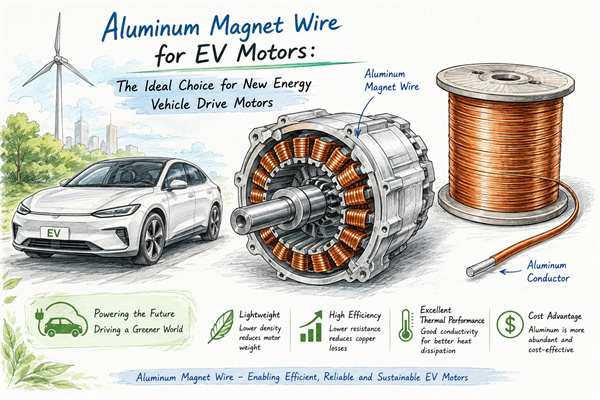
Traction motors (rail transit, electric vehicle drive motors, etc.) are a new core application for high-performance aluminum magnetic wire. Traction motors operate in harsh environments: high power density, high temperature, severe vibration, limited space, and numerous cyclic operating conditions. High-performance aluminum magnetic wire, through the design of flat wire (hairpin wire) and the application of PAI/PI high-dielectric-strength enamel coating, meets the high power density, high efficiency, and high reliability requirements of traction motors. Hairpin wire technology can significantly improve the power density and production efficiency of new energy vehicle drive motors.
Wind turbines (especially direct-drive permanent magnet wind turbines and high-speed permanent magnet wind turbines) are an important application area for high-performance aluminum. Wind turbine windings utilize a large amount of enameled wire, placing stringent requirements on the dielectric strength, thermal stability, mechanical durability, and weather resistance of the enameled coating. Aluminum-based copper substitution solutions offer significant cost and weight advantages in large-scale wind turbines.
Photovoltaic, Home Appliance and Precision Coil Applications
Photovoltaic inverters and energy storage systems are emerging application areas for high-performance aluminum magnetic wire. High-performance aluminum magnetic wire can be used for magnetic components such as boost transformers, filter inductors, and energy storage inductors in photovoltaic inverters. The operating environment of photovoltaic inverters (outdoor, high temperature, large temperature difference) places specific requirements on the weather resistance and temperature change resistance of aluminum magnetic wire.
Household appliance motors (air conditioner compressor motors, washing machine motors, refrigerator compressor motors, etc.) and industrial motors (servo motors, stepper motors, variable frequency motors, etc.) are major application areas for high-performance aluminum wire. Household appliance and industrial motors are characterized by high efficiency, high reliability, low cost, lightweight, and low noise. The application of high-performance aluminum wire in household appliance and industrial motors can significantly improve the energy efficiency rating and overall performance of the motors.
Precision coils (voice coils, RFID antenna coils, precision solenoid valve coils, etc.) and sensors (inductive sensors, Hall effect sensors, current transformers, etc.) are characteristic application areas of high-performance aluminum wire. Precision coils place stringent requirements on the fineness, flexibility, and adhesion of the aluminum wire. Aerospace electrical systems are a high-end application area for high-performance aluminum wire, where aerospace applications place extreme demands on the weight, performance, and reliability of aluminum wire.
Product Forms and Geometric Design
High-performance aluminum winding wire products come in various geometric shapes, including round wire, flat wire, and square wire, each suitable for different application scenarios.
Round, Rectangular and Square Wire
Round wire is a traditional form of aluminum magnetic wire, with diameters ranging from thin wire to heavy-duty wire. Round wire manufacturing processes are mature, winding equipment is universal, and applications are widespread. Round wire is suitable for most small and medium-sized motors, transformers, coils, inductors, sensors, and other applications.
Flat wire (rectangular wire/flat wire) is an important product form of high-performance aluminum magnetic wire. It features a large cross-sectional area, high duty cycle, and high winding density, making it particularly suitable for high power density applications (such as new energy vehicle drive motors, dry-type transformers, and rail transportation traction motors). The corner radius, aspect ratio, and enamel coating thickness of flat wire need to be designed according to specific applications. Hairpin wire is a special flat wire form used in new energy vehicle drive motors. It has a rectangular cross-section with pre-formed U-shapes or hairpin shapes at the ends, forming a complete winding after welding.
Square wire is a special product form of high-performance aluminum magnetic wire, with a square cross-section. It has a high duty cycle in applications such as transformers, reactors, and instrument transformers. The manufacturing process of square wire is relatively complex, and it is mainly used in special customized applications.
Stranded Wire and Multi-Layer Coating
Stranded wire and Litz wire are special product forms for high-frequency applications, which can significantly reduce skin effect loss and proximity effect loss in high-frequency applications.
Multi-layer composite coating is a design method for high-performance aluminum magnet wire enamel coating systems: PEI/PAI double coating (PEI provides adhesion and flexibility, PAI provides high dielectric strength and heat resistance), PI/PAI double coating (PI provides extremely high heat resistance and dielectric strength, PAI provides mechanical and chemical durability), PEI/PI double coating (PEI provides adhesion, PI provides extremely high heat resistance), and triple coating (adding an intermediate layer on top of a double coating to further improve dielectric strength and mechanical durability).
Quality Management and Future Trends
Quality management and batch traceability systems for high-performance aluminum (magnet wire) are the core guarantees for product reliability and supply chain stability.
Quality Management System
Modern high-performance aluminum wire production lines are equipped with online quality monitoring systems (online continuous coating testing, online breakdown voltage testing, online conductor diameter monitoring, and online coating thickness monitoring). Statistical process control (SPC) identifies abnormal trends in the production process through real-time monitoring and statistical analysis of key quality indicators. Each batch of aluminum wire leaving the factory should be accompanied by complete batch traceability information (conductor raw material batch number, conductor processing parameters, coating raw material batch number, coating process parameters, test reports, etc.). A complete database of batch traceability information should be established to support quality traceability throughout the product’s entire lifecycle.
Manufacturers should obtain certification from third-party certification bodies: ISO 9001, ISO 14001, ISO 45001, and IATF 16949 (automotive industry). Specialized certifications such as UL, CSA, and CE are necessary qualifications for entering specific markets.
Future Development Trends
In terms of material innovation: novel aluminum alloy systems (Al-Mg-Si-Cu series high-strength and high-toughness aluminum alloys, Al-Fe-Cu-RE series high-creep-resistant aluminum alloys, Al-Sc series ultrafine-grained aluminum alloys), nano-modified enamel coatings (introduction of nano-SiO₂, nano-Al₂O₃, and nano-TiO₂), and organic-inorganic hybrid enamel coatings (POSS-modified polyimide, etc.).
In terms of process upgrades: development of precision coating molds, optimization of multi-segment baking temperature curves, application of intelligent tension control systems, deployment of laser online monitoring systems, and upgrade of conductor surface pretreatment processes.
In terms of application expansion: High-performance aluminum is expanding from traditional high-voltage motors and dry-type transformers to high-end fields such as new energy vehicles, rail transportation, wind power generation, photovoltaic energy storage, aerospace, and marine engineering.
In terms of intelligent testing: online quality monitoring, non-destructive testing, application of big data analysis and machine learning algorithms, machine learning-assisted process parameter optimization, machine learning-assisted quality prediction, and machine learning-assisted failure analysis.
Conclusion
The engineering implications of High Performance Aluminum Magnet Wire encompass multiple technical dimensions, including material systems (conductor metallurgy, alloying design, grain refinement, surface pretreatment), performance dimensions (conductivity, mechanical properties, thermal properties, dielectric properties, chemical durability, high-frequency performance), application orientation (high-voltage motors, dry transformers, traction motors, wind turbines, photovoltaic energy storage, home appliance industry, precision coils, aerospace), product forms (round wire, flat wire, square wire, Litz wire, multi-layer composite coating), target audience (design engineers, purchasing engineers, quality engineers, failure analysis engineers, standardization engineers), and quality control (online monitoring, SPC, batch traceability, third-party certification).
High-performance aluminum wire represents a systematic upgrade over traditional aluminum wire in terms of conductor metallurgy, insulation system, mechanical properties, and long-term reliability; compared to traditional copper wire, it offers significant advantages in weight, cost, and resource sustainability. Its engineering applications require a comprehensive selection based on factors such as performance requirements, geometry, certification needs, and cost control for specific application scenarios.
With the continuous development of new materials, new processes, new applications, and intelligent testing, high-performance aluminum (magnet wire) technology will continue to evolve towards higher performance, longer life, lower cost, and wider application, providing a solid material foundation for the high-end, lightweight, and sustainable development of electrical equipment.
About the Author
Zhengzhou LP Industry Co., Ltd. is a source manufacturer of enameled wire with 30 years of export experience. With a modern 60-acre production base, it specializes in manufacturing copper/aluminum/copper-clad aluminum enameled round wire, flat wire, and square wire, offering a full range of heat treatment grades. Certified by ISO 9001/14001/45001, UL, REACH, and RoHS, its products are exported to over 50 countries.
Contact Information: – 📧 Email:<office@cnlpzz.com> – 📱 WhatsApp: 0086-19337889070 – 🌐 Website:<https://lpenamelwire.com/>