

Last week a small client who makes high-pressure washers asked me: should I use copper enameled wire or aluminum enameled wire for motor windings? I said: it depends on how weight sensitive you are, how cost sensitive you are, and what your service life requirement is. He replied: “Can you just give me a comparison table so I can decide for myself?”
That request is very real. When procurement, engineers, and designers select materials, the clearest thing they want is a clean comparison table. But when it comes to “comparison,” picking the wrong dimensions can lead you into a trap. Looking only at electrical performance but not thermal. Looking only at the present moment but not long term. Looking only at a single component but not the system.
This article breaks down magnet wire performance comparison thoroughly. The focus is on three mainstream conductor materials: copper, aluminum, and copper-clad aluminum (CCA), plus the performance differences between different temperature class coatings.
Three Foundational Facts You Cannot Skip
Before comparing any performance, confirm three foundational facts.
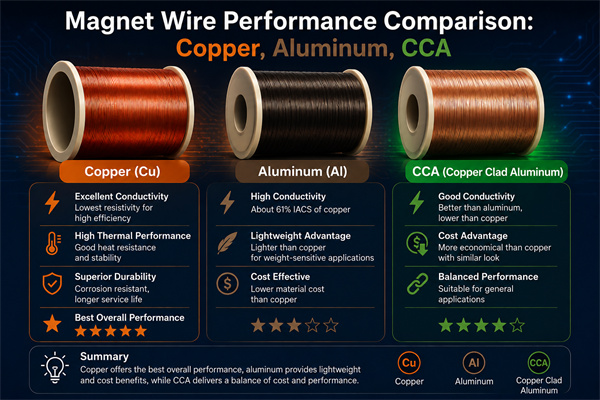
Copper’s conductivity is 100% IACS (International Annealed Copper Standard). Aluminum is only 61% IACS. This means the current carrying capacity of copper at the same cross-sectional area is 1.64 times that of aluminum. To achieve the same current carrying capacity, the cross-sectional area of aluminum wire must be enlarged by 1.64 times.
Copper’s density is 8.96 g/cm³. Aluminum is 2.70 g/cm³. Aluminum’s weight is only 30 percent of copper’s. With the cross-sectional area enlarged by 1.64 times but density only 30 percent, the final weight of aluminum wire under equal conductivity is only 50 percent of copper’s.
Copper’s resistivity is 1.724 μΩ·cm. Aluminum is 2.654 μΩ·cm. Aluminum’s resistivity is 1.54 times that of copper. Under the same current, aluminum generates 54 percent more heat than copper.
These three numbers are the starting point for all “performance comparison.” Any comparison that sidesteps these three is dishonest.
Dimension One: Electrical Performance Comparison
Electrical performance is the most core indicator of magnet wire.
For conductivity, copper is 100% IACS, aluminum is 61% IACS, and CCA (copper-clad aluminum, with copper layer accounting for 10 to 15 percent of volume) is approximately 63 to 68% IACS. Copper is the absolute winner in conductivity. CCA is close to aluminum and far below pure copper.
For resistivity, copper is 1.724 μΩ·cm, aluminum is 2.654 μΩ·cm, and CCA is approximately 2.78 to 2.95 μΩ·cm (depending on copper layer thickness). Copper is still the lowest.
For high-frequency characteristics, copper has a smaller skin effect at high frequencies, and the conductivity advantage is even more pronounced. Aluminum’s current carrying capacity drops faster at high frequencies. Copper is almost irreplaceable in high-frequency applications (high-frequency transformers, precision instruments, medical equipment coils all use copper).
For DC current carrying capacity, copper at the same cross-sectional area is 1.64 times aluminum. For the same current carrying capacity, the cross-sectional area of aluminum wire must be enlarged by 1.64 times. CCA is between the two.
Conclusion for electrical performance: copper > CCA > aluminum. If your product is sensitive to electrical performance (high frequency, precision, high power density), choose copper.
Dimension Two: Thermal Performance Comparison
Thermal performance determines the working capability of magnet wire in high temperature environments.
For long-term working temperature, it depends on the temperature class of the enamel coating. Common temperature classes from low to high are 105°C (Class B, polyvinyl formal), 130°C (Class B, modified polyester), 155°C (Class F, modified polyester), 180°C (Class H, polyesterimide), 200°C (Class C, polyesterimide/polyamide-imide composite), 220°C (above Class C, polyimide), and 240°C (special polyimide).
For thermal shock performance, this is the ability of magnet wire to resist cracking under short-term high temperatures. Polyester enamel has thermal shock around 155 to 180°C. Polyesterimide is 200°C. Polyamide-imide is 220°C. Polyimide is 300°C and above. The higher the temperature class, the more expensive the enamel.
For thermal aging life, it follows Montgomery’s rule: for every 10°C increase in temperature, life is halved. An 180°C class enamel working at 200°C has only one quarter of the life at its rated temperature.
The aluminum enameled wire advantage: aluminum’s thermal conductivity is 237 W/(m·K), and copper’s is only 401 W/(m·K). Wait, copper’s thermal conductivity is actually higher. This may be counterintuitive. Copper’s thermal conductivity is 1.7 times that of aluminum, so it dissipates heat faster and the steady-state temperature of copper wire is actually lower. But aluminum’s specific heat capacity is 0.90 kJ/(kg·K), 2.3 times that of copper’s 0.385. Unit mass of aluminum can absorb more heat. In short-term overload scenarios, aluminum wire has a “thermal buffer” advantage.
Conclusion for thermal performance: copper has better steady-state thermal performance (faster heat dissipation), and aluminum has advantages in short-term overload scenarios (higher specific heat). The choice of temperature class affects the heat resistance of magnet wire more than the choice of conductor material.
Dimension Three: Mechanical Performance Comparison
Mechanical performance affects winding, slot insertion, and reliability under long-term vibration.
For tensile strength, copper is 200 to 400 MPa, aluminum is 90 to 180 MPa, and CCA is 110 to 200 MPa. Copper’s tensile strength is 1.5 to 2 times that of aluminum. This means aluminum enameled wire breaks more easily during drawing and winding.
For elongation, copper is 30 to 50 percent, aluminum is 15 to 25 percent, and CCA is 20 to 30 percent. Copper’s elongation is 1.5 to 2 times that of aluminum. Bending without cracking and passing the winding test both favor copper.
For hardness, copper’s Mohs hardness is 3, aluminum is 2.5 to 3. The difference is small.
For elastic modulus, copper is 110 to 128 GPa, aluminum is 69 GPa. Copper’s stiffness is 1.6 times that of aluminum. Higher stiffness means better shape retention for wound coils, but it is less suitable for winding complex shapes.
For fine wire (below 0.3 mm), aluminum wire has significant drawing process difficulty below 0.3 mm, with high wire break rates and unstable enameling quality. This diameter range is almost monopolized by copper wire.
Conclusion for mechanical performance: copper comprehensively outperforms aluminum. Especially in fine wire, complex windings, and high vibration scenarios, copper is the more reliable choice.
Dimension Four: Long-term Reliability Comparison
Long-term reliability determines the actual service life of the product.
For temperature life, the higher the temperature class, the better the long-term heat resistance. An 180°C class enamel working continuously at 180°C has a life of about 20,000 hours. A 200°C class at 200°C has about 20,000 hours. Class H (180°C) enamel at 150°C actual working temperature can have a life of more than 100,000 hours. Temperature class affects life more than conductor material.
For chemical stability, copper is chemically stable at room temperature. Aluminum forms a dense oxide film. The thickness of this oxide film increases over time, from 2 to 3 nm at delivery to 8 to 10 nm after 1 to 2 years. An excessively thick oxide film affects enamel adhesion (this is why aluminum enameled wire must be coated quickly after annealing).
For vibration resistance, copper wire has better fretting corrosion resistance than aluminum wire. In long-term vibration scenarios such as motors and transformers, copper wire has higher reliability.
For creep, aluminum is more prone to creep under sustained stress. Transformer windings under long-term high temperature and electromagnetic force will experience small plastic deformation of aluminum wire, leading to inter-turn loosening. This is the biggest reliability risk of aluminum replacing copper in transformers.
Conclusion for long-term reliability: copper > CCA > aluminum. But the matching of temperature class to working temperature is more important than the conductor material.
Dimension Five: Cost Performance Comparison
Finally, we have to count the money.
For raw material cost, based on June 2026 LME prices, copper is 9,800 USD per ton, aluminum is 2,700 USD per ton, and the copper-aluminum ratio is 3.63. Aluminum raw material is 70 percent cheaper.
For equal conductivity cost, aluminum wire’s cross-sectional area is enlarged by 1.64 times, so the raw material cost is approximately 4,400 USD per ton equal conductivity (2,700 × 1.64), and copper is 9,800 USD per ton equal conductivity. Aluminum is 55 percent cheaper on an equal conductivity basis.
For processing fees, copper enameled wire processing fees are about 3,500 to 4,500 USD per ton, and aluminum enameled wire is 2,500 to 3,500 USD per ton. Aluminum processing fees are 30 percent cheaper.
For finished product landed price (including regional premium, tariffs, enameling fees), North American enameled copper wire is 13,300 to 15,000 USD per ton, enameled aluminum wire is 6,000 to 9,000 USD per ton. European enameled copper wire is 13,500 to 14,800 USD per ton, enameled aluminum wire is 5,800 to 7,200 USD per ton. Aluminum is 40 to 55 percent cheaper (by weight).
For recycling value, scrap copper is 9,900 to 11,000 USD per ton, and scrap aluminum is 880 to 1,760 USD per ton. Copper’s residual value is 6 to 10 times that of aluminum. For long-life equipment (transformers with 20 to 30 year lifespans), this cannot be ignored.
Conclusion for cost: aluminum comprehensively outperforms copper. But factoring in recycling value, copper’s total cost of ownership (TCO) narrows.
Dimension Six: Special Scenario Performance Comparison
Different application scenarios have specific requirements.
For motor windings, high tensile strength, elongation, and long-term vibration reliability are required. Copper wins. But EV drive motors are weight sensitive, so aluminum enameled flat wire has advantages in EV drive motor scenarios.
For transformers, long-term high temperature, long-term vibration, and 20 to 30 year life are required. Copper wins. Large power transformers have aluminum replacing copper cases, but they bear reliability risks.
For home appliance motors, cost sensitive and 10 to 15 year life required. Aluminum wins. Home air conditioner outdoor unit motors and low-voltage small motors use aluminum extensively.
For high-frequency signals, high-frequency characteristics are required. Copper is mandatory. Aluminum cannot substitute.
For precision instruments, dimensional accuracy and electrical stability are required. Copper is mandatory.
For new energy, photovoltaic combiner boxes, wind power cables, and energy storage connections. Aluminum has cost advantages in high-current scenarios, while copper continues to dominate precision control parts.
Comprehensive Comparison Table
The following comparison is based on engineering practice averages. Specific data will vary by grade, process, and enamel class.
Conductor material comparison (under equal current carrying capacity of 1 A):
Copper enameled wire (typical 0.5 mm): conductivity 100% IACS, tensile 250 MPa, elongation 35 percent, price approximately 14,000 USD per ton equal conductivity, typical application is high frequency, precision, and high power density.
Aluminum enameled wire (typical 0.8 mm, 1.64 times cross-section): conductivity 61% IACS, tensile 130 MPa, elongation 20 percent, price approximately 6,000 USD per ton equal conductivity, typical application is home appliances, low voltage, transformers, and weight sensitive scenarios.
Copper-clad aluminum enameled wire (CCA, typical 0.6 mm): conductivity 65% IACS, tensile 150 MPa, elongation 25 percent, price approximately 8,000 USD per ton equal conductivity, typical application is high-frequency cable, communication cable, and cost sensitive mid-frequency scenarios.
One sentence summary: choose copper for electrical performance, steady-state thermal performance, mechanical, and long-term reliability. Choose aluminum for cost, short-term overload, and lightweight. Choose CCA for mid-frequency and cost sensitivity without going all the way to aluminum. The choice of temperature class is often more important than the choice of conductor material. The performance gap between a 130°C class and a 200°C class for the same copper enameled wire may be larger than the gap between copper and aluminum.
How We Help Customers Choose
Zhengzhou LP Industry produces three product lines: copper enameled wire, aluminum enameled wire, and copper-clad aluminum enameled wire. When customers ask “what should I choose for my product,” we usually ask three questions first.
One: what is the peak working temperature of this product? Is it sustained high temperature or short-term high temperature? Two: is weight a core selling point? Three: what is the required service life? Below 10 years, 10 to 20 years, or over 20 years?
Once the answers come out, the material is decided. There is no best material, only the most matching material.