

Introduction
NEMA MW 35-C Compliant Enameled Copper Magnet Wire is enameled round copper wire conforming to the NEMA MW 1000-2018 standard MW 35-C specifications. This specification has a broad application base in the North American magnetic component manufacturing industry and is a key basic material for the design and manufacture of small and medium-sized electromagnetic components such as transformers, relays, coils, inductors, and sensors. The MW 35-C specification uses a single-layer polyurethane (UEW) enamel coating as its insulation system, with a thermal rating of 155 and an enamel coating rating of Heavy Build. The conductor is electrical grade round copper wire, forming a complete standardized product definition.
From an industrial practice perspective, NEMA MW 35-C Compliant Enameled Copper Magnet Wire is not simply a “compliance mark,” but a comprehensive engineering specification covering conductor metallurgy, enamel coating chemistry, geometric accuracy, electrical performance, mechanical performance, thermal performance, and chemical durability. Any enameled wire product claiming compliance with MW 35-C specifications must systematically meet all test items and judgment limits specified in NEMA MW 1000-2018 Part 2 Test Procedures. The accompanying application of safety standards such as UL 1446 and UL 758 further strengthens the product’s compliance in the North American market.
The core value of MW 35-C specifications lies in its balanced overall performance: the polyurethane enamel coating provides its key advantage in solderability, significantly simplifying the winding connection process; its thermal rating of 155 meets the needs of most medium and low temperature applications; and the Heavy Build enamel coating achieves a reasonable balance between coating strength and conductor duty cycle. Compared to enamel coating systems such as PEW (polyester), PEI (polyester imide), and PAI (polyamide-imide), UEW enamel coating has unique advantages in high-frequency performance, dielectric loss, and solderability.
The engineering implications of NEMA MW 35-C Compliant Enameled Copper Magnet Wire can be systematically explained from seven dimensions: standards system, definitions of specifications, technical specifications, correspondence with IEC/GB standards, testing methods, application scenarios, and selection criteria. This article provides a systematic engineering reference for purchasing engineers, transformer and coil design engineers, magnetic component manufacturers, and UL/CSA certification engineers in the North American market.

NEMA MW 1000-2018 Standard Framework
NEMA MW 1000-2018 is the authoritative standard system for the North American magnetic wire industry, and MW 35-C specifications are a component of it. A thorough understanding of the structure and content of the MW 1000-2018 standard system is fundamental to the correct application of MW 35-C specifications.
Standard Structure
The full name of the NEMA MW 1000-2018 standard is “Magnet Wire Standard,” which is developed and maintained by the NEMA Magnet Wire Section. This standard is divided into three main parts: Part 1 General Requirements, Part 2 Test Methods, and Part 3 Technical Information. These parts form a complete specification matrix, covering the entire process of requirements for magnet wire products, from definition and testing to judgment and technical information.
Part 1, General Requirements, specifies the basic definition, conductor requirements, enamel coating requirements, geometric parameters, and judgment rules for the magnet wire product. Part 2, Test Methods, specifies the detailed operating procedures for dozens of test methods, including breakdown voltage, enamel coating continuity, enamel coating thickness, elongation, thermal shock, softening breakdown, solderability, and chemical resistance. Part 3, Technical Information, provides engineering reference information on magnet wire selection, application, and design.
Conductor and Insulation System
NEMA MW 1000-2018 specifies multiple dimensions for magnet wire conductors, including conductor material, conductor diameter, conductor resistance, conductor elongation, and conductor surface quality. MW 35-C specifications use electrical-grade round copper wire as the conductor material, conforming to the technical requirements of ASTM B3 (soft or annealed copper conductor) or equivalent standards. Conductor diameter tolerances are controlled according to standard grades, conductor resistivity conforms to standard values for copper, and conductor elongation reflects the copper conductor’s plastic deformation capacity. Conductor performance is fundamental to the electrical and mechanical properties of magnet wire, and the precise control of conductor diameter directly affects the consistency of enamel coating thickness and the uniformity of the electric field distribution.
The specifications for magnet wire enamel coating systems cover parameters such as coating type, coating thickness rating, thermal class, and coating color. NEMA MW 1000-2018 covers dozens of enamel coating systems, each corresponding to a specific specification number. Thermal class is the long-term operating temperature classification standard for magnet wire enamel coatings, following the UL 1446 and IEC 60085 standards. Common thermal classes include Class 105, 130, 155, 180, 200, 220, and 240. The thermal class of MW 35-C specifications is Class 155, and the long-term operating temperature is within the temperature range specified by the Class 155 standard.
Film Thickness Grades
NEMA MW 1000-2018 specifies the thickness rating system for magnet wire enamel coatings. Emmel coating thickness ratings include Single Build, Heavy Build, and Triple Build. Different enamel coating thickness ratings correspond to different thickness ranges and dielectric strength ratings. MW 35-C specifications adopt the Heavy Build enamel coating rating, with the enamel coating thickness falling within the range specified for the Heavy Build rating, exhibiting high dielectric strength and mechanical durability within the Class 155 enamel coating system. The selection of enamel coating thickness must comprehensively consider engineering factors such as electrical strength, duty cycle, heat dissipation performance, and processing performance.
MW 35-C Specification Definition
The specifications for NEMA MW 35-C Compliant Enameled Copper Magnet Wire are clearly defined in the NEMA MW 1000-2018 standard. This section elaborates on the definitions of MW 35-C specifications from the perspectives of enamel coating system, thermal rating, enamel coating thickness rating, conductor specifications, and geometric parameters.
Insulation System Definition
The enamel coating system of MW 35-C specifications is a single-layer polyurethane (UEW) coating. This polyurethane enamel coating is a polymer coating formed by the reaction of polyisocyanate and polyol, possessing core characteristics such as direct weldability, low-temperature curing, excellent high-frequency performance, low dielectric loss, and good storage stability. The chemical structure of the polyurethane enamel coating determines its performance characteristics: the polyurethane molecular chain contains urethane groups (-NH-CO-O-), giving the enamel coating good flexibility and adhesion. The polyurethane enamel coating can cure at relatively low temperatures, resulting in significant energy savings.
The single-layer structure employs a single-coating, single-baking process, resulting in a relatively simple structure and high production efficiency. The dielectric strength of the single-layer polyurethane/enamel coating meets the requirements of Class 155 applications, and its mechanical properties and chemical durability meet the standards specified. During winding, embedding, and shaping processes, the single-layer polyurethane/enamel coating exhibits excellent flexibility and adhesion.
Thermal Class and Conductor
The thermal rating of MW 35-C is Class 155, and its corresponding temperature index conforms to the requirements of NEMA MW 1000-2018 and UL 1446 standards for Class 155 enamel coatings. The long-term operating temperature of the Class 155 enamel coating falls within the Class 155 standard temperature range, allowing for reliable operation in small to medium-sized transformers, relays, coils, and other applications. The temperature index is determined based on accelerated aging tests specified in IEC 60216. Failure times of the enamel coating are measured at multiple temperature points, and the maximum operating temperature of the enamel coating under standard lifespan is extrapolated based on an Arrhenius kinetic model.
The conductor is electrical grade round copper wire, with a diameter range covering a wide spectrum from fine wire to heavy-duty wire, selectable according to specific application requirements. Conductor diameter tolerances are controlled according to NEMA MW 1000-2018 standard levels, and conductor elongation meets the standard’s specified levels. The overall diameter of the enamel coating is a key parameter for the overall outer diameter of the winding wire; the enamel coating diameter for MW 35-C specifications is calculated based on the conductor diameter and the heavy-duty build rating.
Specification Coding
The NEMA MW 1000-2018 specification numbering system has a clear logical structure. In MW 35-C, “MW” stands for Magnet Wire, “35” is the specification number, and “C” indicates the current revision. Each specification number corresponds to a specific combination of enamel coating system, thermal rating, enamel coating thickness grade, and conductor material. MW 35-C, along with other specifications (such as MW 24-C, MW 28-C, MW 36-C, etc.), forms a complete specification numbering system covering all magnet wire products in the North American market.
Engineering Performance Specifications
The engineering specifications of NEMA MW 35-C Compliant Enameled Copper Magnet Wire cover five dimensions: conductor, electrical, mechanical, thermal, and chemical.
Conductor and Film Electrical Performance
Conductor performance specifications include: conductor diameter (determined according to standard tolerance grade), conductor resistance (conforming to the standard resistivity of copper, with deviations within the standard range), conductor elongation (achieving the elongation level of the standard grade copper conductor), and conductor surface quality (free from defects such as cracks, peeling, inclusions, oxidation, and contamination). Controlling the deviation in conductor resistance directly affects winding copper loss and temperature rise, while the level of conductor elongation directly affects the reliability of winding, winding, and other processing techniques.
The electrical performance specifications of the enamel coating include: breakdown voltage (incrementing AC voltage under standard electrodes until breakdown, Class 155 Heavy Build enamel coating reaches the corresponding high dielectric strength level), enamel coating continuity (low defect count within a specified length), dielectric loss tangent tanδ (measured at a specific frequency, typically very small), and DC withstand voltage (leakage current detected by applying a specified DC voltage to the enamel-coated wire surface). The electrical performance of the enamel coating is a core indicator of the insulation performance of the magnet wire, determining the safety margin of the magnet wire at operating voltage and the insulation reliability of the windings during long-term operation.
Film Mechanical and Thermal Performance
The mechanical properties of the enamel coating include: flexibility (no cracking when stretched to a specified diameter), adhesion (no peeling under tension and bending conditions), abrasion resistance (number of abrasion cycles measured with an abrasion tester), cutting temperature (breakdown temperature of the enamel coating under hot plate pressure), and coefficient of friction (static and dynamic friction coefficients). These mechanical properties ensure the integrity of the magnet wire during winding, embedding, and shaping processes.
The thermal performance specifications of the enamel coating include: thermal shock (no cracking upon immediate winding after standard temperature heat treatment), softening breakdown (no breakdown upon application of voltage after pressure on a high-temperature hot plate), temperature index (Class 155 enamel coating meets specified temperature index), and aging life (expected life at long-term operating temperatures extrapolated from the Arrhenius model). The thermal performance of the enamel coating is crucial for maintaining the reliability of the magnet wire under operating temperature and short-term over-temperature conditions.
Film Chemical Performance
The chemical properties of the enamel coating include: solderability (a core test item for direct soldering products, where tinning is performed directly after immersion in a standard temperature tin bath, and the wetting area meets standard requirements), solvent resistance (the performance changes of the enamel coating after immersion in a standard solvent), and chemical resistance (specific tests for resistance to transformer oil, ATF oil, refrigerant, acids, alkalis, etc.).
Solderability is one of the core characteristics of MW 35-C polyurethane enamel coating. The molecular structure of the polyurethane enamel coating allows it to decompose and release gases under heating conditions, enabling molten solder to directly wet the copper conductor surface, achieving a direct soldering process without prior removal of the enamel coating. This characteristic significantly simplifies the winding connection process, improves production efficiency, and reduces manufacturing costs. The standard temperature window for solderability testing corresponds to the thermal decomposition temperature range of the polyurethane enamel coating.
Cross-Reference with International Standards
NEMA MW 35-C Compliant Enameled Copper Magnet Wire has equivalent or equivalent standards in the international standards system. Understanding the correspondence between MW 35-C and the IEC 60317 series and GB/T 6109 series is of great significance for cross-border procurement and global supply chain management.
IEC 60317 Cross-Reference
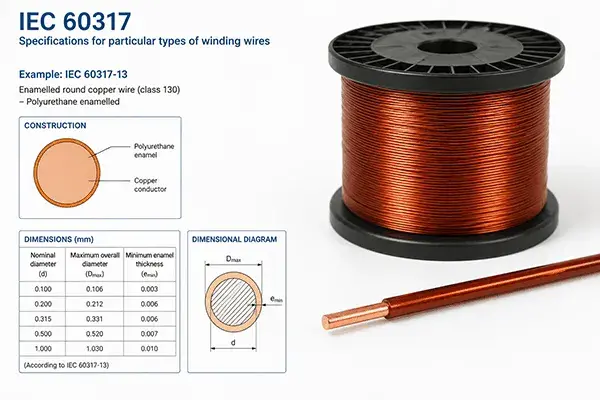
The IEC 60317 series is a set of standards for winding wires developed by the International Electrotechnical Commission (IEC). The corresponding standard in the IEC 60317 series for MW 35-C specifications is IEC 60317-20 (“Specifications for particular types of winding wires – Part 20: Solderable polyurethane enamelled round copper wire, class 155”). The enamel coating system, heat rating, and conductor material specified in this standard are highly consistent with MW 35-C specifications, making them equivalent standards in the international market. IEC 60317-20 specifies a single-layer solderable polyurethane coating system, heat rating 155, and a round copper conductor. MW 35-C and IEC 60317-20 are highly consistent in terms of test items, judgment rules, and performance requirements.
Chinese National Standards Cross-Reference
The GB/T 6109 series is a set of Chinese national standards for testing methods of enameled wire. The corresponding standard for MW 35-C in the GB/T 6109 series is GB/T 6109.10 (“Enameled Round Winding Wire Part 10: 155-Grade Polyurethane Enameled Copper Round Wire”). This standard specifies a 155-grade polyurethane coating system for direct solderability, with round copper wire as the conductor. The enamel coating thickness grades correspond to Single Build, Heavy Build, and Triple Build in NEMA MW 1000-2018.
Global Market Application
Understanding the correspondence between MW 35-C and IEC 60317-20 and GB/T 6109.10 is crucial for global supply chain management. In the North American market, NEMA MW 35-C specifications are preferred; in Europe, Asia, and South America, IEC 60317-20 specifications can be used; and in the Chinese market, GB/T 6109.10 specifications can be adopted. While these three specifications are highly consistent in their technical content, there may be subtle differences in specific testing methods, decision limits, and documentation requirements. For cross-border procurement of enameled wire products, the specific standard requirements, testing items, decision limits, and certification requirements (such as UL, CSA, and CE certifications) should be clearly defined in the procurement specifications to avoid product acceptance disputes due to standard differences.
Test Methods and Quality Assurance
NEMA MW 1000-2018 Part 2 Test Methods specifies routine tests including: conductor diameter, conductor resistance, conductor elongation, enamel coating thickness, enamel coating continuity, breakdown voltage, enamel coating flexibility, thermal shock, softening breakdown, and solderability. Each test has detailed operating procedures, judgment criteria, and equipment requirements. The specific operating procedures of the test methods are highly consistent with IEC 60317-20 and GB/T 6109.10.
Test results should be recorded in a Mill Test Certificate (MTC), including information such as specifications/models, batch number, conductor material, enamel coating type, thermal rating, measured values and acceptance limits for each test item, test date, tester, and quality inspection stamp. Test reports should be retained long-term to establish a batch traceability system.
In the North American market, magnetic wire products typically require certification from third-party certification bodies. Common certifications include UL (Underwriters Laboratories), CSA (Canadian Standards Association), and C-UL (Canada-UL joint certification). UL 1446 is a safety standard for insulating materials and systems for magnetic components, used in conjunction with NEMA MW 1000-2018. After obtaining UL certification, enameled wire products meeting NEMA MW 35-C specifications can be found in the UL database (Product iQ) with their corresponding file number.
Manufacturers of enameled wire should establish a complete quality management system that complies with international standards such as ISO 9001, ISO 14001, and ISO 45001. The manufacturer’s testing center should be equipped with complete testing equipment, which should be regularly calibrated and traceable to national metrological standards.
Typical Application Scenarios
NEMA MW 35-C Compliant Enameled Copper Magnet Wire has wide application value in many application fields.
Small and Medium Transformer Applications
Small and medium-sized transformers are the primary application area for MW 35-C specifications. The primary and secondary windings of control transformers, isolation transformers, electronic transformers, and power transformers extensively utilize MW 35-C specifications’ enameled wire. The direct solderability of the polyurethane enamel coating significantly simplifies the lead wire connection process for transformer windings, eliminating the need for pre-removal of the enamel coating and allowing for direct dip soldering. The Class 155 thermal rating meets the long-term operating temperature requirements of most small and medium-sized transformers. The Heavy Build enamel coating rating provides sufficient dielectric strength to ensure the transformer’s insulation reliability under operating voltage and short-time overvoltage conditions.
Relay and Coil Applications
Relays and solenoids are another core application area for MW 35-C specifications. MW 35-C specifications are widely used in the coil windings of automotive relays, industrial control relays, and household appliance relays. The direct solderability of the polyurethane enamel coating makes the lead wire connection process of the relay coil efficient and reliable. The Class 155 thermal rating meets the operating temperature requirements of the relay coil, and the Heavy Build enamel coating rating provides good mechanical durability.
Coils and inductors are important application areas for MW 35-C specifications. MW 35-C specifications is widely used in the windings of magnetic components such as RF coils, power inductors, energy storage inductors, filter inductors, common-mode inductors, and differential-mode inductors. The excellent high-frequency performance and low dielectric loss of polyurethaneenamel coating make MW 35-C specifications particularly suitable for high-frequency coil and inductor applications.
Sensor and Speaker Applications
Sensors and detectors are emerging application areas for MW 35-C specifications. The windings of magnetic components such as inductive sensors, Hall effect sensors, current transformers, voltage transformers, position sensors, and speed sensors can utilize MW 35-C specifications. The direct solderability of polyurethaneenamel coating enables the miniaturization and precision manufacturing of sensor windings.
Loudspeakers and microphones are key application areas for MW 35-C specifications. The voice coil is the core component of a loudspeaker, and its windings have stringent requirements regarding the flexibility, adhesion, and dielectric strength of the enamel coating. MW 35-C specifications’ polyurethane enamel coating meets these specific process requirements. MW 35-C specifications can also be used for the coil windings of headphones, receivers, and microphones. RFID electronic tags and smart cards are another emerging application area for MW 35-C specifications.
Selection Criteria and Engineering Considerations
The selection criteria for MW 35-C enameled wire include: whether the operating temperature of the application is within the Class 155 range (yes → continue; no → consider other thermal grades), whether direct solderability is required (yes → MW 35-C is preferred; no → consider other specifications), whether high-frequency low-loss performance is required (yes → MW 35-C polyurethane enameled coating is preferred; no → consider other specifications), whether the conductor diameter and enameled coating thickness are within the MW 35-C specifications, and whether UL/CSA certification requirements are met.
MW 35-C (specifications) requires the use of other materials in practical applications. It has good compatibility with most impregnating varnishes and potting compounds, but the following precautions should be taken: the curing temperature of the impregnating varnish should not exceed the softening breakdown temperature of the polyurethane coating; the solvent of the impregnating varnish should not excessively swell the polyurethane coating; and the curing shrinkage rate of the potting compound should not be too large to avoid stress concentration in the polyurethane coating.
During processing, the following should be noted: winding tension control (avoiding excessive tension that could cause tensile damage to the enamel coating), winding speed control (avoiding high-speed winding that could generate frictional heat and cause softening of the enamel coating), bending radius control (avoiding sharp bends that could cause cracking of the enamel coating), welding temperature and time control (the weldability of polyurethane enamel coating is effective within a standard temperature window; exceeding the temperature window may lead to poor welding or residual carbonization of the enamel coating), and storage condition control (polyurethane enamel coating may deteriorate under high temperature and high humidity conditions and should be stored under standard storage conditions).
Future Development Trends
Chemical modification of polyurethane enamel coatings is a core direction of materials innovation. Modified polyurethane enamel coatings, through the introduction of specific chemical groups or nanomaterials, further enhance the thermal stability, mechanical properties, and dielectric properties of the enamel coating. Nanomaterial modification of polyurethane enamel coatings can significantly improve their heat resistance and chemical resistance.
Innovation in conductor materials is also an important direction. High-purity oxygen-free copper (OFC) conductors can further reduce the conductivity loss of magnet wires and improve high-frequency performance. Copper alloy conductors (such as Cu-Ag and Cu-Cr alloys) can improve mechanical strength and creep resistance while maintaining conductivity.
The application areas of MW 35-C specifications are expanding from traditional small and medium-sized transformers, relays, coils, and inductors to high-end fields such as new energy vehicles, 5G communications, the Internet of Things, artificial intelligence, aerospace, and medical electronics. The NEMA MW 1000-2018 standard is continuously being updated, and new versions will reflect the latest developments and market demands in magnet wire technology. The technical content and testing methods of MW 35-C specifications will also be continuously optimized with each standard update.
Conclusion
The engineering implications of NEMA MW 35-C Compliant Enameled Copper Enameled Wire encompass the NEMA MW 1000-2018 standard system, MW 35-C specifications, conductor properties, electrical properties, mechanical properties, thermal properties, chemical properties, solderability, and other core dimensions. The core concept of MW 35-C specifications is “standardization, compliance, and engineering.”
For procurement engineers in the North American market, understanding the correspondence between MW 35-C and international and domestic standards such as IEC 60317-20 and GB/T 6109.10 is crucial for global supply chain management and cross-standard procurement. For transformer and coil design engineers, the direct solderability of the polyurethane/enamel coating in MW 35-C specifications is a core value that simplifies winding connection processes and improves production efficiency. For magnetic component manufacturers, the standardization and third-party certification of MW 35-C specifications are core guarantees for product quality and supply chain reliability.
With the continuous development of new materials, new processes, and new applications, the technical content and testing methods of MW 35-C specifications will continue to be optimized, and the application fields will continue to expand, providing a solid material foundation for the high-end, intelligent, and sustainable development of the magnetic component industry.
About the Author
Zhengzhou LP Industry Co., Ltd. is a source manufacturer of enameled wire with 30 years of export experience. With a modern 60-acre production base, it specializes in manufacturing copper/aluminum/copper-clad aluminum enameled round wire, flat wire, and square wire, offering a full range of heat treatment grades. Certified by ISO 9001/14001/45001, UL, REACH, and RoHS, its products are exported to over 50 countries.
Contact Information: – 📧 Email:<office@cnlpzz.com> – 📱 WhatsApp: 0086-19337889070 – 🌐 Website:<https://lpenamelwire.com/>