

The insulation class of enameled wire is a standardized grading system used to characterize the long-term operating temperature resistance of the enamel coating. In mainstream standards such as IEC 60085, GB/T 11021, and NEMA MW 1000-2018, the insulation class directly corresponds to the “maximum allowable operating temperature of the hottest spot in the winding.” For winding wire designers, correctly selecting the three classes (F, H, C) (155°C, 180°C, 200°C) of enameled wire is a key engineering decision balancing equipment power density, expected lifespan, and manufacturing costs. This article systematically explains the position of these three classes in the standard system, the composition of the enamel coating material, key testing methods, typical application scenarios, and key points for selection decisions.
Insulation Class System and Standard Cross-Reference
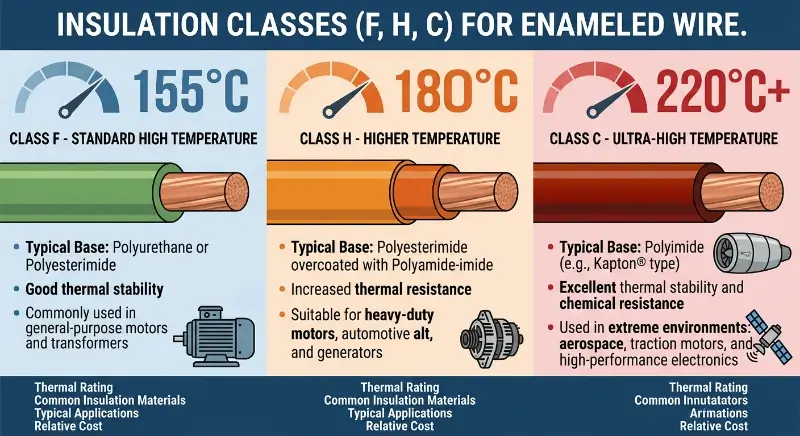
Insulation classes originally came from the heat resistance classification of electrical insulation materials and were later extended to the field of winding wires. IEC 60085, “Electrical insulation – heat resistance classification and marking,” classifies insulation materials into nine classes according to their long-term operating temperature: Y (90°C), A (105°C), E (120°C), B (130°C), F (155°C), H (180°C), N (200°C), R (220°C), and 250 (250°C). In the field of enameled wire, classes F, H, and C (i.e., N) are commonly used. The table below shows the correspondence with various standard systems.
| Class | IEC 60085 | GB/T 11021 | NEMA Marking | Old Letters | °C | °F |
|---|---|---|---|---|---|---|
| F | Class F | Class F | Class 155 | Class B (obsolete) | 155 | 311 |
| H | Class H | Class 180 | Class F (obsolete) | 180 | 356 | |
| C | Class C | Class 200 | Class H (obsolete) | 200 | 392 |
It is important to note that although both IEC 60085 and NEMA MW 1000-2018 use numerical designations such as “Class 180”, their specific testing methods differ. The IEC 60317 series is based on the enamel coating standard, while NEMA MW 1000-2018 Part 3 specifies the specific test methods (such as §3.50 softening breakdown, §3.52 breakdown at rated temperature, and §3.58 thermal life extrapolation). When complete machines and winding wires are imported from the North American market to Europe, certification engineers need to verify both standards.
Class F 155°C Enameled Wire System
The mainstream enamel coating systems for Class F enameled wire (Class 155) include modified polyurethane (UEW), modified polyester (PEW), and polyester glass fiber wrapped wire. IEC 60317-20 specifies the technical requirements for polyurethane Class 155, and IEC 60317-21 specifies polyurethane nylon Class 155, corresponding to MW 79 and MW 80 in the NEMA system. Modified polyurethane (Class 155 UEW) increases the long-term operating heat resistance temperature from 130°C to 155°C by introducing partially cross-linked resin, while maintaining the direct soldering performance of polyurethane (soldering temperature 375-390°C). It is widely used in applications requiring high-performance direct soldering, such as mobile phone chargers, ignition coils, and industrial relays. The direct soldering characteristic distinguishes 155-grade UEW from other F-grade enamel coatings, a key advantage for consumer electronics and small transformer applications. Modified polyester (155-grade PEW) is chemically modified by introducing the THEIC (trimethylolethane triisocyanate) structure. THEIC-modified polyester enamel coatings exhibit significantly improved thermal shock resistance and crack resistance compared to 130-grade polyester. The combination of “high mechanical strength + F-grade heat resistance + low cost” makes it dominant in common household appliance motors, generator windings, and conventional dry-type transformers. Polyester-wrapped wire (MW 45 / IEC 60317-60) is another structural form of Class F. By wrapping polyester-impregnated glass fiber around the enameled wire, the mechanical strength and thermal shock resistance are significantly improved. It is often used in traction motors and large transformer windings below Class H.
Class H 180°C Enameled Wire System
Class H enameled wire (Class 180) is the standard configuration for industrial motors and traction motors. IEC 60317-8 specifies the technical requirements for Class 180 round copper wire (polyester imide), IEC 60317-22 specifies Class 180 for nylon, and IEC 60317-51 specifies Class 180 for polyurethane. MW 30 (polyester imide) in the NEMA system is the most representative product of Class H. Polyester imide (PEI) is the mainstream choice for Class H enamel coatings. Its molecular structure contains both ester bonds and imide rings, giving it both the mechanical properties of polyester and the heat resistance of polyimide. NEMA MW 30-C specifies the key technical indicators for polyester imide enameled round copper wire: long-term operating temperature 180°C, thermal shock temperature 200°C (no visible cracks after winding at 200°C), hot breakdown voltage ≥ 75% of room temperature value, and softening breakdown temperature ≥ 300°C. These indicators collectively determine the widespread application of PEI enameled wire in industrial motors, new energy vehicle drive motors, dry-type transformers, and rail transportation traction motors. Polyester-Nylon 180 grade (MW 76) has a nylon coating on the outer layer of PEI, further improving the chemical resistance, abrasion resistance, and processability of the enamel coating, making it particularly suitable for motor windings requiring complex winding processes. Solderable polyester (MW 77) retains the solderability of polyester enamel coating while achieving H-grade temperature resistance, making it one of the few enamel coating systems that combines direct soldering technology with H-grade temperature resistance. High-temperature polyester glass fiber (MW 51 / MW 53) is included in the standard winding wire system with a 180°C rating and is widely used in large high-voltage motors, traction motor stator windings, and mining motors. Its double-layer polyester glass fiber structure allows the enameled wire to exceed the limits of a single enamel coating in terms of thermal shock resistance, and its mechanical strength meets the winding requirements for large-size windings.
Class C 200°C Enameled Wire System
Class C enameled wire (Class 200 / Class N) encompasses various high-temperature enamel coating systems, among which polyester imide coated with polyamide-imide (PEI/PAI dual coating) is the most representative product. IEC 60317-13 specifies the technical requirements for this structure, corresponding to MW 35 (round wire) / MW 36 (flat wire) in the NEMA system.
Furthermore, polyimide (PI) as a special enamel coating for the 240°C class (NEMA MW 16 / IEC 60317-46) is equally important in applications above Class C+ (i.e., N + 200°C). The technical advantages of polyamide-imide (PAI/AIW) are reflected in three key performance aspects. First, the softening breakdown temperature of PAI (enamel coating) is typically between 330-350°C, far exceeding the required operating temperature of 200°C. This is due to the synergistic effect of the amide bonds and imine rings in its molecular chain, which allows the enamel coating to maintain structural stability even near its softening point.
Second, in 200°C rapid cooling and heating cycling tests, the internal stress of PAI (enamel coating) is extremely low, and cracking does not occur. This property makes PAI (enameled wire) suitable for applications with drastic temperature changes, such as automotive engine compartments and electric compressors.
Third, the corona resistance of PAI (enamel coating) is 5-10 times that of ordinary polyester imine, making it irreplaceable in high-frequency pulse voltage applications such as variable frequency motors and rail transit traction. Polyimide-coated polyamide-imide (PEI + PAI dual-coating) combines the advantages of two enamel coatings: the inner PEI layer provides mechanical strength and basic temperature resistance, while the outer PAI layer provides corona resistant, chemical resistant, and abrasion resistant protection.
This dual-coating structure has become the mainstream choice for high-end applications such as new energy vehicle drive motors, rail transit traction motors, and wind power direct-drive generators.
IEC 60317-13 specifies a temperature index of 200, a thermal shock temperature ≥220°C, an extractable substance content ≤0.5%, and a breakdown voltage ≥75% of the room temperature value. Polyimide (PI) is a representative enamel coating of the 240°C grade (i.e., C+ or R grade), and NEMA MW 16 specifies round wire, while MW 20 specifies flat wire. PI (enamel coating) maintains excellent electrical and mechanical properties even at long-term operating temperatures of 240°C, making it the preferred choice for extreme high-temperature applications such as aircraft generators, deep-well motors, and nuclear power equipment. However, its processing is complex and costly, and it is mainly used in special applications with extremely high reliability requirements.
Temperature Index and Thermal Life Testing
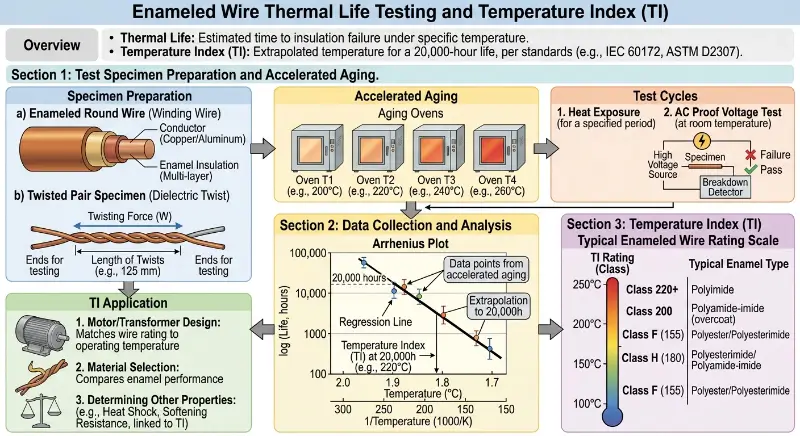
The Temperature Index (TI) is a core quantitative indicator of insulation class. The IEC 60216 series of standards specifies the test method for the thermal life of insulation materials: the sample is subjected to accelerated aging at multiple temperature points (usually 4-5), and its electrical or mechanical properties are measured periodically. The failure time is recorded when the performance drops to 50% of the initial value. The temperature corresponding to 20,000 hours (approximately 2.3 years) extrapolated using the Arrhenius model is the temperature index of the material. For enameled wire, the failure criteria for thermal life testing are usually a drop in breakdown voltage to a specified threshold, cracking of the enameled coating, or conductor exposure. NEMA MW 1000-2018 Part 3 §3.58.1 specifies the specific procedure for thermal life extrapolation. Thermal life data for Class H polyester imide (MW 30) typically shows over 20,000 hours of operation at 200°C and over 80,000 hours at 180°C, perfectly matching the temperature index 180 of IEC 60317-8. Thermal shock temperature is another key parameter, distinct from the temperature index. While the temperature index reflects long-term temperature resistance, thermal shock temperature reflects the enamel coating’s resistance to cracking under short-term temperature fluctuations.
NEMA MW 30 specifies a thermal shock test condition of 200°C for 30 minutes for polyester imide, with no visible cracks in the enamel coating after winding. Class C polyester imide coated with polyamide-imide (MW 35) requires a thermal shock temperature ≥220°C. Even if their long-term operating temperatures are similar, the difference in thermal shock temperature is crucial in transient high-temperature scenarios such as motor starting and regenerative braking. The softening breakdown temperature (TBT) reflects the structural stability of the enamel coating at high temperatures. NEMA MW 1000-2018 Part 3 §3.50 specifies the test method: the specimen is loaded with a specified pressure on a heated plate, and the temperature at which the enamel coating softens to the point of short-circuiting the conductor is recorded. For Class H polyester imides, the TBT requirement is ≥300°C, while for Class C PAI enamel coatings, it is typically above 330-350°C, significantly higher than their operating temperature. This indicator is crucial for assessing the safety of enameled wire under abnormal operating conditions.
Breakdown Voltage and Withstand Voltage Testing
The breakdown voltage of the enamel coating is another core indicator of the insulation performance of the enameled wire. For round copper wire with a nominal diameter of 0.5mm, the minimum room temperature breakdown voltage specified in IEC 60317 series is: Grade 1 ≥1.4 kV, Grade 2 ≥2.8 kV, and Grade 3 ≥4.2 kV. The enamel coating grade (Grade 1/2/3) is directly related to the insulation thickness: Grade 1 single layer, Grade 2 thickened layer, and Grade 3 double layer. Hot breakdown voltage is a key indicator for evaluating the insulation retention capability of the enamel coating at rated operating temperature. NEMA MW 1000-2018 Part 3 §3.52 stipulates that after pretreatment at the rated temperature (e.g., 180°C for Class H), the average breakdown voltage of the sample should not be less than 75% of the specified value at room temperature.
This indicator ensures the actual insulation margin of the enameled wire at the operating temperature, preventing failure due to a sharp drop in breakdown voltage caused by temperature rise. For high-frequency pulse voltage scenarios such as new energy vehicle drive motors and rail transit traction motors, the corona resistant performance and surge resistance of the enamel coating are more critical than the traditional breakdown voltage. The corona resistant test specified in IEC 60851-5 typically uses high-frequency high-voltage pulses (e.g., 20 kHz, ±2 kV) for accelerated aging and records the failure time. The corona resistant life of PAI enamel coating is 5-10 times that of PEI, which is the fundamental reason why double-coated structures dominate in frequency conversion applications.
Selection Decisions and Engineering Applications
The selection of the enameled wire rating should be based on the actual operating temperature of the equipment’s hotspots, rather than simply “the higher the better.” The design should follow the temperature classification principle of IEC 60085: the highest operating temperature of the hottest point of the winding plus an appropriate temperature margin (usually 10-15°C), and then select the corresponding enameled wire rating. For example, if the hottest point of the motor winding is 145°C, a rating of F (155°C) enameled wire should be selected, not rating H. The typical application scenario for rating selection is as follows. Grade F (155°C) is suitable for household appliance motors, general industrial motors, small transformers, and consumer electronics; Grade H (180°C) is suitable for industrial motors, new energy vehicle drive motors, dry-type transformers, rail transit traction motors, and wind turbines; Grade C (200°C) is suitable for high-end new energy vehicle drive motors, rail transit traction motors, mining motors, aircraft generators, and high-frequency inductors; Grade C+ (220°C+) is suitable for deep well motors, nuclear power equipment, aircraft engine windings, and special high-temperature inductors. The trade-off between cost and grade is a key consideration in winding wire selection. From Grade F to Grade H, the cost of enamel coating materials increases by approximately 30-50%; from Grade H to Grade C, the cost of enamel coating materials increases by approximately 50-100%; the cost of C+ grade polyimide enameled wire is typically 3-5 times that of Grade F.
While meeting temperature requirements, the expected lifespan of the equipment, manufacturing costs, and process compatibility should be comprehensively considered to avoid over-design. Process compatibility also needs to be a key focus during selection. Direct-soldering enameled wire (such as 155 grade UEW, solderable polyester) is suitable for automated winding + automatic tinning processes; non-direct-soldering enameled wire (such as PEI, PAI) requires pre-stripping or mechanical scraping. Polyurethane-bonded wire (such as 130 grade, 155 grade UEW bonded wire) is suitable for self-bonding coil processes, and coil curing can be achieved under heating or solvent action. Polyester nylon (such as MW 76, MW 78) with a nylon outer layer can improve the lubricity and wear resistance of the enamel coating, making it suitable for high-speed winding processes.
Common Misconceptions in Class Confusion
In practical engineering, engineers easily confuse “insulation class” with “operating temperature”. Insulation class characterizes the long-term temperature resistance of the enamel coating (based on IEC 60216 extrapolated to 20,000 hours), not the “operating temperature of the equipment”. For example, “Class F enameled wire” means the enamel coating can operate at 155°C for 20,000 hours, but the actual operating temperature of the equipment can be 100°C or 140°C. The key is whether the “actual temperature of the enamel coating” is below 155°C. Another common misconception is equating “thermal class” with “thermal shock resistance”. The fact that Class H enameled wire does not crack under a short-term thermal shock at 200°C does not mean it can operate continuously at 200°C. Similarly, Class C enameled wire does not crack under short-term thermal shock at 220°C, but a temperature index of 200 means that 200°C is its upper limit for long-term operation.
The difference between the temperature index and the thermal shock temperature reflects the different performance dimensions of enamel coating: “long-term temperature resistance” and “short-term shock resistance.” Another misconception is ignoring the many-to-one relationship between enamel coating materials and their grades. The same thermal class (such as Class H 180°C) can be achieved by various enamel coating systems (PEI, PEI+nylon, weldable PE, UEW, polyester glass fiber, etc.), and different enamel coating systems vary significantly in terms of corona resistance, chemical resistance, weldability, and mechanical strength. When selecting a coating, one cannot only look at the thermal class; it is essential to consider whether the additional properties of the specific enamel coating system meet the requirements of the application scenario.
Conclusion
The F, H, and C insulation classes form the temperature resistance foundation for enameled wire in numerous applications across industry, automotive, rail transportation, and aerospace. Class F (155°C), primarily using modified polyurethane, modified polyester, and polyester glass fiber with enamel coating, is the standard choice for motors in consumer electronics and home appliances. Class H (180°C), represented by polyester imide (PEI), is the mainstream configuration for industrial motors and new energy vehicle drive motors. Class C (200°C), primarily using polyester imide coated with polyamide imide (PEI/PAI double coating), is irreplaceable in high-frequency, high-voltage scenarios such as variable frequency motors and traction motors.
Understanding the position of these three levels in standards such as IEC 60085 and NEMA MW 1000-2018, the corresponding enamel coating material systems, and the key test methods (temperature index, thermal shock, softening breakdown, and hot breakdown) is the engineering foundation for winding wire designers to make reasonable selections.