


Last week, I chatted with a client who makes transformers for home appliances. They were calculating the BOM cost for their new project, and the windings were using copper enameled wire. I suggested they try aluminum. He said, “Aluminum is cheaper, but we need to change the slot type, redesign the magnetic circuit, and worry about the client not accepting it.”
This is a very real scenario. But by the end of the conversation we realized that what really held them back from choosing aluminum was not the price, but a few technical questions that were not clear in their minds.
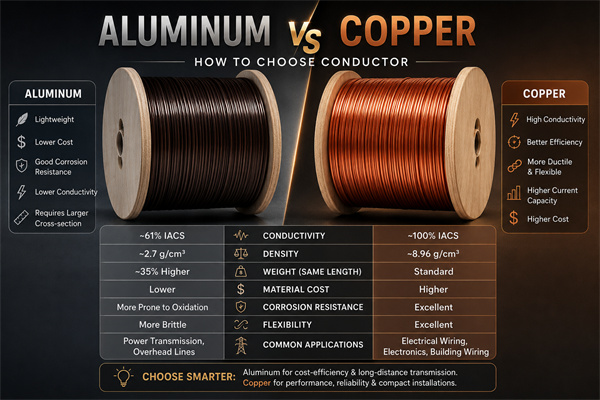
There are a lot of price comparisons online, so this article does not repeat the wheel. I am taking a different angle: setting aside the price, I will explain clearly the differences between aluminum and copper at the engineering application level—to help you judge whether your product should consider replacing copper with aluminum.
An Overlooked Fact
Many engineers, when choosing a conductor material, instinctively think “copper has higher conductivity, aluminum is cheaper” and then calculate based on price. But in reality, replacing copper with aluminum was never purely a price issue. In the industry this conversation has been going on for more than a decade, and the only three scenarios where it has truly landed at scale are EV high-voltage wiring harnesses, large transformers, and low-voltage motors in air conditioner outdoor units. In other scenarios, either the technical constraints are too tight (high frequency, medical, precision instruments) or the batch size is too small (home appliances, specialty equipment) to support the redesign cost.
Understanding the why is far more important than calculating the price.
Three Unavoidable Physical Facts
It is dishonest to compare materials without discussing physical parameters. Three key facts to remember.
Copper has a density of 8.96 g/cm³, and aluminum has a density of 2.70 g/cm³. Aluminum’s weight is only 30 percent of copper’s. This means that for the same volume, aluminum needs much less material, and the burden on transport, handling, and mounting is lighter.
Copper’s conductivity is 100 percent IACS (International Annealed Copper Standard), and aluminum’s is only 61 percent IACS. Aluminum’s conductivity is roughly six tenths of copper’s. This means that to achieve the same current carrying capacity, the cross-sectional area of aluminum wire must be enlarged by 1.64 times.
Copper’s resistivity is 1.724 μΩ·cm, and aluminum’s is 2.654 μΩ·cm. Aluminum’s resistivity is 1.54 times that of copper. Higher resistivity means more heat generated under the same current, making heat dissipation design more complex in long-distance power transmission or high power density scenarios.
Stacking these three together: under equal conductivity, the cross-sectional area of aluminum wire is enlarged by 1.64 times, but the density is only 30 percent, and the final weight is 50 percent of copper’s. This is why electric vehicles, aviation, and rail transit, all of which are weight sensitive, are almost all moving toward aluminum.
The Real Advantages of Copper
We all say copper has better performance, but few people break down exactly where copper is better. Copper’s advantages have four layers, from hard metrics to soft metrics.
Layer One: Electrical and Thermal Hard Metrics
Conductivity is 64 percent higher, resistivity is 35 percent lower. At the same cross-sectional area, copper wire can carry 64 percent more current. At the same current, copper wire generates 35 percent less heat. These two metrics determine that all high performance scenarios must use copper: high frequency transformers, precision instruments, medical equipment, high power density motors.
Layer Two: Mechanical Performance
Copper’s tensile strength is 200 to 400 MPa, aluminum’s is only 90 to 180 MPa. Copper has better elongation, bending 180 degrees without cracking. Aluminum wire breaks more easily during drawing and winding, especially for fine wire below 0.3 mm. This is why the enameled fine wire market is almost monopolized by copper.
Layer Three: Connection Reliability
Copper brazing is cheap and mature, with decades of process accumulation. Aluminum welding requires TIG/MIG equipment, ultrasonic welding heads, and special fluxes, with 30 to 60 percent higher process cost. Aluminum also forms a dense oxide film on its surface, which must be polished off before each weld, otherwise the joint will not hold. The uncertainty of connection processes is the biggest hidden cost of replacing copper with aluminum in the automotive and home appliance fields.
Layer Four: Long-term Reliability
Copper is chemically stable. Decades-old equipment disassembled still shows bright copper wire. Aluminum has creep, a larger thermal expansion coefficient (aluminum 23×10⁻⁶ vs copper 17×10⁻⁶), and fretting corrosion under long-term vibration. All of these require additional reliability verification. Standards such as IEC 60317, ASTM B230/B231, and ISO 19642 have specific test requirements for aluminum wire harnesses, and each OEM’s verification cycle is measured in months.
One sentence summarizing copper’s advantages: hard metrics plus mechanical plus connection plus long-term reliability, all four layers are the default. Choosing copper will not go wrong.
The Real Advantage of Aluminum
Looking at it from the other angle. Aluminum has only one real advantage: weight. But in some scenarios that advantage is decisive.
Scenario One: EV High-voltage Wiring Harnesses
Tesla Model 3’s high-voltage wiring harness was the first to go fully aluminum, reducing the overall vehicle wiring harness weight by 21 percent. BYD, Lucid, and NIO followed. Why? Because for every 100 kg of weight reduction in an electric car, the range can increase by 2 to 3 percent. That 2 to 3 percent on a 600 km range is 15 to 20 km, which is real money. Aluminum high-voltage wiring harnesses are now mature and OEM consensus.
Scenario Two: Enameled Aluminum Flat Wire Entering EV Drive Motor Windings
This is the hottest track from 2024 to 2026. Flat wire has a 20 to 30 percent higher slot fill rate than round wire, and aluminum flat wire is 50 percent lighter than copper flat wire. Drive motors run at high speeds and high power density, and flat wire is the direction of winding evolution. This segment is still in small-batch trials, and will move into mass production in 2026 to 2028.
Scenario Three: Home Appliance Air Conditioner Outdoor Unit Motors and Low-voltage Motors
Aluminum replacing copper has been mature for many years in these scenarios. Outdoor air conditioners are not weight sensitive but are cost sensitive. Low-voltage motors (IE3 and below) have low efficiency requirements. Aluminum enameled wire is more than sufficient in these two scenarios.
Scenario Four: Large Transformers and New Energy Applications
In these scenarios aluminum replacing copper is not mainly about weight reduction, but about material cost and resource security. Copper’s global reserves are far smaller than aluminum’s, with greater geopolitical risk.
One sentence summarizing aluminum’s advantages: the weight advantage is decisive in EV and aviation scenarios. In other scenarios it is a bonus, and cannot be the only reason.
Things You Cannot Look at Only the Physical Characteristics
One: Connection Process Cost
Copper brazing is cheap and mature. Aluminum welding requires TIG/MIG equipment, ultrasonic welding heads, and special fluxes, increasing investment by 30 to 60 percent per production line.
Two: Reliability Verification Cost
Aluminum wire exhibits creep, a high coefficient of thermal expansion (aluminum 23×10⁻⁶ vs copper 17×10⁻⁶), and fretting corrosion under long-term vibration. Standards such as IEC 60317, ASTM B230/B231, and ISO 19642 have specific requirements for aluminum wire harnesses, but each OEM’s verification cycle is measured in months.
Three: Customer Education Cost
End customers have a natural distrust of enameled aluminum wire products, partly because of the aftermath of aluminum cable fires in the 2010s. Marketing, consulting, and after-sales service all need to be counted.
Four: Recycling Value
Scrap copper prices are 4.5 to 5.0 USD per pound (approximately 9,900 to 11,000 USD per ton). Scrap aluminum prices are 0.4 to 0.8 USD per pound (approximately 880 to 1,760 USD per ton). Copper’s residual value is 6 to 10 times that of aluminum. This cannot be ignored for long-life equipment such as transformers and home appliances.
The Real Threshold for Selection
Stacking all of the above dimensions, the real threshold for replacing copper with aluminum is not technology, but batch size.
Small-batch custom projects below 50,000 units per year, stick with copper. The change cost amortized over 50,000 units means every additional dollar per unit is considered expensive.
Medium batches of 200,000 to 500,000 units per year, judge by scenario. Mature scenarios such as transformers, air conditioner outdoor units, and IE3 motors can directly use aluminum. For other scenarios, run a TCO calculation first.
Standardized products with large batches above 500,000 units per year, the cost advantage of replacing copper with aluminum can be fully realized. EV drive motors, new energy photovoltaics, and air conditioner outdoor units. All these scenarios are on the main track of aluminum replacing copper.
The word batch is the core. Look at Tesla, BYD, Haier, Midea. These companies that have made the biggest moves on aluminum replacing copper are all players at the level of millions of units per year. It is not that they have higher awareness, but that they have the confidence to bear the upfront engineering change costs.
When to Choose Aluminum, When to Choose Copper
Strongly Recommended Scenarios for Aluminum
- EV high-voltage wiring harnesses (mature, OEM consensus)
- Large transformers (distribution, power)
- New energy (photovoltaic combiner boxes, wind power cables)
- Weight-sensitive aviation and rail transit
- Residential air conditioner outdoor units and low-voltage motors (IE3 and below)
- Mid-to-low-end enameled wire products (home appliances, consumer goods)
Recommended Scenarios for Copper
- High-frequency signals, precision instruments, medical equipment (stability is the core)
- High power density motors (IE4/IE5)
- High-voltage switches and transformer windings (high insulation requirements)
- High-reliability scenarios where customers do not accept aluminum replacing copper
- Enameled fine wire below 0.3 mm where aluminum drawing is difficult
- Small-batch custom projects
Our View
Zhengzhou LP Industry produces both copper and aluminum wires. After 30 years in the business, we do not take sides.
When a client asks should we use aluminum, we usually ask three questions first.
One: what is your annual production volume? Two: is weight a core selling point of your product? Three: do you have any reusable experience with aluminum replacing copper in your existing designs?
Once those three questions are answered, the answer is clear.
Small batch, weight not sensitive, no aluminum experience. Use copper, do not bother. If one of these three conditions is met, aluminum replacing copper can be considered. If two are met, strongly recommended. If all three are met, you must go aluminum.
There is no standard answer when it comes to conductor materials. Prices change, scenarios change, and customer acceptance changes. But thinking through the why is always more important than calculating how much you saved.
For specific selection analysis tailored to your product, or to learn the engineering change path for aluminum replacing copper, please contact our technical team.