


Core Definition and Engineering Significance of Enameled Wire Flexibility Testing
What is Enameled Wire Flexibility Testing?
Section 2.1 of the Philips Technical Review clearly states that the core testing method for flexibility and windability is: winding copper wire around a needle of approximately the same diameter and testing whether the insulation layer is damaged after winding, requiring the copper wire to remain intact when suddenly heated after winding (simulating immersion treatment). Flexibility testing and adhesion testing are two of the most basic and often confused mechanical performance tests for enameled wires. Flexibility focuses on whether the enamel coating “can be bent,” while adhesion focuses on how well the enamel coating “sticks.” The combined effect of these two factors determines the reliability of enameled wire in sharp bend scenarios.
Why Is Flexibility Testing the “Touchstone of Mechanical Reliability”?
The experimental data in Philips Section 5.1 is alarming: Even microscopic cracks can significantly reduce insulation resistance—dry state enameled wire 10^13–10^14 Ω, slight bending (radius of curvature approximately 1m) can reduce it by 10–100 times, with even stronger effects in sharp bends or around sharp corners.
The flexibility and adhesion comparison table is shown below:
| Dimensions | Flexibility | Adhesion |
|---|---|---|
| Focus Points | Can the enamel coating be bent? | How firmly does the enamel coating adhere? |
| Testing Methods | Mandrel winding + sharp bend + elongation | Check for peeling after winding + 10% stretching |
| Chemical Nature | Molecular chain segment flexibility + crosslinking degree | Chemical bonding between polar groups and the copper surface |
| Strong Characteristics of the Enamel Coating | Soft and bendable enamel coating | Tight bond between the enamel coating and copper |
| Weaknesses | Too soft and easily deformed enamel coating | Too hard and easily peeled |
Both Must Synergize: Excessive flexibility (too soft enamel coating) can lead to decreased adhesion; excessive adhesion (too hard enamel coating) can lead to bending and cracking. In engineering, a “primer + topcoat” double-coating structure is often used to balance this contradiction.
Chemical and Physical Basis of Enameled Coating’s Flexibility
Glass Transition Temperature (Tg): The Physical Watershed of Flexibility
- When the ambient temperature < Tg: The enamel coating is in a glassy state, the molecular chains are “frozen,” resulting in poor flexibility and easy cracking when bent. – When the ambient temperature > Tg: The enamel coating is in a highly elastic state, the molecular chains can move, resulting in good flexibility and no cracking when bent. – Near Tg: The enamel coating is in the transition region, and its mechanical properties change drastically.
In engineering, the Tg of all enamel coatings used in enameled wires is designed to be above the operating temperature to ensure that the enamel coating remains in a glassy state at room temperature and has sufficient mechanical strength. However, Tg cannot be too high, otherwise, at low temperatures (such as -40℃ in automotive electronics), the enamel coating will become too hard and brittle.
Molecular Structure Determines the Flexibility of Enamel Coating
The flexibility of the enamel coating is determined by the following molecular-level factors: – Balance of Rigidity vs. Flexibility of the Main Chain: Polyurethane (UEW) contains a large number of flexible aliphatic segments, resulting in excellent flexibility; polyamide-imide (AIW) achieves both high strength and high toughness through the special arrangement of amide and imide bonds. – Crosslinking Density: Excessive crosslinking results in a hard and easily cracked enamel coating; insufficient crosslinking results in a soft and easily collapsed enamel coating. – Plasticizers: Appropriate addition can improve the toughness of the enamel coating. – Degree of Curing: Incomplete curing results in a soft enamel coating; over-curing results in a brittle enamel coating.
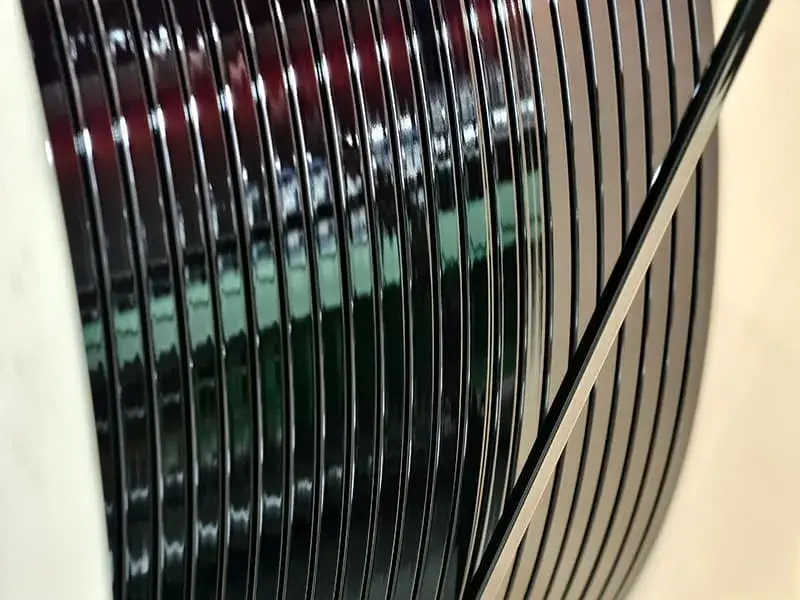
Influence of Enamel Coating Thickness on Strain Distribution
This is why the GB/IEC/JIS system classifies enamel coatings into three levels: Level 1 (thin), Level 2 (medium), and Level 3 (thick)—Level 1 offers the best flexibility, while Level 3 has the highest breakdown voltage.
Five Core Factors Affecting Flexibility
Enamel Coating System: The “Gene” of Flexibility
Enamel Coating Thickness: The Balance Between Flexibility and Breakdown Voltage
Curing Degree: The “Process Lever” of Flexibility
Operating Temperature: The Influence of Environment on Flexibility
The harder the coating, the more brittle it is (e.g., automotive electronics starting at -40℃). Higher temperatures result in softer, more easily deformed coatings. Higher thermal class coatings have higher glass transition temperatures (Tg) and better low-temperature flexibility. 130-grade PEW may crack below -20℃; 220-grade AIW remains flexible at -40℃.
Conductor Pretreatment: An Often-Overlooked Indirect Factor
- Insufficient conductor annealing: micro-cracks occur when bending hard copper wires. – Oil on conductor surface: affects paint wettability and causes uneven coating thickness.
Flexibility Testing Methods and Industry Standards
IEC 60851: A Unified Test Method Basis
The core clauses related to flexibility include: flexibility test, Snap Test, Elongation Test, and Heat Shock Test.
NEMA MW 1000-2018: North American Standard for Flexibility Testing
- Clause 3.3.5: Snap Test – Complete the winding within 1 second. – Clause 3.4: Elongation Test – Record the percentage elongation at which the enamel coating breaks. – Clause 3.58.1: Thermal Shock Test – Check for cracking of the enamel coating after 200°C / 72h.
A core innovation of the NEMA standard is “graded assessment”—the same enameled wire is tested with mandrels of different diameters, corresponding to different levels of application scenarios.
GB/T 6109 and JIS C 3216
JIS C 3216 is widely used in the Asian market, and its grading system (Grade 1/2/3) is fully compatible with GB and IEC.
Mandrel Wrapping Test: 7.1 Polyester Fiberglass Copper Round Wire
Table 4 details the mandrel diameters corresponding to different wire diameter ranges (≤0.500mm uses 0 mandrel, 0.500-1.000mm uses the same diameter, 1.000-2.000mm uses twice the wire diameter, >2.000mm uses three times the wire diameter).
Philips “Flexibility & Windability” Field Testing Method
An insulation resistance ≥ 10^11 Ω is considered (qualified).
Jarnel 0 Winding Test: The Most Stringent Flexibility Test
Passing the Jarnel 0 test indicates that the enameled wire will not crack even under the most extreme sharp bending scenarios.
Elongation Test: Another Important Quantitative Indicator
NEMA standards specify minimum elongation for different diameter ranges: ≥ 15% for 0.630-1.250 mm, ≥ 20% for 1.250-2.800 mm, and ≥ 30% for 2.800-5.000 mm. Higher elongation means the enamel coating can withstand tensile deformation without cracking.
Comparison of Flexibility Among Five Major Enamel Coating Systems
Polyurethane (UEW): The “Champion” of Flexibility.
Polyurethane (UEW) contains a large number of flexible aliphatic segments in its molecular chain, resulting in a soft enamel coating with extremely high elongation. Advantages: Excellent flexibility, highest elongation among the five major systems, direct solderability (180℃ grade, can be immersed in tin at 390-410℃). Disadvantages: Limited heat resistance (130-180℃ grade), lower mechanical strength than PEW/EIW.
Polyesterimide (EIW): The Most Balanced Performance
Advantages: Balanced flexibility, adhesion, and mechanical properties, ensuring flawless performance even in extremely tight, hard-bending winding processes (such as power tool rotors). Disadvantages: Not suitable for direct soldering.
Polyamide-imide (AIW): A Double Ceiling of Flexibility and Heat Resistance
Advantages: Best scratch resistance, softening breakdown temperature of 330-350℃, extremely low internal stress and no cracking when subjected to sudden temperature changes exceeding 200℃. Disadvantages: Highest cost, not suitable for direct soldering, dark color.
Polyester (PEW): A “Veteran” with Moderate Flexibility
Advantages: High mechanical strength, the enamel coating extends synchronously with the conductor and is not prone to cracking, low cost. Disadvantages: Lower flexibility than UEW and EIW, poor thermal shock resistance, and extremely poor hydrolysis resistance.
Polyimide (PI): Designed for Extreme Environments
Advantages: Heat resistance above 240℃, radiation resistance, and chemical resistance. Disadvantages: Worst flexibility (high rigidity), difficult to process, and extremely high cost.
Comparison Table of Five System Flexibility
The table below summarizes the five major enamel coating systems across six key dimensions. The flexibility ranking is: UEW >= AIW > EIW > PEW > PI.
| Enameled Coating System | Flexibility | Elongation | Scratch Resistance | Heat Resistance | Direct Weldability | Cost |
|---|---|---|---|---|---|---|
| PEW | ★★★ | ★★★ | ★★★ | 130-155 | ✗ | ★ |
| UEW | ★★★★★ | ★★★★★ | ★★ | 130-180 | ✓ | ★★ |
| EIW | ★★★★ | ★★★★ | ★★★★ | 180 | ✗ | ★★★ |
| AIW | ★★★★★ | ★★★★★ | ★★★★★ | 220 | ✗ | ★★★★★ |
| PI | ★★ | ★★ | ★★★ | 240+ | ✗ | ★★★★★★ |
Flexibility vs. Adhesion: A Dialectical Relationship
A soft enamel coating (e.g., pure UEW) offers good flexibility but reduces adhesion; a hard enamel coating (e.g., pure PI) has high mechanical strength but is prone to cracking when bent. 200/220 grade EIW/PAIW composite coatings are a classic balance—the bottom layer EIW (70-80%) provides adhesion, and the top layer PAIW (20-30%) provides flexibility and heat resistance.
Flexibility vs. Heat Resistance: The Trade-off of Cross-linking
AIW is the only enamel coating system that maintains high flexibility at 220℃, due to the special design of its molecular structure (amide + imide).
Flexibility vs. Cost: The Trade-off of Engineering Materials
Higher performance enamel coating systems (PI, AIW) are significantly more expensive than standard systems (PEW, UEW). In cost-sensitive applications, lower-grade enamel coatings (e.g., Grade 1 PEW) can be selected to balance flexibility and cost. In high-reliability applications, AIW or composite coatings are recommended despite the higher cost, as the long-term reliability gain outweighs the initial material investment.
Flexibility vs. Breakdown Voltage: The Trade-off of Coating Thickness
Thicker enamel coatings result in higher breakdown voltage but lower flexibility. Thinner enamel coatings offer better flexibility but lower breakdown voltage. Level 1 enamel coatings have lower optimal breakdown voltages for flexibility, while Level 3 enamel coatings have higher optimal breakdown voltages.
Typical Failure Modes and Root Cause Analysis of Flexibility
Bending Cracking: Brittle Fracture
Root Causes: Excessively high enamel coating Tg, excessive crosslinking, excessively small bending radius (R/Ø ≤ 0.5), and incorrect selection of the enamel coating system. Solutions: Select enamel coatings with good flexibility (UEW, EIW, AIW), optimize the curing process, and reduce bending radius limitations.
Stress Whitening: Microscopic Plastic Deformation
Root Cause: The elastic limit of the enamel coating is exceeded, which is usually a critical state and does not necessarily constitute failure. Countermeasures: Use enamel coatings with higher elongation and reduce the bending radius.
Cracking After Impregnation: Thermal Shock Failure
Root Cause: The enamel coating’s thermal shock resistance (Tg) is lower than the impregnation temperature, or the impregnation process involves rapid temperature rise and fall. Countermeasures: Use enamel coatings with good thermal shock resistance (AIW, EIW) and optimize the impregnation process.
Neck Fracture: Philips’ Classic Research in Section 5.1
Root Cause: The enamel coating’s cohesive strength is lower than its interfacial strength, its molecular structure is loose, and curing is insufficient. Countermeasures: Increase curing temperature and switch to an enamel coating system with higher crosslinking density.
How to Improve Flexibility in the Production Process
Optimize the Paint Formulation
Optimize the Coating Process
Optimizing the Curing Temperature Profile
Typical process: 80℃ preheating → 150℃ main curing → 250℃ post-curing → 300℃ final curing. Key: Maintain a curing degree of 85-95%, retaining a certain “flexibility margin.”
Advantages of Dual-Coating Structures
Engineering Requirements for Flexibility in Different Application Scenarios
Motor Windings: Extreme Challenge of Sharp Bends
Flexibility requirements: Jarnel 0 pass + no cracking after 200℃/72h thermal shock. Recommended enamel coatings: 180 grade EIW, 200 grade EIW/PAIW, 220 grade AIW.
Transformer Windings: Stable Flexibility under Long-Term High Temperature
Flexibility requirements: ≥80% flexibility retention after high-temperature aging. Recommended enamel coatings: 180 grade EIW, 200 grade EIW/PAIW, 220 grade AIW.
Home Appliance Motors: Cost-Sensitive Application
Flexibility requirements: Basic flexibility standards met. Recommended enamel coatings: 155 grade UEW, 155 grade PEW.
Automotive Electronics: Reliable Flexibility in Extreme Temperatures
Flexibility requirement: Passes Jarnel 0 testing at -40℃. Recommended enamel coating: Grade 200 EIW/PAIW, Grade 220 AIW.
Aerospace: Ultimate Flexibility for Extreme Environments
Flexibility requirement: Meets extreme temperature cycling requirements. Recommended enamel coating: Grade 240 PI (but requires special formulation design).
How to Quantify Flexibility Requirements in Procurement Specifications
Five Essential Items in Procurement Specifications
Coating: No cracking, no peeling. – Elongation requirement: Refer to NEMA standards, specifying the minimum elongation for different diameter ranges (e.g., ≥ 15% for the 0.630-1.250 mm range).
Best Practice for Sourcing Standards
Acceptance Tolerances and Return Terms
Typical Specifications Example: A Directly Quotable Spec
The enamel coating must pass the following tests: ① No visible cracks after 10 turns of Jarnel 0; ② No cracking or peeling after 72 hours at 200℃; ③ Breakdown voltage not less than 100% of the minimum specified value. The supplier shall provide a factory inspection report and material certificate for each batch of goods.”
Quality Control and Incoming Inspection
Mandatory Incoming Inspection Items
Philips Field Rapid Testing Method
After cooling, visually inspect the coating for visible cracks, bubbles, and peeling. Test the insulation resistance with a 500V megohmmeter; it should remain above 10^11 Ω. Any failure to meet any of these requirements will result in the batch of enameled wire being deemed “inflexible”.
Jarnel 0 Extreme Test: The Most Stringent Flexibility Test
Observe whether the enamel coating at the bend cracks. Enameled wire that passes the Jarnel 0 test can be safely used in sharp bend scenarios and should be a mandatory inspection item for high flexibility enameled wire.
Statistical Sampling Plan: AQL-Based Approach
Industry Misconceptions and Common Misconceptions
Misconception 1: The stronger the flexibility, the better Incorrect.
Excessive flexibility (overly soft enamel coating) can lead to decreased mechanical strength and weakened adhesion. Correct approach: Choose an appropriate flexibility level based on the application scenario.
Myth 2: Thicker enamel coating, better flexibility Incorrect.
A thicker enamel coating results in more uneven bending strain distribution, making it more prone to cracking. Correct approach: Choose the enamel coating grade based on actual working conditions; G1 is sufficient, G2 is unnecessary.
Myth 3: All “high flexibility” promises are the same Incorrect.
Even with the same “high flexibility” promise, test conditions can vary significantly: bending radius, temperature, thermal shock, immersion. Correct approach: Require suppliers to clearly specify test methods, conditions, and criteria in their specifications.
Myth 4: PI is the best enameled wire Incorrect.
PI is the best choice in extreme environments above 240℃, but has the worst flexibility at room temperature. In most civilian applications, PI is over-designed. Correct Approach: Select the enamel coating system based on the thermal class.
Myth 5: UEW is always more flexible than PEW Partially Correct.
At the same thickness, UEW is indeed more flexible than PEW; however, UEW enamel coating can be made thinner, so specific comparisons are needed in actual engineering. Correct Approach: Consider enamel coating thickness, enamel coating system, and application scenario comprehensively.
Myth 6: Passing Jarnel 0 means everything is fine Incorrect.
Jarnel 0 is an initial flexibility test and cannot predict flexibility degradation over long-term operation. Correct Approach: Combine Jarnel 0 + thermal shock + immersion simulation testing.
Conclusion
Enameled wire flexibility testing is an engineering indicator that can be quantified through international standards (IEC 60317 / NEMA MW 1000 / GB/T 6109 / JIS C 3216). Key points: Flexibility and adhesion tests are two of the most basic and easily confused mechanical property tests for enameled wire; the glass transition temperature (Tg) is the physical dividing line for flexibility; the five major factors affecting flexibility are the enamel coating system, enamel coating thickness, curing degree, operating temperature, and conductor pretreatment; the flexibility ranking of the five enamel coating systems is UEW ≥ AIW > EIW > PEW > PI; a 200/220 grade EIW/PAIW composite coating is the optimal solution overall; Philips Section 5.1: dry state 10^13-10^14 Ω, slight bending reduces resistance by 10-100 times, and sharp bending is even stronger; the Jarnel 0 test is the most stringent flexibility test. For downstream users in industries such as motors, transformers, home appliances, new energy vehicles, and rail transportation, choosing “high flexibility” enameled copper wire is essentially choosing long-term reliability, end-user satisfaction, and brand reputation. If your application involves harsh conditions such as sharp bends, automated winding, tight winding, and low-temperature environments, it is recommended to explicitly require “high flexibility” enameled copper wire in your procurement specifications and request complete test reports and material certificates from the supplier. Furthermore, establishing long-term technical partnerships with enameled wire suppliers, involving them in the early stages of product design, and jointly optimizing the enameled coating system and winding process parameters will be the key to achieving the best return on investment for “high flexibility.”