

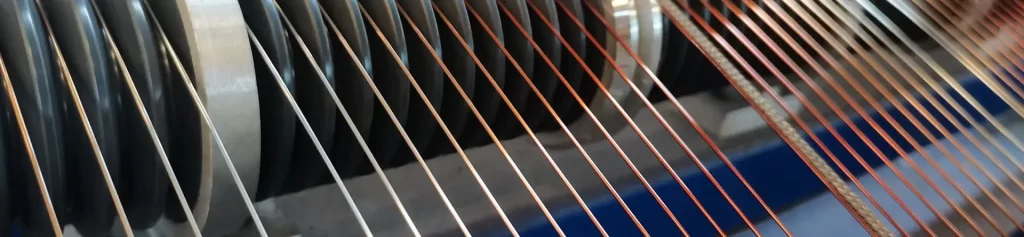
For enameled aluminum wire to “withstand high temperatures” is no easy task.
It must work long-term in high-temperature scenarios such as motor windings, transformers, compressors, and new energy vehicles, requiring excellent heat resistance.
Today, we will systematically explain the core points of heat resistance performance of enameled aluminum wire.
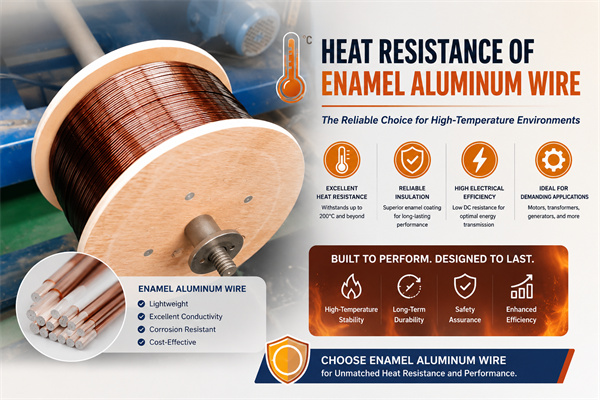
I. What Is Heat Resistance of Enameled Aluminum Wire?
Heat resistance of enameled aluminum wire refers to the ability of enameled aluminum wire to maintain stable performance in high-temperature environments. It contains three layers of meaning:
Thermal Class:
Refers to the highest temperature at which enameled aluminum wire can work reliably long-term, usually expressed in forms such as “Class 200” or “Class 220.” The thermal class is jointly determined by the enamel material, enamel thickness, and thermal aging life.
Heat Shock:
Refers to the ability of enameled aluminum wire to withstand rapid temperature changes in a short time (such as instantly rising from room temperature to above 200°C) without cracking or peeling. This is a key indicator for measuring enamel toughness.
Long-term Thermal Aging:
Refers to the life performance of enameled aluminum wire at long-term working temperature, usually marked as “20,000 hours life” or “10 years life.”
Core Relationship:
The thermal class of enameled aluminum wire is not the “working temperature” but the “working temperature that ensures life.” For example, Class 200 enameled aluminum wire can work at 200°C for more than 20,000 hours long-term.
II. International Markings for Thermal Class of Enameled Aluminum Wire
1. IEC Standard (IEC 60085 / 60317)
IEC 60085 is the thermal classification standard for electrical insulation, directly corresponding to the thermal class of enameled aluminum wire:
- Class E (120°C) — Lowest thermal class
- Class B (130°C) — General class
- Class F (155°C) — More general
- Class H (180°C) — High temperature
- Class C (200°C / N class) — Higher temperature
- Class C+ (220°C / R class) — Extremely high temperature
- Class HC (240°C) — Highest thermal class
2. Common Thermal Classes for Enameled Aluminum Wire
According to the IEC 60317 series standards, the thermal classes of enameled aluminum wire are mainly distributed between 120°C-240°C:
- 120°C (Class E): Polyester (PEW)
- 130°C (Class B): Modified polyester, polyurethane
- 155°C (Class F): Polyesterimide (EIW)
- 180°C (Class H): Polyesterimide (EIW)
- 200°C (Class C): Polyesterimide + polyamide-imide composite coating
- 220°C (Class C+): Polyamide-imide (AIW)
- 240°C (Class HC): Polyimide (PI)
3. NEMA Standard (NEMA MW 1000)
The NEMA standard also uses Class 105/130/155/180/200/220/240 markings. NEMA Class 200 corresponds to IEC Class 200, and NEMA Class 220 corresponds to IEC Class 220.
4. GB/T Standard (China)
The GB/T 6109 series standards are equivalent to IEC 60317 and use the same thermal class markings.
III. Key Factors Affecting Heat Resistance of Enameled Aluminum Wire
1. Enamel Material (Most Critical Factor)
Different enamel materials have completely different heat resistance capabilities:
| Enamel Material | Thermal Class | Abbreviation |
|---|---|---|
| Polyester | 130/155°C | PEW |
| Polyurethane | 130/155/180°C | UEW |
| Polyesterimide | 180/200°C | EIW |
| Polyamide-imide | 220°C | AIW |
| Polyimide | 240°C | PI |
| Composite Coating | 200-220°C | Multi-layer |
Key Point: The enamel material is the fundamental factor determining the thermal class. For high-temperature applications, enamels with high thermal class must be selected.
2. Enamel Thickness
Generally, the thicker the enamel, the better the heat resistance (because the impact of thermal aging is mainly on the surface layer). But excessively thick enamel affects slot fill rate and winding performance.
The IEC 60317 standard divides enamel thickness into three grades:
- Grade 1 (thin enamel): Good heat dissipation, suitable for dense winding
- Grade 2 (standard enamel): Universal, balanced performance
- Grade 3 (thick enamel): Better heat resistance but more space occupation
3. Purity of Aluminum Conductor
Enameled aluminum wire uses high-purity aluminum of 99.99% or above. High-purity aluminum has better enamel adhesion and heat resistance compared with alloy aluminum.
Aluminum conductors require pre-oxidation treatment or coupling agent treatment before use to enhance enamel adhesion.
4. Enamel Coating Process
- Coating passes: usually 4-8 passes
- Curing temperature: 400-600°C
- Curing time: affects enamel crosslinking degree
5. Adhesion Between Enamel and Aluminum
Aluminum surfaces easily form aluminum oxide layers (Al₂O₃), requiring special treatment before coating: pre-oxidation treatment, coupling agent treatment, chemical conversion treatment.
Good adhesion is the foundation of enamel heat resistance. Insufficient adhesion causes the enamel to easily crack and peel at high temperatures.
IV. Core Indicators of Heat Resistance for Enameled Aluminum Wire
1. Temperature Index
A comprehensive indicator of heat resistance, usually based on 20,000 hours of life.
2. Heat Shock Temperature
- Class 130: Heat shock temperature 140°C
- Class 155: Heat shock temperature 175°C
- Class 180: Heat shock temperature 200°C
- Class 200: Heat shock temperature 220°C
- Class 220: Heat shock temperature 240°C
- Class 240: Heat shock temperature 260°C
Heat shock test method: place enameled aluminum wire at the specified temperature for 30 minutes, then cool to room temperature, and check whether the enamel cracks.
3. Cut-Through Temperature
- Typical value: ≥ 200°C (Class 130 and above)
- Class 200: ≥ 320°C
- Class 220: ≥ 340°C
- Class 240: ≥ 360°C
4. Long-term Thermal Aging Life
- Typical requirement: more than 20,000 hours
- Actual application: usually requires 10-20 years of life
- Equivalent temperature: every 10°C increase halves the life (10°C rule)
5. Breakdown Voltage Retention
- Room temperature breakdown voltage: ≥ 5000V (typical value)
- Rated temperature breakdown voltage: ≥ 75% of room temperature value
V. Comparison of Different Thermal Classes of Enameled Aluminum Wire
1. Class 120 (E Class) — 120°C
Enamel: Polyester (PEW)
Features: Lowest cost, lowest thermal class, suitable for room temperature, low temperature, or oil-immersed environments
Typical Applications: Oil-immersed transformers, ordinary home appliances, industrial control coils
2. Class 130 (B Class) — 130°C
Enamel: Modified polyester, polyurethane
Features: Low cost, moderate performance, strong universality
Typical Applications: General motors, home appliance motors, general transformers
3. Class 155 (F Class) — 155°C
Enamel: Polyesterimide (EIW)
Features: High cost-performance ratio, moderate thermal class, wide range of applications
Typical Applications: General motors, industrial motors, medium temperature transformers
4. Class 180 (H Class) — 180°C
Enamel: Polyesterimide (EIW)
Features: High thermal class, good comprehensive performance, extremely wide range of applications
Typical Applications: Industrial motors, traction motors, wind power motors, high temperature transformers, general inverter motors
5. Class 200 (C Class) — 200°C
Enamel: Polyesterimide + polyamide-imide composite coating
Features: Higher thermal class, excellent chemical resistance, suitable for harsh environments
Typical Applications: High temperature industrial motors, inverter-driven motors, compressor motors, traction motors
6. Class 220 (C+ Class) — 220°C
Enamel: Polyamide-imide (AIW)
Features: Extremely high temperature, excellent chemical resistance, refrigerant resistance, extremely high mechanical strength
Typical Applications: Air conditioner compressors, refrigerator compressors, electric vehicle drive motors, high-end industrial motors
7. Class 240 (HC Class) — 240°C
Enamel: Polyimide (PI)
Features: Highest temperature, radiation resistance, suitable for extreme environments, very high cost
Typical Applications: Aerospace motors, spacecraft, military equipment, nuclear industry
VI. Impact of High Temperature on Enameled Aluminum Wire
1. Impact of Short-term High Temperature
Short-term high temperature (less than 1 hour) mainly affects: instant enamel softening, instant enamel expansion, possible cracking after cooling, with reversible or slightly irreversible impact.
2. Impact of Long-term High Temperature
Long-term high temperature (thousands to tens of thousands of hours) continuously affects: slow enamel aging, gradual embrittlement, decreased enamel-aluminum adhesion, gradual decrease in breakdown voltage, with irreversible impact eventually leading to failure.
3. Impact of Temperature Cycling
Temperature cycling (alternating high and low temperatures) accelerates enamel aging: internal stress from thermal expansion and contraction, enamel-aluminum expansion coefficient differences, easy cracking after multiple cycles, significantly accelerating aging.
4. Compound Impact of Actual Working Conditions
In actual working conditions, temperature is often compounded with: vibration, humidity, chemical media, oil contamination, mechanical stress. These factors significantly accelerate enamel aging and shorten the actual life of enameled aluminum wire.
VII. Methods to Improve Heat Resistance of Enameled Aluminum Wire
1. Select High Temperature-Resistant Enamel
The most direct method: select Class 200 or above enamel. For example, inverter motors recommend Class 200 or above enamel (polyesterimide + polyamide-imide composite coating).
2. Increase Enamel Thickness
For high temperature applications, consider selecting Grade 3 (thick enamel): increased enamel thickness, improved breakdown voltage, enhanced thermal aging resistance, at the cost of increased space occupation.
3. Optimize Coating Process
- Increase coating passes (from 4-6 to 6-8 passes)
- Increase curing temperature (within reasonable range)
- Control coating speed
- Improve enamel uniformity
4. Optimize Aluminum Conductor Treatment
- High-purity aluminum (≥99.99%)
- Surface pretreatment (pre-oxidation, coupling agent)
- Control conductor surface roughness
- Reduce enamel-aluminum interface defects
5. Design Derating Use
Leave sufficient margin for temperature in design: working temperature < 80% of enamel thermal class, < 60% for critical applications (automotive, military), leaving sufficient safety margin.
6. Optimize Use Environment
- Strengthen heat dissipation (add fans, improve air ducts)
- Lower working temperature
- Reduce temperature cycling
- Avoid chemical media erosion
VIII. Heat Resistance Requirements for Common Application Scenarios
- Home Appliance Motors: Working temperature 100-130°C, recommended Class 130-155, PEW or EIW enamel, focus on cost control
- Industrial Motors: Working temperature 130-180°C, recommended Class 155-180, EIW enamel, focus on reliability
- Inverter Motors: Working temperature 120-180°C, recommended Class 180-200, EIW+AIW composite coating, focus on corona resistance
- New Energy Vehicle Drive Motors: Working temperature 140-180°C, recommended Class 200-220, PEW+AIW composite coating, focus on high temperature resistance, corona resistance, long life
- Air Conditioner/Refrigerator Compressors: Working temperature 120-160°C, recommended Class 180-200, PEW+AIW composite coating, focus on refrigerant resistance and high temperature
- Aerospace Motors: Working temperature 180-240°C, recommended Class 220-240, AIW or PI enamel, focus on extreme environments and long life
- Wind Power Generators: Working temperature 120-150°C, recommended Class 180, EIW enamel, focus on long life and reliability
IX. Common Misconceptions
Misconception 1: Thermal Class = Working Temperature
Actually, the thermal class is the highest temperature at which the enamel can work reliably long-term, not the design working temperature. The design working temperature should leave a 20-30% safety margin.
Misconception 2: Aluminum Wire Has Worse Heat Resistance than Copper Wire
Actually, the heat resistance of enameled aluminum wire mainly depends on the enamel material and has little to do with aluminum or copper conductor. Under the same enamel, the thermal class of aluminum wire and copper wire is the same.
Misconception 3: Higher Thermal Class Is Always Better
The higher the thermal class, the higher the cost. The appropriate thermal class should be selected based on actual working temperature to avoid over-specification.
Misconception 4: Only Looking at Short-term High Temperature, Not Long-term Aging
Short-term high temperature tests may pass, but long-term thermal aging performance may be poor. Design should focus on long-term thermal aging life.
Misconception 5: Ignoring Heat Shock
Many enameled aluminum wires perform well at stable high temperatures but are prone to cracking during rapid temperature changes. Heat shock performance is equally important.
Misconception 6: Thicker Enamel Is Always Better
Thicker enamel has better heat resistance, but excessively thick enamel affects slot fill rate and winding performance. The appropriate enamel thickness grade should be selected based on actual needs.
X. FAQ
Q: What is the highest thermal class of enameled aluminum wire?
A: The highest thermal class is Class 240 (HC class), using polyimide (PI) enamel, which can withstand 240°C high temperature.
Q: Can Class 200 enameled aluminum wire be used at 220°C?
A: No. The highest long-term working temperature of Class 200 enameled aluminum wire is 200°C. Use at 220°C will significantly shorten life.
Q: Which has better heat resistance, aluminum wire or copper wire?
A: The heat resistance of enameled aluminum wire and enameled copper wire mainly depends on the enamel material. Under the same enamel, both have the same thermal class.
Q: What is the difference between thermal class and heat shock resistance?
A: Thermal class is the long-term working temperature; heat shock resistance is the ability to withstand rapid temperature changes in a short time. Both are key indicators of enameled aluminum wire.
Q: Why do inverter motors require Class 200 or above enameled aluminum wire?
A: Inverter drive generates high-frequency voltage pulses and harmonics, leading to elevated motor winding temperature and corona discharge. Class 200 or above corona-resistant enamel can effectively address this.
Q: How to determine if enameled aluminum wire meets Class 200?
A: Require suppliers to provide third-party test reports, including breakdown voltage, heat shock, long-term thermal aging, and other indicators. Class 200 requires a minimum temperature index of 200 and heat shock temperature of at least 220°C.
Q: What is the working temperature of new energy vehicle drive motors?
A: Usually 140-180°C, with some high-performance motors reaching above 200°C. Class 200 or above enameled aluminum wire is recommended.
Q: Will the life of enameled aluminum wire be shortened in high temperature environments?
A: Yes. Empirical rule: for every 10°C increase in working temperature, the life of enameled aluminum wire is halved. Therefore, higher thermal class enameled aluminum wire should be selected in high temperature environments.
XI. Future Trends of Heat Resistance for Enameled Aluminum Wire
1. Higher Thermal Classes
With the development of high-temperature applications such as new energy vehicles, aerospace, and nuclear industry, the demand for higher thermal classes (Class 240 and above) continues to increase.
2. Improved Corona Resistance
New corona-resistant enamels combine the dual characteristics of Class 200 or above thermal resistance and corona resistance.
3. Eco-Friendly Enamels
- Water-based enamels
- Solvent-free enamels
- RoHS and REACH compliant
- More environmentally friendly while ensuring heat resistance
4. Intelligent Detection
- Online enamel thickness detection
- Real-time monitoring of curing process
- AI quality control
- Improving consistency of enameled aluminum wire
5. Composite Coating Technology
- More flexible primer + topcoat combinations
- Customized enamel for specific applications
- Precise control of thermal class