

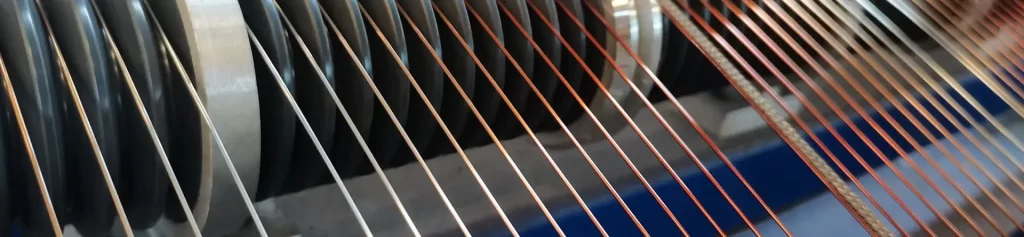
The performance of enameled wire depends largely on the thin enamel film on its surface.
Different enamel materials vary dramatically in thermal class, chemical resistance, mechanical strength, and processability.
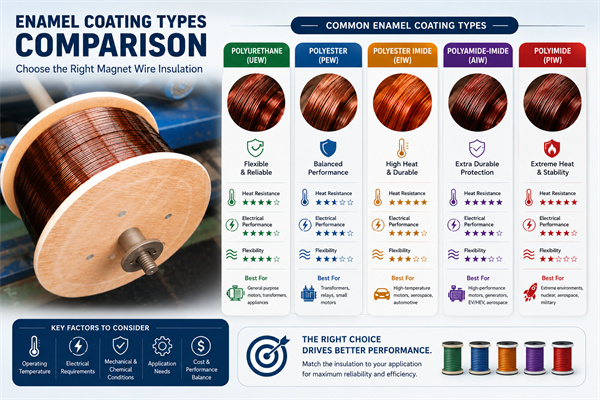
Today, we will systematically compare the various enameled wire insulation types to help you make the most appropriate choice.
I. Understanding the Core Functions of Enamel Film
The enamel film is a key component of enameled wire, serving multiple core functions.
Electrical Insulation:
The enamel provides electrical isolation between conductors, preventing short circuits and leakage. The thicker and more uniform the enamel, the better the insulation performance.
Mechanical Protection:
The enamel protects the conductor from mechanical damage, including friction, bending, and tension during winding.
Thermal Protection:
The enamel withstands thermal stress at working temperatures, determining the thermal class of the enameled wire.
Chemical Protection:
The enamel resists chemical attack from solvents, oils, and moisture, maintaining long-term stability.
Process Adaptation:
Different enamels suit different winding, soldering, and impregnation processes.
II. International Markings for Enamel Coatings
Before examining the various enamels, let’s understand the internationally accepted marking system.
Abbreviation Markings (IEC/NEMA Standards):
- PVF / PVAc: Polyvinyl Acetal
- UEW: Urethane Enamel Wire
- PEW: Polyester Enamel Wire
- EIW: Polyesterimide Enamel Wire
- AIW: Polyamide-imide Enamel Wire
- PI: Polyimide
Thermal Class Markings (IEC 60085):
- Class E: 120°C
- Class B: 130°C
- Class F: 155°C
- Class H: 180°C
- Class C: 200°C
- Class C+: 220°C
- Class HC: 240°C
III. Detailed Overview of Seven Mainstream Enamel Types
1. Polyvinyl Acetal (PVF / PVAc)
Thermal Class: 105°C / 120°C
Polyvinyl acetal is one of the earliest commercially available synthetic enamels. It offers excellent adhesion and flexibility, with a strong bond between the enamel and copper conductor and good mechanical performance.
Main Advantages: Good flexibility, strong adhesion to copper, high mechanical strength, lower cost
Main Disadvantages: Lower thermal class, average chemical resistance, not suitable for high-temperature applications
Typical Applications: Oil-immersed transformers, general motors, early home appliances, industrial coils
International Standards: IEC 60317-1, NEMA MW 15
2. Polyurethane (UEW)
Thermal Class: 130°C / 155°C / 180°C
Polyurethane enamel is one of the mainstays of modern enameled wire. Its greatest feature is solderability—no need to pre-strip the enamel, it can be directly soldered in 380-420°C solder.
Main Advantages: Direct solderability eliminates stripping, thin enamel suits dense winding, easy to process, good high-frequency performance
Main Disadvantages: Relatively lower mechanical strength, average heat shock resistance, limited high-temperature applications
Typical Applications: Electronic transformers, high-frequency coils, inductors, automated winding products, relay coils
International Standards: IEC 60317-4, NEMA MW 75
3. Polyester (PEW)
Thermal Class: 130°C / 155°C
Polyester enamel is one of the most widely used enamel types, offering good comprehensive performance and cost advantages. Polyester enamel has excellent mechanical performance at room temperature, but its performance drops more quickly in high-temperature environments.
Main Advantages: Low cost, high cost-performance ratio, good mechanical properties, mature process, strong universality
Main Disadvantages: Average heat shock resistance, not suitable for high-humidity environments, not direct solderable
Typical Applications: General motors, home appliance motors, transformers, industrial control, ordinary coils
International Standards: IEC 60317-13, NEMA MW 24
4. Polyesterimide (EIW)
Thermal Class: 180°C / 200°C
Polyesterimide enamel is an “upgraded” version of polyester. By introducing imide groups into the molecular structure, it significantly improves thermal class and heat shock resistance. EIW enamel is widely used in Class H (180°C) and Class C (200°C) motors.
Main Advantages: High thermal class, excellent heat shock resistance, high mechanical strength, excellent cost-performance ratio
Main Disadvantages: Not direct solderable, slightly higher cost than polyester
Typical Applications: Industrial motors, traction motors, wind power motors, inverter motors, high-temperature transformers
International Standards: IEC 60317-8, NEMA MW 30
5. Polyamide-imide (AIW)
Thermal Class: 220°C
Polyamide-imide enamel is a representative high-temperature-resistant enamel, often used as a topcoat for double-coating enameled wire. Its molecular structure combines the flexibility of amide bonds with the high-temperature resistance of imide bonds, making it one of the best-performing enamels overall.
Main Advantages: Extremely high thermal class, excellent chemical resistance, refrigerant resistance, very high mechanical strength, wear and abrasion resistance
Main Disadvantages: Higher cost, not direct solderable, usually requires use with primer
Typical Applications: Inverter motors (corona resistance), air conditioner compressors, refrigerator compressors, electric vehicle drive motors, high-end industrial motors
International Standards: IEC 60317-26, NEMA MW 81
6. Polyimide (PI)
Thermal Class: 240°C
Polyimide enamel has the highest thermal class among organic enamels, known as the “tip of the enamel pyramid.” PI enamel can work continuously at the extreme high temperature of 240°C and even withstand peak temperatures above 400°C for short periods.
Main Advantages: Highest thermal class, radiation resistance, excellent chemical resistance, good dimensional stability, excellent dielectric properties
Main Disadvantages: Extremely high cost, dark color (usually deep brown), not direct solderable, high process requirements
Typical Applications: Aerospace motors, spacecraft, military equipment, nuclear industry, high-end medical equipment
International Standards: IEC 60317-7, NEMA MW 16
7. Composite Coating Enamel
Thermal Class: 180-220°C (depending on combination)
Composite coating enamels combine the advantages of two enamels, with the common combination being “primer + topcoat.” The primer provides adhesion and heat shock resistance, while the topcoat provides thermal and chemical resistance.
Main Composite Solutions:
- PEW + AIW: Polyester primer + Polyamide-imide topcoat (Class H/C)
- EIW + AIW: Polyesterimide primer + Polyamide-imide topcoat (Class C/C+)
- UEW + PA: Polyurethane primer + Polyamide topcoat (self-bonding wire)
Typical Applications: High-end industrial motors, electric vehicle drive motors, high-reliability products, aerospace and military
International Standards: IEC 60317-13, NEMA MW 35/36
IV. Comprehensive Enamel Coating Comparison Table
| Enamel Type | Abbreviation | Thermal Class | Solderable | Chemical Resistance | Cost | Main Applications |
|---|---|---|---|---|---|---|
| Polyvinyl Acetal | PVF | 105/120°C | No | Medium | Low | Oil-immersed transformers |
| Polyurethane | UEW | 130/155/180°C | Yes | Medium | Medium | Electronic transformers |
| Polyester | PEW | 130/155°C | No | Medium | Low | General motors |
| Polyesterimide | EIW | 180/200°C | No | Good | Medium | Industrial motors |
| Polyamide-imide | AIW | 220°C | No | Excellent | High | Inverter motors |
| Polyimide | PI | 240°C | No | Excellent | Very High | Aerospace and military |
| Composite Coating | Multi-layer | 180-220°C | No | Excellent | High | High-end motors |
V. Core Factors in Enamel Selection
1. Working Temperature
Working temperature is the primary factor in enamel selection. Principle: select an enamel with thermal class greater than or equal to the working temperature plus safety margin.
2. Soldering Process
For scenarios requiring automated soldering, prioritize direct solderable polyurethane (UEW) enamel.
3. Working Environment
- Humid environment: Choose hydrolysis-resistant enamels
- Chemical media: Choose chemical-resistant enamels
- High radiation: Choose PI enamel
4. Mechanical Stress
For high mechanical stress scenarios, prioritize enamels with high mechanical strength.
5. Cost
- Budget-sensitive: PEW, UEW
- Performance-first: EIW, AIW
- Extreme requirements: PI
6. Process Compatibility
- High-speed winding: Choose thin enamel
- Impregnation process: Choose impregnation-resistant enamel
- Automated soldering: Choose direct solderable enamel
VI. Best Enamel Selection for Different Applications
- General Motors: PEW + Grade 2
- Industrial Motors: EIW + Grade 2
- Inverter Motors: PEW + AIW composite coating
- New Energy Vehicle Drive Motors: PEW + AIW composite coating or AIW
- Air Conditioner/Refrigerator Compressors: PEW + AIW composite coating
- High-Frequency Transformers: UEW
- Aerospace Motors: PI
- Oil-Immersed Transformers: PVF
VII. Development Trends of Enamel Coatings
1. Thermal Class Improvement
Class C+ (220°C) and Class HC (240°C) enamels are finding increasingly wider applications.
2. Corona Resistance
New corona-resistant enamels significantly improve performance by adding inorganic nano-fillers.
3. Eco-Friendly Enamels
- Water-based enamels
- Solvent-free enamels
- Low VOC emissions
- RoHS and REACH compliance
4. High-Frequency Applications
Polyurethane thin-film enamels show increasing advantages in high-frequency applications.
5. Multifunctional Composites
Future enamels will combine multiple characteristics including thermal resistance, corona resistance, chemical resistance, and flame retardancy.
VIII. FAQ
Q: How to quickly identify enamel types?
A: Identify from the color of the enameled wire, specifications, or supplier documentation. Polyurethane is usually light-colored or transparent, while polyimide is usually deep brown.
Q: Why can polyurethane enamel be directly soldered?
A: Polyurethane enamel rapidly decomposes and carbonizes at the high temperature of 380-420°C, exposing the copper conductor and allowing solder to wet it.
Q: What are the advantages of composite coating over single coating?
A: Composite coatings combine the advantages of primer and topcoat.
Q: How to choose the thermal class of enamel?
A: Select an enamel with thermal class greater than or equal to the working temperature plus safety margin.
Q: Why is AIW enamel often used as a topcoat?
A: AIW enamel has high mechanical strength and good chemical resistance, but relatively weak adhesion to copper.
Q: Why is PI enamel so expensive?
A: High raw material costs, complex synthesis process, and strict coating process requirements.