

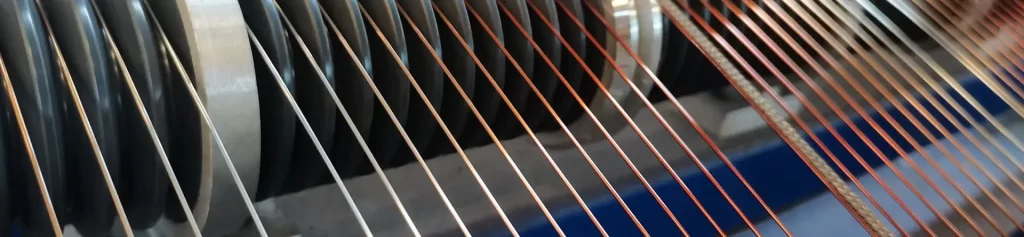
Elongation is an important indicator for measuring the mechanical properties of enameled wire, directly affecting the processability of the conductor and the reliability of the finished product. As an important winding material, the elongation characteristics of enameled aluminum magnet wire have important effects in winding, assembly, and operation processes. Elongation reflects the material’s ability to undergo plastic deformation under tensile load. For enameled wire, elongation affects both operability during winding and the reliability of finished windings under temperature changes and mechanical stress.
Basic Concept of Elongation
Definition and Calculation
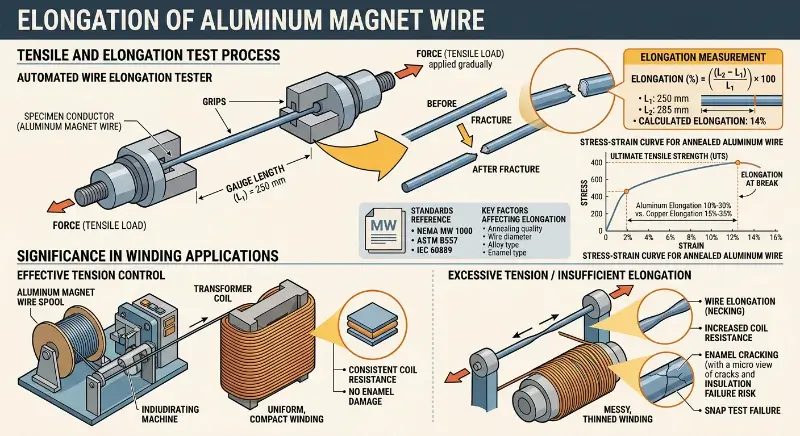
Elongation refers to the ratio of the elongation of the original gauge length to the original gauge length when the specimen breaks during a tensile test, usually expressed as a percentage. Elongation formula: Elongation(%) = (L₁ – L₀) / L₀ × 100%. Where L₀ is the original gauge length and L₁ is the gauge length after specimen fracture. The greater the elongation, the stronger the material’s plastic deformation ability.
Engineering Significance of Elongation
Elongation is an important characterization parameter of material plasticity, reflecting the maximum plastic deformation degree the material can withstand before fracture. For enameled wire, elongation has multiple engineering significances. First, it affects the winding process: higher elongation allows the conductor to withstand greater bending and tension during winding without fracture. Second, it affects finished product reliability: conductors with good elongation are less prone to brittle fracture under temperature cycling and vibration environments.
Elongation Characteristics of Aluminum Magnet Wire
Inherent Properties of Aluminum
As a face-centered cubic metal material, aluminum itself has good plasticity and ductility. Pure aluminum’s elongation can reach 30%-50%, far higher than many other metals. However, aluminum conductors used for enameled wire are typically electrical-grade aluminum alloys, requiring balance between conductivity and mechanical properties. Electrical aluminum’s elongation is typically between 15%-30%.
Comparison with Copper Wire
| Material | Elongation |
|---|---|
| Pure Aluminum (1350-O) | 30%-50% |
| Pure Copper | 30%-50% |
| Electrical Aluminum | 15%-30% |
| Oxygen-Free Copper | 20%-40% |
It is worth noting that although aluminum’s elongation absolute value is close to copper, aluminum’s elastic modulus is lower, about one-third of copper’s. This means under the same force, aluminum wire is more prone to deformation.
Elongation of Different Aluminum Materials
| Material | Elongation |
|---|---|
| Pure Aluminum (1350-O) | 25%-35% |
| Al-Mg Alloy (5000 series) | 15%-25% |
| Al-Mg-Si Alloy (6000 series) | 10%-20% |
Factors Affecting Elongation
Chemical Composition
Aluminum’s chemical composition has a significant effect on elongation. Pure aluminum has higher elongation than aluminum alloys, because alloying elements form second phases that hinder dislocation movement. Electrical aluminum usually contains small amounts of impurity elements such as iron, silicon, and copper. Although these elements help increase strength, they reduce elongation.
Processing Technology
The processing technology of aluminum conductors significantly affects the final elongation. Annealing treatment is one of the most important influencing factors. Fully annealed (O-temper) aluminum has the highest elongation. Cold-work hardened aluminum has significantly reduced elongation. Half-hard state (H14, etc.) elongation falls between the two. The aluminum conductor of enameled aluminum magnet wire typically uses O-temper (annealed state) to ensure good elongation and processability.
Wire Diameter Specification
Different diameter aluminum conductor elongations differ. Fine wire typically has relatively higher elongation, because fine wire experiences relatively uniform deformation during drawing. Coarse wire (larger diameter) may experience uneven deformation during drawing, leading to uneven elongation distribution. Quality control needs to pay attention to elongation stability of coarse wire.
Temperature Factors
Temperature has a significant effect on elongation. At higher temperatures, aluminum’s elongation increases and strength decreases. Enameled aluminum magnet wire’s temperature rise during operation affects its mechanical properties. Design should consider the influence of elongation changes at operating temperatures on winding reliability.
Coating Influence
The coating has influence on the overall elongation of aluminum magnet wire. The coating, as an insulation layer, affects the overall mechanical behavior of the conductor. When the conductor is pulled, the coating shares the load with the aluminum conductor. The coating’s elastic modulus and elongation at break affect overall performance. The adhesion between coating and conductor also affects the actual measurement of elongation.
Elongation Testing Methods
Standard Testing Methods
Elongation testing is usually carried out according to international and regional standards. IEC 60851 series standards specify enameled wire testing methods, including elongation testing. NEMA MW1000 standard also contains elongation testing requirements. China GB/T 4074 series standards basically correspond to international standards.
Testing Equipment
Elongation testing typically uses universal material testing machines or dedicated enameled wire elongation testers. Testing equipment should have precise displacement control and load measurement capabilities. Modern testing equipment is equipped with computer control systems that can automatically record stress-strain curves and calculate elongation.
Sample Preparation
Sample preparation for elongation testing requires standardization. Standard samples should be kept in their original state without pretreatment. The original gauge length of the sample should be measured before testing, typically 200mm. Clamping the sample should ensure concentricity, avoiding eccentric loads.
Testing Conditions
Testing environment temperature is usually room temperature (20-25°C). Tensile speed needs to be standardized, avoiding test result impact from too fast or too slow speed. According to standard requirements, elongation testing tensile speed is usually 5-50 mm/min, depending on wire diameter and standard requirements.
Elongation Standard Requirements for Enameled Aluminum Magnet Wire
IEC Standard
| Wire Diameter | Elongation Requirement |
|---|---|
| 0.25-1.0 mm | ≥15% |
| 1.0-2.5 mm | ≥20% |
| Large diameter | Higher |
For aluminum magnet wire of different diameters, elongation requirements differ. Typical requirements include: 0.25-1.0mm diameter aluminum magnet wire, elongation not less than 15%. 1.0-2.5mm diameter aluminum magnet wire, elongation not less than 20%. Large diameter aluminum magnet wire elongation requirements are usually higher.
NEMA Standard
| Wire Diameter | Elongation Requirement |
|---|---|
| 0.25-0.50 mm | 10-15% |
| 0.50-2.0 mm | 15-20% |
For example, for 0.25-0.50mm diameter aluminum magnet wire, elongation typically requires not less than 10-15%. For 0.50-2.0mm diameter aluminum magnet wire, elongation requirement is approximately 15-20%.
China Standard
China GB/T 6109 series standards for enameled aluminum magnet wire elongation requirements are basically consistent with IEC standards. Some domestic standards may make appropriate adjustments based on domestic product specifications.
Actual Production Level
Advanced enameled aluminum magnet wire manufacturers can provide products with elongation superior to standard requirements. Premium aluminum magnet wire elongation typically exceeds standard requirements by 3-5 percentage points.
Impact of Elongation on Applications
Winding Process
Elongation is a key factor affecting enameled wire winding process. During winding, the conductor needs to withstand combined stresses of bending, tension, and torsion. Higher elongation allows the conductor to withstand greater deformation during high-speed winding without fracture. Insufficient elongation conductor may experience fracture, coating cracking, and other problems during winding.
End Forming
The end portions of motor and transformer windings need to be formed into specific shapes. End forming involves bending, torsion, and other processing, requiring certain elongation of the conductor. Insufficient elongation conductor may experience coating cracking or conductor fracture during end forming. This directly affects the insulation performance and reliability of windings.
Temperature Cycling
Electrical equipment experiences temperature cycling during operation. Temperature changes cause winding material thermal expansion and contraction, producing mechanical stress. Conductor with good elongation can better adapt to deformation caused by thermal cycling. Insufficient elongation may lead to insulation layer fatigue cracking.
Vibration Environment
Under vibration environments, windings experience periodic mechanical loads. Good elongation helps the conductor absorb vibration energy and reduce fatigue damage. In applications with severe vibration (such as rail transit, electric vehicles, etc.), elongation becomes an important reliability indicator.
Short Circuit Impact
When electrical equipment experiences short circuits, windings experience huge electromagnetic force impact. Short circuit impact is an extreme mechanical load. Conductor with higher elongation is less prone to mechanical failure under short circuit impact. Short circuit withstand capability is closely related to elongation.
Engineering Application Selection of Elongation
Selection Based on Winding Method
Different winding methods have different elongation requirements. Automatic winding: requires higher elongation to adapt to high-speed winding process requirements. Manual winding: relatively lower elongation requirements, but still needs to meet basic process requirements. Embedded windings: require higher elongation to adapt to complex embedding forming.
Selection Based on Equipment Type
| Application | Recommended Elongation |
|---|---|
| Small Motors | 15-20% |
| Large Industrial Motors | 20-25% |
| Transformer Windings | 15-20% |
| Vibration Environments | ≥25% |
| Aerospace | ≥30% |
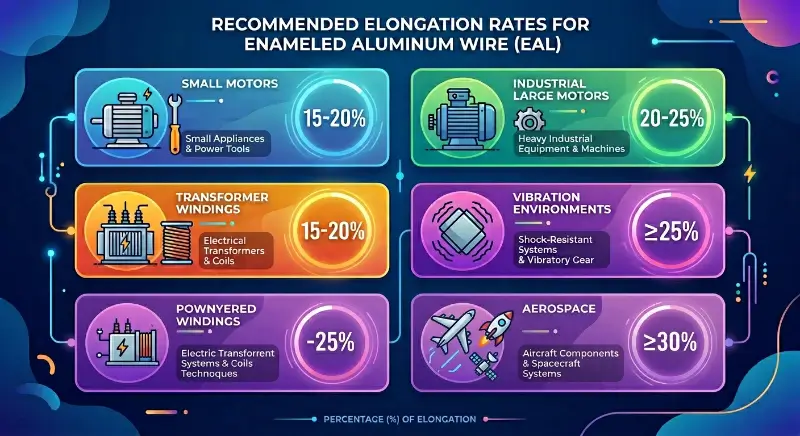
Small motors: usually require elongation 15-20% or above. Large industrial motors: elongation requirements usually 20-25%. Transformer windings: generally require 15-20%. Special applications (such as vibration environments): require elongation 25% or above.
Selection Based on Operating Environment
Harsh operating environments require higher elongation. Normal temperature stable environment: 15% elongation meets requirements. Temperature cycling environment: 20% or above. Vibration and impact environments: 25% or above. Extreme environments (aerospace, etc.): 30% or above.
Ways to Improve Elongation
Material Selection
Selecting high-purity aluminum or aluminum alloys with excellent elongation is the foundation. The purity of electrical aluminum significantly affects elongation, higher Al content usually means better elongation.
Heat Treatment Process
Annealing treatment is the key process for improving aluminum conductor elongation. Appropriate annealing temperature and time can eliminate cold work hardening and restore aluminum’s plasticity. Full annealing (O-temper) achieves the highest elongation. Enameled aluminum magnet wire production usually adopts online annealing process.
Drawing Process Optimization
Optimizing drawing process parameters can improve elongation. Appropriate drawing speed, lubrication conditions, pass deformation amount, etc. all affect final elongation. Reasonable intermediate annealing process is also important. Intermediate annealing between multiple drawing passes can restore material plasticity.
Coating and Conductor Matching
Coating flexibility and elongation should match the aluminum conductor. Too small coating elongation affects overall performance. Developing new coatings whose elongation matches the conductor is one of the technology development directions.
Testing Equipment and Quality Control
Online Inspection
Modern enameled aluminum magnet wire production lines are equipped with online inspection equipment, capable of real-time monitoring of conductor elongation. The application of laser diameter gauges and online elongation testers has improved quality control levels.
Sampling Inspection
In addition to online inspection, finished product sampling inspection is a necessary part of quality control. Sampling inspection should include multiple aspects such as elongation, coating integrity, and electrical performance.
Quality Traceability
A complete quality traceability system is the quality guarantee of high-end enameled aluminum magnet wire. The entire process quality record from raw materials to finished products helps problem tracing and continuous improvement.
Future Development Trends
High-Performance Aluminum Alloys
New aluminum alloy research is dedicated to further improving elongation. High-performance aluminum alloys such as Al-Mg-Sc alloys and Al-Zn-Mg-Cu alloys have better elongation while maintaining strength.
Refined Manufacturing
Refined manufacturing processes can further improve product quality. Progress in precision drawing, uniform annealing, and stable coating processes has significantly improved product elongation consistency.
Intelligent Inspection
Artificial intelligence and machine vision technology have begun to be applied to enameled wire inspection. Intelligent elongation analysis systems can provide more accurate quality assessment.
Summary
Elongation is an important mechanical performance indicator of enameled aluminum magnet wire, directly affecting the conductor’s processability and finished product reliability. The elongation of enameled aluminum magnet wire is affected by multiple factors including material composition, processing technology, wire diameter specification, and temperature. IEC, NEMA, China and other standards have clear requirements for elongation of aluminum magnet wire of different specifications. Premium product elongation usually exceeds standard requirements. Selection should comprehensively consider elongation requirements based on winding method, equipment type, and operating environment. With continuous progress in material science and manufacturing processes, the elongation performance of enameled aluminum magnet wire will further improve, providing higher quality winding material choices for the electrical industry.