


Introduction
Connector springs are core elastic components in electronic connectors, responsible for providing stable contact pressure, reliable current paths, and long-term mechanical life during mating and unmating. Spring performance directly determines connector contact reliability, signal integrity, mating force, and service life.
According to different connector types and application scenarios, connector springs can take various forms: board-to-board connector springs, wire-to-board connector terminal springs, POGO Pin springs, SIM card springs, battery springs, RF coaxial connector springs, automotive connector springs, and others. Different applications have different requirements for spring material conductivity, elasticity, strength, fatigue resistance, plating adhesion, and environmental resistance.
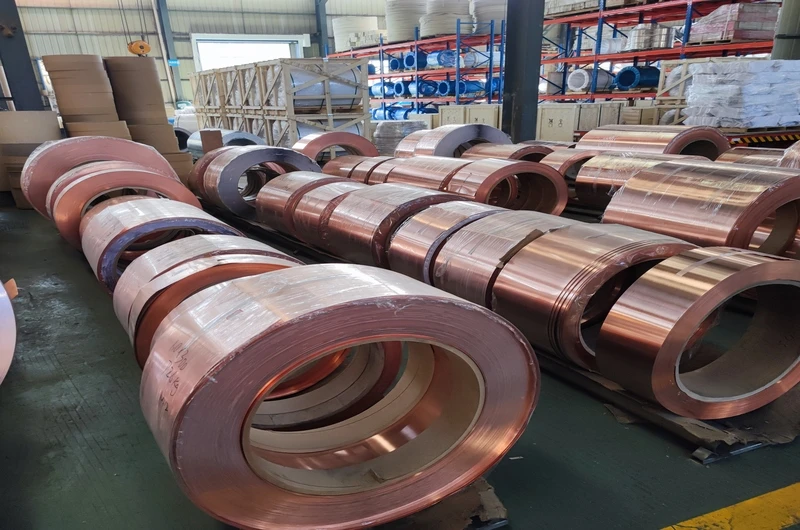
As a key raw material for connector springs, copper foil has wide applications in mid-to-low end connectors, consumer electronic connectors, automotive connectors, and other fields, with its excellent electrical conductivity, good elasticity, and processability. This article systematically explains key parameters, selection criteria, and industrial applications for copper foil used in connector springs, serving as a professional reference for connector manufacturers and procurement personnel.
1. Connector Spring Structure and Copper Foil Role
1.1 Basic Structure of Connector Springs
Connector springs typically consist of the following components:
Contact section: The part directly contacting the mating connector, usually designed in arc, fork, or pin shape to ensure stable contact pressure.
Elastic arm section: The elastic deformation part providing contact pressure, requiring good elasticity and fatigue resistance.
Base section: The part fixing the spring to the connector housing, requiring sufficient strength and stability.
Lead-out terminal: The part connecting the spring to the PCB or wire, requiring good weldability.
1.2 Core Role of Copper Foil in Connector Springs
Copper foil mainly undertakes the following functions in connector springs:
Conductivity function: Copper foil provides low-resistance current paths for the spring, ensuring efficient transmission of signals or current.
Elasticity function: After appropriate heat treatment and processing, copper foil can provide lasting elasticity and contact pressure.
Mechanical support: Copper foil provides necessary mechanical strength for the spring, enabling it to withstand mechanical stress during mating/unmating processes.
Thermal dissipation: Copper foil’s thermal conductivity helps the spring dissipate heat when carrying large currents.
1.3 Main Failure Modes of Springs
Understanding spring failure modes helps understand the importance of copper foil selection:
Contact pressure decay: Elasticity decreases after long-term use, insufficient contact pressure leads to increased contact resistance.
Spring fracture: Metal fatigue or overload causes spring fracture.
Contact resistance increase: Surface oxidation, wear, or contamination leads to poor contact.
Plastic deformation: Overload or high temperature causes permanent deformation, elastic failure.
Plating wear: Frequent mating/unmating causes plating wear, exposing base material.
As spring raw material, copper foil needs to balance elasticity, conductivity, strength, and processing performance to ensure overall connector reliability.
1.4 Comparison of Copper Foil and Other Spring Materials
Common connector spring materials are classified by performance characteristics as follows: Pure copper foil has the highest conductivity (98–101% IACS), but moderate elasticity and strength, mainly used in mid-to-low end consumer electronics; tin bronze foil (C51000 series) has conductivity of 15–20% IACS, high elasticity, high strength, moderate cost; phosphor bronze foil (C51900/C52100 series) has conductivity of 15–20% IACS, high elasticity and high strength, the mainstream material for mid-to-high end connectors; beryllium bronze foil (C17200) has conductivity of 20–30% IACS, extremely high elasticity and strength, the preferred choice for high-end connectors and POGO Pins, but the highest cost; stainless steel has conductivity of only 2–3% IACS, extremely high strength but poor elasticity; copper-clad steel has conductivity of 30–50% IACS, a compromise choice for cost-sensitive connectors. For most consumer electronic and mid-end industrial connectors, copper foil (especially tin bronze or phosphor bronze) is the most economical and practical choice.
2. Key Specifications and Technical Requirements
2.1 Copper Foil Purity
Copper foil purity directly affects the conductivity, elasticity, and reliability of connector springs.
T2 pure copper (99.9%): Conductivity approximately 98% IACS, suitable for general connector springs. Pure copper has relatively low elasticity, mainly used where elasticity requirements are not high.
TP1/TP2 phosphorus deoxidized copper (99.9%): Contains a small amount of phosphorus (0.015%–0.04%), has good weldability and processability. The presence of phosphorus slightly reduces conductivity (85%–90% IACS) but improves elasticity and resistance to high temperature softening, widely used in connector springs.
TU1 oxygen-free copper (99.97%): Conductivity above 101% IACS, suitable for high-end connectors with extremely high conductivity requirements.
Tin bronze (C51000/C51100): Contains 4%–6% tin, a common material for connector springs. Conductivity 15%–20% IACS, good elasticity, high strength, the preferred choice for most consumer electronic connector springs.
Phosphor bronze (C51900/C52100): Contains 5%–8% tin, 0.1%–0.3% phosphorus. Conductivity 12%–20% IACS, excellent elasticity, high strength, the mainstream material for high-end connector springs.
2.2 Thickness Selection
Copper foil thickness is the key parameter determining the mechanical performance of connector springs.
Ultra-thin copper foil (30μm–80μm): Used for micro connectors, SIM card springs, ultra-thin board-to-board connectors.
Thin copper foil (80μm–150μm): Used for mobile phone connectors, miniaturized consumer electronic connectors. The mainstream thickness for current consumer electronic connectors.
Medium-thick copper foil (150μm–250μm): Used for general connectors, automotive connectors, POGO Pins, etc.
Thick copper foil (250μm–500μm): Used for high-current connectors, industrial connectors, high mating force applications.
Ultra-thick copper foil (above 500μm): Used for special applications requiring high strength and high elasticity.
Selection advice: Copper foil thickness for connector springs needs comprehensive consideration of spring dimensions, contact pressure requirements, mating force requirements, and working current. Consumer electronic small connectors typically use 100μm–150μm thickness.
2.3 Width and Dimensions
Copper foil width is determined according to the specific design of connector springs.
Standard width range: Usually between 5mm and 100mm, customizable according to spring design.
Width precision: Copper foil width tolerance should be strictly controlled (usually within ±0.05mm) to ensure stamping forming precision.
Slitting quality: Edges should be neat and burr-free, avoiding burrs or debris during high-speed stamping processes.
2.4 Annealing State
Copper foil annealing state significantly affects spring elasticity and formability.
Soft state copper foil (O state, R6/R7): Good elongation (≥30%), easy for deep drawing and bending forming, but lower strength and poor elasticity. Usually used as the intermediate state for stamping forming, requiring subsequent heat treatment (age hardening) to obtain elasticity.
Half-hard state copper foil (H02/H04, R3/R4): Moderate strength (tensile strength 400–600MPa), elongation 10%–25%, with certain elasticity. Suitable for springs requiring moderate elasticity.
Hard state copper foil (H06/H08, R1/R2): High strength (tensile strength 600–800MPa), elongation 2%–8%, good elasticity. Suitable for springs requiring high elasticity, but poor formability.
Ultra-hard state copper foil (R0): Extremely high strength and elasticity, but extremely poor formability, only suitable for simple shapes.
Selection advice: Connector springs typically use half-hard or hard state copper foil, combined with subsequent heat treatment (aging) to obtain optimal comprehensive performance.
2.5 Mechanical Properties
Connector springs have strict requirements for copper foil mechanical properties:
Tensile strength: Connector spring copper foil usually requires tensile strength 500–800MPa.
Yield strength: Affects spring deformation behavior under contact pressure, usually requires ≥450MPa.
Elongation: Ensures stamping formability, usually requires 5%–25%.
Elastic modulus: Approximately 110–130GPa, affects spring elasticity and contact pressure.
Fatigue life: Springs need to withstand thousands to tens of thousands of mating cycles, requiring high fatigue life.
2.6 Surface Quality Requirements
Connector springs have strict requirements for copper foil surface quality:
Surface roughness: Ra is usually required between 0.4μm and 0.8μm. Excessive roughness affects electroplating quality; overly smooth may affect plating adhesion.
Thickness uniformity: Copper foil thickness tolerance should be controlled within ±3%; for high-precision springs, it is recommended to control within ±2%.
Surface cleanliness: Copper foil surface should be free from oil contamination, oxide film, dust, and other impurities. Microscopic contaminants may affect electroplating and welding quality.
Surface defects: Copper foil surface should be free from scratches, dents, pinholes, inclusions, and other defects.
3. Surface Treatment and Plating
3.1 Plating Types
Connector springs usually require surface plating to improve performance:
Gold plating (Au): Provides excellent conductivity, oxidation resistance, and low contact resistance. Gold plating thickness is usually 0.05μm–0.5μm (thin gold) or 1μm–3μm (thick gold), suitable for high-end signal connectors.
Silver plating (Ag): Best conductivity and thermal conductivity, lower cost than gold. Silver plating thickness is usually 1μm–5μm, suitable for power connectors and high-frequency connectors. However, silver layer is prone to sulfide tarnishing and requires protection.
Tin plating (Sn): Provides good weldability at low cost. Tin plating thickness is usually 3μm–10μm, suitable for general connectors and applications requiring welding.
Nickel plating (Ni): As base layer or functional plating, provides wear and corrosion resistance. Nickel plating thickness is usually 1μm–3μm, typically used as base layer for gold and silver plating.
Palladium-nickel plating (PdNi): As gold substitute, moderate cost, excellent performance. Plating thickness is usually 0.5μm–1μm.
3.2 Plating Structure
Typical connector spring plating structures:
Base layer: Copper substrate → Nickel plating (1μm–3μm) → Precious metal plating (gold/silver/palladium)
Composite plating: Copper substrate → Nickel plating (1μm–2μm) → Palladium-nickel plating (0.5μm) → Gold plating (0.05μm–0.1μm)
Selective gold plating: Gold plating in contact area, tin plating in other areas, cost saving.
3.3 Surface Pretreatment
Copper foil requires surface pretreatment before electroplating:
Chemical cleaning: Remove surface oil contamination and organic pollutants.
Acid pickling/activation: Remove oxide film, expose fresh copper surface.
Pre-nickel plating: Improve adhesion of subsequent plating.
4. Insulation Class and Temperature Management
4.1 Effect of Temperature on Connector Springs
The impact of temperature on spring performance:
Elasticity decay: High temperature accelerates stress relaxation of copper and copper alloys, leading to decreased contact pressure.
Oxidation acceleration: High temperature accelerates surface oxidation, contact resistance increases.
Plating degradation: High temperature may cause plating diffusion and oxidation.
Creep: Long-term high temperature may cause creep deformation of springs.
4.2 Working Temperature Grades
| Grade | Max Operating Temperature | Applicable Connector Type | Copper Foil Selection |
|---|---|---|---|
| Standard Grade | 85°C | General consumer electronic connectors | Tin bronze + tin/gold plating |
| Industrial Grade | 105°C | Industrial control connectors | Phosphor bronze + gold/silver plating |
| Extended Grade | 125°C | Automotive interior connectors | Phosphor bronze + silver/gold plating + nickel base layer |
| High Temperature Grade | 150°C | Engine compartment automotive connectors | Beryllium copper or high-performance phosphor bronze + thick gold/thick silver |
| Special Grade | Above 200°C | Aviation, military special connectors | Special alloys + thick gold plating |
4.3 Common Spring Alloy Characteristics
Common connector spring alloys and their performance characteristics are as follows: C11000 pure copper (Cu 99.9%) tensile strength 220–400MPa, conductivity 100% IACS, the base material for low elasticity springs; C51000 tin bronze (Cu-Sn 4-6%) tensile strength 400–700MPa, conductivity 15-20% IACS, the common choice for general springs; C51900 phosphor bronze (Cu-Sn-P) tensile strength 500–800MPa, conductivity 12-18% IACS, the mainstream material for high-end springs; C52100 phosphor bronze (Cu-Sn-P) tensile strength 600–900MPa, conductivity 10-15% IACS, the preferred choice for high-strength springs; C17200 beryllium copper (Cu-Be 1.8-2%) tensile strength 800–1300MPa, conductivity 20-30% IACS, the preferred material for extreme high-end springs (POGO Pin, IC testing).
5. Industrial Applications and Selection Recommendations
5.1 Consumer Electronics Field
Consumer electronics is the largest application market for connector springs.
Smartphone connectors: Board-to-board connectors, battery connectors, SIM card springs, USB Type-C springs, etc. Require miniaturization, high elasticity, and good gold plating. Recommended: C51900 phosphor bronze foil (100μm–150μm) + gold/palladium-nickel plating.
Laptop connectors: Hinge connectors, battery connectors, display connectors, etc. Require high mating life and stable contact. Recommended: C52100 phosphor bronze foil (150μm–200μm) + gold plating.
Wearable device connectors: Bracelets, earphones, smart watches, etc. Require ultra-thin and high elasticity. Recommended: C51000 tin bronze foil (80μm–120μm) + gold plating.
Household appliance connectors: Power connectors, signal connectors. Cost sensitive, recommended: C11000 pure copper or C51000 tin bronze (150μm–250μm) + tin/silver plating.
5.2 Automotive Electronics Field
Automotive connectors have extremely high requirements for reliability and environmental adaptability.
Engine compartment connectors: ECU, sensors, ignition system connectors, working temperature -40°C to 150°C. Recommended: C52100 phosphor bronze foil (200μm–300μm) + silver or thick gold plating + nickel base layer.
Body electronics connectors: Dashboard, lights, window controller connectors. Recommended: C51900 phosphor bronze foil (150μm–250μm) + gold or tin plating.
New energy vehicle connectors: High-voltage connectors (400V/800V platform), charging connectors, BMS connectors. Require high current, high insulation, and high safety. Recommended: thick copper foil (above 300μm) + thick silver/thick gold plating + reinforced insulation.
In-vehicle entertainment system connectors: Audio, displays, navigation connectors. Recommended: C51900 phosphor bronze foil (150μm–200μm) + gold plating.
5.3 Industrial Control Field
Industrial connectors require high reliability and long life.
Industrial Ethernet connectors: M12, M8 D-Code/X-Code connectors. Require high-speed transmission and anti-interference. Recommended: phosphor bronze foil + thick gold plating.
Industrial power connectors: High-current power connectors. Recommended: thick copper foil (above 300μm) + thick silver plating + reinforced heat dissipation.
Rail transit connectors: Train control, signal connectors. Require high reliability and long life. Recommended: high-performance phosphor bronze or beryllium copper + thick gold plating.
5.4 Communication and Data Center Field
Communication connectors require high-frequency characteristics and high signal integrity.
RF coaxial connectors: SMA, BNC, SMP, etc. Require low loss and high shielding. Recommended: C51900 phosphor bronze foil + thick gold/silver plating.
Optical module connectors: SFP/QSFP modules, optical module springs. Require high precision and long-term stability. Recommended: C52100 phosphor bronze foil + thick gold plating.
Server connectors: DDR memory slots, PCIe slots, CPU sockets. Require extremely high contact reliability. Recommended: C17200 beryllium copper or high-performance phosphor bronze + thick gold plating.
5.5 Test and Measurement Field
Test connectors require extremely high precision and life.
POGO Pin spring probes: IC testing, ATE testing. Recommended: C17200 beryllium copper or C52100 phosphor bronze + thick gold plating.
Test sockets: Chip testing, burn-in testing. Recommended: high-performance beryllium copper + thick gold plating.
5.6 Common Selection Problems and Solutions
Insufficient contact pressure: Check if copper foil elasticity is sufficient (whether annealing state is appropriate); confirm spring design dimensions; consider using more elastic alloys (such as beryllium copper or high-tin phosphor bronze).
Excessive contact resistance: Check copper foil surface cleanliness; confirm plating integrity; consider using highly conductive silver or gold plating.
Excessive mating force: Check if spring design is reasonable; confirm if copper foil elasticity is too strong; consider using thinner copper foil or adjusting heat treatment process.
Spring fracture: Check copper foil fatigue life; confirm working environment (temperature, humidity, corrosion); consider using alloys with high fatigue life.
Plating peeling or wear: Check copper foil surface pretreatment quality; confirm plating process and thickness; consider adding nickel base layer or thickening precious metal plating.
High temperature elasticity decay: Check copper foil resistance to high temperature softening; confirm if working temperature exceeds material limits; consider using high temperature resistant alloys.
6. Supplier Selection and Quality Control
6.1 Quality Certifications
ISO9001 quality management system certification is the basic requirement. IATF16949 certification is necessary for automotive connector applications. UL, VDE, TUV and other safety certifications are necessary for export connectors. RoHS, REACH environmental certifications are necessary for overseas markets.
6.2 Technical Capability Evaluation
Custom drawing capability: Whether copper foil with specific thickness, width, and mechanical properties can be customized according to customer drawings. Whether sample development cycle is reasonable (typically 5–10 working days).
Process quality control: Whether key control capabilities such as thickness testing, mechanical performance testing, surface quality testing, and purity testing are available. Whether on-site supervision and third-party testing are supported.
Heat treatment capability: Whether mature heat treatment (annealing, aging) processes are available, able to provide different elasticity grade copper foil.
Electroplating capability: Whether precious metal electroplating processes such as gold, silver, nickel, palladium-nickel plating are available, especially selective electroplating capability.
6.3 Production Capacity and Delivery
Stable production capacity is the guarantee for long-term supply. It is recommended to select suppliers with monthly production capacity above 100 tons and complete quality control systems. Quick response capability and flexible delivery arrangements are also important considerations. Precious metal plating prices fluctuate greatly, requiring attention to price linkage mechanisms.
7. Product Specifications Summary
| Parameter | Specification Range |
|---|---|
| Alloy Type | C11000 / C51000 / C51900 / C52100 / C17200 |
| Purity | 99.9% – 99.97% |
| Thickness | 30μm – 500μm |
| Width | 5mm – 100mm |
| State | Soft / Half-hard / Hard / Ultra-hard |
| Tensile Strength | 220MPa – 1300MPa |
| Elongation | 2% – 35% |
| Surface Treatment | Gold plating / Silver plating / Tin plating / Nickel plating / Palladium-nickel plating |
| Standards | IEC / GB / JIS / ASTM |
8. Technical Support and Contact
For detailed product specifications, samples, or technical selection support, please contact Zhengzhou LP Industry Co., Ltd. With years of expertise in electronic copper materials exports, our copper foil products are widely used in connector springs, POGO Pin spring probes, battery springs, automotive connectors, and other fields.
- Email: office@cnlpzz.com
- Phone/WhatsApp: 0086-19337889070
- Key Products: Copper foil, Connector spring copper foil, Phosphor bronze foil, Tin bronze foil
This document provides professional guidance for copper foil selection in connector spring applications. For specific projects, please consult with technical professionals based on actual operating conditions.