

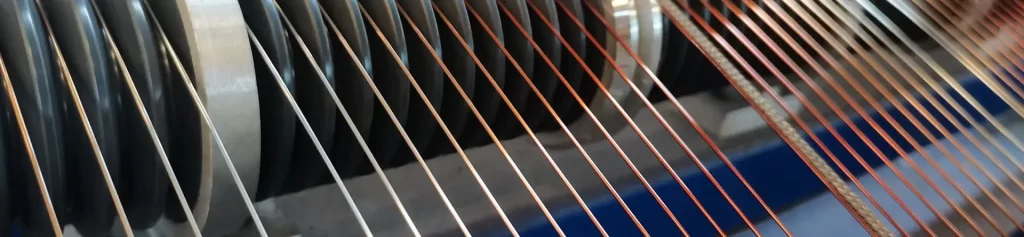
Transformer designers face constant pressure to reduce material costs and weight while maintaining or improving performance. Copper has long been the preferred conductor material for transformer windings, but rising copper prices and the inherent weight of copper have created strong demand for alternatives. Copper Clad Aluminum (CCA) wire has emerged as an attractive solution for many transformer applications, offering significant cost and weight savings while providing a solderable, easy-to-process conductor.
What is Copper Clad Aluminum (CCA) Wire?
Copper Clad Aluminum wire is a bimetallic conductor composed of an aluminum core with a copper outer layer that is metallurgically bonded to the aluminum substrate. The two metals are joined through a continuous cladding process that creates a permanent, inseparable bond between the copper and aluminum layers. The resulting composite conductor combines the surface conductivity of copper with the lightweight, cost-effective nature of aluminum.
The copper cladding typically represents 10% to 15% of the total cross-sectional area of the conductor, with the remaining 85% to 90% being aluminum. The standard cladding ratios used in transformer applications include 10%, 12.5%, and 15% by volume, with higher copper content providing better surface conductivity at higher cost. CCA wire is available in round, rectangular, and strip forms to suit different transformer winding configurations.
CCA wire is manufactured to international standards that define the cladding thickness, mechanical properties, electrical characteristics, and test methods. The primary standards for CCA magnet wire include ASTM B566 (round CCA wire) and various customer-specific specifications. These standards ensure the copper-aluminum bond is durable and that the conductor meets electrical performance requirements for transformer applications.
Why Use CCA Wire in Transformer Windings?
CCA wire offers several compelling advantages that have made it an increasingly popular choice for transformer windings, particularly in cost-sensitive and weight-sensitive applications.
Significant Material Cost Savings
The most compelling advantage of CCA wire for transformer windings is the substantial material cost savings. Copper costs have risen dramatically over the past two decades, and aluminum remains consistently less expensive on a per-kilogram basis. Because CCA wire is approximately 40% to 60% lighter than equivalent copper wire, the cost savings per unit length are even greater than the per-kilogram price differential suggests. For high-volume transformer production, these savings can amount to millions of dollars annually.
For distribution transformers, power transformers, and electronic transformers produced in large quantities, the cost differential is often the primary driver for specifying CCA wire. The savings allow manufacturers to offer more competitive pricing while maintaining healthy profit margins.
Weight Reduction for Easier Handling
Transformers are heavy equipment, and reducing weight delivers multiple benefits. CCA wire windings make transformers significantly lighter than equivalent copper-wound designs, with weight reductions of 30% to 40% being common. Lighter transformers are easier to manufacture, transport, install, and service—reducing logistics costs and improving worker safety during handling.
In pole-mounted distribution transformers, pad-mounted transformers, and traction transformers, the weight reduction from CCA windings can be substantial enough to allow the use of lighter support structures, smaller mounting hardware, and less expensive transportation equipment.
Good Solderability and Termination
Unlike pure aluminum wire, which requires special techniques and aluminum-compatible fluxes for reliable termination, CCA wire accepts standard soldering processes. The copper outer layer provides a readily solderable surface, simplifying the manufacturing process and reducing the time, cost, and complexity of producing reliable electrical connections. This is a particularly important advantage for small transformer manufacturers that may not have specialized aluminum termination equipment.
Adequate Performance for Many Applications
For many transformer applications—particularly those operating at 50/60 Hz line frequency or at low to moderate switching frequencies—CCA wire provides electrical performance that is more than adequate. The current distribution within the conductor at these frequencies is essentially uniform across the entire cross-section, and the higher resistance of the aluminum core (compared to pure copper) is offset by the practical cost and weight advantages.
Construction and Properties of CCA Wire
Understanding the construction and key properties of CCA wire helps transformer designers select the right product and apply it correctly in their designs.
Cladding Process
CCA wire is manufactured using a continuous cladding process. A copper strip is formed around an aluminum core rod, and the assembly is then drawn through a series of dies that progressively reduce the cross-sectional area while maintaining the proportional thickness of the copper layer. The cold-working of the drawing process creates a strong metallurgical bond between the two metals at the interface.
After drawing, the wire is typically annealed to achieve the desired mechanical properties. Soft temper (fully annealed) is most common for transformer winding applications because it provides maximum flexibility for winding. Half-hard and full-hard tempers are also available for applications requiring additional mechanical strength during winding.
Electrical Properties
Key electrical properties of CCA wire for transformer applications include:
- DC conductivity: Approximately 63% to 65% of the International Annealed Copper Standard (IACS), depending on the cladding ratio
- DC resistance: Higher than pure copper by approximately 1.4 to 1.6 times for equivalent cross-section
- AC resistance at 50/60 Hz: Essentially the same as DC resistance due to minimal skin effect at these low frequencies
- Temperature coefficient of resistance: Approximately 0.004 per degree Celsius, similar to pure copper
Mechanical Properties
CCA wire has mechanical properties that combine characteristics of both copper and aluminum:
- Tensile strength: Lower than pure copper but higher than pure aluminum
- Elongation: Good ductility, allowing winding without cracking
- Flexibility: Sufficient for most transformer winding applications, though slightly stiffer than pure copper
- Bond strength: The copper layer remains firmly bonded to the aluminum core under normal handling and winding conditions
Thermal Properties
CCA wire has thermal characteristics that are important for transformer design:
- Thermal conductivity: Lower than pure copper but higher than pure aluminum
- Thermal expansion coefficient: Different from pure copper, which can be relevant in thermal cycling applications
- Maximum operating temperature: Generally limited to approximately 150°C to maintain the integrity of the copper-aluminum bond
Advantages of CCA Wire for Transformers
CCA wire delivers a range of practical advantages that make it the preferred choice in many transformer winding applications.
Lower Material Cost Per Transformer
The most direct advantage is lower material cost. For a typical distribution transformer, switching from copper to CCA wire can reduce the conductor material cost by 40% to 50%. Across a manufacturer’s product line, this saving translates directly into improved profitability or more competitive market pricing—or both.
Lighter Transformers
Weight reduction benefits include lower transportation costs (especially important for international shipping where freight is charged by weight), easier installation (requiring less heavy lifting equipment and reducing worker injury risk), and reduced structural support requirements for mounted transformers.
Simplified Termination
CCA wire terminates easily using standard soldering techniques. The copper outer layer accepts solder readily, eliminating the special fluxes, mechanical crimps, or welding procedures required for pure aluminum. This simplifies manufacturing, reduces tooling costs, and improves production throughput.
Adequate Performance at Standard Frequencies
For 50/60 Hz power transformers and low-frequency audio transformers, the performance of CCA wire is essentially equivalent to pure copper. The slightly higher resistance translates to marginally higher I²R losses, but the difference is often small enough to be acceptable given the cost savings.
Good Availability from Multiple Suppliers
CCA wire is widely available from multiple global suppliers, providing transformer manufacturers with procurement flexibility and supply chain resilience. The mature manufacturing technology and broad supplier base ensure consistent quality and competitive pricing.
Key Applications in Transformer Design
CCA wire is used in a wide range of transformer types and applications, particularly where cost and weight are primary design considerations.
Distribution Transformers
Distribution transformers that step down voltage from distribution levels to service levels for residential, commercial, and industrial customers represent one of the largest application areas for CCA wire. These transformers are produced in high volumes, making material cost savings particularly significant. The weight reduction also makes installation and maintenance more efficient for utility crews.
Power Transformers
Medium-sized power transformers for industrial and commercial applications frequently use CCA windings, particularly in regions where cost is a primary driver of equipment selection. The cost savings per unit can be substantial for power transformers, which use hundreds or thousands of kilograms of conductor material.
Control Transformers
Control transformers used in industrial control panels, machine tools, and process equipment often use CCA wire for their primary and secondary windings. The lower weight is particularly beneficial in control panels where multiple transformers may be installed in a single enclosure.
Audio Transformers
Audio transformers for tube amplifiers, professional audio equipment, and high-end consumer audio often use CCA wire as a cost-effective alternative to pure copper. At audio frequencies (20 Hz to 20 kHz), the performance difference between CCA and pure copper is negligible, and the cost savings are appreciated in price-sensitive market segments.
Lighting Transformers
Transformers for low-voltage lighting systems, landscape lighting, and architectural lighting installations frequently use CCA windings. The cost savings make these transformers more affordable for large-scale lighting installations, and the lighter weight simplifies mounting.
Isolation Transformers
Isolation transformers for medical equipment, industrial machinery, and sensitive electronics often specify CCA wire to balance performance requirements with cost considerations. The reliable insulation and termination characteristics of CCA wire support the safety and performance requirements of these applications.
Specialty Transformers
Specialty transformers for solar inverters, wind turbine generators, electric vehicle charging stations, and other renewable energy applications frequently use CCA wire. The cost-effectiveness of CCA is particularly important in these growing markets where competitive pricing is essential for adoption.
Design Considerations and Best Practices
Successful application of CCA wire in transformer windings requires attention to several design considerations that differ from pure copper designs.
Sizing the Conductor
Because CCA wire has higher DC resistance than pure copper, the conductor cross-section must be increased to achieve the same resistance. As a general rule, the CCA wire cross-section should be approximately 1.4 to 1.6 times the equivalent copper cross-section. This larger cross-section must be accommodated in the transformer window design, potentially requiring adjustments to core size or winding configuration.
Thermal Management
The higher resistance of CCA wire results in greater I²R losses compared to pure copper windings. The additional heat generated must be managed through appropriate thermal design, including adequate cooling surfaces, ventilation, and possibly larger transformer enclosures. Verify that the transformer’s thermal design can handle the additional losses without exceeding temperature limits.
Termination Design
While CCA wire is solderable, the termination design must consider the higher thermal mass of the larger conductor cross-section required for equivalent current capacity. Soldering iron temperature and dwell time may need adjustment to ensure reliable solder joints. For larger terminations, mechanical crimping using copper-compatible connectors is often preferred.
Joint Compatibility
When CCA windings are connected to copper bus bars, terminals, or other components, consider the potential for galvanic corrosion at dissimilar metal interfaces, particularly in humid environments. Use anti-oxidant compounds at the joint interface and ensure proper sealing to prevent moisture ingress.
Winding Process Adjustments
CCA wire is slightly stiffer than pure copper and may require minor adjustments to winding tension and equipment settings. The mechanical properties of CCA are well-suited to standard winding equipment, but operators may need to recalibrate tension settings for optimal winding quality.
Quality Verification
Source CCA wire from reputable manufacturers with documented quality control procedures. Verify that the wire meets the specified cladding ratio, electrical properties, and mechanical characteristics. Conduct incoming inspection including dimensional verification, resistance measurement, and bond strength testing for critical applications.
Limitations and Challenges
Despite its many advantages, CCA wire has important limitations that must be considered in transformer design.
Higher Resistance Means Higher Losses
The higher resistance of CCA wire results in I²R losses that are 1.4 to 1.6 times those of an equivalent copper winding. For high-efficiency transformer designs, this loss increase may not be acceptable. Premium efficiency transformers for energy-conscious applications often continue to use pure copper windings despite the cost differential.
Limited High-Temperature Performance
CCA wire is generally limited to maximum operating temperatures of approximately 150°C, above which the copper-aluminum bond may begin to degrade. For high-temperature transformer applications—Class H (180°C) or Class C (200°C) insulation systems—CCA wire is not suitable, and pure copper or pure aluminum must be used instead.
Galvanic Corrosion Risk
When CCA windings are connected to copper components in the presence of moisture, galvanic corrosion can occur at the dissimilar metal interface. This is a particular concern for outdoor transformers and equipment operating in humid environments. Proper joint design and environmental protection are essential to prevent corrosion-related failures.
Lower Short-Circuit Withstand
CCA wire generally has lower short-circuit withstand capability than pure copper due to its lower tensile strength and elongation. For transformers that must demonstrate high short-circuit withstand (per IEEE or IEC standards), the design may need to be optimized or copper windings may be required.
Not Universally Accepted
Some industry standards, utility specifications, and customer requirements mandate pure copper conductors and do not accept CCA wire as an alternative. Before specifying CCA wire for a transformer design, verify that the application and end customer will accept this material.
Standards and Selection Criteria
Selecting the right CCA wire for transformer applications requires understanding the relevant standards and applying systematic selection criteria.
Relevant Standards
Standards that govern CCA wire for transformer applications include:
- ASTM B566: Standard specification for copper-clad aluminum wire for electrical purposes
- IEC 60317: International standards for magnet wire (specific parts apply to different wire types)
- UL 1446: Systems of insulating materials—general (applies when CCA wire is used in UL-certified equipment)
- JIS C 3102: Japanese standard for copper-clad aluminum conductors
Cladding Ratio Selection
Select a cladding ratio based on the application’s performance requirements:
- 10% cladding: Maximum cost savings, suitable for low-frequency applications with relaxed performance requirements
- 12.5% cladding: Balanced performance and cost, suitable for most distribution transformer applications
- 15% cladding: Higher surface conductivity, suitable for applications with elevated frequency content or higher performance requirements
Insulation System
Select an insulation system appropriate for the transformer’s thermal class and application environment. CCA wire is available with the same insulation options as pure copper magnet wire, including polyester, polyesterimide, polyester-polyamide-imide, and polyamide-imide. Match the insulation thermal class to the transformer’s design temperature.
Quality Verification
When selecting a CCA wire supplier, evaluate:
- Compliance with relevant international standards
- Quality management system certifications (ISO 9001 or equivalent)
- Manufacturing process control and traceability
- Technical support capability and application engineering resources
- References from other transformer manufacturers
Conclusion
Copper Clad Aluminum wire has established itself as a practical and cost-effective conductor for transformer windings, offering substantial material cost savings and meaningful weight reduction compared to pure copper. The combination of adequate electrical performance at standard power frequencies, good solderability, and broad availability has made CCA wire the material of choice for distribution transformers, control transformers, and many other transformer applications where cost and weight are primary design drivers.
Successful application of CCA wire in transformer windings requires attention to design considerations including conductor sizing for equivalent resistance, thermal management of the additional I²R losses, proper termination design, and joint compatibility with other system components. By understanding the capabilities and limitations of CCA wire, transformer designers can leverage its advantages while avoiding the pitfalls that can lead to premature failure.
For transformer applications with extreme efficiency requirements, high operating temperatures, critical short-circuit withstand, or strict customer specifications mandating pure copper, CCA wire may not be the appropriate choice. In these cases, the higher cost of pure copper is justified by the performance and reliability benefits.
For the majority of standard transformer applications, however, CCA wire represents a proven, cost-effective conductor that delivers reliable performance throughout the transformer’s service life. With proper specification, quality verification, and application engineering support from the wire manufacturer, CCA wire enables transformer manufacturers to offer competitive products while maintaining the performance and reliability their customers expect.