

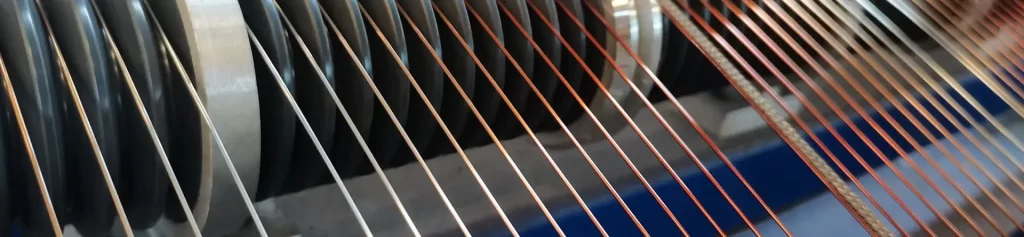
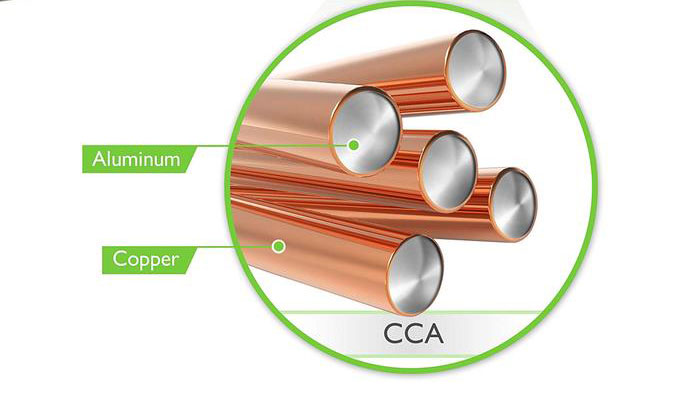
Copper Clad Aluminum wire (CCA) is a bimetallic composite conductor material with high-purity oxygen-free copper as the outer layer and electrical-grade aluminum as the inner core. This structural design combines the excellent conductivity of copper with the lightweight and economical advantages of aluminum, showing unique advantages in many application scenarios. Thermal class is an important indicator for measuring the long-term reliable operation capability of winding wire. Copper clad aluminum wires with different thermal classes are suitable for different operating temperature environments, and correctly selecting the thermal class is essential to ensure equipment reliability and extend service life.
Basic Structure of Copper Clad Aluminum Wire
Conductor Structure
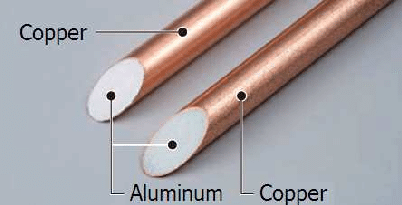
The core structure of copper clad aluminum wire consists of two parts: the outer copper sheath and the inner aluminum core. The copper sheath forms reliable metallurgical bonding with the aluminum core through special metallurgical processes, ensuring good electrical conduction and mechanical strength. Copper sheath thickness typically accounts for 10%-30% of the total cross-sectional area, with specific ratios determined by product type and application requirements. Common copper layer ratios include 10%, 15%, 20%, 25%, 30% specifications. The aluminum core uses electrical-grade pure aluminum with conductivity reaching or exceeding 61% IACS.
Insulation Layer
Similar to enameled wire, copper clad aluminum wire usually requires coating with insulating varnish to be used as winding wire. The choice of coating material determines the wire’s thermal class. Common insulating coatings for copper clad aluminum wire include: Polyurethane (UEW), Polyester (PEW), Polyester-imide (EIW), Polyamide-imide (AIW), etc. Copper clad aluminum wire can also use other insulation methods such as paper covering, glass fiber wrapping, film wrapping, forming composite insulation structures suitable for higher temperature environments.
Thermal Class Standard System
IEC Standard
The International Electrotechnical Commission (IEC) has established a complete classification standard system for electrical insulation material thermal classes. This system is widely adopted globally.
| Class | Temperature (°C) | Temperature (°F) |
|---|---|---|
| E | 120 | 248 |
| B | 130 | 266 |
| F | 155 | 311 |
| H | 180 | 356 |
| C | 200 | 392 |
| C+ | 220 | 428 |
Thermal class represents the highest working temperature that any part of the winding should not exceed. At this temperature, the insulation material should maintain long-term stable operation without significant performance degradation.
NEMA Standard
The American National Electrical Manufacturers Association (NEMA) has developed the widely used MW1000 standard in North America, with detailed specifications for enameled wire thermal class, specifications, and performance testing methods. Common thermal classes in NEMA MW1000 standard include 105°C, 130°C, 155°C, 180°C, 200°C, 220°C, 240°C, etc.
China Standard
China GB/T 6109 series standards correspond basically to IEC standards, similarly using letters + numbers to indicate thermal class. Major domestic winding wire products are classified by thermal class as: Class B (130°C), Class F (155°C), Class H (180°C), Class C (200°C), etc.
Common Thermal Classes of Copper Clad Aluminum Wire
130°C Class (Class B)
130°C class is one of the most common thermal classes, corresponding to polyurethane coating (UEW) or polyester coating (PEW). Polyurethane enameled copper clad aluminum wire has good direct solderability, facilitating winding connections; at the same time has good mechanical performance, suitable for general industrial environments. Widely used in transformers, relays, small motors, household appliances, etc. Polyester enameled copper clad aluminum wire has high mechanical strength and good wear resistance, suitable for high-speed winding applications. Widely used in small and medium transformers and general motors.
155°C Class (Class F)
155°C class is a medium-high grade thermal class, corresponding to modified polyester or polyester-imide coating. Polyester-imide enameled copper clad aluminum wire has good heat resistance and chemical resistance, capable of long-term stable operation at higher temperatures. Commonly used in industrial motors, fan motors, power tools, etc. F-class thermal class copper clad aluminum wire achieves a good balance between efficiency and reliability, currently one of the most widely used thermal classes.
180°C Class (Class H)
180°C class is a relatively high thermal class, corresponding to polyamide-imide coating or composite insulation structure. Polyamide-imide enameled copper clad aluminum wire has excellent heat resistance, chemical resistance, and wear resistance, capable of long-term use in harsh environments. Mainly used in new energy vehicle drive motors, traction motors, special motors, etc. 180°C class copper clad aluminum wire has relatively longer insulation life, capable of withstanding greater overload and temperature fluctuations, suitable for high-reliability applications.
200°C Class (Class C)
200°C class is a premium thermal class, corresponding to polyamide-imide coating or special composite insulation. 200°C class copper clad aluminum wire requires minimum temperature index of 200, thermal shock temperature at least 220°C. Extractable substance content not exceeding 0.5%, breakdown voltage requirement is 75% of the minimum specified value. This type of product is mainly used in high-end applications such as aviation, aerospace, and military industries, as well as special electrical equipment in harsh industrial environments.
220°C Class (Class C+)
220°C class is one of the highest thermal classes, corresponding to specially formulated high-temperature-resistant insulation materials. 220°C class copper clad aluminum wire uses polyamide-imide composite coating or multi-layer composite insulation structure, capable of maintaining stable performance in extremely high temperature environments. Mainly used in extreme environment applications such as aerospace, nuclear power, and deep well drilling.
Key Factors Affecting Thermal Class
Coating Material
Coating material is the most direct factor determining copper clad aluminum wire’s thermal class. Different chemical structures of coating have different temperature resistance capabilities. Polyurethane coating’s heat resistance temperature is approximately 130°C. Polyester coating’s heat resistance temperature is approximately 130-155°C. Polyester-imide coating’s heat resistance temperature is approximately 155-180°C. Polyamide-imide coating’s heat resistance temperature can reach above 200°C. Coating thickness, coating process, curing degree, etc. also affect actual heat resistance performance.
Composite Insulation Structure
For applications requiring higher thermal class, relying solely on coating is difficult to meet requirements, requiring composite insulation structures. Paper covered enameled copper clad aluminum wire: cable paper is wrapped outside the enameled wire, improving insulation strength and heat resistance. Glass fiber wrapped copper clad aluminum wire: glass fiber yarn is wrapped, providing mechanical protection and heat resistance. Film wrapped copper clad aluminum wire: polyimide film, polyester film, etc. are wrapped, significantly improving thermal class. Multi-layer composite insulation structures can raise copper clad aluminum wire’s thermal class to 200°C or even higher.
Manufacturing Process
Coating application process and curing parameters directly affect the product’s actual heat resistance performance. Advanced coating equipment can ensure uniform coating thickness. Precise baking temperature and time control ensure thorough coating curing. Strict quality inspection ensures each batch of products’ heat resistance performance meets standards.
Operating Environment
Actual operating environment significantly affects copper clad aluminum wire’s heat resistance performance. Temperature cycling: frequent temperature changes accelerate insulation aging. Chemical media: acids, alkalis, organic solvents may erode insulation layer. Mechanical vibration: vibration may cause insulation layer cracking or peeling. Humid environment: moisture intrusion will reduce insulation performance.
Comparison with Copper Wire and Aluminum Wire Thermal Class
Comparison with Pure Copper Wire
Copper clad aluminum wire and pure copper wire are basically consistent in thermal class, because thermal class is mainly determined by insulating coating and has little relationship with conductor material. Under the same coating type and class, copper clad aluminum wire and pure copper wire have the same heat resistance performance. Differences are mainly reflected in electrical performance (resistance) and mechanical performance (strength, weight).
Comparison with Pure Aluminum Wire
Copper clad aluminum wire and pure aluminum wire’s thermal class are also mainly determined by coating. Both have the same heat resistance temperature under the same coating class. However, it should be noted that aluminum’s melting point is 660°C, lower than copper’s 1085°C. Under extreme high temperature conditions, the pure aluminum core may soften before the copper sheath. But this situation does not occur under normal working temperatures.
Selection Recommendations for Copper Clad Aluminum Wire Thermal Class
Selection Based on Operating Environment
Ambient temperature is the primary basis for selecting thermal class. Ambient temperature plus equipment’s own temperature rise should be within the coating’s thermal class. Considering safety margin, design temperature should be 10-20°C lower than the rated heat resistance temperature. For high-temperature environment applications, products with higher thermal class should be selected, and appropriate heat dissipation measures should be taken.
Selection Based on Load Characteristics
Load characteristics affect the actual temperature rise of windings. Continuously running motors require higher thermal class to withstand long-term operating temperature rise. Intermittently running loads can appropriately reduce thermal class requirements. Frequently starting and stopping loads need to consider the impact of thermal cycling on insulation.
Selection Based on Service Life Requirements
Insulation life has an exponential relationship with temperature, and for every 10°C increase in temperature, insulation life is approximately halved. For products with a designed life of 20-30 years, products with thermal class higher than the actual operating temperature should be selected. For short-term use or one-time products, thermal class just meeting requirements can be selected.
Selection Based on Application Field
| Application | Recommended Thermal Class |
|---|---|
| Household Appliances | Class B (130°C) |
| Industrial Motors, Fans | Class F (155°C) |
| EV Drive Motors | Class H (180°C) |
| Aerospace, Military | Class C/C+ (200-220°C) |
Household appliances typically use Class B or F (130-155°C). Industrial motors and fans typically use Class F or H (155-180°C). New energy vehicle drive motors typically use Class H (180°C). Aerospace and military applications typically use Class C or C+ (200-220°C).
Testing and Certification
Thermal Class Testing Methods
Copper clad aluminum wire’s thermal class needs to be determined through rigorous testing. Thermal aging test: long-term exposure at specified temperature, testing insulation performance changes. Thermal shock test: testing insulation layer’s cracking resistance when temperature changes rapidly. Temperature index test: extrapolating long-term use temperature through accelerated aging tests. Breakdown voltage test, temperature index test, extractable content test, etc. are all key test items for thermal class evaluation.
Certification Standards
Copper clad aluminum wire products need to pass relevant certifications before entering the market. UL certification is an important certification in the North American market. VDE certification is an authoritative certification in the European market. CCC certification is a mandatory certification in the Chinese market. RoHS and REACH are important environmental certifications for product safety.
Development Trends
Higher Thermal Class Materials
With continuous improvement of electrical equipment power density, requirements for thermal class are also increasing. New coating materials with resistance above 220°C are being researched and developed. Nanomodified insulation materials may provide better heat resistance performance. Ceramic coating insulation materials are potential choices for high-temperature applications.
Environmentally Friendly Materials
Environmental regulations are driving heat-resistant insulation materials toward more environmentally friendly directions. Solvent-free coatings reduce VOC emissions. Water-based coatings reduce environmental pollution during production. Biodegradable materials are the future development direction.
Smart Manufacturing
Advanced manufacturing technology improves the stability of copper clad aluminum wire’s thermal class. Automated coating and curing processes improve product quality consistency. Online detection technology monitors insulation layer quality in real time. Digital production management ensures product performance is traceable.
Summary
Copper clad aluminum wire’s thermal class is a key indicator determining its application range and reliability. Thermal class is mainly determined by insulating coating material and has little relationship with conductor structure (copper clad aluminum). From 130°C to 220°C, copper clad aluminum wires with different thermal classes meet the needs of different applications from ordinary household appliances to aerospace. Correctly selecting thermal class requires comprehensive consideration of operating environment, load characteristics, service life, and application field. With continuous progress in material technology and manufacturing processes, copper clad aluminum wire’s heat resistance performance will further improve, providing better material support for miniaturization, lightweight, and high efficiency of electrical equipment.