


Introduction
Coupling capacitors are key passive components in electronic circuits used to connect two circuit nodes, allowing AC signals to pass while blocking DC components. Their core functions are signal coupling, DC isolation, and AC selection. Coupling capacitors are widely used in amplifier inter-stage coupling, filter circuits, bypass circuits, resonant loops, and various analog and digital electronic systems.
According to different application frequency bands and power levels, coupling capacitors can be classified into audio coupling capacitors, RF coupling capacitors, power electronic coupling capacitors, and other types. Different applications have different requirements for capacitor capacitance accuracy, frequency characteristics, loss, insulation resistance, and other parameters.
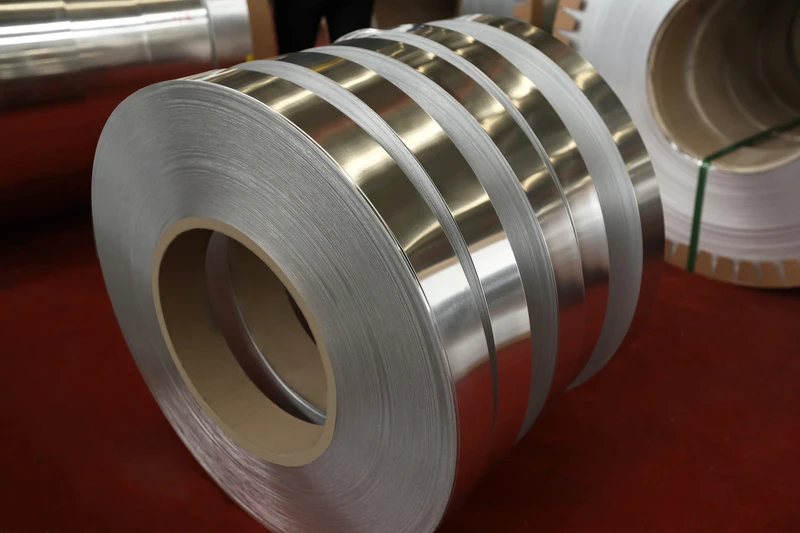
Aluminum foil, as one of the electrode materials for coupling capacitors, forms metal foil capacitor structures with dielectric film. With its lightweight properties, cost advantages, and good processing performance, aluminum foil has wide applications in small to medium power coupling capacitors. This article systematically explains key parameters, selection criteria, and industrial applications for aluminum foil used in coupling capacitors, serving as a professional reference for coupling capacitor manufacturers and procurement personnel.
1. Coupling Capacitor Structure and Aluminum Foil Principles
1.1 Basic Structure of Coupling Capacitors
Coupling capacitors typically use metallized film capacitor or metal foil film capacitor structures.
Metallized film capacitors: Vacuum deposit a thin layer of metal (aluminum or zinc) on the dielectric film (such as polypropylene, polyester) surface as electrodes. This structure has small volume and good self-healing performance, and is the standard structure for most commercial coupling capacitors.
Metal foil capacitors: Use metal foil (aluminum foil or copper foil) as electrodes, alternating with dielectric film through winding or lamination. Metal foil as an independent conductor layer has large electrode cross-sectional area, strong conductivity, and low ESR, particularly suitable for high-current and high-frequency applications.
In some special application scenarios, aluminum foil is also used as the metallization substrate for metallized film, or as the current-carrying layer of electrodes, carrying the conduction of main current.
1.2 Working Principle of Coupling Capacitors
Coupling capacitors perform the following functions in circuits:
DC isolation: Capacitors have the characteristic of “blocking DC and passing AC,” capable of blocking DC components in circuits, preventing DC bias from affecting the working point of the next stage circuit.
AC coupling: Allow AC signals of specific frequencies to pass, achieving effective inter-stage signal transmission.
Filter frequency selection: Combined with resistors or inductors, form high-pass, low-pass, or band-pass filters, achieving selection or filtering of specific frequency signals.
1.3 Core Role of Aluminum Foil in Coupling Capacitors
In metal foil coupling capacitors, aluminum foil undertakes the following core functions:
Conductivity function: Aluminum foil provides low-resistance conductive path, ensuring efficient transmission of AC signals.
ESR reduction: The low resistance characteristics of aluminum foil help reduce the capacitor’s equivalent series resistance (ESR), decreasing signal loss.
Mechanical support: Aluminum foil provides necessary mechanical strength for capacitors, facilitating winding and assembly.
Thermal dissipation: The good thermal conductivity of aluminum foil helps dissipate heat during capacitor operation.
1.4 Comparison of Aluminum Foil and Copper Foil Electrodes
In coupling capacitors, aluminum foil and copper foil electrodes each have their applications:
Aluminum foil electrodes: Low cost, light weight (density only 30% that of copper), suitable for large-scale production. In the medium frequency range (audio to mid-frequency), aluminum foil electrode performance meets most application requirements.
Copper foil electrodes: Superior conductivity (approximately 1.7 times that of aluminum), suitable for high-frequency or extremely high-efficiency applications. But higher cost.
For consumer electronics and most industrial application coupling capacitors, aluminum foil electrodes are the optimal cost-performance choice.
2. Key Specifications and Technical Requirements
2.1 Aluminum Foil Purity
Aluminum foil purity directly affects coupling capacitor electrical performance and long-term stability.
Industrial pure aluminum (99.5%–99.8%): Lower cost, suitable for general industrial application coupling capacitors.
1060 pure aluminum (99.6%): Conductivity approximately 61% IACS, the most commonly used industrial pure aluminum, suitable for most coupling capacitor applications.
1070 pure aluminum (99.7%): Performance similar to 1060, can serve as an alternative choice.
Selection advice: For general audio coupling and signal coupling applications, industrial pure aluminum can meet requirements. For high-frequency or precision coupling applications, recommend selecting higher purity aluminum with better conductivity.
2.2 Thickness Selection
Aluminum foil thickness affects coupling capacitor electrical performance and processing technology.
Thin aluminum foil (5μm–15μm): Suitable for small-capacity, high-frequency coupling capacitors. Thin aluminum foil is soft and easy to bend, suitable for precision winding.
Medium aluminum foil (15μm–30μm): Suitable for general specification coupling capacitors, the common specification range.
Thick aluminum foil (30μm–50μm and above): Suitable for applications requiring larger current-carrying capacity or higher reliability.
Selection advice: Coupling capacitor capacitance is usually small (pF to μF level), aluminum foil thickness selection mainly considers mechanical strength and processing convenience. Medium aluminum foil (15μm–30μm) is the most commonly used specification.
2.3 Width and Dimensions
Aluminum foil width needs to match dielectric film and capacitor structural design.
Standard width range: Customizable according to customer requirements; common widths range from a few millimeters to tens of millimeters.
Width precision: Aluminum foil width tolerance should be strictly controlled (usually within ±0.1mm) to ensure smooth winding and consistent capacitance value.
Slitting quality: Aluminum foil edges should be neat, without burrs or tears, avoiding damage to dielectric film during winding.
2.4 Annealing State
Aluminum foil annealing state affects its flexibility and processing performance.
Soft state aluminum foil (O): Very soft, easy to bend and form, suitable for manual or semi-automatic winding processes requiring complex shapes.
Half-hard state aluminum foil (H14/H16): Has both formability and mechanical strength, the ideal choice for automatic winding machines.
Hard state aluminum foil (H18/H19): Strongest shape-holding ability, suitable for high-speed automatic winding and applications requiring high mechanical stability.
Selection advice: For high-frequency precision coupling capacitors, soft state aluminum foil helps reduce high-frequency loss; for large-scale industrial production, half-hard state is the best choice.
2.5 Surface Quality Requirements
Coupling capacitors have strict requirements for aluminum foil surface quality.
Surface roughness: Ra is usually required below 0.8μm; smooth surface facilitates tight bonding with dielectric film.
Thickness uniformity: Aluminum foil thickness tolerance should be controlled within ±5% to ensure capacitance value consistency and stability.
Surface cleanliness: Aluminum foil surface should be free from oil contamination, oxide film, dust, and other impurities, avoiding affecting dielectric performance.
Edge quality: Aluminum foil edges should be neat, without burrs or tears.
3. Insulation Class and Temperature Management
3.1 Effect of Temperature on Coupling Capacitors
Coupling capacitor working temperature affects its capacitance, loss, and lifespan.
Capacitance temperature coefficient: The dielectric constant of dielectric film changes with temperature, causing capacitor capacitance to shift. Polypropylene film has smaller temperature coefficient (-200 to -400ppm/°C), suitable for precision applications; polyester film has larger temperature coefficient (approximately 400-600ppm/°C).
Insulation resistance: When temperature rises, insulation resistance decreases, affecting capacitor isolation performance.
Lifespan impact: High temperature will accelerate aging of dielectric film and insulation varnish, shortening capacitor lifespan.
3.2 Insulation Class and Selection
| Insulation Class | Max Operating Temperature | Application Scenarios | Aluminum Foil Selection |
|---|---|---|---|
| Class E | 120°C | General consumer electronics | Soft + polyurethane insulation |
| Class B | 130°C | Industrial control | Soft/half-hard + polyester insulation |
| Class F | 155°C | Automotive electronics, industrial equipment | Half-hard + polyesterimide insulation |
| Class H | 180°C | High temperature environments | Half-hard + polyamide-imide insulation |
Selection calculation: Design Temperature = Ambient Temperature + Temperature Rise + Safety Margin (15-20°C). For example: at 40°C ambient temperature, if temperature rise is 30°C plus 20°C margin, design temperature is 90°C, and Class E or Class B insulation is sufficient.
3.3 Dielectric Film Selection
Common dielectric films used in coupling capacitors and their characteristics:
Polypropylene film (PP): Extremely low loss (tanδ<0.001), high insulation resistance, good frequency characteristics, the preferred choice for high-frequency precision coupling capacitors. Temperature resistance approximately 105°C.
Polyester film (PET): Lower cost, good mechanical strength, temperature resistance up to 150°C, suitable for general industrial applications.
Polystyrene film (PS): Excellent electrical performance, small temperature coefficient (approximately -150ppm/°C), suitable for precision filtering and timing circuits.
Polyethylene naphthalate film (PEN): Excellent comprehensive performance, temperature resistance approximately 155°C, an emerging high-end material.
4. Industrial Applications and Selection Recommendations
4.1 Consumer Electronics Field
In consumer electronics, coupling capacitors are used for various signal coupling and filtering applications.
Audio equipment: Amplifier input/output coupling, speaker crossover networks, etc. Recommended: polypropylene film capacitors, aluminum foil thickness 15μm-25μm.
Televisions/displays: Inter-stage coupling of signal processing circuits, power supply filtering, etc. Recommended: polyester film capacitors, aluminum foil thickness 10μm-20μm.
Communication equipment: Modulation/demodulation, signal filtering, etc. Recommended: low-loss polypropylene film capacitors.
4.2 Industrial Control Field
Industrial control equipment has high requirements for coupling capacitor reliability and stability.
PLC/DCS systems: Analog signal input/output coupling, requiring high stability and low noise. Recommended: precision polypropylene film capacitors.
Industrial power supplies: Switching power supply feedback coupling, power factor correction, etc. Recommended: high temperature resistant polyester film capacitors.
Sensor signal processing: Weak signal coupling and amplification, requiring capacitors with low noise and high insulation resistance.
4.3 Automotive Electronics Field
Automotive electronics is an important application field for coupling capacitors.
In-vehicle audio systems: Amplifier coupling, speaker crossover, requiring high-fidelity audio characteristics. Recommended: polypropylene film capacitors.
In-vehicle infotainment systems: Signal processing and power filtering, requiring stable operation across wide temperature range.
New energy vehicles: Battery management systems (BMS), motor controllers, etc., with strict requirements for capacitor reliability and temperature characteristics.
4.4 Common Selection Problems and Solutions
Excessive capacitance deviation: Check if aluminum foil thickness is uniform; confirm dielectric film thickness and dielectric constant consistency; consider using higher precision capacitor specifications.
Poor high-frequency performance: Select low-loss dielectric film (such as polypropylene); check aluminum foil surface roughness (high roughness increases high-frequency loss); consider using thinner aluminum foil to reduce skin effect.
Insufficient insulation resistance: Check dielectric film quality and thickness; confirm inter-electrode insulation layer integrity; consider using higher grade insulation materials.
Excessive capacitor noise: Select low-loss, low-noise dielectric film; check bonding quality between aluminum foil and dielectric film; consider using non-inductive capacitor structure.
5. Supplier Selection and Quality Control
5.1 Quality Certifications
ISO9001 quality management system certification is the basic requirement. For automotive-grade applications, IATF16949 certification is required. Environmental certifications such as RoHS and REACH are necessary for exporting to overseas markets.
5.2 Technical Capability Evaluation
Custom drawing capability: Whether aluminum foil thickness, width, and tolerance range can meet design requirements. Whether sample development cycle is reasonable (typically 5–10 working days).
Process quality control: Whether key control capabilities such as thickness testing, surface quality testing, and purity testing are available. Whether on-site supervision is supported.
5.3 Production Capacity and Delivery
Stable production capacity is the guarantee for long-term supply. It is recommended to select suppliers with complete quality control systems.
6. Product Specifications Summary
| Parameter | Specification Range |
|---|---|
| Aluminum Foil Purity | 99.5% – 99.8% |
| Thickness | 5μm – 50μm |
| Width | 3mm – 100mm |
| State | Soft / Half-hard / Hard |
| Surface Roughness | Ra≤0.8μm |
| Thickness Tolerance | ±5% |
| Standards | IEC / GB / JIS / NEMA |
7. Technical Support and Contact
For detailed product specifications, samples, or technical selection support, please contact Zhengzhou LP Industry Co., Ltd. With years of expertise in electronic aluminum materials exports, our aluminum foil products are widely used in coupling capacitors, film capacitors, power electronics, and other fields.
- Email: office@cnlpzz.com
- Phone/WhatsApp: 0086-19337889070
- Key Products: Aluminum foil, Electrode aluminum foil, Film capacitor materials
This document provides professional guidance for aluminum foil selection in coupling capacitor applications. For specific projects, please consult with technical professionals based on actual operating conditions.