

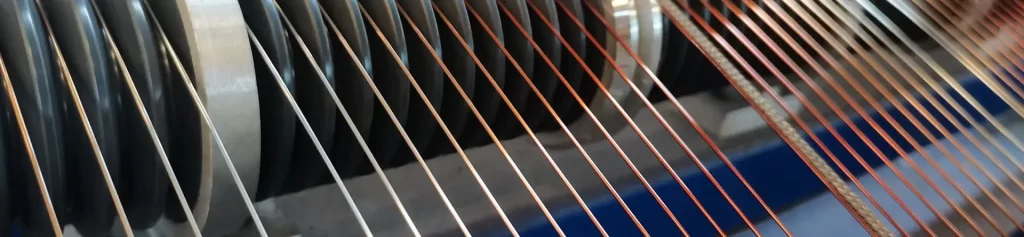
Enamelled wire is the basic material used in the construction of motors, transformers and induction coil machinery.
So many folk will be unaware that what looks like a standard enameled wire is in fact highly engineered and precise matter of science and art.
Today, let‘s get down to one of following technx: How does it work with enamelled wire?
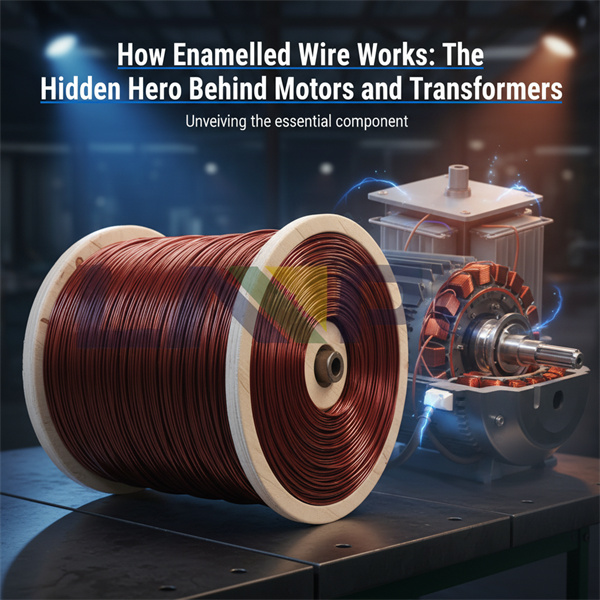
What Is Enamelled Wire?
Enamelled Wire (also called Enameled Wire or Magnet Wire) is a type of electromagnetic wire that uses a metal conductor with an insulating enamel coating on the outer surface.
Three Core Elements:
- Conductor—usually copper or aluminum wire, responsible for conducting current
- Insulation Coating—enamel film coated on the conductor surface, responsible for insulation
- Adhesion—the firm bond between the insulation layer and the conductor
How Enamelled Wire Works: Why do they insulate?
1. Conductor Carries Current Copper Conductor Advantages: Optimumity of low resistivity (around 1.7×10 m) Good conduction Good mechanical properties Aluminum Conductor Advantages: Density: only 30% of copper Cost around 1/3 of copper Plenty of resources
2. Insulation Enamel Isolates Current The resistance of the film enamel itself (1012-101 m) The film thickness is generally only a few tens of micrometers in thickness. Though only small to be dangerous, it may be able to withstand hundreds to a thousand volts, which if in a stray electro static charge would be very dangerous.
3. Synergistic Work Between Enamel and Conductor Enamelled wire works normally thanks to the synergy between the conductor and the insulation layer: Conductor gives the current path. Insulation means that the current cannot flow to places it isn‘t meant to. Both combine to form a fully integrated electrical system.
Enamelled Wire Structure
Single-Coating Structure
Conductor
Primer Layer
Single Insulation Enamel Layer
Top Coat
Application Scenarios: Common motor windings, other transformer. Low insulation applications.
Double-Coating Structure
Advantages: Higher breakdown voltage, better heat resistance, superior mechanical properties
Application scenarios: High-voltage motor, inverter motor, high reliability requirements;
Triple-Insulation (TIW) Structure
Advantages: Breakdown voltage 2-3 times greater than normal enamelled wire, can eliminate need for external protection measures, major safety improvement.
Manufacturing Process of Enamelled Wire
Main Process Flow
Step 1: Drawing
Stretch thick copper rod or aluminum rod through dies into fine wire:
The width can be taken from 8mm to 0.05mm
Drawing process needs lubrication and cooling;
Post drawing annealing treatment 1. Annealing treatment after drawing, work hardening of copper and silver is fairly high after drawing. To make them soft and ready for subsequent work then annealing is necessary.
Step 2: Annealing
To eliminate internal stress from drawing and restore metal flexibility:
Heating temperature 400-600 degreesC (copper) / 300-400 degreesC (aluminum)
Control over time and temperature is essential.
Step 3: Enamel Coating
Felt Method:
Use felt (or similar) material immersed in enamel.
Conductor wire that has passed through felt and offers the application of the enamel
Room temperature (less than 20°C) would be acceptablea. This is for small batch, multi-variety production.
Die Method:
Enamel with metal die in the appliancer.
A more uniform film thickness
Large batch processing: processed both as an individual product and within a batch.
Step 4: Curing
Oven temperature: 400-600 degreesC
The crosslinking reaction in the enamel system occurs at elevated temperature
Create a hard insulation coating
Step 5: Spooling
The currents producing the spooling tension should be accurately regulated
Spool specifications changed according to customer order requirements
Key Process Parameters
| Parameter | Typical Value |
|---|---|
| Conductor Diameter | 0.05-5.0mm |
| Enamel Film Thickness | 10-50μm |
| Curing Temperature | 400-600°C |
| Line Speed | 100-500m/min |
| Coating Times | 4-12 passes |
Enamel Materials: Key to Enamelled Wire Performance
Mainstream Enamel Materials
| Enamel Type | Thermal Class | Features | Applications |
|---|---|---|---|
| Polyester (PEW) | Class 130 (B) | Low cost, good processability | General motors, home appliances |
| Polyurethane (UEW) | Class 130 (B) | Solderable, easy welding | Small transformers, electronic components |
| Polyesterimide (EIW) | Class 180 (H) | Good heat resistance | Industrial motors, high temperature environments |
| Polyamideimide (AIW) | Class 200 (N) | Heat and chemical resistant | Special motors, harsh environments |
| Polyimide (PI) | Class 220 (R) | Highest temperature resistance | Aerospace, military |
Composite Coatings
Modern enamelled wires increasingly use composite coatings:
- Polyesterimide + Polyamideimide: Excellent comprehensive performance
- Polyester + Polyamideimide: High cost-performance ratio
- Polyurethane + Polyamide: Good solderability
Working Mechanism in Actual Applications
How It Works in Motors
Step 1 is called Energization the current passed through the enamelled wire conductor, the enamel prevents the current going into leakage.
Step 2: Generation of magnetic field the current through the wire generates the magnetic field due to the principles of electromagnetic induction.
Step 3. Magnetic Field Interaction–The magnetic field produced in the armature of the motor interacts with the magnetic field produced in the stator to generate a torque
Step 4: Mechanical Output Torque causes mechanical load
Critical Enamel Functions:
Prevent inter-turn short circuits
Prevent ground disturbance
Operating temperature tolerance
How It Works in Transformers
Initial step: AC input First coil (winding consisting of coated wire) receives alternating current.
Step 2: Alternatin g Magnetic Field Alternating current generates an alternaitnG magnetic flux coupled through iron core
Step 3: EMF Induced Secondary coil of enamelled wire winding.
Step 4: Power output the secondary coil outputs to load.
Tensile Strength:
Copper: 220-270N/ mm2 (annealed).
Hard aluminum: 130-180 N/mm2
Elongation: Usually needs 25%
Flexibility: bending and winding tests.
Thermal Performance
Heat Shock Performance: Enamel does not crack or delaminate at specified temperatures
Softening Breakdown Temperature: the temperature at which the failure of the enamel takes place under combined heat and pressure.
Common Failure Modes
Enamel Breakdown:
Cause:104.1 Voltage higher than enamel withstanding ability
Result: Inter-turn short circuit
Prevention: choose the next insulation class, design with a lower class.
Enamel Cracking:
Cause: Thermal shock, mechanical stress
Results: localised failed insulation
Prevention control process and quality
Enamel Aging:
Cause: High temperature for long term, Chemical erosion
Result: Insulation performance degraded
Prevention: Use suitable materials, prevent overload
Conductor Oxidation:
Cause: Moisture, acid/alkali erosion.
Result: Higher contact resistance
Prevention: 1. Keep dry environment.
Core Differences Between Enamelled Wire and Ordinary Wire
| Comparison | Ordinary Wire | Enamelled Wire |
|---|---|---|
| Structure | Conductor + thick plastic insulation | Conductor + ultra-thin enamel film |
| Insulation Thickness | 0.5-2.0mm | 10-50μm |
| Flexibility | Relatively hard | Extremely soft |
| Temperature Resistance | About 70°C | 130-220°C |
| Winding Performance | Not suitable for dense winding | Suitable for dense winding |
| Main Use | Power transmission | Electromagnetic conversion |
Key Differences:
- Enamelled wire’s insulation layer is very thin, allowing dense winding
- Enamelled wire’s higher temperature resistance adapts to heat from electromagnetic conversion
- Enamelled wire is specifically designed for electromagnetic induction and inductance applications
Application Fields of Enamelled Wire
1. Motors
- Home appliance motors
- Industrial motors
- New energy vehicle drive motors
- Wind power generators
2. Transformers
- Power transformers
- Distribution transformers
- Special transformers
3. Induction Coils
- Relays
- Contactors
- Solenoid valves
4. Electronic Components
- Inductors
- Chokes
- Tuning coils
5. Instrumentation
- Measuring instruments
- Precision instruments
FAQ
Q: Why can enamelled wire be so thin?
A: Modern insulation enamel material technology is very advanced. Materials like polyimide can withstand thousands of volts at thicknesses of just tens of micrometers.
Q: Can enamelled wire be soldered?
A: Depends on the enamel material. Polyurethane enamelled wire (UEW) can be directly soldered. Other types require stripping first.
Q: How long is the lifespan of enamelled wire?
A: Under normal use conditions, enamelled wire lifespan is usually 15-30 years. The key is using within the specified temperature range.
Q: Can enamelled wire be used outdoors?
A: Depends on specific environment. The enamel itself cannot be exposed to UV and moisture for long periods, requiring additional protection.
Q: How to judge the quality of enamelled wire?
A: Check enamel uniformity, perform breakdown voltage tests, flexibility tests, etc.