

Motors are the foundation of modern industry, from household appliances to electric vehicles, from industrial robots to aerospace equipment, motors are everywhere. With the increasingly severe global energy crisis and environmental protection pressures, improving motor efficiency has become one of the key paths for energy conservation and emission reduction.
Technical Background of High-Efficiency Motors
Evolution of Energy Efficiency Standards
Major economies worldwide have raised motor energy efficiency standards in recent years. The IEC 60034-30 series standards classify motor efficiency into four grades: IE1 (standard efficiency), IE2 (high efficiency), IE3 (super high efficiency), and IE4 (ultra super high efficiency).
Relationship Between Motor Losses and Winding Wire
During motor operation, various losses exist including iron losses (core magnetization losses), copper losses (winding resistance heating losses), mechanical losses (bearing friction, wind resistance, etc.), and stray losses. The core to improving motor efficiency is reducing various types of losses.
Comprehensive Requirements for High-Efficiency Motor Winding Wire
High-efficiency motors impose multi-dimensional technical requirements on winding wire. Electrical performance requires low resistivity to reduce copper losses; good insulation performance ensures long-term electrical reliability; appropriate thermal class meets different operating environment requirements.
Winding Wire Material Systems
Copper Wire
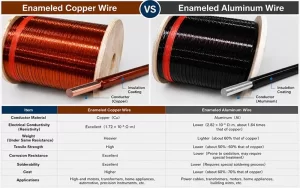
Copper is the most commonly used conductor material for motor windings. Copper has low resistivity (0.0175 Ω·mm²/m) and excellent conductivity, second only to silver. Copper wire processing technology is mature with comprehensive product specifications, making it the preferred material in the motor industry.
Aluminum Wire
Aluminum wire is an important alternative for motor windings. Aluminum’s resistivity is approximately 1.6 times that of copper, but aluminum’s density is only 30% of copper’s, and raw material costs are significantly lower than copper.
Copper-Clad Aluminum Composite Material
Copper-clad aluminum wire (CCA) is a bimetallic composite material with copper on the outside and aluminum inside. This material combines copper’s conductivity with aluminum’s lightweight advantages.
Enameled Wire Technical Characteristics
Enameled Wire Structure and Classification
Enameled wire is manufactured by coating insulating varnish on the conductor surface and baking to cure. Insulating varnish film provides electrical insulation protection while protecting the conductor from environmental erosion. Common insulation types include: Polyurethane enameled wire (UEW): Has direct solderability; thermal class typically 130°C; widely used in micro motors and electronic equipment. Polyester enameled wire (PEW): Thermal class 130°C with good mechanical strength and electrical performance; one of the most commonly used types in industrial motors. Polyester-imide enameled wire (EIW): Thermal class 155°C with better thermal resistance and chemical resistance; widely used in high-efficiency motors and special motors. Polyamide-imide enameled wire (AIW): Thermal class 200°C, belonging to the highest thermal class products; has excellent heat, chemical, and wear resistance; used for high-temperature environments and special applications.
Insulation Varnish Performance Indicators
Insulation varnish film performance directly affects overall enameled wire quality and motor reliability. Breakdown voltage is a key indicator for measuring insulation strength, typically expressed in kV or kV/mm.
Thermal Class Selection
Selecting the appropriate thermal class is an important decision in motor design. High-efficiency motors typically require higher thermal classes. For IE3/IE4 efficiency motors, 155°C (polyester-imide) or 200°C (polyamide-imide) enameled wire is recommended.
High-Efficiency Motor Winding Design Key Points
Slot Fill Rate Optimization
Slot fill rate is the ratio of conductor cross-sectional area in the slot to the slot effective cross-sectional area. Higher slot fill rate means more effective utilization of slot space, which can reduce core size or increase turns. In high-efficiency motor design, improving slot fill rate is an effective means to reduce copper losses.
Winding Form Optimization
Winding form affects motor electrical performance and manufacturing process. Distributed windings distribute coils across multiple slots with good electromagnetic performance but longer end portions and greater copper losses. Concentrated windings have only one coil per pole per phase with compact structure and short end portions but slightly inferior electromagnetic performance.
End Design
The end portion is an important part of the winding, though it does not participate in energy conversion, it adds resistance and heat dissipation. Shortening the end portion can reduce copper material consumption and copper losses. High-efficiency motors typically employ short-pitch end designs to optimize end shape and reduce unnecessary copper material.
Selection Recommendations
Selecting Based on Efficiency Class
IE3 (super high efficiency) and above motors: Polyester-imide enameled copper wire (155°C) is recommended to ensure good thermal performance and electrical reliability. Consider appropriately increasing conductor cross-sectional area or turns to reduce copper losses. IE4 (ultra super high efficiency) motors: Polyamide-imide enameled copper wire (200°C) is recommended to provide greater design margin for reducing copper losses. Can combine flat wire technology for further optimization. Ordinary efficiency motors (IE1/IE2): Polyester enameled copper wire (130°C) typically meets requirements while controlling costs.
Selecting Based on Power Level
Large power motors (>100kW): High efficiency requirements with large copper loss proportion. Large gauge enameled copper wire or flat wire recommended. Consider low resistivity conductors or increasing conductor cross-sectional area. Medium power motors (1-100kW): Polyester-imide enameled copper wire is an ideal choice. Balance performance and cost, can optimize winding design to improve efficiency. Small power motors (<1kW): Select based on efficiency requirements and cost budget. Micro motors can use polyurethane enameled wire to utilize its direct solderability.
Selecting Based on Operating Environment
High-temperature environments (>130°C): Must use high thermal class enameled wire such as 200°C polyamide-imide enameled wire. May need to consider special insulation materials. Humid or corrosive environments: Select enameled wire with good moisture and chemical resistance, and consider additional protective measures such as impregnation treatment. Vibration environments: Select enameled wire with strong insulation layer adhesion and mechanical stress resistance to ensure long-term operational reliability.
Technology Development Trends
Flat Wire Technology
Flat wire (rectangular conductor) is an important development direction for high-efficiency motors. Flat wire has larger cross-sectional area and lower resistance; rectangular cross-section facilitates higher slot fill rate; short end portions reduce copper material consumption. Flat wire technology has been widely applied in new energy vehicle drive motors. Hair-pin and 发卡式 windings using flat wire have achieved extremely high efficiency and power density.
Ultra-Fine Enameled Wire
Ultra-fine enameled wire (diameter below 0.1mm) has important applications in electronic motors and micro motors. With the trend toward smaller electronic products, demand for ultra-fine enameled wire continues to grow.
New Insulation Materials
New insulation materials with higher temperature resistance and reliability continue to emerge. Nanomodified insulating varnish and ceramic-coated insulation are gradually being applied.
Environmentally Friendly Enameled Wire
Environmental regulations are becoming increasingly stringent on enameled wire. Lead-free enameled wire and water-based enameled wire are becoming development directions. These products reduce or eliminate hazardous substances in traditional enameled wire, more aligned with sustainable development requirements.
Summary
High-efficiency motors impose comprehensive and strict requirements on winding wire. From low resistivity to high thermal class, from good processability to reliable insulation performance, each indicator affects the motor’s final efficiency and reliability. Copper wire remains the preferred choice for high-efficiency motors due to its excellent conductivity, but aluminum wire and copper-clad aluminum wire also have unique value in specific applications. Selecting the appropriate thermal class and enameled wire type requires comprehensive consideration based on specific applications. With continuous improvement of energy efficiency standards and ongoing advancement of new material technology, high-efficiency motor winding wire will continue to develop toward better performance, higher reliability, and greater environmental friendliness.