


Introduction
Safety capacitors are key safety components in electronic equipment used to suppress electromagnetic interference (EMI). According to application location and safety standard requirements, safety capacitors are mainly divided into two types: Class X and Class Y. Class X capacitors are connected across power supply lines (L-N) for differential mode interference suppression; Class Y capacitors are connected between power supply lines and ground (L-G, N-G) for common mode interference suppression.
As products involving personnel safety, manufacturing materials for safety capacitors need to comply with strict safety standards and certification requirements. Copper foil, as one of the electrode materials for safety capacitors, needs to have special performance characteristics to meet safety application requirements. Unlike ordinary film capacitors, safety capacitors need to present an “open circuit” mode when failing, avoiding safety hazards caused by short circuits.
This article systematically explains key parameters, selection criteria, and industrial applications for copper foil used in safety capacitors, serving as a professional reference for safety capacitor manufacturers and procurement personnel.
1. Safety Capacitor Structure and Copper Foil Principles
1.1 Classification and Standards of Safety Capacitors
Safety capacitors have different classifications according to international safety standards, including:
Class X capacitors: Connected across L-N at the power input terminal, mainly used for differential mode interference suppression. When a capacitor fails, a short circuit may occur, so strict requirements are imposed on capacitor voltage withstanding and combustion characteristics. Class X capacitors are further divided into X1, X2, X3 grades according to allowed maximum pulse voltage.
Class Y capacitors: Connected between L-G or N-G, they are safety components involving electric shock protection. When a capacitor fails, it must remain in an open state to avoid electric shock hazards. Class Y capacitors are similarly divided into Y1, Y2, Y3, Y4 grades according to voltage withstanding class.
Main certification standards for safety capacitors include: IEC 60384-14 (international standard), UL 60384-14 (North American standard), EN 60384-14 (European standard), etc. These standards have strict regulations on capacitor voltage withstanding, insulation resistance, combustion characteristics, failure mode, etc.
1.2 Basic Structure of Safety Capacitors
Safety capacitors usually adopt metallized film structure, which differs from ordinary metal foil electrode capacitors.
Metallized film capacitors: Use metallized film with a thin layer of metal (usually aluminum or zinc) vacuum-deposited on the dielectric film surface as electrodes. The characteristic of this structure is that when the capacitor experiences overvoltage breakdown, the metallized layer will self-heal and is unlikely to cause permanent short circuits.
Metal foil electrode capacitors: Some special specification safety capacitors also adopt metal foil electrode structure, providing larger current-carrying capacity.
For safety capacitors using metal foil electrodes, copper foil needs to meet more stringent quality requirements to ensure product safety and reliability.
1.3 Role of Copper Foil in Safety Capacitors
Copper foil serves as electrode material in safety capacitors, undertaking the following functions:
Conductivity function: Copper foil provides low-resistance conductive path, ensuring good electrical performance during normal capacitor operation.
Current carrying: In applications such as switching power supplies, safety capacitors need to withstand certain pulse currents; copper foil cross-sectional area affects current-carrying capacity.
Thermal conduction: Copper foil helps capacitors dissipate heat during operation, reducing temperature rise and improving reliability.
Mechanical support: Provides necessary mechanical strength for capacitors, facilitating installation and fixation.
2. Key Specifications and Technical Requirements
2.1 Copper Foil Purity
Safety capacitors have high requirements for copper foil purity to ensure electrical performance and chemical stability.
T2 pure copper (99.9%): The most commonly used industrial pure copper, suitable for most safety capacitor applications, with optimal cost-performance ratio.
Oxygen-free copper (OFHC, 99.99%): Extremely low impurity content, better electrical conductivity, suitable for high-end safety capacitors with extremely high performance requirements.
Impurity control: Impurities such as iron and sulfur may affect copper foil corrosion resistance and electrical stability. For safety applications, it is recommended to select products with strictly controlled impurity content.
2.2 Thickness Selection
Copper foil thickness affects safety capacitor electrical performance and manufacturing process.
Thin copper foil (9μm–18μm): Suitable for small safety capacitors, helping reduce volume and cost.
Medium copper foil (18μm–35μm): Suitable for general specification safety capacitors, the common specification range.
Thick copper foil (35μm–50μm and above): Suitable for applications requiring larger current-carrying capacity or higher reliability.
Selection advice: Copper foil thickness selection for safety capacitors needs comprehensive consideration of rated voltage, capacitance, pulse current withstanding capacity, and winding process requirements.
2.3 Width and Dimensions
Copper foil width needs to match dielectric film and capacitor structural design.
Standard width specifications: Customizable according to customer requirements; common slit widths range from a few millimeters to tens of millimeters.
Width precision: For safety capacitors, precise control of copper foil width is important, affecting capacitor capacitance precision and safety.
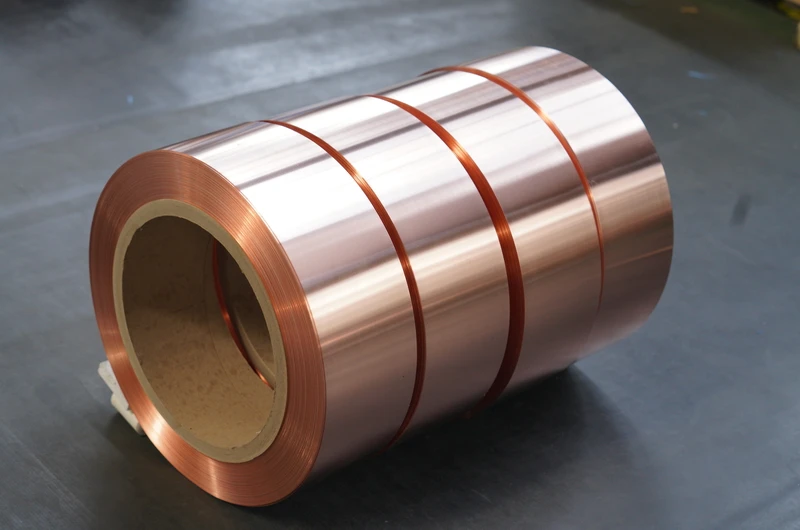
Coil quality: Copper foil is usually supplied in coil form; needs to be free from wrinkles and ripples, ensuring smooth winding.
2.4 Annealing State
Copper foil annealing state affects its flexibility and processing performance.
Hard state copper foil: High tensile strength, suitable for high-speed automatic winding, with good electrode dimensional stability.
Soft state copper foil: Soft and easy to bend, suitable for applications requiring subsequent forming.
Selection advice: Most safety capacitor manufacturers use hard or half-hard copper foil for automatic winding.
2.5 Surface Quality Requirements
Safety capacitors have strict requirements for copper foil surface quality.
Surface roughness: Ra is usually required to be below 0.8μm; smooth surface facilitates tight bonding with dielectric film.
Thickness uniformity: Copper foil thickness tolerance should be controlled within ±5% to ensure capacitor performance consistency.
Surface cleanliness: Copper foil surface must be free from oil contamination, oxide film, or other impurities.
Edge quality: Copper foil edges should be neat, free from burrs or tears.
3. Safety Standards and Certification Requirements
3.1 Voltage Withstanding Requirements
Safety capacitors need to pass strict voltage withstanding tests to ensure electrical safety during use.
Class X capacitor voltage withstanding grades:
- Class X1: Test voltage 4.3kV, suitable for occasions with higher pulse voltage.
- Class X2: Test voltage 2.7kV, the most common Class X capacitor grade.
- Class X3: Test voltage 2.0kV, suitable for general purposes.
Class Y capacitor voltage withstanding grades:
- Class Y1: Test voltage 8.0kV, suitable for applications requiring high isolation.
- Class Y2: Test voltage 5.0kV, the most common Class Y capacitor grade.
- Class Y4: Test voltage 2.5kV, suitable for general purposes.
3.2 Combustion Characteristics Requirements
Safety capacitors need to meet strict combustion characteristic standards to avoid fire hazards.
UL 94V-0 is the most commonly used combustion grade requirement, demanding that materials can self-extinguish during testing and not produce burning droplets.
The combination of copper foil and dielectric film needs to pass relevant combustion test verification.
3.3 Certification Requirements
As safety components, safety capacitors need to pass relevant safety certifications before being used in products.
IEC 60384-14 is the internationally通用安全电容器标准。UL认证对于进入北美市场是强制要求。CE标志对于进入欧盟市场是强制要求。CCC认证对于进入中国市场是强制要求。
4. Industrial Applications and Selection Recommendations
4.1 Consumer Electronics Field
In consumer electronics, safety capacitors are essential EMI suppression components at power input terminals.
Mobile phone chargers: Need to use Class X2 and Class Y2 safety capacitors, meeting IEC/UL/CE certification requirements.
Televisions and monitors: Power sections require various specifications of safety capacitors for EMI filtering and lightning protection.
Computer power supplies: Need to comply with strict EMI standards; safety capacitors are key objects in certification testing.
4.2 Industrial Power Field
Industrial power has higher requirements for safety capacitor reliability and certification.
Switching power supplies: Need to use safety capacitors meeting IEC 60384-14 standard, and pass relevant EMC testing.
Variable frequency drives: Involving high power applications, with higher requirements for safety capacitor current-carrying capacity and reliability.
Uninterruptible power supplies (UPS): As safety-related equipment, with more stringent requirements for capacitors.
4.3 Automotive Electronics Field
Automotive electronics is a rapidly developing application field with special requirements for safety capacitors.
Vehicle chargers: Need to use automotive-grade safety capacitors, meeting AEC-Q200 certification requirements.
In-vehicle infotainment systems: Need strict EMI suppression to ensure electromagnetic compatibility of the system.
4.4 Common Selection Problems and Solutions
Certification non-compliance: Confirm certification requirements for target markets (IEC/UL/CE/CCC, etc.); select copper foil and capacitor products that have passed relevant certifications.
Insufficient voltage withstanding: Confirm if copper foil thickness meets rated voltage requirements; check if capacitor design has sufficient voltage withstanding margin.
Combustion test failure: Check if the combination of dielectric film and copper foil meets combustion grade requirements; consider using material combinations with better flame-retardant properties.
Poor EMI suppression effect: Select capacitors with appropriate capacitance; confirm correct capacitor connection position in the circuit; consider multi-stage filter design.
5. Supplier Selection and Quality Control
5.1 Quality Certifications
ISO9001 quality management system certification is the basic requirement. For safety capacitor applications, attention to UL, CE and other relevant product certifications is needed.
5.2 Technical Capability Evaluation
Custom drawing capability: Whether copper foil thickness, width, and tolerance range can meet design requirements.
Process quality control: Whether complete testing equipment is available to perform factory inspection on key parameters.
5.3 Production Capacity and Delivery
Stable production capacity is the guarantee for long-term supply. It is recommended to select suppliers with complete quality control systems and stable production capacity.
6. Product Specifications Summary
| Parameter | Specification Range |
|---|---|
| Copper Foil Purity | 99.9% – 99.99% |
| Thickness | 9μm – 50μm |
| Width | 3mm – 100mm |
| State | Hard / Half-hard / Soft |
| Surface Roughness | Ra≤0.8μm |
| Standards | IEC 60384-14 / UL 60384-14 |
7. Technical Support and Contact
For detailed product specifications, samples, or technical selection support, please contact Zhengzhou LP Industry Co., Ltd. With years of expertise in electronic copper materials exports, our copper foil products are widely used in safety capacitors, film capacitors, power electronics, and other fields.
- Email: office@cnlpzz.com
- Phone/WhatsApp: 0086-19337889070
- Key Products: Copper foil, Electrode copper foil, Safety capacitor materials
This document provides professional guidance for copper foil selection in safety capacitor applications. For specific projects, please consult with technical professionals based on actual operating conditions.