

In the context of the world‘s carbon neutral, New Energy Vehicles is accelerating the replacement of traditional fuel vehicles.
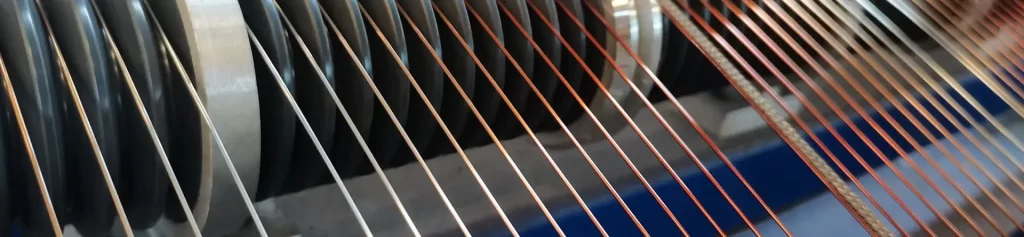
Drive motor, and magnet wire (enameled wire) is one of the essential technology for electric car drive motor.
A trend that is becoming more and more prevalent in recent years is the use of aluminum magnet wire in electric vehicle drive motors.
Today we will discuss the use of aluminum magnet wire for electric vehicle motors…what it is, why it is chosen, the benefits and considerations in choosing it.
What Is Aluminum Magnet Wire for EV Motors?
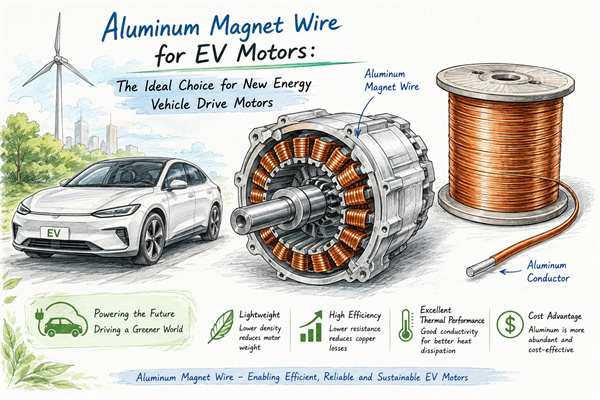
Aluminum Magnet Wire for EV Motors is enameled magnet wire with aluminum conductor, for use in electric vehicle drive motors.
Core Features:
Aluminum conductor widely available and cost controllable The prices ofthe cable are not stable and depend on the market. Therefore it is used widely.
Enameled has an excellent heat resistance, weather resistance and insulation performance.
Specifically Designed for EV high power density and high efficiency requirements, etc.
Differences from Ordinary Aluminum Magnet Wire:
EV motors have higher requirements for magnet wire than ordinary motors:
Greater power density
More efficient.
Enhanced heat dispersion
Greater reliability requirements.
Why Use Aluminum Magnet Wire for EV Motors?
- Weight Advantage
Range is one of the main difficulties of EV. If weight of EV can be decreased by 10kg it can highly improve range by 2%-3%. Aluminum‘s density is just 30%of copper‘s. Applying aluminum magnet wire can only weight of motor heavily decreased, thus increase range. - Cost Advantage
Recently, copper price stays high and aluminum price is relatively stable. Incorporating aluminum magnet wire into the motor design could cost several thousand yuan less, which is a quite attractive factor in a competitive market on electric vehicles. - Efficiency Advantage
Many consider that aluminum wire has worse resistance and use more. Actually speaking, aluminum wire resistance can be equal to copper wire through properly increases the cross-sectional area. And aluminum wire was better in heat dissipation performance, motor‘s continuous power output will be more strong. - Supply Chain Security
Copper is a strategic resource that is more geographically concentrated, while aluminum resources are more abundant, and the supply more diversified. Replacement with aluminum magnet wire can mitigate supply risk. - Lightweight Trend
As EV technology is evolving, lightweight design is becoming more and more important. Aluminum magnet wire is naturally beneficial in motors for weight savings.
Special Challenges of EV Motors
The electric vehicle drive motors are driven more severe operation condition than the conventional industrial motors.
High-Frequency Operation
EV motors generally run over a very large speed range, from a few hundred RPM at idle to over ten thousand at high speed, so magnet wire must be able to deal with the skin and proximity effects of these high frequency currents.
High Power Density
In order to realize higher power, EV motor with high power density design (8KW/liter to 14KW/liter) are generally applied due tothe constrain in limited volume. So higher power density mainly refers to higher current density and in turn more heat.
High Operating Temperature
High-power charging, long-time cruising, or other conditions that produce high motor temperature. An ideal condition that magnet wire is required to perform at stable insulate characteristic even at high temperature.
Vibration and Mechanical Stress
Vehicle operation momentum could directly affect the mechanical properties of magnet wire during vibration.
High Reliability Requirements
Automobile service life requirement is over 15 years. Motors and proper materials should meet this requirement.
Aluminum vs Copper Magnet Wire: Which to Choose for EV Motors?
| Comparison | Aluminum Magnet Wire | Copper Magnet Wire |
|---|---|---|
| Weight | Light (~30% of copper) | Heavy |
| Cost | Low (~1/3 of copper) | High |
| Conductivity | Good (requires larger cross-section) | Excellent |
| Heat Dissipation | Good | Average |
| Supply Stability | Stable | Volatile |
| Suitable For | Lightweight-focused EVs | High power density EVs |
In fact, both solutions are adopted by mainstream EV manufacturers. Tesla, BYD, and other manufacturers use aluminum winding solutions in some models.
Specifications and Parameters
Standard Round Wire Specifications
| Wire Diameter (mm) | Cross-sectional Area (mm²) | F Class Current (A) | H Class Current (A) |
|---|---|---|---|
| 1.0 | 0.785 | 2.5 | 3.0 |
| 1.5 | 1.767 | 5.5 | 6.5 |
| 2.0 | 3.142 | 10 | 12 |
| 2.5 | 4.909 | 15 | 18 |
Hairpin Flat Wire Specifications
Hairpin winding is the current mainstream technology for EV motors, with special requirements for flat wire specifications:
| Thickness (mm) | Width (mm) | Cross-sectional Area (mm²) | Typical Application |
|---|---|---|---|
| 2.0 | 6.0 | 11.5 | 15kW motor |
| 3.0 | 8.0 | 23.5 | 50kW motor |
| 4.0 | 10.0 | 39.0 | 100kW motor |
| 5.0 | 12.0 | 58.5 | 150kW+ motor |
Insulation Class
| Insulation Class | Max Operating Temp | Recommended Application |
|---|---|---|
| Class F | 155°C | Standard EV models |
| Class H | 180°C | High-performance EV models |
| Class 200 | 200°C | High power, high heat dissipation requirement models |
Typical Applications in EV Motors
- Permanent Magnet Synchronous Motor (PMSM)
PMSM is the current main stream for passenger vehicle. Aluminum magnet wire can be used in stator winding, which can reduce weight and cost. - Induction Motor
Commercial vehicles and some passenger vehicles employ induction motors. Aluminum magnet wire is an inexpensive magnet wire for these motors. - Switched Reluctance Motor (SRM)
It is that SRM had a simple shape, high reliability. Aluminum magnet wire production to lightweight and cost control. - Power Electronics
Along with the motors, aluminum magnet wire makes a lot of use in on-board transformers, reactors and other power devices.
Key Technology for EV Motors
Hairpin winding is currently the leading technology for EV motors.
Hairpin Advantages:
High level of slot fill rate may be more than 70%
Good heat transfer: Large contact area between flat wire and cooling system.
Production efficiencies – relatively high for automation ( automated operations)
Very good high frequency suitable, performance is very good.
Requirements for Hairpin Flat Wire:
Quantitative high dimensional accuracy ( tight controls on tolerances)
Shall have good surface finish, no loose burrs or other surface defects
Outstanding insulation performance: robust to high voltage pulses
Good bend performance – working ideal for hairpin forming
Selection Key Points
Choose form of winding5 Round wire winding or Hairpin flat wire winding?7 Various form of winding are applied to different wire indications.
Determine Power Rating Determine the cross section of the conductor considering the maximum peak power and the continuous power.
Evaluate Insulation Class Choose what insulation class specified on the motor heat dissipation design and operating temperature.
Corona Resistance: EV motors operate with high voltage pulses they may result into partial discharge at edge of the insulation. Use corona resistant insulation coating.
Check suppliers qualifications what quality control/ certification do they have? Magnet wire of EV-grade should have automotive certification.
Processing Considerations
Winding Process:
- Aluminum wire mechanical properties differ from copper wire; tension control needs adjustment
- Hairpin forming requires professional molds and equipment
Welding Process:
- Aluminum wire welding requires professional aluminum welding process
- Laser welding is the mainstream choice for Hairpin motors
Insulation Treatment:
- Vacuum impregnation is the standard process for EV motors
- Aluminum wire impregnation process is basically the same as copper wire
Cost Analysis
| Cost Factor | Aluminum Magnet Wire | Copper Magnet Wire |
|---|---|---|
| Material cost | Low | High |
| Lightweight benefit | Significant | None |
| Process cost | Slightly higher | Standard |
| Overall cost | More advantageous | Higher |
Quality Certification Requirements
- IATF 16949—Automotive industry quality management system
- AEC-Q200—Automotive-grade passive component certification
- IEC/EN Standards—IEC 60317, NEMA MW1000, etc.
FAQ
Q: Is aluminum magnet wire conductivity really sufficient?
A: By appropriately increasing cross-sectional area, aluminum wire resistance can match copper wire. Meanwhile, aluminum wire’s better heat dissipation helps maintain lower operating temperature; actual efficiency is not poor.
Q: How are the lifespan and reliability of aluminum magnet wire?
A: As long as the insulation system is properly designed, aluminum magnet wire lifespan is comparable to copper magnet wire. The key is selecting reliable quality products.
Q: Which EV manufacturers are using aluminum magnet wire?
A: Tesla, BYD, Geely, and other mainstream manufacturers all have models using aluminum winding solutions.
Q: What is the delivery time for aluminum magnet wire?
A: Standard specifications are usually in stock; custom specifications are 4-8 weeks. Planning procurement in advance is recommended.
Q: Is Hairpin flat wire processing very difficult?
A: Hairpin process is indeed more complex than traditional round wire. It requires professional forming and welding equipment. But for experienced manufacturers, it is already mature technology.
Summary
Aluminum magnet wire is becoming a popular choice for electric vehicle drive motors.
Its weight advantage, cost advantage, and heat dissipation advantage are highly aligned with the EV development direction of lightweight, high efficiency, and high cost-effectiveness.
The application of Hairpin winding has further promoted the popularity of aluminum magnet wire in the EV field.