

In the electrical industry, insulation has been one of the most serious problems for engineers.
The ordinary enameled wire insulation quality may not be enough for some high-voltage and high-safety requirement places.
How about to discuss about the functions of different types of wire in special applications such as the Triple Insulated Wire?
What Is Triple Insulated Enameled Aluminum Wire?
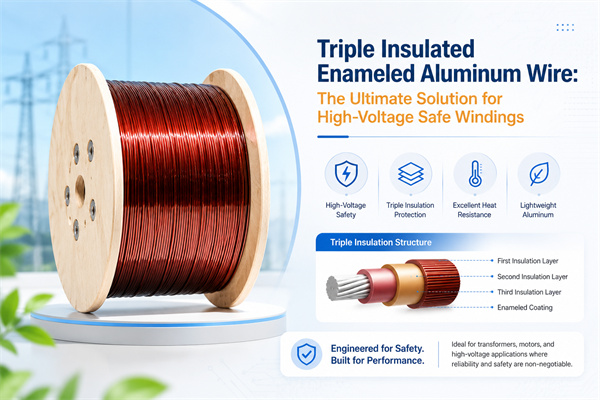
Triple Insulated Wire (TIW) is an insulated wire that put three layer superimposed insulation structure based on traditional enameled wire by special technology.
The three-layer insulation structure includes:
First layer (primer): Just on top of the aluminum conductor, basic electrical isolation.
Layer 2 (middle layer): To increase the insulation strength and voltage resistance.
Third Layer ( Top Coat ): Protects the final insulation and also the mechanical protection.
Together, these 3 layers create an incredible insulation system that goes well beyond the insulation you would get with any single or double layer of most standard enameled wire.
Why Triple Insulation Is Needed?
High Voltage Application Safety
The dangers of insulation failure are even more serious with high-voltage motors and transformers. A triple-insulation offers extra safety margin, greatly reducing the chance of insulation breakdown.
Space-Constrained Design Challenge
Electronic equipment today is dwindling into very small size. The higher power density in a limited volume implies the need for an insulation system with a higher dielectric strength. Now triple insulation makes an insulation thickness decrease without influencing safety performance.
High Reliability Requirements
Electrical system reliability requirement of equipments in medical, aerospace and rail transit industries is very high. The triple insulation is a primary method to accomplish this high requirement.
Simplified Manufacturing Process
For some application where triple insulation is used either the external insulation such as for insulating sleeving and insulating paper can be omitted in the manufacture process.
Triple Insulation vs Ordinary Insulation: Core Differences
| Comparison | Ordinary Enameled Wire | Triple Insulated Wire (TIW) |
|---|---|---|
| Insulation Layers | 1-2 layers | 3-layer composite structure |
| Voltage Resistance | Standard | 2-3x ordinary enameled wire |
| Safety Margin | Standard | Several times higher |
| Cost | Lower | Higher |
| Typical Applications | General motors | High voltage, high safety requirements |
Structure and Materials of Triple Insulated Enameled Aluminum Wire
Three-Layer Structure Details
Inner Layer (Primer):
- In direct contact with aluminum conductor
- Usually polyester (PET) or polyurethane (PU) coating
- Thickness: approximately 20-40μm
Middle Layer:
- Provides main insulation strength
- Usually polyester imide (PEI) coating
- Thickness: approximately 30-50μm
Outer Layer (Top Coat):
- Provides mechanical protection and chemical resistance
- Usually polyamide-imide (PAI) or polyimide (PI) coating
- Thickness: approximately 20-40μm
Aluminum Conductor Advantages
- Light Weight—Aluminum density is only 30% of copper, crucial for weight-sensitive applications
- Cost Effectiveness—Aluminum price is approximately 1/3 of copper, offering significant cost advantages
- Adequate Conductivity—Through appropriate cross-sectional area design, aluminum conductor can fully meet performance requirements
Specifications and Parameters
Standard Specification Range
| Wire Diameter (mm) | Cross-sectional Area (mm²) | Insulation Thickness (μm) | Voltage Resistance (V) |
|---|---|---|---|
| 0.5 | 0.196 | 90-130 | 3000+ |
| 0.8 | 0.502 | 90-130 | 3000+ |
| 1.0 | 0.785 | 90-130 | 3000+ |
| 1.5 | 1.767 | 100-140 | 3500+ |
| 2.0 | 3.142 | 100-140 | 3500+ |
Thermal Class
| Insulation Class | Max Operating Temp | Typical Coating Combination |
|---|---|---|
| Class 130 (F) | 130°C | PET/PEI/PET |
| Class 155 (F) | 155°C | PEI/PEI/PAI |
| Class 180 (H) | 180°C | PEI/PAI/PI |
| Class 200 (N) | 200°C | PAI/PI/PAI |
| Class 220 (R) | 220°C | Full PI system |
Typical Application Scenarios
- High Voltage Motors
Triple insulated motors, especially inverter-driven high voltage motors, can prevent insulation breakdown effectively and improve the operation reliability of the motor. For high voltage motors, it is almost a standard. - Power Transformers
In distribution transformers and specific transformers, for high voltage windings, aluminum wiring using 3 triple insulations can be used, as this allows to reduce weight and cost, without modifying insulation performance. - Medical Equipment
The requirements for electrical safety are very high for equipment used in medical imaging fields, for example MRI, CT, etc., and for surgical robots. Triple insulation is a very important aspect of safe operation of equipment. - Aerospace
In the most demanding environments, Electric systems on aircraft not only must be lightweight but also very reliable. The triple insulated aluminum wire is the ideal requirement. - Rail Transit
Electrical system of high-speed rail/subway vehicle must operate reliably for long hours under environment of vibration, high temperature and high humidity etc. Triplex insulation can provide necessary security. - New Energy Vehicles
New energy vehicles high-voltage electrical system, including battery management system, drive motor, etc. Taking triple insulation as an important measure to improve the safety. - Industrial Inverters
Inverter output stages must bear volt pulses. It seems that triple insulation can successfully withstand these particular working conditions.
Selection Key Points
Voltage Rating specify maximum working voltage, choose suitable voltage resistance class.
Choose Thermal Class- must select proper thermal class based on operation temperature. Suggest 15%-20% temperature margin;
Wire Dimension and Cross-Sectiondefinition-Calculate the wire broad and thickness according to the present load current and heat load condition.
Mechanical Performance Requirements in vibration environment particularly take notice of conductor flexibility and fatigue .
Chemical Compatibility Verify existence of oil, solvents, radiation or other parameters that could influences insulation properties
Certification Requirements various industry has various certification requirements like UL, IEC, CQC.
Processing Considerations
Winding Process:
Tension must be correct set in order not to melt insulation layer
Bend radius should be no less than 3-5 times the wire diameter
Use of a specialized winding die.
Welding Process:
Aluminum conductor welding aluminum welding process to be competent
Maintain insulation layer in protection during welding and avoid heating.
Test for insulation should be carried out following to the joint processing
Impregnation Process:
Choose impregnating resin suitable for three-in-one insulation materials
Vacuum impregnation provides better results
Impregnation temperature should be less than or equal to maximum allowed temperature for the insulation class.
Quality Inspection Key Points
Appearance Inspection:
- Three-layer insulation should be uniform, continuous, free of bubbles and impurities
- Surface should be smooth and defect-free
Electrical Performance Inspection:
- Voltage withstand test: must pass at specified test voltage
- Insulation resistance: should reach specified megohm value
- Dielectric loss: should be controlled within specified range
Mechanical Performance Inspection:
- Tensile strength and elongation
- Flexibility and bend performance
- Adhesion testing
Cost and Value Analysis
Triple insulated wire costs more than ordinary enameled wire, but offers greater overall value:
| Cost Factor | Ordinary Enameled Wire | Triple Insulated Wire |
|---|---|---|
| Raw material cost | Low | Higher |
| Processing cost | Standard | Requires special process |
| Auxiliary insulation cost | Requires sleeves, etc. | May be omitted |
| Assembly labor | Standard | May be reduced |
| Long-term reliability | Average | Significantly improved |
FAQ
Q: Can triple insulated wire and ordinary enameled wire be interchanged?
A: Depends on specific applications. In high voltage or high safety requirement situations, triple insulation cannot be simply replaced with ordinary enameled wire.
Q: Is welding triple insulated wire more difficult than ordinary enameled wire?
A: Yes. Welding triple insulated wire requires first removing the insulation layer (stripping), then welding the conductor, and finally re-insulating. Professional welding equipment is recommended.
Q: Which is better, aluminum or copper conductor triple insulated wire?
A: Each has advantages. Copper has better conductivity and corrosion resistance; aluminum is lighter and more cost-effective.
Q: What is the delivery time for triple insulated wire?
A: Standard specifications are usually in stock or have short lead times. Custom specifications typically require 4-8 weeks.