


Enameled round magnet wire, the most popular product form in the industry of magnet wire, is well known to everyone. However, few people would recognize that special shaped magnet wire is also indispensable in order to higher slot fill and better electrical characteristic.
Today I will discuss what it really means for a magnet wire to be special shaped magnet wire, and I will go over the different classifications of this wire, how they behave, and what you need them for.
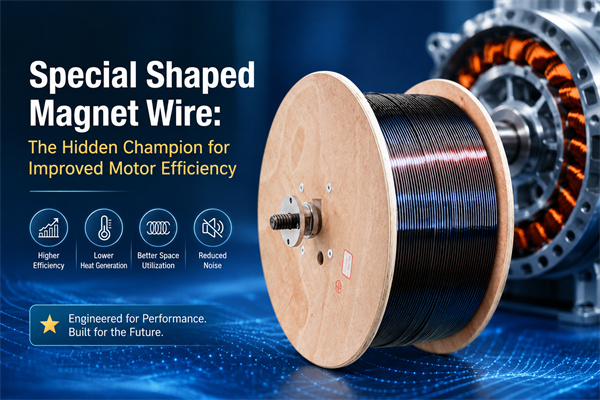
What Is Special Shaped Magnet Wire?
Shaped profiles magnet wire (Profile wire) means enameled magnet wire having special cross section other than ordinary round.
Common Special Shapes:
Flat Wire / Rectangle Wire cross section rectangular, widest dimension considerably greater than thickness
Square Wire cross-section is nearly square
Edgewise Wound Wire flat wire with relatively large width-to-thickness ratio
Transposed wire Wires placed in round or flat form, used in high power capacity transformers.
All these shapes have been designed to answer specific engineering problems.
Why Special Shapes? Isn’t Ordinary Round Wire Enough?
- Slot Fill Rate Issue
If round wires are installed in motor slots then between the circles there will be gaps, just like when constructed from circular blocks. Special shaped flat wire offers a perfect fit to the motor slots to give higher slot fill rate. - Skin Effect
On high current or high frequency applications, the current will just travels on surface of the conductor. Flat wire shape will decrease the effect of skin effect and enhance transmission efficiency of current. - Heat Dissipation
The flat wire has a larger surface area compared with the round wire, which is advantageous in the high power density motor where heat dissipation is important. - Thin-Profile Design
When motors do demand flat design ( EV drive motors), flat wire is simply the only alternative.
Flat Wire Specifications and Parameters
Flat wire is the most common special shaped magnet wire.
Flat Wire Designation Method
Flat wire is typically expressed as “thickness × width”:
- 2.0mm × 5.0mm
- 3.0mm × 8.0mm
- 5.0mm × 12.0mm
IEC Standard Flat Wire Specifications (Partial)
| Thickness (mm) | Width (mm) | Cross-sectional Area (mm²) | Typical AWG |
|---|---|---|---|
| 2.0 | 5.0 | 9.7 | AWG 8 |
| 2.5 | 6.0 | 14.5 | AWG 6 |
| 3.0 | 7.0 | 20.3 | AWG 4 |
| 4.0 | 10.0 | 38.7 | AWG 2 |
| 5.0 | 12.0 | 58.2 | AWG 1/0 |
Flat Aluminum Wire vs Flat Copper Wire
| Comparison | Flat Aluminum Wire | Flat Copper Wire |
|---|---|---|
| Weight | Light (~30% of copper) | Heavy |
| Cost | Low | High |
| Resistance | Higher (needs larger cross-section) | Lower |
| Power Range | Medium-low power | High power |
Square Enameled Wire: Choice for Special Applications
Square Wire Characteristics:
- Isotropic—more uniform magnetic field distribution
- Easy winding—consistent bend radius
- High space utilization—suitable for square slot design
Typical Applications:
- Stepper motors
- Linear motors
- Special purpose transformers
Fiber Glass Covered Magnet Wire: Solution for High Voltage Environments
For high voltage operating environments, ordinary enameled wire insulation may be insufficient.
Fiber Glass Covered Magnet Wire adds a braided glass fiber jacket outside the enameled wire.
Advantages:
- Higher breakdown voltage
- Better heat resistance (up to 200°C+)
- Stronger mechanical protection
Typical Applications:
- High voltage transformers
- Reactors
- Large motors
Sheath Thickness Grades
| Grade | Description |
|---|---|
| PG1 | Thin sheath |
| PG2 | Thick sheath |
Per IEC 60317 standards, glass fiber covered wire has clear sheath thickness specifications.
Fully Insulated Wire (FIW)
FIW (Fully Insulated Wire) is a rapidly developing product in recent years.
Characteristics:
- Multi-layer composite insulation structure
- Excellent insulation performance
- Suitable for high voltage and high frequency applications
Grades:
- EIW (Polyimide) grade: 220°C rated
- Applicable to precision electronics, aerospace, and other fields
Insulation Class of Special Shaped Magnet Wire
| Insulation Class | Max Operating Temp | Enamel Type | Applicable Scenarios |
|---|---|---|---|
| Class E | 120°C | Polyester | General equipment |
| Class B | 130°C | Polyester | General motors |
| Class F | 155°C | Polyester Imide | Industrial equipment |
| Class H | 180°C | Polyester Imide / Polyamide-Imide | High temperature environments |
| Class 200 | 200°C | Polyamide-Imide | Special high temperature applications |
Typical Application Scenarios
Electric Vehicle Drive Motors
New energy vehicle drive motors commonly use flat wire windings:
What about the high slot fill rate? High slot fill rate -> high efficiency
Good flat heat dissipation->High power density
Convenient for automatically manufacturing;
Our currently mainstream technology is Hairpin flat wire motors.
Industrial Servo Motors
Servo motors need lot of accuracy and high response. Flat wire windings offer lesser cogging torque ripple and better positioning accuracy.
Power Transformers
Large power transformer windings commonly use:
Copper busbars in flat form
Transposed conductor 1.02p.75, a process used to cross different runs to have similar lengths.
Flat wire with glass fiber coating
Reactors and Inductors
The products are also made using flat-bottom wire, or copper foil.
Aerospace Motors
Aircraft motors need to be lightweight, efficient and reliable. FIW and special high performance magnet wire are the best options.
Medical Equipment Motors
Deep-end medical equipment, for example MRI equipment, surgical robot, etc. Have very demanding motor performance.
Selection Key Points
Shape selection: High slot fill–> Flat wire, Uniform magnetic field–> Square wire, High voltage insulation–> Glass fiber covered wire, High temperature–> Polyamide-imide insulation.
Dimension Tolerances verify thickness uniformity, width consistency and edge straightness
Insulation Class, Select suitable insulation system in accordance with operating temperature and voltage10
Surface Quality Edges shoulf be free of Burrs, warping etc.
Bend Performance especially narrow flat wire requires good bend performance for automated winding.
Processing Key Points
Winding Technique: flat wire winding. This type of winding uses specialized equipment; tension control is stronger than round wire.
Welding Procedure: Large cross-sectional flat wire should be soldered by experienced professionals using proper welding tools.
Impregnation: Flat wire is much more difficult to impregnate than round wire, requiring vacuum or pressure impregnation.
Cost Analysis
Special shaped magnet wire costs more than round wire due to:
| Cost Factor | Description |
|---|---|
| Raw materials | Slightly lower material utilization in flat wire processing |
| Complex processes | Drawing, annealing, and coating are more difficult |
| Equipment requirements | Requires more precise equipment |
| Complex inspection | More stringent dimension and performance testing |
But comprehensive benefits are higher: Motor efficiency improves 2%-5%, material usage may decrease, and overall size reduces.
Procurement Considerations
- Specification Confirmation—Clarify thickness, width, insulation class, glass fiber covering, etc.
- Sample Confirmation—Confirm samples before mass production; pay attention to dimension tolerances and surface quality
- Batch Consistency—Choose manufacturers with complete quality control
- Delivery Time—Special shapes have longer delivery times than round wire; plan procurement in advance
- Technical Support—Choose suppliers who can provide technical support
XIII. FAQ
Q: Can flat wire and round wire be mixed?
A: Not recommended. Flat and round wire have completely different design parameters.
Q: What is the minimum order quantity for special shaped magnet wire?
A: Varies by manufacturer. Usually 1 ton for standard specs, higher for custom specs.
Q: Is manufacturing flat wire motors difficult?
A: Yes. But for manufacturers with mature processes, it’s no longer a problem.
Q: Why do EVs use flat wire?
A: The core reason is improving power density and efficiency. Flat wire’s high slot fill and heat dissipation directly affect EV range and power performance.
Q: What is the lifespan of special shaped magnet wire?
A: As long as selection is correct and usage is proper, lifespan is comparable to ordinary round wire. The key is controlling operating temperature and mechanical stress.