

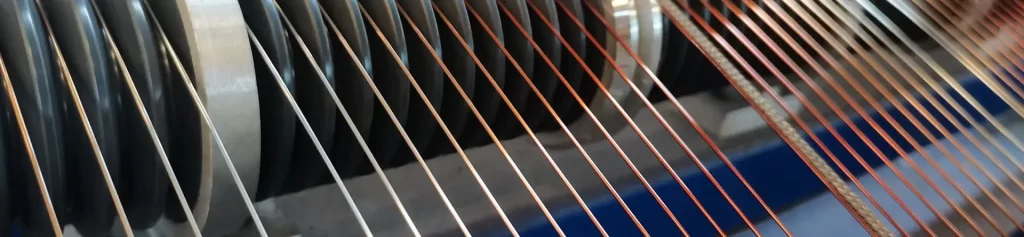
A large diameter wire is a often neglected specialty area in the magnet wire and motor industries. When we speak of large diameter, many people might not have a good understanding. What does it mean for enameled aluminum wire to have a diameter greater than 5mm? Thicker than a small finger. Yes, that thick.
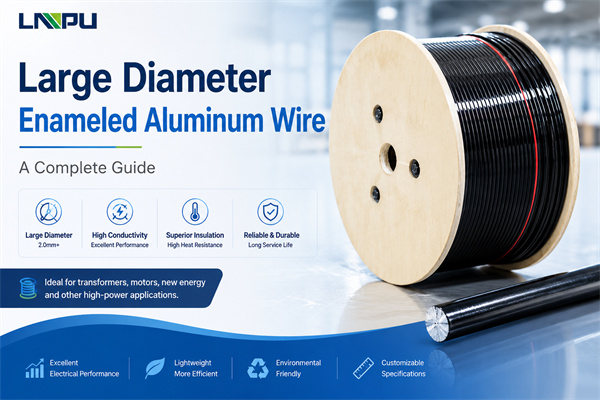
What Is Large Diameter Enameled Aluminum Wire?
As the name suggests, large diameter enameled aluminum wire refers to enameled aluminum wire with a relatively large diameter.
Industry Definition: Generally, enameled round aluminum wire with a diameter greater than 5.0mm is called large diameter aluminum wire.
The current capacity will increase greatly as the wire diameter increases, since there will be an increase in the cross section of the conductor. As the wire diameter increases the processing difficulty will also increase drawing, annealing and coating of large diameter aluminum wire is more difficult.
Key Features:
Large Cross-sectional Area 5mm, 7mm or larger, maximum current carrying capacity.
Aluminum Conductor aimed at as the fundamental material, such as lightweight and inexpensively.
Surface Insulation coating which has an insulating layer is insulated from the heat and corrosion resistance.
High Current-Carrying Capacity perfect for high power devices.
Why Choose Large Diameter Aluminum Wire Instead of Copper Wire?
- The weight advantage remains significant
The density of aluminum is a mere 30% of copper, so for the same cross section, an aluminum wire will be significantly lighter than a copper wire. - The cost advantage becomes more pronounced
Cost Of Copper is about a third of that of Aluminum. The extra total wire cost of a whole machine could be substantial. - The conductivity gap is acceptable
Though aluminum‘s resistivity is 67.91% greater than copper, this difference is offset where the cross section of the tiewire is increased accordingly. - Construction difficulty is reduced
Aluminium wire is softer than copper wire and therefore more flexible and easier to install.
Specifications and Parameters
Standard Large Diameter Aluminum Wire (Above 5.0mm)
| Wire Diameter (mm) | Cross-sectional Area (mm²) | F Class Current (A) | H Class Current (A) |
|---|---|---|---|
| 5.0 | 19.63 | 38 | 45 |
| 5.5 | 23.76 | 44 | 52 |
| 6.0 | 28.27 | 50 | 60 |
| 6.5 | 33.18 | 56 | 68 |
| 7.0 | 38.48 | 62 | 75 |
Flat Aluminum Wire (High Current Scenarios)
| Thickness (mm) | Width (mm) | Cross-sectional Area (mm²) | F Class Current (A) |
|---|---|---|---|
| 2.0 | 10.0 | 19.5 | 65 |
| 2.5 | 12.0 | 29.0 | 90 |
| 3.0 | 15.0 | 43.5 | 125 |
| 4.0 | 20.0 | 78.0 | 200 |
| 5.0 | 25.0 | 122.0 | 280 |
Insulation Class
| Class | Max Temp | Applicable Scenarios |
|---|---|---|
| Class E | 120°C | General High-Power Equipment |
| Class F | 155°C | Industrial High-Power Equipment |
| Class H | 180°C | Heavy Load, High Temperature |
| Class C | 200°C+ | Special High Temperature Applications |
Typical Applications
- Large Power Transformers
Compared to copper-wound transformers, aluminum-wound transformers will be 30%-50% lighter and will cost at least 70% less. - High-Power Industrial Motors
The use of aluminum wire is also a mature solution in the case of industrial motors (> 100kW), particularly with continuous duty cycles. - Energy Storage Equipment
Provides high-current capability. Large diameter aluminum wire is suitable. - Aluminum Electrolysis Equipment
The aluminum electrolysis plant…. High-current DC power needed; large diameter aluminum busbars, aluminum wire are widely used. - High-Power Electric Heating Equipment
Resistance furnaces, induction heating equipment, etc. need to have comparatively large diameters of conducting materials. - Wind Power Generation Systems
The stator and rotor windings of a wind turbine are usually made of large diameter aluminum wire or busbars of aluminum.
Key Selection Parameters
- Insulation Class—Select based on operating temperature
- Coating Uniformity—Critical for insulation performance
- Tensile Strength—Must withstand winding tension
- Tolerance Control—Critical for consistent performance
- Surface Quality—Must be free of defects
- Connection Handling—High-current connections require professional techniques
Connection Handling
Mechanical Connection: Intended to be made by aluminum dedicated terminals and torque wrench.
Welding: Needs an argon arc weld and suitable metalworking tools or high quality professional aluminum welding equipment.
Connection Protection: Connections of high currents should be well-insulated and properly protected from oxidation.
Cost Analysis
Using a 1000kVA transformer the total cost of aluminum-wound transformers is 20%-35% less than for copper-wound transformers.
Procurement Considerations
Specification Verification check actual wire diameter upon receipt
Examine for Surface Flaws scratches, stamps, red rotoxidation
Coating Integrity Look for any bubbles and impurities
Batch Traceability Ensure documented quality is complete