

Electronics and magnet wire Industries have a fondness for ultra fine wire products. “Ultra fine” probably has no concrete definition to most. How can it be defined when the ideal thickness for an aluminum wire is less than 0.1mm? About as thick as a human hair.
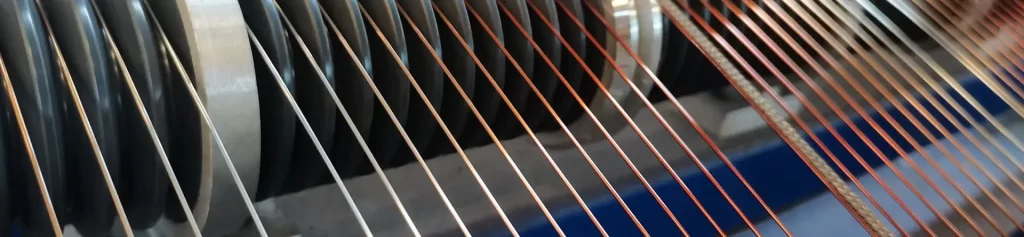
This virtually invisible wire (see close-up) is the essential link in most modern high-tech electronic devices. It is produced in infinitely small sizes for use in tiny headphones speakers, medical micro-motors, aerospace precision sensors and many other applications.
Today, I will tell you my marketing experience in this industry: what is ultra-fine enameled aluminum wire, what properties it has, in what options should we apply it, and what be paid attention to when choosing it.
What Is Ultra-Fine Enameled Aluminum Wire?
As its name suggests ultra-fine enameled aluminum wire, is an enameled aluminum wire of ultra-fine diameter.
Industry Specifics: As for the industry specific, the most common enameled round aluminum wire of less than 0.5mm in diameter is called fine aluminum wire. When wire has a diameter of less than 0.1mm, then it is called ultra-fine aluminum wire.
However, the definition is not definitive. According to different manufacturers and standards, “ultra-fine” still have a few slight differences, the most important one is the smaller the wire, the more difficult it is to be processed. The 0.5mm wire is easy to be manufactured in most of the manufactures, while less than 0.08mm ultra-fine wire with stable machining mass production is rare in the world.
Key Features of Ultra-Fine Aluminum Wire:
Superfine Diameter 0.1mmto0.016mm; the tightest finishing diameter is below 0.01mm, super-fine
Aluminum conductor using aluminum as the base material. Light and low cost.
Surface Insulation has an insulating coating. Coatings of this type generally offer heat resistance and corrosion resistance.
Precision Manufacturing very high levels of precision are needed in the drawing process, coating uniformity and equipment.
Why Choose Ultra-Fine Aluminum Wire Instead of Copper Wire?
Whilst in the general range of wire diameter there is a much greater conductivity for copper wire than that for aluminium, within the ultra fine field this will become:
- The weight advantage is amplified
With a density 30% that of copper this is further enhanced at ultra fine wire diameters and if you‘re working with weight critical precision instrumentation, every milligram counts. - The cost advantage remains significant
Cost of copper is three times higher than aluminum. Albeit hardest ultra-fine wires have to be dealt with but still the price of wire will be the same advantage by aluminum. - The “softness” of aluminum wire is actually an advantage
Very thin diameter copper wire may break brittle at high stiffness at a coarse wend. Aluminum wires are more flexible and easier to wind tightly. - Mature applications in specific scenarios
Application to the areas of inductors, audio transformers and micro-motors is well developed and established with ultra-fine aluminum wire.
Specifications and Parameters
Conventional Fine Aluminum Wire (0.1mm – 0.5mm)
| Wire Diameter (mm) | Cross-sectional Area (mm²) | Insulation Class | Typical Applications |
|---|---|---|---|
| 0.10 | 0.00785 | F/H Class | Precision Inductors, Miniature Relays |
| 0.12 | 0.0113 | F/H Class | Miniature Motors for Medical Equipment |
| 0.15 | 0.0177 | F/H Class | Audio Equipment |
| 0.20 | 0.0314 | F/H Class | Instrument Coils |
| 0.25 | 0.0491 | F/H Class | Small Transformers |
| 0.30 | 0.0707 | F/H Class | General Purpose Miniature Motors |
| 0.40 | 0.126 | F/H Class | Small Fan Motors |
| 0.50 | 0.196 | F/H Class | Toy Motors, Small Water Pumps |
Ultra-Fine Aluminum Wire (0.016mm – 0.10mm)
| Wire Diameter (mm) | Cross-sectional Area (mm²) | Insulation Class | Typical Applications |
|---|---|---|---|
| 0.030 | 0.000707 | H/C Class | Precision Sensors |
| 0.040 | 0.00126 | H/C Class | Miniature Inductors |
| 0.050 | 0.00196 | H/C Class | Headphones & Speakers |
| 0.060 | 0.00283 | H/C Class | Medical Instruments |
| 0.070 | 0.00385 | H/C Class | Precision Instruments |
| 0.080 | 0.00503 | H/C Class | Aerospace |
| 0.090 | 0.00636 | H/C Class | Miniature Coils |
Note: Specific specifications vary by manufacturer; please refer to the manufacturer’s specifications when selecting.
IV. Insulation Grade
| Insulation Class | Max Operating Temperature | Enameled Coating Type | Applicable Scenarios |
|---|---|---|---|
| Class E | 120°C | Polyester | General Electronic Equipment |
| Class B | 130°C | Polyester | General Micro Motors |
| Class F | 155°C | Polyester Imide | Industrial Precision Equipment |
| Class H | 180°C | Polyester Imide / Polyamide-Imide | High Temperature, High Reliability |
| Class C | 200°C+ | Polyamide-Imide | Special High Temperature Applications |
V. Typical Application Scenarios
- Audio Equipment
Headphones, speakers, hearing aids all need accurate voice coils. Voice coils wound with ultra-thin aluminum wire are light and thin, enabling the diaphragm to react quickly and produce more nuanced sounds. - Medical Equipment
Automobiles, pacemakers, insulin pumps, tiny sensors these products even have very strict limitations on the minimum size and weight they can be. Here, the light weight benefits of ultra thin aluminum wire are on prominent display. - Aerospace
Aerospace products small motors, satellite attitude control components, precision navigation instruments in which reliable performance is the paramount concern. Ultra fine aluminum wire, loaded with high special treatment, would be able to encounter strict aerospace standards. - Miniature Motors
Miniature fan motors, miniature pumps, miniature robot joints.. These “little things” are everywhere in our life. Ultra-fine aluminum wire is their “blood vessels”. - Electronic Transformers
Power adapters, charge modules, LED drivers…all these electronic components are more and more compact. It is thanks to ultra-fine aluminum wire. - Precision Instruments
Space flight instruments, medical test apparatus, industrial automation sensorstheir signal transmission precision requirements are too high, so the ultra-fine wire tightly wound coil can be reduced to Resistance and enhance the sensitivity.
Key Selection Parameters
- Insulation Class—Select based on operating temperature
- Enameled Coating Type—UEW (solderable), PEW (cost-effective), EIW (heat resistant), AIW (highest grade)
- Tolerance Control—Critical for consistent winding and electrical performance
- Tensile Strength—Must meet winding process requirements
- Flexibility—Better flexibility reduces breakage during winding
- Packaging—Spool size and winding density affect downstream use
Ultra-Fine Aluminum Wire vs. Ultra-Fine Copper Wire
| Comparison | Ultra-Fine Aluminum Wire | Ultra-Fine Copper Wire |
|---|---|---|
| Conductivity | Lower (~61% of copper) | High |
| Weight | Light (~70% lighter) | Heavy |
| Cost | Low (~1/3 of copper) | High |
| Flexibility | Good, not easily brittle | Relatively stiff |
| Typical Applications | Audio, Medical, Micro Motors | High-performance Precision |
Procurement Considerations
- Specification Verification—Request samples for testing before bulk orders
- Batch Consistency—Choose manufacturers with robust quality control
- Packaging & Transportation—Ultra-fine wire is delicate; proper packaging is essential
- Storage Conditions—Store in dry, dark environment to prevent oxidation
FAQ
Q: Is soldering ultra-fine aluminum wire very difficult?
A: Yes, it requires dedicated soldering irons and flux. Consider polyurethane-coated wire for better solderability.
Q: Will the resistance be too high, affecting efficiency?
A: For micro-devices with small operating currents, the impact is limited. For higher power applications, consider increasing wire diameter.
Q: Can you customize non-standard ultra-fine specifications?
A: Yes, but with minimum order quantity requirements. Contact us to discuss your specific needs.
Q: What is the typical delivery time?
A: Standard specifications ship within 1-2 weeks. Custom specifications may take 4-8 weeks.