


In the design of electromagnetic equipment such as motors and transformers, current carrying capacity is a core parameter. Many people ask me: How exactly is the current carrying capacity of enameled aluminum wire calculated? How does it differ from copper wire? Why do some aluminum wires with the same specifications say they can handle 10A, while others say they can only handle 6A?
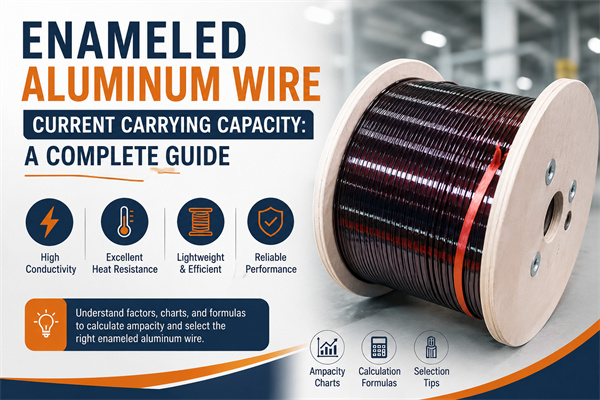
Frankly speaking, current carrying capacity is not a fixed value. It is affected by multiple factors such as conductor specifications, insulation class, operating temperature, laying method, and ventilation conditions.
Today, I will systematically discuss the current carrying capacity of enameled aluminum wire with you, combining industry standards and practical experience.
What Is Current Carrying Capacity?
Current carrying capacity (Current Capacity / Ampacity), simply put, is the maximum current that a conductor can safely carry under normal operating conditions.
This “safely carry” has several meanings:
First, it does not exceed the conductor’s maximum operating temperature. A conductor generates heat when energized. If the current is too high and the temperature exceeds the upper limit of the insulation layer’s temperature resistance, the insulation performance will drop sharply, or even burn out.
Second, the temperature must not exceed the ambient temperature rise range. The equipment as a whole has temperature rise limitations. The heat generated by the conductors must not bake surrounding components beyond their allowable range.
Third, long-term operational stability. Current carrying capacity is for continuous operation. For equipment with frequent start-stop cycles, the impact of thermal cycling needs to be considered.
Enameled Aluminum Wire vs. Enameled Copper Wire: How Much Does the Current Carrying Capacity Differ?
This is the question everyone is most concerned about.
The conclusion is: At the same cross-sectional area, the current carrying capacity of aluminum wire is approximately 77%-80% of that of copper wire.
In other words, if you replace copper wire with aluminum wire of the same cross-sectional area, the current carrying capacity will be reduced by about 20%.
But this is just the surface figure. In actual selection, a key factor must also be considered—temperature rise.
| Conductor Type | Resistivity (20°C) | Density | Coefficient of Thermal Expansion |
|---|---|---|---|
| Copper | 1.68×10⁻⁸ Ω·m | 8.89 g/cm³ | 17×10⁻⁶ |
| Aluminum | 2.82×10⁻⁸ Ω·m | 2.70 g/cm³ | 23×10⁻⁶ |
Aluminum’s resistivity is 1.68 times that of copper. This means that under the same current, aluminum wire generates more heat than copper wire.
However, aluminum’s density is only 30% of copper’s. Therefore, even with higher heat generation, aluminum wire’s temperature rise may actually be lower—because aluminum has a higher heat capacity and dissipates heat more easily.
A common misconception is: Aluminum wire current carrying capacity = Copper wire current carrying capacity × 0.77
This calculation is overly simplistic. The correct method is to calculate the cross-sectional area of both conductors according to the temperature rise requirements, and then compare their current carrying capacity.
Calculation Method for Current Carrying Capacity of Enameled Aluminum Wire
The core basis for calculating the current carrying capacity of enameled aluminum wire is international standards such as IEC 60317 and NEMA MW 1000.
Method 1: Standard Lookup Table Method
This is the most commonly used method. The standards provide reference current carrying capacity under different specifications and insulation classes.
Taking common round aluminum wire as an example (reference data, actual specifications may vary depending on the manufacturer):
| Wire Diameter (mm) | Cross-sectional Area (mm²) | Class E Current Carrying Capacity (A) | Class F Current Carrying Capacity (A) | Class H Current Carrying Capacity (A) |
|---|---|---|---|---|
| 0.5 | 0.196 | 1.2 | 1.5 | 1.8 |
| 0.8 | 0.503 | 2.5 | 3.0 | 3.5 |
| 1.0 | 0.785 | 3.5 | 4.2 | 5.0 |
| 1.5 | 1.767 | 6.0 | 7.2 | 8.5 |
| 2.0 | 3.142 | 9.0 | 11.0 | 13.0 |
| 2.5 | 4.909 | 12.0 | 15.0 | 18.0 |
| 3.0 | 7.069 | 15.0 | 18.0 | 22.0 |
Important Reminder: The above data is for reference only. Actual current carrying capacity will vary depending on the type of enamel coating, heat dissipation conditions, duty cycle, etc. Please refer to the manufacturer’s official specifications when selecting a model.
Method 2: Empirical Formula Method
For scenarios without tables, an empirical formula can be used for estimation:
I = K × A
Where:
- I = Current carrying capacity (A)
- K = Current density (A/mm²)
- A = Effective cross-sectional area of the conductor (mm²)
Recommended current density for enameled aluminum wire:
| Operating Conditions | Recommended Current Density (A/mm²) |
|---|---|
| Continuous operation, ambient temperature below 40°C | 2.5 – 3.5 |
| Intermittent operation, good ventilation | 3.5 – 4.5 |
| Short-time operation | 5.0 – 6.0 |
Method 3: Temperature Rise Back-Calculation Method
This is the most accurate method, but the calculation is more complex.
Basic principle:
- Determine the allowable temperature rise (e.g., 65K)
- Calculate the required cross-sectional area based on the conductor’s thermal resistance and heat dissipation coefficient
- Then, back-calculate the current carrying capacity based on the cross-sectional area
This method is mainly used for the design of high-power equipment and requires the use of a thermoelectric coupling model.
Key Factors Affecting Current Carrying Capacity
Many people ask: Why do different manufacturers have such different current carrying capacity data for enameled aluminum wire with the same specifications?
Because current carrying capacity is not a fixed value, but is affected by multiple factors.
1. Insulation Class (Thermal Class)
This is the most critical factor. The insulation class determines the maximum operating temperature of the conductor. The higher the class, the greater the allowable temperature rise, and naturally the higher the current carrying capacity.
| Insulation Class | Maximum Operating Temperature | Applicable Scenarios |
|---|---|---|
| Class E | 120°C | General Household Appliance Motors |
| Class B | 130°C | General Motors |
| Class F | 155°C | Industrial Motors |
| Class H | 180°C | High Temperature Environment, Heavy Load |
| Class C | 200°C+ | Special High Temperature Equipment |
A Practical Rule: For every level increase in insulation class (e.g., from Class E to Class B), the current carrying capacity can increase by approximately 8%-12%.
2. Conductor Specifications
The current carrying capacity of round aluminum wire is positively correlated with its diameter, but not linearly. As the wire diameter increases, the heat dissipation area increases, but so does the heat generated. Overall, the larger the wire diameter, the lower the current carrying capacity per unit cross-sectional area.
This is why high-power motors prefer flat wire over thick round wire—flat wire has higher heat dissipation efficiency.
3. Duty Cycles
Different duty cycles result in different heat dissipation conditions and therefore different current carrying capacities:
- Continuous Duty (S1): Temperature rise reaches thermal equilibrium; calculations are based on stable temperature rise.
- Intermittent Duty (S3-S6): Short working periods allow time for heat dissipation; current carrying capacity can be appropriately increased.
- Short-Time Duty (S2): Short working periods primarily focus on starting current.
- Variable Frequency Duty (S5): The additional impact of harmonic heating needs to be considered.
4. Ambient Temperature
Current carrying capacity data in standards are typically based on an ambient temperature of 40°C. If your equipment operates at higher ambient temperatures, derating is required.
Empirical formula: Actual current carrying capacity = Standard current carrying capacity × (Allowable temperature rise / Actual temperature rise)
5. Heat Dissipation Conditions
This is the most easily overlooked factor.
- Natural cooling: Poor heat dissipation, reduced current carrying capacity.
- Forced air cooling: Can increase current carrying capacity by 30%-50%.
- Oil/water cooling: Can significantly increase current carrying capacity, but costs also increase accordingly.
Specifications and Current Carrying Capacity Reference
Round Aluminum Wire Specifications
| Wire Diameter (mm) | Cross-sectional Area (mm²) | Class F Current Carrying Capacity (A) | Class H Current Carrying Capacity (A) |
|---|---|---|---|
| 0.5 | 0.196 | 1.5 | 1.8 |
| 0.6 | 0.283 | 2.0 | 2.4 |
| 0.7 | 0.385 | 2.5 | 3.0 |
| 0.8 | 0.503 | 3.0 | 3.5 |
| 0.9 | 0.636 | 3.8 | 4.5 |
| 1.0 | 0.785 | 4.2 | 5.0 |
| 1.2 | 1.131 | 5.5 | 6.5 |
| 1.5 | 1.767 | 7.2 | 8.5 |
| 2.0 | 3.142 | 11.0 | 13.0 |
| 2.5 | 4.909 | 15.0 | 18.0 |
| 3.0 | 7.069 | 18.0 | 22.0 |
| 4.0 | 12.566 | 28.0 | 33.0 |
| 5.0 | 19.635 | 38.0 | 45.0 |
Note: The above data are reference values based on continuous operation, an ambient temperature of 40°C, and natural cooling conditions. Please refer to the manufacturer’s specifications for actual selection.
Flat Aluminum Wire Specifications
| Thickness (mm) | Width (mm) | Cross-sectional Area (mm²) | Class F Current Carrying Capacity (A) |
|---|---|---|---|
| 0.8 | 3.0 | 2.3 | 12 |
| 1.0 | 4.0 | 3.8 | 18 |
| 1.2 | 5.0 | 5.7 | 25 |
| 1.5 | 6.0 | 8.7 | 36 |
| 2.0 | 8.0 | 15.5 | 58 |
Design Selection Checklist
- Confirm Insulation Class—Select the corresponding insulation class based on the operating temperature.
- Calculate Current Carrying Capacity—Use formulas or lookup tables to confirm whether the conductor cross-sectional area is sufficient.
- Consider Derating Factor—If the ambient temperature is high or the heat dissipation is poor, appropriate derating is required.
- Check Slot Fill Rate—Aluminum wire has a larger cross-sectional area; confirm whether the iron core slot can accommodate it.
- Verify End Dimensions—Check if the end extension length meets process requirements.
- Confirm Certification Requirements—Ensure UL, RoHS, REACH, and other certifications are complete.
Frequently Asked Questions
Q1: Aluminum wire has a lower current carrying capacity than copper wire; does this mean using aluminum wire is not cost-effective?
A: Not entirely. Current carrying capacity is only one dimension of selection. The advantages of aluminum wire are: lighter (approximately 70% lighter) and cheaper (approximately 1/3 the price of copper). In high-power transformers, lightweight equipment, and cost-sensitive products, the overall advantages of aluminum wire are obvious.
Q2: Under inverter drive, should the current carrying capacity of aluminum wire be additionally derated?
A: Yes. The PWM wave output by the inverter contains abundant harmonics, which will lead to additional copper losses. It is recommended to use it with a 10%-20% derating based on the power frequency current carrying capacity.
Q3: How to calculate the current carrying capacity of aluminum wire in high-temperature environments?
A: A general rule of thumb is that for every 10°C increase in ambient temperature above 40°C, the current carrying capacity decreases by approximately 5%.
Q4: What precautions should be taken when connecting aluminum and copper wires?
A: Aluminum wire cannot be directly twisted with copper wire; a special transition terminal or a specially treated connector must be used. Otherwise, electrochemical corrosion will occur.