

Introduction High-voltage
Transformers are core equipment in power systems, undertaking key functions such as voltage transformation, power transmission, and power distribution.
Their design involves multiple interdisciplinary fields including electromagnetics, thermodynamics, and materials mechanics.
In the design process of high-voltage transformers, the selection of winding materials is one of the core factors determining the transformer’s performance, reliability, and service life.
The winding conductor material must simultaneously meet multiple requirements for electrical, thermal, and mechanical performance.
Under high-voltage application conditions, the insulation performance of traditional enameled wire is insufficient to withstand the strong electric field stress generated during operation.
Paper-insulated wire, as a composite insulated conductor formed by winding insulating paper layers around the enameled wire, effectively solves this technical problem through enhanced dielectric strength and resistance to partial discharge.
This article systematically elaborates on various aspects of paper-insulated wire technology in high-voltage transformer applications, covering basic structural principles, relevant industry standards, material selection methods, and key engineering application points.
This article is suitable for technical personnel in transformer design, manufacturing, and procurement.
Basic Concepts
Definition and Basic Structure
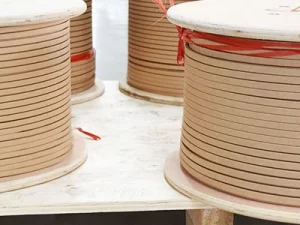
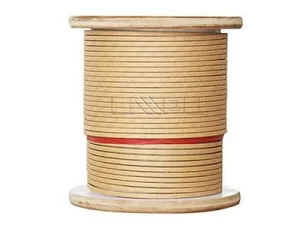
Paper-covered wire (PCW) or paper-covered magnet wire is a composite insulated conductor formed by winding insulating paper layers around the outside of a traditional enameled wire.
Compared to a single enameled wire structure, paper-covered wire significantly improves the insulation strength and corona resistance of the conductor by adding a paper insulation layer, making it more suitable for high-voltage operating environments.
A typical three-layer structure of paper-covered wire includes: an inner conductor material, which can be copper or aluminum; a middle enameled insulation layer, providing basic electrical insulation; and an outer insulating paper layer, which provides enhanced insulation and mechanical protection.
The presence of the paper layer allows paper-covered wire to effectively disperse the electric field gradient under high-voltage conditions, reducing the risk of partial discharge caused by localized electric field concentration.
In oil-immersed applications, the insulating paper and the oil together constitute the insulation system, and their combined use achieves excellent electrical performance.
Types and Characteristics of Insulating Paper
Electrical insulating paper is mainly divided into two categories, each with different thermal and electrical properties.
Kraft paper is made through the sulfate pulping process and has a long history of application and mature technology in transformer applications.
Kraft paper has good impregnation properties and compatibility with transformer oils.
Its standard thermal class is 105°C to 120°C, and some high-performance products can reach 130°C.
Kraft paper is cost-effective and is a widely used insulating material in oil-impregnated transformers.
Aramid paper, commercially known as NOMEX paper, is developed and produced by DuPont.
This material uses aromatic polyamide fibers as a base material and has excellent heat resistance, with a continuous operating temperature of 220°C to 240°C, while also possessing good electrical and mechanical strength properties.
These properties make it particularly suitable for dry-type transformers and high-voltage transformer applications with high fire resistance requirements.
Manufacturing Process
The manufacturing process of paper-insulated wire involves winding paper layers onto a substrate.
The winding methods are mainly divided into two types: overlapping winding and non-overlapping winding.
In the overlapping winding process, a certain proportion of overlap is maintained between adjacent paper strips, with the overlap rate typically controlled within the range of 50% to 65%.
This process can achieve better insulation strength and moisture resistance, but the manufacturing cost is relatively high.
In non-overlapping winding, gaps are maintained between adjacent paper tapes, resulting in a relatively simple manufacturing process and lower cost, but insulation performance is slightly inferior to overlapping winding.
The number of paper layers can be selected as single-layer, double-layer, or multi-layer structures depending on the voltage level and insulation requirements.
In high-voltage transformer applications, double-layer paper sheath structures are more common, providing higher electrical strength and better partial discharge performance.
Technical Requirements
Electrical Performance Requirements
During high-voltage transformer operation, a high electric field strength is generated inside the winding, imposing strict electrical performance requirements on the insulation materials.
The insulation material must possess high dielectric strength to withstand the operating voltage without breakdown.
Dielectric strength is a physical quantity that measures the ability of an insulation material to withstand electric field strength.
High-voltage transformer insulation design must ensure that the insulation material maintains sufficient dielectric strength margin under both operating voltage and overvoltage conditions.
Partial discharge (PD) performance is another key electrical indicator.
When defects exist inside or on the surface of the insulation material, minute discharge phenomena will occur under the action of a high electric field.
Partial discharge, while not immediately causing insulation breakdown, gradually erodes the insulating material, forming a discharge tree-like channel, ultimately leading to insulation failure.
The multi-layered structure of paper-insulated wire effectively suppresses the destructive effects of partial discharge on insulation.
The paper fiber structure disperses the electric field intensity, reducing local electric field concentration; simultaneously, the paper layer absorbs the energy generated by the discharge, mitigating continuous damage to the insulation structure.
Thermal Performance Requirements
Thermal performance directly affects the load capacity and service life of the transformer.
Insulating materials must maintain their functional characteristics across the entire operating temperature range.
The thermal class represents the highest continuous operating temperature that the insulating material can withstand.
The thermal class of the paper-insulated wire depends on the type of insulating paper and the thermal class of the enameled wire substrate.
During design, an appropriate thermal class of paper-insulated wire must be selected based on the transformer’s load rating and environmental conditions.
Thermal aging refers to the gradual deterioration of the performance of insulating materials under prolonged high temperatures.
The thermal aging characteristics of the insulating material determine the expected service life of the transformer.
In oil-immersed transformers, the paper-insulated wire and transformer oil together form the insulation system, achieving a service life of 20 to 30 years within the normal operating temperature range.
Mechanical Performance Requirements
During transformer operation, the windings are subjected to electromagnetic forces, generating vibration and noise.
Under conditions of sudden load changes or short-circuit faults, the windings withstand enormous electrodynamic shocks.
The insulation material must possess sufficient mechanical strength to resist these mechanical stresses.
The mechanical performance indicators of the paper-insulated wire include tensile strength, elongation, flexibility, and abrasion resistance.
The paper layer provides mechanical protection for the conductor, enhancing its abrasion resistance and bending resistance, which helps protect the conductor from damage during winding and installation.
Compatibility with Transformer Oil
In oil-immersed transformers, the insulating paper and transformer oil together form the insulation system; their compatibility is crucial for the safe operation of the transformer.
Transformer oil possesses excellent electrical insulation performance and heat dissipation properties.
It can fill the gaps between insulating paper fibers, enhancing the electrical strength of the entire insulation system.
Simultaneously, transformer oil can remove heat generated during operation, improving the heat dissipation efficiency of the transformer.
After the insulating paper is immersed in transformer oil, its electrical strength and thermal properties are significantly improved.
The oil immersion effect can also fill tiny defects in the paper layers, improving insulation reliability.
Therefore, the combined use of paper-insulated wire and transformer oil is a key technical approach to achieving the superior insulation performance of oil-immersed transformers.
NEMA Standards
for Paper-Insulated Wires
Overview of NEMA MW 1000-2018 Standard
The NEMA MW 1000-2018 standard is a magnetic wire standard published by the National Electrical Manufacturers Association (NEMA), and is one of the most widely used standards in the North American transformer and electrical machinery manufacturing industries.
This standard systematically specifies the models, specifications, performance requirements, and test methods for various types of magnetic wire.
The NEMA standard uses a five-digit numbering system (MW XXXXX), where MW represents Magnet Wire, and the following numbers indicate the specific insulation type and class.
Paper-insulated wire occupies an important position in the NEMA standard system, and is divided into several model series based on conductor shape and insulation type.
Circular Paper-Sheathed Wire Specifications
The main specifications for circular paper-sheathed wire in the NEMA standard are as follows: | Models | Conductor Material | Insulation Type | Thermal Class | Paper Layer Structure | |——|———-|———-|———-|———-| | MW 31-A | Aluminum | Plain Kraft Paper Sheath | 105°C | Single Layer Paper | | MW 31-C | Copper | Plain Kraft Paper Sheath | 105°C | Single Layer Paper | | MW 61-A | Aluminum | Aromatic Polyamide Paper Sheath | 240°C | Single Layer Aramid Paper | | MW 61-C | Copper | Aromatic Polyamide Paper Sheath | 240°C | Single Layer Aramid Paper | The MW 31 series is a traditional kraft paper-sheathed round wire, thermal The class {105°C to 120°C} is suitable for general oil-immersed {transformers}.
The MW 61 series uses aromatic polyamide paper insulation, thermal class up to 240°C, and is suitable for dry {transformers} and high-voltage {transformers}.
Rectangular Paper-Sheathed Wire Specifications
Rectangular and square paper-sheathed wires are mainly used for specific winding structures in high-voltage transformers.
The main models are as follows: | Models | Conductor Material | Insulation Type | Thermal Class | Paper Layer Structure | |——|———-|———-|———-|———-| | MW 33-A | Aluminum | Plain Kraft Paper Sheath | 105°C | Single Layer Paper | | MW 33-C | Copper | Plain Kraft Paper Sheath | 105°C | Single Layer Paper | | MW 60-A | Aluminum | Aromatic Polyamide Paper Sheath | 240°C | Single Layer Aramid Paper | | MW 60-C | Copper | Aromatic Polyamide Paper Sheath | 240°C | Single Layer Aramid Paper | Rectangular paper-insulated wire has strict dimensional tolerances specified in NEMA standards, including parameters such as conductor width, thickness, diagonal dimensions, and insulation layer thickness.
When designing and selecting, products meeting the requirements must be chosen according to the specific specifications table, and the required tolerance grade must be clearly defined.
Importance of Dimensional Tolerances
In high-voltage transformer design, the dimensional tolerances of the paper-insulated wire directly affect the winding fill factor and electrical performance.
Excessive dimensional deviations may lead to problems such as reduced winding fill factor, localized electric field concentration, or poor heat dissipation.
NEMA standards specify maximum and minimum limits for key dimensions such as conductor diameter and insulation layer thickness of the paper-insulated wire.
Standards typically specify two tolerance grades: standard and precision.
The precision grade is suitable for high-voltage transformer applications with higher dimensional requirements.
When selecting and purchasing, the required tolerance grade must be clearly defined with the manufacturer.
Paper-insulated Wire
Selection Methods in High-Voltage Transformer Design
Voltage Level Classification and Selection Principles
Voltage level is the primary factor determining the selection of paper-insulated wire.
Different voltage levels have significantly different requirements for insulation materials, necessitating different types of paper-insulated wire and insulation design schemes.
For distribution transformers below 10kV, ordinary kraft paper-insulated wire usually meets the insulation requirements.
Transformers in this voltage range often employ oil-immersed structures, with kraft paper and transformer oil used together to achieve reliable insulation performance.
For transformers with voltage levels from 10kV to 35kV, double-layer paper-insulated structures or aromatic polyamide paper-insulated wire are recommended.
Partial discharge problems are more prominent in this voltage range, requiring enhanced insulation design.
Double-layer kraft paper-insulated wire can improve insulation strength to some extent, but aromatic polyamide paper-insulated wire is a more reliable choice.
For high-voltage and ultra-high-voltage transformers above 35kV, aromatic polyamide paper-insulated wire must be used, and rigorous partial discharge testing is required.
This voltage level places strict requirements on the performance of insulation materials and manufacturing processes.
Selection of Conductor Materials
Copper conductor and aluminum conductor are two main winding conductor materials in high-voltage transformers, each with its own advantages and disadvantages, and the choice must be made based on the specific application.
Copper conductor has excellent conductivity, approximately 1.6 times that of aluminum.
With the same cross-sectional area, copper conductor can carry a larger current.
Furthermore, copper conductor has higher mechanical strength and better corrosion resistance, making it suitable for large power transformers and applications with high reliability requirements.
The main advantages of aluminum conductor are its light weight and low cost.
Aluminum has a density approximately one-third that of copper, giving it an advantage in applications requiring reduced transformer weight.
The raw material cost of aluminum conductor is significantly lower than copper, but its cross-sectional area needs to be approximately 60% larger than that of copper conductor to achieve the same current carrying capacity, which affects the winding fill factor and transformer volume.
In large power transformers, copper conductor is usually preferred for better overall performance.
In small and medium-sized power distribution transformers, aluminum conductors can be considered to control costs.
The selection of conductor materials must comprehensively consider factors such as the transformer’s operating environment, load characteristics, and expected service life.
Insulation Structure Design
The insulation structure design of high-voltage transformers is a complex systems engineering project, requiring comprehensive consideration of electrical, thermal, and mechanical factors.
The selection of paper-insulated wire is only one aspect of insulation design; reasonable design of insulation distances, insulation supports, and insulation ends is also necessary.
Inside the winding, sufficient insulation distance must be maintained between adjacent conductors; this distance depends on the operating voltage and the dielectric strength of the insulation material.
Appropriate insulation barriers and distances are also required between the winding and the core, and between the winding and the tank.
During the winding process, end insulation treatment is particularly important.
The electric field distribution at the ends of high-voltage windings is uneven, easily leading to partial discharge.
Therefore, additional insulation measures are usually required at the ends, such as using thickened insulating paper or installing insulating end caps.
Selection Differences Between Oil-Immersed and Dry-Type Transformers Oil-immersed and dry-type transformers have significantly different requirements for paper-insulated wire, requiring differentiated selection.
In oil-immersed transformers, the paper-insulated wire and transformer oil together form the insulation system.
This structure utilizes the excellent insulation performance and heat dissipation properties of oil, allowing the use of ordinary kraft paper-insulated wire to reduce costs.
The oil immersion environment also effectively prevents moisture absorption by the paper layer, improving insulation reliability.
However, oil-immersed transformers pose risks of oil leakage and fire, limiting their application in certain situations.
Dry-type transformers cannot use transformer oil; their insulation relies entirely on solid insulating materials.
Therefore, dry-type transformers must use aromatic polyamide paper-insulated wire or other insulation materials with higher thermal class.
Dry-type transformers have excellent fire resistance and are suitable for indoor or high-safety-requirement applications, but their insulation and cooling structures are more complex to design.
Typical Application
Scenarios of Paper-Insulated Wire
Power Transformer Applications Power transformers are key equipment used for voltage conversion in power grids, with capacities ranging from tens of kilovolt-amperes to thousands of megavolt-amperes. Power transformers have extremely high requirements for reliability and service life, and typically employ an oil-immersed structure. In power transformers, paper-insulated wire is mainly used in the manufacture of high-voltage windings. High-voltage windings bear the highest voltage in the system, and the requirements for insulation materials are the most stringent. Power transformers of 35kV and below typically use copper conductor paper-insulated wire, with conductor specifications determined according to capacity and voltage level.
The insulation design of power transformers needs to consider the insulation aging problem during long-term operation.
Insulation materials gradually deteriorate under high temperature and electric field conditions, which is a key factor determining the transformer’s service life.
Selecting appropriate thermal class paper-insulated wire and controlling the transformer’s operating temperature within a reasonable range can effectively delay insulation aging and extend the transformer’s lifespan.
Special Transformer Applications
Special transformers refer to transformer equipment used in special applications, including electric furnace transformers, rectifier transformers, and rail transit transformers.
These transformers typically have special electrical performance requirements or operating environments, placing specific demands on the selection of paper-insulated wire.
Electric furnace transformers are used to power industrial electric furnaces, operating under harsh conditions and needing to withstand high temperatures and frequent load changes.
Electric furnace transformers typically use high-thermal-class aromatic polyamide paper-insulated wire and have reinforced insulation structure design.
Rectifiers are used to convert alternating current (AC) to direct current (DC) and are essential equipment in industries such as electrolytic aluminum and chemicals.
Rectifiers handle large load currents and contain harmonic components, placing high demands on the thermal stability and mechanical strength of the insulation materials.
Rail transit transformers are used in electrified railway traction power supply systems and need to withstand vibration and impact loads.
Rail transit transformers have high requirements for the mechanical properties of paper-insulated wire, typically requiring products with excellent flexibility and wear resistance.
Current Transformer Applications Current transformers are crucial devices for measurement and protection in power systems. Their working principle involves converting a large measured current into a smaller current through electromagnetic induction, which is then used by measuring instruments and relay protection devices. The insulation reliability of current transformers directly affects the measurement accuracy and protection performance of the power system.
In high-voltage current transformers, paper-insulated wire is used to wind the primary and secondary windings.
The primary winding withstands the high voltage of the system, requiring strict insulation strength.
The insulation structure of current transformers typically employs oil-immersed or SF6 gas insulation.
Oil-immersed current transformers use paper-insulated wire windings, with the paper layer and oil providing reliable insulation.
Reactor Applications
Reactors are important devices for reactive power compensation and current limiting in power systems.
Power reactors typically operate at high or ultra-high voltage levels, and the performance requirements for paper-insulated wire are similar to those for power transformers.
Series reactors are connected in series in transmission lines to limit short-circuit current and regulate line power flow.
Their windings need to withstand the electrodynamic impacts generated by system voltage and short-circuit current, requiring the paper-insulated wire to have excellent mechanical properties.
Shunt reactors are connected in parallel in ultra-high voltage transmission lines to absorb capacitive reactive power and regulate voltage.
Shunt reactors are typically oil-immersed, using paper-insulated wire windings, similar to transformers.
Comparison of
Paper-Insulated Wire with Other Insulated Conductors
Comparison of Paper-Insulated Wire and Glass Fiber Covered Wire
Glass fiber covered wire is another common high-voltage insulated conductor, with its own advantages and disadvantages compared to paper-insulated wire.
Glass fiber covered wire uses glass fiber woven or wound around the outside of the conductor as an insulation layer.
Glass fiber has excellent heat resistance, reaching up to 200°C to 280°C, far exceeding that of ordinary paper-insulated wire.
In addition, glass fiber covered wire also has good fire resistance and chemical corrosion resistance.
However, glass fiber covered wire also has obvious disadvantages.
First, glass fiber covered wire has poor flexibility and is prone to shedding during the winding process, which may affect equipment cleanliness and insulation performance.
Second, the cost of glass fiber covered wire is generally higher than that of paper-insulated wire.
When selecting, if the application environment has high requirements for heat resistance or fire safety considerations, glass fiber covered wire should be chosen.
For general high-voltage transformer applications, paper-insulated wire is a more cost-effective choice.
Comparison of Paper-Insulated Wire and Enameled Wire Ordinary enameled wire only has an insulating varnish layer coated on the conductor surface, resulting in a thin insulation layer. It is mainly suitable for low-voltage motors and general electrical products.
In high-voltage transformer applications, relying solely on enameled wire insulation is far from sufficient.
High-voltage transformers typically use enameled wire as the base insulation layer, with an additional paper-insulated layer or other insulation measures to form a composite insulation structure.
This design can fully utilize the performance advantages of both enameled wire and the paper layer, achieving excellent overall insulation performance.
In practical design, the specific combination of enameled wire and paper layer needs to be determined according to the voltage level and insulation requirements.
For medium-voltage transformers, a structure of ordinary enameled wire plus a single-layer paper sheath can be used.
For high-voltage transformers, a structure of high-performance enameled wire plus a double-layer paper sheath or aromatic polyamide paper sheath is required.
Summary and
Selection Recommendations Paper-insulated wire, as a crucial insulation material for high-voltage transformers, plays a vital role in power systems.
Its technical selection requires comprehensive consideration of factors such as electrical performance, thermal performance, mechanical performance, and compatibility with transformer oil.
The insulation performance of paper-insulated wire mainly depends on the type of insulating paper, paper layer structure, and manufacturing process.
Kraft paper-insulated wire has lower cost and is suitable for ordinary oil-immersed transformers; aromatic polyamide paper-insulated wire has higher thermal class and is suitable for dry-type transformers and high-voltage transformers.
In high-voltage transformer design, the selection of paper-insulated wire needs to comprehensively consider factors such as voltage level, conductor material, insulation structure type, operating environment, and service life.
Correct selection is the foundation for ensuring reliable transformer operation.
With the development of power systems and the continuous improvement of equipment reliability requirements, paper-insulated wire technology is also continuously advancing.
In the future, the application of high-performance insulation materials and advanced manufacturing processes will further enhance the application value of paper-insulated wire in the field of high-voltage transformers.