

Introduction
High current coils are key fundamental components in power electronics, metallurgical equipment, electrolytic processes, and new energy fields. Whether in electrolytic aluminum rectifier cabinets, welding power supplies, induction heating equipment, or new energy vehicle charging stations and PV inverters, all depend on high current coils.
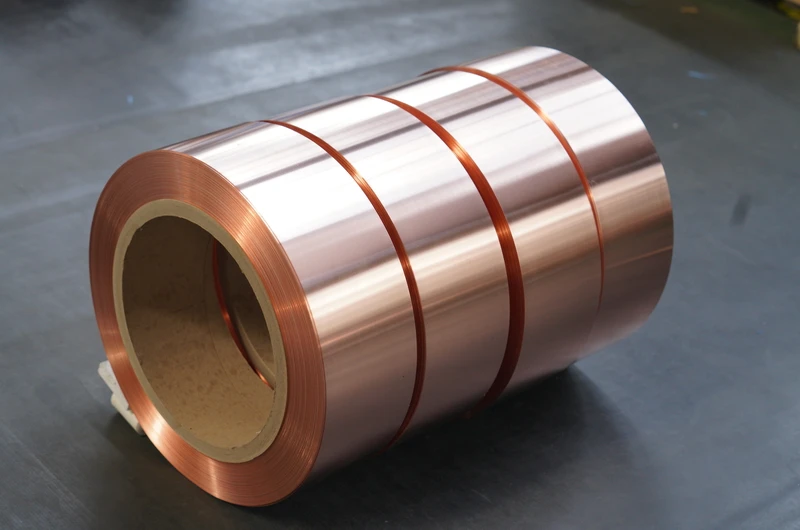
With excellent electrical conductivity, thermal management capability, and mechanical processing characteristics, copper foil has become the preferred material for high current coils. This article systematically explains key parameters, selection criteria, and industrial applications for copper foil used in high current coils, serving as a professional reference for engineers and procurement personnel.
1. Applications and Copper Foil Requirements for High Current Coils
1.1 Working Characteristics of High Current Coils
The working environment of high current coils is fundamentally different from ordinary inductive coils. Current typically ranges from hundreds to tens of thousands of amperes, and coils need to withstand enormous thermal stress. Taking the electrolytic aluminum industry as an example, a single rectifier transformer can have output current reaching hundreds of thousands of amperes, with extremely high heat generation density in the coils.
Copper foil demonstrates unique advantages in this situation: higher conductivity reduces resistive losses, excellent thermal conductivity quickly removes heat, and good ductility facilitates precision winding.
1.2 Advantages of Copper Foil Over Copper Wire
Copper foil offers significant advantages over copper wire for high current applications. Copper foil coils provide specialized high current capacity with flat structure offering large heat dissipation area and high fill factor, resulting in relatively low processing difficulty. Copper wire coils are suited for small to medium current with cylindrical structure where heat dissipation is limited and surface area utilization is moderate.
1.3 Typical Application Fields
High current coils are widely used in: electrolytic aluminum rectifier cabinets, arc welding power supplies, induction heating equipment, electroplating power supplies, new energy vehicle charging stations, PV inverters, wind power converters, rail transit traction converters, and more.
2. Key Specifications and Technical Requirements
2.1 Thickness Selection
Copper foil thickness is the core parameter determining current-carrying capacity. Greater thickness means larger cross-sectional area, lower resistance, and stronger current-carrying capability.
For small current applications (below 100A), recommended thickness is 0.05–0.10mm. For medium current applications (100–1000A), recommended thickness is 0.10–0.30mm. For large current applications (above 1000A), recommended thickness is 0.30–0.50mm. For ultra-large current applications (above 10000A), copper foil of 0.50mm or thicker is required, or multi-sheet parallel winding solutions are used.
Selection advice: In high current applications, do not over-pursue thin profiles. Sufficient thickness is the foundation for ensuring low resistance, high heat dissipation, and mechanical strength.
2.2 Width and Shape
Standard width specifications include 20mm, 30mm, 50mm, 80mm, and 100mm, with custom widths available above 150mm. For ultra-large current coils, multi-sheet narrow copper foil parallel winding is often used, which ensures total cross-sectional area while facilitating coil forming.
Special-shaped copper foil such as step copper foil and bent copper foil can be customized according to customer drawings to optimize coil fill factor.
2.3 Purity and Conductivity
Purity is a key factor affecting copper foil electrical performance. T2 pure copper (99.9%) has conductivity reaching 98% IACS, suitable for the vast majority of high current applications. OFHC oxygen-free copper (99.99%) has conductivity reaching above 101% IACS, suitable for high-end applications with extremely high efficiency requirements.
Impurity content directly affects conductivity performance and service life. Iron, sulfur, and other impurities must be strictly controlled.
2.4 Annealing State Selection
Hard copper foil has tensile strength of 300–380MPa with elongation of 3–8%, strong shape-holding ability, suitable for fixed high current coils. Soft copper foil has tensile strength of 200–260MPa with elongation of 20–40%, soft and easy to form, suitable for coil designs requiring bending or complex shapes.
2.5 Surface Quality Requirements
Surface roughness should be controlled at Ra≤0.8μm, and ≤0.4μm recommended for high-frequency applications. Surfaces should be free from cracks, folds, inclusions, and other defects. For high-voltage applications, the dielectric strength of copper foil also needs to be tested.
3. Temperature Resistance and Thermal Design
3.1 Effect of Temperature on High Current Coils
The operating temperature of high current coils directly affects equipment efficiency and service life. For every 10°C increase in temperature, copper resistance increases by approximately 4%. This means that if coil temperature rise is too high, not only do losses increase, but a vicious cycle is also created.
Common heat dissipation methods include: natural air cooling, forced air cooling, water cooling, and oil cooling. Copper foil selection needs to match the heat dissipation design.
3.2 Insulation Class and Temperature Resistance Selection
| Insulation Class | Max Operating Temperature | Application Scenarios |
|---|---|---|
| Class B | 130°C | General industrial environments |
| Class F | 155°C | Applications with higher temperature rise |
| Class H | 180°C | High power density applications |
| Class C | Above 200°C | Special high-temperature environments |
Selection requires consideration of: ambient temperature, coil temperature rise, and safety margin. Design temperature = ambient temperature + temperature rise + 20°C margin.
4. Insulation Treatment Solutions
4.1 Enameled Copper Foil
Enamel insulation is the most economical and practical solution. Polyesterimide varnish (EIW) has temperature resistance of 155°C with dielectric strength of 120–180 kV/mm, making it a common choice for high current coils. Polyamide-imide varnish (AIW) has temperature resistance of 200°C, suitable for high power density or high-temperature environments.
4.2 Insulation Paper/Film Lamination
NOMEX paper lamination solution offers heat resistance above 200°C with excellent moisture resistance, particularly suitable for humid environments or outdoor equipment.
4.3 Epoxy Resin Impregnation
After integral impregnation and curing, sealing is excellent with high mechanical strength and strong weather resistance, making it the preferred choice for rail transit, electric vehicle charging stations, and other applications with high reliability requirements.
5. Industrial Applications and Selection Recommendations
5.1 Typical Application Cases
Electrolytic aluminum rectifiers with power ranges reaching hundreds of thousands of amperes require multi-sheet parallel copper foil with Class H insulation. Induction heating power supplies operating from hundreds of Hz to tens of kHz require copper foil with low skin effect thickness selection. New energy vehicle high-power charging stations with currents reaching hundreds of amperes require soft copper foil with optimized heat dissipation design.
5.2 Common Selection Problems
When coil temperature rises, priority should be given to checking whether copper foil thickness is sufficient, heat dissipation design is reasonable, and insulation class matches. For AC high current applications, skin effect impact needs to be considered, using thin copper foil multi-turn parallel winding. For vibration environments, hard copper foil or reinforced mechanical structures should be selected.
6. Supplier Selection Criteria
6.1 Quality Certifications
ISO9001 quality management system certification is the foundation, and UL, CE, and RoHS product certifications are necessary conditions for exporting to overseas markets. For high current coil projects, supplier actual supply cases should also be reviewed.
6.2 Technical Capabilities
Copper foil thickness and width can be customized according to drawings, supporting sample processing. Material certificates are provided with shipments, with traceable chemical composition, mechanical properties, and conductivity.
6.3 Production Capacity and Delivery
Monthly production capacity of 100 tons or more, sample delivery in 5–10 working days, mass production delivery in 20–30 working days.
7. Product Specifications Summary
| Parameter | Specification Range |
|---|---|
| Thickness | 0.05mm – 0.50mm |
| Width | 10mm – 150mm |
| Purity | 99.9% – 99.99% |
| State | Soft / Half-hard / Hard |
| Temperature Range | -40°C – +220°C |
| Standards | IEC / GB / JIS / NEMA |
8. Technical Support and Contact
For detailed product specifications, samples, or technical selection support, please contact Zhengzhou LP Industry Co., Ltd. With 30 years of expertise in electromagnetic wire exports, our high current copper foil products are widely used in power electronics, new energy, and metallurgical equipment fields.
- Email: office@cnlpzz.com
- Phone/WhatsApp: 0086-19337889070
- Key Products: Enameled copper (aluminum) round wire, Enameled copper (aluminum) flat wire, Copper foil, Aluminum foil
This document provides professional guidance for copper foil selection in high current coil applications. For specific projects, please consult with technical professionals based on actual operating conditions.