


Dry-type transformer A type of transformer which has no system for immersing the core and the windings in insulating oil but the insulating is realized by air, epoxy resin and other solid insulating mediums. Compared with the oil-immersed type, this kind of transformer have many advantages such as fireproof, explosion-proof, maintenance-free, environment protection and etc. It is widely used in architecture of safe construction, High building, Subway, Airport Terminal, Hospital, Data-center, Industrial plant area and etc.
In dry-type transformer, as the only core component of conduction of electromagnetic energy, windings performance directly influences the aspect of dry-type transformers for operating efficiency, temperature type, insulation life and working reliability of transformer. Dry-type transformer winding-wire material is the key factor influencing the entire performance of transformer because it is core material of transformer. Working environment of dry-type transformer(air cooling without oil), insulation(former casting or VPI) and electrical safety( flame retardant, low partial discharge) makes special technical requirement of winding wire performance. This paper is to be a systematic technical approach to design of dry-type transformer for designers and procurement personnel from nine aspect of product definition, application scenario analysis, conductor material selection, insulation system, resin casting compatibility, partial discharge control, manufacturing process, quality control and selection criteria.
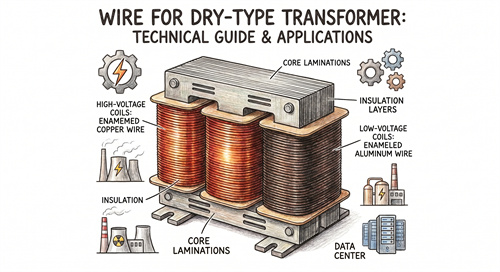
I. Product Definition of Dry-Type Transformer Winding Wire
Dry type transformer winding wire is the electromagnetic wire product used for dry type transformer, including mainly enameled copper wire, enameled aluminum wire, copper/aluminum foil and special insulated wire. According to dry type transformer insulation process, the winding wire should be compatible.
Special Requirements for Dry-Type Transformer Windings:
Oil-Free Cooling: Cooling achieved through air convection, winding temperature rise control is important.
Resin Casting Compatibility: Winding wire insulating varnish must be compatible with epoxy resin.
Low Partial Discharge: Dry-type transformer insulation systems can be prone to partial discharge
Flame Retardancy: Fire safety standard satisfied.
Moisture Resistance: if required, adapt to moe humid environment
II. Application Scenarios Analysis
2.1 Epoxy Resin Cast Dry-Type Transformer
The current mainstream type of dry-type transformer:
Technical Requirements:
- Insulation Class: Class F/H
- Capacity: 30kVA-2500kVA
- Voltage Level: 10kV/35kV
- Cooling Method: AN/AF (Air Natural/Air Forced)
2.2 VPI Impregnated Dry-Type Transformer
Dry-type transformer with vacuum pressure impregnation process:
Technical Requirements:
- Insulation Class: Class F/H
- Capacity: 30kVA-2500kVA
- Voltage Level: 10kV/35kV
- Impregnation Resin: Polyester or epoxy-based
2.3 Amorphous Alloy Dry-Type Transformer
Energy-efficient dry-type transformer with amorphous alloy core:
Technical Requirements:
- Insulation Class: Class F
- Low no-load loss
- Capacity: 30kVA-2000kVA
2.4 Special Dry-Type Transformer
Dry-type transformers for special applications:
Technical Requirements:
- Mining dry-type transformer: Explosion-proof, flame retardant
- Marine dry-type transformer: Salt spray resistant, vibration resistant
- Traction dry-type transformer: Impact load resistant
III. Conductor Material Selection
3.1 Enameled Copper Wire
The mainstream choice for dry-type transformer windings:
Advantages:
- High conductivity (≥100% IACS), low loss
- Good mechanical strength
- Corrosion resistant, long service life
- Good weldability
Applications:
- Mid-to-high-end dry-type transformers
- Large-capacity dry-type transformers (≥1000kVA)
- Applications with high efficiency requirements
3.2 Enameled Aluminum Wire
Cost-effective dry-type transformer solution:
Advantages:
- Low cost, approximately 30-40% of copper wire
- Lightweight, approximately 30% of copper wire
- Meets basic performance requirements of dry-type transformers
Applications:
- Small to medium dry-type transformers
- Cost-sensitive projects
- Applications with weight requirements
3.3 Copper/Aluminum Foil
Foil winding dry-type transformer:
Advantages:
- Low eddy current loss
- Strong axial short-circuit withstand capacity
- Good heat dissipation
Applications:
- Low-voltage high-current windings
- Rectifier transformers
3.4 Copper vs. Aluminum Selection
| Considerations | Copper Wire | Aluminum Wire |
|---|---|---|
| Conductivity | 100% IACS | 61% IACS |
| Cost | High | Low (30-40%) |
| Weight | Heavy | Light (30%) |
| Temperature Rise | Low | Slightly Higher |
| Short-Circuit Withstand | Strong | Medium |
| Applicable Capacity | Large-Medium | Small-Medium |
IV. Insulation System
4.1 Insulation Classes
Commonly used insulation classes for dry-type transformer winding wires:
| Insulation Class | Maximum Operating Temperature | Temperature Rise Limit (K) | Typical Applications |
|---|---|---|---|
| Class B (130°C) | 130°C | 80 | General Purpose Dry-Type Transformers |
| Class F (155°C) | 155°C | 100 | Mainstream Dry-Type Transformers |
| Class H (180°C) | 180°C | 125 | High-Temperature Application Dry-Type Transformers |
4.2 Insulation Material Types
Polyester Imide (PEI) Enameled Wire:
- Thermal Class: Class F
- Suitable for epoxy resin cast dry-type transformers
- Good electrical and mechanical properties
- Good compatibility with epoxy resin
Polyamide-Imide (PAI) Enameled Wire:
- Thermal Class: Class H
- Suitable for high-temperature application dry-type transformers
- Excellent chemical resistance and mechanical strength
- Resin corrosion resistant
Self-Adhesive Enameled Wire:
- With self-adhesive layer, self-bonds after heating
- Suitable for dry-type transformers without casting process
- Simplifies manufacturing process
4.3 Dry-Type Transformer Insulation System
The insulation system of dry-type transformers includes:
Epoxy Resin Casting System:
- Epoxy resin + curing agent + filler
- Winding wire insulating varnish must be compatible with resin
- Forms a solid insulation whole after casting
VPI Impregnation System:
- Polyester or epoxy impregnation resin
- Vacuum pressure impregnation process
- Fills winding gaps, improves insulation strength
V. Resin Casting Compatibility
5.1 Compatibility Issues
During epoxy resin casting, winding wires may face:
Chemical Corrosion:
- Active substances in epoxy resin may corrode the enamel coating
- Leads to decreased insulation performance
Thermal Stress:
- Casting curing temperature is relatively high (120-150°C)
- Thermal stress is generated during cooling
- Enamel coating may crack
Expansion Coefficient Differences:
- Thermal expansion coefficients of copper/aluminum and epoxy resin differ
- Interface delamination may occur during temperature changes
5.2 Solutions
Select Compatible Insulating Varnish:
- Use insulating varnish resistant to epoxy resin
- PEI/PAI enamel coating has good resin resistance
Control Casting Process:
- Control casting temperature
- Control curing rate
- Reduce thermal stress
Preheating Treatment:
- Preheat windings before casting
- Reduce temperature difference
VI. Partial Discharge Control
6.1 Hazards of Partial Discharge
Partial discharge in dry-type transformers is the main cause of insulation aging:
Impact:
- Accelerates insulation material aging
- Reduces insulation strength
- Shortens transformer life
6.2 Sources of Partial Discharge
Voids:
- Residual bubbles during casting
- Air in winding gaps
Interfaces:
- Winding wire and resin interface
- Interlayer insulation interface
6.3 Control Measures
Winding Wire Level:
- Use winding wires with smooth surfaces and dense enamel coating
- Reduce surface defects
- Ensure enamel coating continuity
Process Level:
- Vacuum casting to reduce bubbles
- VPI impregnation to fully fill gaps
- Control casting speed and temperature
VII. Key Manufacturing Processes
7.1 Conductor Preparation
Copper Conductor Requirements:
- Purity ≥99.9%
- Conductivity ≥100% IACS
- Smooth surface, free from oxidation and scratches
Aluminum Conductor Requirements:
- Purity ≥99.5%
- Conductivity ≥61% IACS
- Smooth surface, free from oxidation and scratches
7.2 Winding Process
Layer Winding:
- Interlayer insulation control
- Oil duct/air duct design
Disc Winding:
- Disc-to-disc insulation
- Transposition control
7.3 Casting Process
Epoxy Resin Casting:
- Vacuum casting
- Control casting temperature
- Control curing rate
- Demolding treatment
7.4 VPI Impregnation Process
Process Key Points:
- Vacuum degree: ≤100Pa
- Impregnation pressure: 0.6-0.8MPa
- Impregnation time: Determined based on winding dimensions
- Curing temperature and time: As per impregnation resin requirements
VIII. Quality Control
8.1 Raw Material Inspection
Conductor Inspection:
- Purity, conductivity
- Wire diameter/cross-section tolerance
- Surface quality
Insulating Varnish Inspection:
- Breakdown Voltage
- Flexibility
- Enamel coating continuity (spark test)
- Heat Resistance
- Resin Resistance
8.2 Production Process Inspection
| Process | Control Points | Inspection Items |
|---|---|---|
| Drawing/Rolling | Compression Ratio, Die Condition | Cross-Section Accuracy, Surface Quality |
| Annealing | Temperature Profile, Protective Atmosphere | Conductivity, Flexibility |
| Coating | Enamel Coating Thickness, Uniformity | Breakdown Voltage, Appearance |
| Baking | Temperature Profile, Time | Enamel Coating Curing Degree, Flexibility |
| Winding | Number of Turns, Interlayer Insulation | Dimensional Accuracy, Insulation Integrity |
8.3 Factory Inspection
Dry-type transformer winding wires must undergo strict inspection before leaving the factory:
| Inspection Items | Requirements |
|---|---|
| Conductor Dimensions | Meets tolerance requirements |
| Breakdown Voltage | ≥ Specified Value |
| Flexibility | Passes Bending Test |
| Enamel Coating Continuity | Spark Test: No Breakdown |
| Heat Resistance | Passes Thermal Aging Test |
| Resin Resistance | Passes Compatibility Test |
IX. Selection Guide
9.1 Transformer Type Confirmation
Select according to dry-type transformer type:
- Epoxy Resin Cast Dry-Type Transformers: Class F/H, copper or aluminum wire, resin resistant
- VPI Impregnated Dry-Type Transformers: Class F/H, copper or aluminum wire
- Amorphous Alloy Dry-Type Transformers: Class F, copper or aluminum wire
- Foil Winding Dry-Type Transformers: Copper foil or aluminum foil
9.2 Insulation Class Selection
Select according to temperature rise requirements:
- Class B (130°C): General purpose dry-type transformers
- Class F (155°C): Mainstream dry-type transformers
- Class H (180°C): High-temperature application dry-type transformers
9.3 Conductor Material Selection
- Copper Wire: Mid-to-high-end dry-type transformers, large-capacity dry-type transformers, high efficiency requirements
- Aluminum Wire: Small to medium dry-type transformers, cost-sensitive projects, lightweight requirements
- Copper/Aluminum Foil: Low-voltage high-current windings, rectifier transformers
9.4 Certification Requirements
Ensure products meet relevant certification requirements:
- UL: North American market
- IEC: International standard (IEC 60076-11)
- TÜV: European market
- CCC: Chinese market
- RoHS: Environmental requirements
Conclusion
The choice of dry-type transformer winding wire has a positive impact for the transformer characterized efficiency, temperature rise, insulation life, working reliability. In terms of various dry-type transformer (epoxy resin cast, VPI impregnated, amorphous alloy, foil winding), insulation class (Class B/F/H) and conductor material (copper/aluminum/foil), strategic scientific choice of the type of winding wire and whether to match the resin casting process is need.
Working together with professional manufacturers of magnet wire, choosing the suitable one according to application conditions, especially guaranteeing the adhesion of winding wire insulating varnish using with epoxy resin, controlling partial discharge level, can effectively ensure the quality and performance of dry-type transformers.