


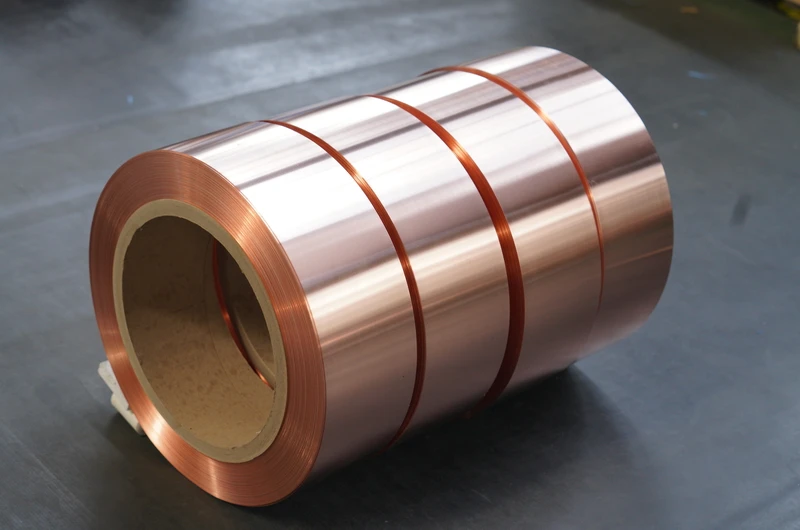
Copper foil for VFD (Variable Frequency Drive) reactors is a key conductive material in VFD reactor windings. A VFD is a power control device that changes motor operating frequency to control AC motor speed, widely used in industrial production, petrochemical, metallurgy, mining, water treatment, HVAC systems, ship propulsion and other fields.
I. Working Characteristics and Principles of VFD Reactors
1.1 VFD System Overview
A VFD system consists of three parts: rectifier, filter, and inverter. The rectifier converts AC to DC, the filter smooths DC voltage, and the inverter converts DC back to adjustable frequency and voltage AC for motors. Reactors play indispensable roles in VFD systems.
1.2 Functions of Reactors in VFD Systems
Input reactors on the power supply side of the rectifier restrict the flow of harmonic currents back into the grid, eliminate the problem of harmonic pollution, reduce the inrush current when rectifier is connected to the power supply side, and enhance the power factor to above 0.9, usually. Output reactors are placed between the inverter and motor to limit the harmonic voltages at the motor terminals, so as to avoid the insulation aging, to suppress the over voltages due to the switching of inverter, to protect the motor insulation, to prolong the motor life, and to decrease the risk of electrolytic corrosion of the rotatory bearing. DC reactors in the DC bus also smooth ripple currents, lessening the burden on the DC capacitors, thereby increasing capacitor life, and improving the system electomagnetic compatibility.
1.3 Operating Characteristics
Wide frequency range: Fundamental frequency from sub-Hz to hundreds of Hz, with carrier frequencies typically between 2kHz-16kHz. Reactors need stable inductance over a wide frequency range.
Rich harmonic content: Harmonics from hundreds of Hz to over 10kHz create extra copper losses and temperature rise.
High heat dissipation requirements: Reactors are installed inside VFD cabinets with limited space and relatively poor heat dissipation.
Strict reliability requirements: VFD systems require continuous long-term operation; reactor failure causes production system shutdown.
II. Special Requirements for Copper Foil Materials
2.1 Excellent Electrical Conductivity
High conductivities lowers reactor copper losses. content 99.90 or more, conductivity 1ACS 98or more. Low resistivity reduces heat generation, temperature rise, we also improve efficiency. In the context of high frequency harmonic environments, follows skin effect, which channeled the current toward conducting surface, thus decreasing the effective conductive cross section. And low DC resistance in combination with a good AC resistance at high frequencies are both important. Impurities management (Fe, S, O) is essential to ensure a stable conductivity. Grain uniformity decreases electron scattering and, consequently, resistivity.
2.2 Excellent High-Frequency Performance
Skin effect formula: delta = 66.1 / square root of f (mm), where f is frequency in Hz. At 50Hz fundamental, skin depth is approximately 9.4mm. At carrier frequencies 2kHz-16kHz, skin depth drops to approximately 1.5mm and 0.5mm respectively. If foil thickness approaches or exceeds skin depth, AC resistance increases significantly.
Proximity effect in densely wound reactors causes non-uniform current distribution from magnetic field interaction between adjacent conductors, further increasing AC resistance.
Eddy current losses from high-frequency magnetic fields can be reduced by using thinner foil or transposed braided structures.
2.3 Reliable Mechanical Properties
Winding performance: O-state foil is soft and suitable for complex winding shapes; H04-state foil has higher strength for applications requiring shape retention.
Tensile strength: Determines resistance to breakage under stress. Large power reactors need to withstand large electromagnetic forces, especially under short-circuit conditions.
Fatigue strength: Critical for long-term reliability under temperature cycling and electromagnetic force cycling.
2.4 Precise Dimensional Accuracy
Thickness accuracy directly affects inductance values. Width accuracy affects winding fill factor. Thickness uniformity ensures consistent reactor performance across production batches.
End-face quality is important for welding or crimping. Poor end-face quality increases contact resistance, causing localized overheating.
2.5 Excellent Thermal Resistance
High-temperature strength: Winding temperature can exceed 100 degrees C at full load. Quality reactor foil maintains sufficient strength at high temperatures.
Thermal expansion coordination: Copper’s thermal expansion coefficient is approximately 17 x 10 to the power of -6 per degree C, requiring coordination with surrounding materials.
Resistance temperature coefficient: Copper’s is approximately +0.4% per degree C, requiring consideration in reactor design.
III. Specifications
3.1 Copper Foil Substrate
C11000 pure copper: copper content 99.90% or higher, iron 0.005% or less, sulfur 0.001% or less, oxygen 0.005% or less. Conductivity 98% IACS or higher in annealed state.
3.2 Thickness Selection
| Application | Thickness Range |
|---|---|
| Low frequency fundamental (50-60Hz), small power | 0.1-0.3mm |
| Low frequency, medium power | 0.3-0.5mm |
| Low frequency, large power | 0.5-2.0mm |
| Carrier frequency below 4kHz | 0.2-0.5mm |
| Carrier frequency 4-8kHz | 0.1-0.3mm |
| Carrier frequency above 8kHz | 0.05-0.15mm |
3.3 Mechanical Properties
| State | Tensile Strength | Elongation | Hardness | Applications |
|---|---|---|---|---|
| O State (Annealed) | 200-260MPa | 35% or higher | 40-50HV | Bending and forming |
| H04 State (Semi-hard) | 260-320MPa | 20% or higher | 50-65HV | Standard reactor windings |
| H06 State (Hard) | 320MPa or higher | 5% or higher | 65HV or higher | High-power applications |
3.4 Width Specifications
Common widths: 10mm, 15mm, 20mm, 25mm, 30mm, 40mm, 50mm, 60mm, 80mm, 100mm, with custom widths available.
IV. Selection Guide
4.1 By Reactor Type
- Input reactors: Thickness 0.3-1.0mm, H04 or H06 state
- Output reactors: Thickness 0.1-0.5mm, O or H04 state
- DC reactors: Thickness 0.3-1.5mm, H04 or H06 state
4.2 By VFD Power Level
| Power Level | Current Range | Thickness | Width |
|---|---|---|---|
| Small (below 7.5kW) | 10-30A | 0.1-0.3mm | 10-30mm |
| Medium (7.5-55kW) | 30-100A | 0.2-0.5mm | 20-50mm |
| Large (55-315kW) | 100-630A | 0.3-1.0mm | 40-100mm |
| Extra-large (above 315kW) | Above 630A | 0.5-2.0mm | 60-200mm |
4.3 By Carrier Frequency
- Low carrier (2-4kHz): Thickness 0.2-0.5mm
- Medium carrier (4-8kHz): Thickness 0.1-0.3mm
- High carrier (8-16kHz): Thickness 0.05-0.2mm
4.4 By Insulation Class
General (F-class, 155 degrees C): Basic insulation treatment
Enhanced (H-class, 180 degrees C): H-class insulation coating or paper wrapping
Special (C-class, above 180 degrees C): Special insulation materials and processes
V. Dimensional Tolerance Requirements
Thickness tolerance: Standard +/-0.02mm, High precision +/-0.01mm, Ultra-high precision +/-0.005mm
Width tolerance: Standard +/-0.3mm, High precision +/-0.1mm, Ultra-high precision +/-0.05mm
Thickness uniformity: Standard 3% or less, Precision 1% or less, Ultra-precision 0.5% or less
VI. Production Process
Raw material (electrolytic copper 99.90% or higher) to smelting and casting, hot rolling, cold rolling with high-precision AGC system, annealing, slitting, and inspection.
Key controls: Copper content, thickness uniformity within +/-0.001mm, defect-free surface, clean edges without burrs.
VII. Quality Inspection
- Chemical composition: Spectroscopic analysis
- Mechanical properties: Universal testing machine
- Electrical: Eddy current conductivity meter, IACS 98% or higher
- Dimensional: Thickness gauge with 0.001mm accuracy
VIII. Supplier Selection
Key points: Material quality (C11000), specification range, thickness precision, production capacity, testing capability, technical support.
Testing process: Dimensional inspection, appearance inspection, performance test, process test, finished product test.
IX. Conclusion
30 years of experience exporting electrical wire and metal foil. C11000 pure copper, conductivity IACS 98% or higher, thickness range 0.05-2.0mm, width range 10-200mm, ultra-high thickness precision +/-0.005mm, multiple states available (O, H04, H06), complete test reports, customization and technical support available.
Contact:
Email: office@cnlpzz.com
WhatsApp: 0086-19337889070