


Generator as a kind of essential power device that can change mechanical energy to electrical energy. It is widely used in thermal power, hydropower, nuclear power, wind power, diesel emergency power supply and other applications. For generator, stator and rotor winding are the core parts for electromagnetic energy conversion. The performance of stator and rotor winding directly affect the efficiency, power density, reliability and service life of the generator. And the choice of power wire, which is the core material of winding, is the most important aspect to influence the performance of the generator.
Different types of generator, such as steam turbine generator, hydro generator, diesel generator, wind generator and others, have a variety of characteristics (such as principle, speed, capacity, voltage, working environment, etc.)which can result in different technical requirements on winding wires. This paper offers a systematic technical guidance for generator design engineers and purchasing decision makers from eight aspects: product definition, application scenario analysis, conductor materials, insulation system, flat wire and transposed wire, manufacturing process, quality control and selection criteria.
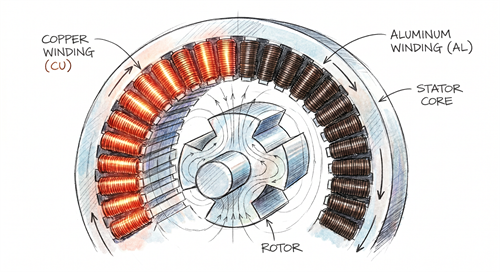
I. Product Definition of Generator Magnet Wire
Generator magnet wire is an electric wire product of electromagnet in the generator which is primarily used for stator- and rotor windings in the generator, including enameled round wire, enameled flat wire, insulated wire with mica tape, transposed conductors (a.k.a. Roebel bars), and special insulated wires.
Special Requirements for Generator Windings:
High Voltage: Large generators may have output voltages of 10-30k V.
High Current: 100’s to K Amperes of current is involved.
Resistance to elevated temperatures. Winding temperature rise is one of the limiting factors to generator capacity
Vibration Resistance- (indo): Particularly for steam turbine generators (3000/3600rpm) and hydro generators.
Long life: Design life of power stations 30-50 years
High Reliability: very high downtime maintenance costs
II. Application Scenarios Analysis
2.1 Steam Turbine Generator
Main equipment for thermal and nuclear power generation:
Technical Requirements:
- Insulation Class: Class F/B
- Speed: 3000rpm (50Hz) / 3600rpm (60Hz)
- Capacity: 50MW-1700MW
- Cooling Method: Air-cooled, hydrogen-cooled, water-cooled
2.2 Hydro Generator
Core equipment for hydropower generation:
Technical Requirements:
- Insulation Class: Class F/B
- Speed: Low speed (100-1000rpm)
- Capacity: Several MW to 1000MW+
- Environment: Humid, water mist
2.3 Diesel Generator
Backup power and mobile power supply:
Technical Requirements:
- Insulation Class: Class F/H
- Speed: 1500-3000rpm
- Capacity: Several kW to several MW
- Environment: High vibration, frequent temperature changes
2.4 Wind Generator
Core of wind power generation systems:
Technical Requirements:
- Insulation Class: Class F/H/200
- Capacity: 1.5MW-15MW
- Environment: Salt spray, vibration, low temperature
2.5 DC Generator
Special industrial applications:
Technical Requirements:
- Insulation Class: Class B/F
- Commutator winding
- Frequent start-stop
III. Conductor Material Selection
3.1 Enameled Copper Wire
The mainstream choice for large generator windings:
Advantages:
- High conductivity (≥100% IACS), low loss
- Good mechanical strength, capable of withstanding electromagnetic forces
- Corrosion resistant, long service life
- Good weldability
Applications:
- Large steam turbine generator stator/rotor
- Large hydro generators
- Wind generators
3.2 Enameled Aluminum Wire
Small to medium generators and cost-effective solutions:
Advantages:
- Low cost, approximately 30-40% of copper wire
- Lightweight, approximately 30% of copper wire
- Meets basic performance requirements
Applications:
- Small diesel generators
- Small hydro generators
- Cost-sensitive projects
3.3 Copper vs. Aluminum Selection
| Considerations | Copper Wire | Aluminum Wire |
|---|---|---|
| Conductivity | 100% IACS | 61% IACS |
| Cost | High | Low (30-40%) |
| Weight | Heavy | Light (30%) |
| Mechanical Strength | High | Medium |
| Corrosion Resistance | Excellent | Good (Requires Protection) |
| Applicable Capacity | Large-Medium | Small-Medium |
IV. Insulation System
4.1 Insulation Classes
Commonly used insulation classes for generator magnet wire:
| Insulation Class | Maximum Operating Temperature | Typical Applications |
|---|---|---|
| Class B (130°C) | 130°C | Small Generators, Diesel Generators |
| Class F (155°C) | 155°C | Steam Turbine Generators, Hydro Generators |
| Class H (180°C) | 180°C | Diesel Generators, Wind Generators |
| Class 200 (200°C) | 200°C | Large-Capacity Wind Generators |
4.2 Insulation Material Types
Polyester Imide (PEI) Enameled Wire:
- Thermal Class: Class F
- Suitable for steam turbine generators, hydro generators
- Good electrical and mechanical properties
Polyamide-Imide (PAI) Enameled Wire:
- Thermal Class: Class H
- Suitable for diesel generators, wind generators
- Excellent chemical resistance and mechanical strength
Mica Tape Insulated Wire:
- Thermal Class: Class F/H
- Suitable for high-voltage generators (≥3.3kV)
- Excellent corona resistance and voltage resistance
4.3 High-Voltage Insulation System
Large generators (≥3.3kV) require special insulation systems:
Mica Tape Insulation:
- Multiple layers of mica tape wrapping
- Vacuum Pressure Impregnation (VPI)
- High voltage resistance level
- Excellent corona resistance performance
Voltage Resistance Class Comparison:
| Voltage Level | Insulation Requirement | Typical Applications |
|---|---|---|
| ≤1kV | Standard Enameled Wire | Small Generators |
| 3.3kV-6.6kV | Mica Tape + VPI | Medium Generators |
| 10kV-30kV | Thickened Mica Tape + VPI | Large Generators |
V. Flat Wire and Transposed Conductors
5.1 Enameled Flat Wire
Flat wire is widely used in large generator stator windings:
Advantages:
- High slot fill rate, good space utilization
- Large heat dissipation area
- High mechanical strength
- Suitable for high current applications
Specifications:
- Width: 2mm-20mm
- Thickness: 0.5mm-5mm
- Corner Radius: R0.5-R3
5.2 Transposed Conductors (Roebel Bars)
Key technology for large generator stator windings:
Purpose:
- Reduce circulating current losses
- Equalize current distribution among strands
- Reduce additional losses
Types:
- Standard transposed conductors
- Half-transposed conductors
- Fully transposed conductors
5.3 Wire Type Selection Comparison
| Wire Type | Applicable Scenarios | Advantages | Limitations |
|---|---|---|---|
| Round Wire | Small-Medium Generators | Low Cost, Mature Process | Low Slot Fill Rate |
| Flat Wire | Large-Medium Generators | High Slot Fill Rate, Good Heat Dissipation | Complex Process |
| Transposed Conductor | Large Generators | Low Circulating Current Loss | High Cost, Complex Process |
| Mica Tape Insulated Wire | High-Voltage Generators | Voltage Resistant, Corona Resistant | Complex Process, High Cost |
VI. Key Manufacturing Processes
6.1 Conductor Preparation
Copper Conductor Requirements:
- Purity ≥99.9%
- Conductivity ≥100% IACS
- Smooth surface, free from oxidation and scratches
Aluminum Conductor Requirements:
- Purity ≥99.5%
- Conductivity ≥61% IACS
- Smooth surface, free from oxidation and scratches
6.2 Coating Process
Thin Coating Multiple Times:
- Ensure uniform and dense enamel coating
- Avoid excessive enamel coating leading to cracking
Baking and Curing:
- Precise temperature profile control
- Ensure full curing of enamel coating
6.3 Flat Wire Forming
Forming Process:
- Rolling forming
- Corner radius control
- Dimensional accuracy control
6.4 Transposed Conductor Manufacturing
Transposition Process:
- Precise transposition pitch
- Strand insulation integrity
- Accurate transposition angle
6.5 Mica Tape Wrapping
Wrapping Process:
- Continuous multi-layer mica tape wrapping
- Overlap rate control
- Uniform tension
6.6 Vacuum Pressure Impregnation (VPI)
Process Key Points:
- Vacuum degree: ≤100Pa
- Impregnation pressure: 0.6-0.8MPa
- Impregnation time: Determined based on winding dimensions
- Curing temperature and time: As per insulating varnish requirements
VII. Quality Control
7.1 Raw Material Inspection
Conductor Inspection:
- Purity, conductivity
- Wire diameter/cross-section tolerance
- Surface quality
Insulating Varnish Inspection:
- Breakdown Voltage
- Flexibility
- Enamel coating continuity (spark test)
- Heat Resistance
7.2 Production Process Inspection
| Process | Control Points | Inspection Items |
|---|---|---|
| Drawing/Rolling | Compression Ratio, Die Condition | Cross-Section Accuracy, Surface Quality |
| Annealing | Temperature Profile, Protective Atmosphere | Conductivity, Flexibility |
| Coating | Enamel Coating Thickness, Uniformity | Breakdown Voltage, Appearance |
| Baking | Temperature Profile, Time | Enamel Coating Curing Degree, Flexibility |
| Transposition/Wrapping | Transposition Pitch, Overlap Rate | Dimensional Accuracy, Insulation Integrity |
| VPI | Vacuum Degree, Pressure, Time | Impregnation Quality |
7.3 Factory Inspection
Generator magnet wire must undergo strict inspection before leaving the factory:
| Inspection Items | Requirements |
|---|---|
| Conductor Dimensions | Meets tolerance requirements |
| Breakdown Voltage | ≥ Specified Value |
| Flexibility | Passes Bending Test |
| Enamel Coating Continuity | Spark Test: No Breakdown |
| Heat Resistance | Passes Thermal Aging Test |
| Voltage Resistance | ≥ Specified Value (High-Voltage Type) |
VIII. Selection Guide
8.1 Generator Type Confirmation
Select according to generator type:
- Steam Turbine Generators: Class F/B, copper flat wire or transposed conductors
- Hydro Generators: Class F/B, copper flat wire
- Diesel Generators: Class F/H, copper round wire or aluminum wire
- Wind Generators: Class F/H/200, copper wire or aluminum wire
8.2 Voltage Level Confirmation
Select insulation type according to voltage level:
- ≤1kV: Standard enameled wire
- 3.3kV-6.6kV: Mica tape insulation + VPI
- 10kV-30kV: Thickened mica tape insulation + VPI
8.3 Conductor Material Selection
- Copper Wire: Large-medium generators, high-voltage generators, long lifespan requirements
- Aluminum Wire: Small generators, cost-sensitive projects, lightweight requirements
8.4 Certification Requirements
Ensure products meet relevant certification requirements:
- UL: North American market
- IEC: International standard (IEC 60034)
- TÜV: European market
- RoHS: Environmental requirements
Conclusion
Determination generator magnet wire has great influence to the efficiency, reliability, power density and life of generator. For various types of generator (steam turbine, hydro, diesel and wind), various voltage levels (low, medium and high voltage) and various capacity ranges, combined with the condition of operating environment; conduct materials (copper/aluminum), types of wires (round wire/flat wire/transposed conductors), insulation class and special properties (voltage resistance, corona resistance, vibration resistance) should be systematically selected.
Cooperation with professional magnet wire manufacturers and choosing suitable product according to the specific application demand is a good approach to guarantee the generator quality and performance. For large high-voltage generator, choosing special magnet wire with voltage resistance, corona resistance and high thermal class could greatly decrease its failure rate and prolong its service life.