

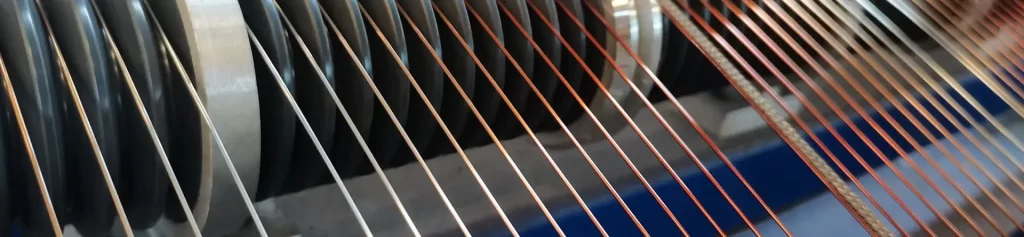
The wind turbine is the central apparatus for wind power generation, which utilize wind energy to generate electricity. The performance of the wind turbine crucially depends on its key components stator and rotor windings. Since winding wire is the key material of the windings, the choice of winding wire is vitally important to the overall performance of the wind turbine.
Along with the rapid development of wind power industry, especially the wind power industry experience rapid growth of offshore wind power, working environment of wind turbine is in quickly deteriorating, the technical level of winding wire becomes higher and higher. This paper in seven dimensions of wind turbines technical aspects, product definition, application scenario analysis, environment adaptability, insulation system, manufacturing process, quality control and selection specification to provide a comprehensive technical reference for design engineers of wind turbines and purchase Decision-maker.
I. Product Definition of Wind Turbine Generator Winding Wire
Generator winding wire of wind turbines is an electromagnetic wire product that can be used for stator windings and rotor windings of wind turbines mainly including enameled copper wire, enameled aluminum wire, mica tape insulated wire, special insulated wire etc.
Special Requirements for Wind Turbine Generator Windings:
Vibration Resistance: Wind turbines are working in a vibration condition for a long term. It must use winding wire with good vibration fatigue resistance.
Environmental Resistance: Salt spray on offshore turbines and sand, cold temperatures and high humidity on onshore turbines
Corona Resistance Inverter power supply produces high frequency pulse voltages. It will trigger corona discharge lightly.
Durability (Time): Turbine technology is durable and it can operate for more than 20 years.
High reliability: High maintenance costs (e.g. Offshore wind turbines)
II. Application Scenarios Analysis
2.1 Permanent Magnet Direct Drive Generator
Permanent magnet direct drive generators are one of the mainstream types of wind turbine generators:
Technical Requirements:
Insulation Class: Class F/H
Large Capacity: Megawatt-level (1.5MW-15MW)
Low Speed: Direct drive, gearless
Corona Resistance: Inverter power supply
2.2 Doubly Fed Induction Generator
Doubly fed induction generators increase speed via a gearbox:
Technical Requirements:
- Insulation Class: Class F/H
- Medium to High Speed: Speed increase via gearbox
- Inverter Power Supply: Rotor-side frequency conversion
2.3 Yaw Motor
Controls wind turbine yaw alignment:
Technical Requirements:
- Insulation Class: Class F
- Frequent Start-Stop
- Vibration Resistance
2.4 Pitch Motor
Controls blade pitch angle:
Technical Requirements:
- Insulation Class: Class F/H
- High Precision Control
- Low Temperature Resistance (-40°C)
III. Environmental Adaptability Analysis
3.1 Vibration Resistance
Wind turbines operate under long-term vibration conditions:
Sources of Vibration:
The effects of periodic loads caused by rotor moving: where.
Gearbox transmission vibration (doubly fed type)
Yaw and pitch motion
Winding Wire Requirements:
Good flexibility of the enamel coating, resistant to the vibration fatigue
Binding and fixing Reliable
Correctly performing the impregnation.
3.2 Salt Spray Corrosion Resistance
Offshore wind turbines face harsh salt spray environments:
Corrosion Effects:
- Accelerates conductor oxidation
- Reduces insulation performance
- Shortens service life
Protective Measures:
- Use corrosion-resistant insulating varnish
- Increase insulation layer thickness
- Impregnation treatment (VPI)
3.3 Low Temperature Adaptability
Onshore wind turbines (especially in northern regions) face low temperature environments:
Low Temperature Challenges:
- Ambient temperatures can reach -40°C
- Low temperature embrittlement of insulation materials
- Difficulty in starting
Material Requirements:
- Maintain flexibility of enamel coating at low temperatures
- Maintain ductility of conductors at low temperatures
3.4 High Altitude Adaptability
High-altitude areas have thin air and poor heat dissipation conditions:
Impacts:
- Reduced heat dissipation efficiency
- Reduced corona initiation voltage
Countermeasures:
- Use high thermal class insulation
- Increase insulation thickness
- Optimize heat dissipation design
3.5 Copper vs. Aluminum Selection
| Considerations | Copper Wire | Aluminum Wire |
|---|---|---|
| Conductivity | 100% IACS | 61% IACS |
| Cost | High | Low (30-40%) |
| Weight | Heavy | Light (30%) |
| Vibration Resistance | Excellent | Good |
| Corrosion Resistance | Excellent | Good (Requires Protection) |
| Connection Method | Conventional Welding | Requires Special Treatment |
IV. Insulation System
4.1 Insulation Classes
Commonly used insulation classes for wind turbine generator winding wires:
| Insulation Class | Maximum Operating Temperature | Typical Applications |
|---|---|---|
| Class F (155°C) | 155°C | Onshore Wind Turbines |
| Class H (180°C) | 180°C | Offshore Wind Turbines, High-Temperature Conditions |
| Class 200 (200°C) | 200°C | Large-Capacity Offshore Wind Turbines |
4.2 Insulation Material Types
Polyester Imide (PEI) Enameled Wire:
- Thermal Class: Class F
- Suitable for onshore wind turbines
- Good electrical and mechanical properties
Polyamide-Imide (PAI) Enameled Wire:
- Thermal Class: Class H
- Suitable for offshore wind turbines
- Excellent chemical resistance and mechanical strength
Polyimide (PI) Enameled Wire:
- Thermal Class: Class 200
- Suitable for large-capacity offshore wind turbines
- Excellent heat resistance and corona resistance properties
4.3 Corona Resistant Insulation System
Wind turbines powered by frequency converters must consider corona resistant performance:
Corona Resistant Enameled Wire:
- Addition of nano-inorganic fillers
- Increased partial discharge initiation voltage
- Extended service life under corona conditions
Corona Resistance Class Comparison:
| Class | Corona Resistance Time | Applicable Scenarios |
|---|---|---|
| Class A | ≥20 hours | General Inverter Applications |
| Class B | ≥100 hours | Offshore Wind Turbines |
| Class C | ≥500 hours | Large-Capacity Offshore Wind Turbines |
V. Key Manufacturing Processes
5.1 Conductor Preparation
Conductor Requirements:
- Copper Wire: Purity ≥99.9%, Conductivity ≥100% IACS
- Aluminum Wire: Purity ≥99.5%, Conductivity ≥61% IACS
- Smooth surface, free from oxidation and scratches
5.2 Coating Process
Thin Coating Multiple Times:
- Ensure uniform and dense enamel coating
- Avoid excessive enamel coating leading to cracking
Baking and Curing:
- Precise temperature profile control
- Ensure full curing of enamel coating
5.3 Vacuum Pressure Impregnation (VPI)
Vacuum pressure impregnation is a key process for wind turbine windings:
Process Key Points:
- Vacuum degree: ≤100Pa
- Impregnation pressure: 0.6-0.8MPa
- Impregnation time: Determined based on winding dimensions
- Curing temperature and time: As per insulating varnish requirements
5.4 Corona Resistant Treatment
For corona resistant enameled wire:
- Add nanofillers (Al&sub2;O&sub3;, SiO&sub2;, etc.)
- Control filler dispersion uniformity
- Ensure enamel coating mechanical properties do not decrease
VI. Quality Control
6.1 Raw Material Inspection
Conductor Inspection:
- Purity, conductivity
- Wire diameter tolerance: ±0.002mm
- Surface quality
Insulating Varnish Inspection:
- Breakdown Voltage
- Flexibility
- Enamel coating continuity (spark test)
- Heat Resistance
- Corona Resistance Performance
6.2 Production Process Inspection
| Process | Control Points | Inspection Items |
|---|---|---|
| Wire Drawing | Compression Ratio, Die Condition | Wire Diameter Accuracy, Surface Quality |
| Annealing | Temperature Profile, Protective Atmosphere | Conductivity, Flexibility |
| Coating | Enamel Coating Thickness, Uniformity | Breakdown Voltage, Appearance |
| Baking | Temperature Profile, Time | Enamel Coating Curing Degree, Flexibility |
| Corona Resistant Treatment | Filler Dispersion, Enamel Coating Quality | Corona Resistance Time |
6.3 Factory Inspection
Wind turbine generator winding wires must undergo strict inspection before leaving the factory:
| Inspection Items | Requirements |
|---|---|
| Conductor Dimensions | Meets tolerance requirements |
| Breakdown Voltage | ≥ Specified Value |
| Flexibility | Passes Bending Test |
| Enamel Coating Continuity | Spark Test with No Breakdown |
| Heat Resistance | Passes Thermal Aging Test |
| Corona Resistance Performance | ≥ Specified Time |
VII. Selection Guide
7.1 Application Scenarios Confirmation
Select according to wind turbine type and working environment:
Onshore Wind Turbines: Class F, standard environment
Offshore Wind Turbines: Class H/200, salt spray resistant
High-Altitude Wind Turbines: Class F/H, enhanced insulation
Low-Temperature Wind Turbines: Class F, good low-temperature flexibility
7.2 Conductor Material Selection
Copper wire: Capacity for wind turbines, offshore wind turbines, time requirements of life.
Aluminum Wire: Onshore turbines, tend to be a price-sensitive project, the lighter the better.
7.3 Insulation Class Selection
Based on operating temperature and environmental conditions:
Class F (155 degreesC): Onshore wind turbines
Class H (180 degreesC): Deepwater floating turbines, Industrial turbines that operate at high temperature
Class 200 (200 o C): Large Capacity offshore wind turbines.
7.4 Corona Resistance Class Selection
Based on inverter type and output characteristics:
Class A (20 hrs): General inverters
Category B (100 h): Turbines are fished in the offshore wind farm.
Class C (500 Hrs): Large-Capacity Offshore Wind Turbines.
7.5 Certification Requirements
Ensure products meet relevant certification requirements:
UL: North American market
DNV-GL: Certification of offshore wind power
IEC: International standard (IEC 60034)
TUV: European market
RoHS: Environmental requirements
Conclusion
The application of wind turbine generator winding wires is critical to improve the efficiency, reliability and lifetime. For various wind turbine types (i.e. PMDD, doubly fed, yaw, pitch) and various working environment (i.e. on-shore, off-shore, high altitude, low temperature), conductor material, insulation class and performance (corona-resistant, salt spray- resistant, vibration resistance) need to be scientifically selected.
Working with professional winding wire production companies and choose products accordingly can be an effective method of ensuring wind turbine quality and performance. Especially for high end usage such as offshore wind power, special winding wires with a corona resistance, salt spray resistance and high thermal class could also greatly reduce the maintenance cost and improve its working life.