

Photovoltaic inverters are the core equipment of solar power generation systems, responsible for converting the direct current (DC) generated by solar panels into alternating current (AC) compatible with the power grid. In photovoltaic inverters, magnetic components such as inductors and transformers are key components, directly affecting the inverter’s efficiency, power density, and reliability. The choice of the core material for these magnetic components—the winding wire—plays a decisive role in their performance.
With the rapid development of the photovoltaic industry and the continuous requirements for cost control, the application of aluminum winding wire in photovoltaic inverters is becoming increasingly widespread. Aluminum winding wire, with its lightweight, cost advantages, and good electrical performance, has been successfully applied in large-scale photovoltaic inverters, energy storage inverters, and micro-inverters. This article provides a systematic technical guide for photovoltaic inverter design engineers and purchasing decision-makers, covering seven dimensions: product definition, application scenario analysis, technical feasibility, insulation system, manufacturing process, quality control, and selection guidelines.
I. Product Definition of Photovoltaic Aluminum Winding Wire
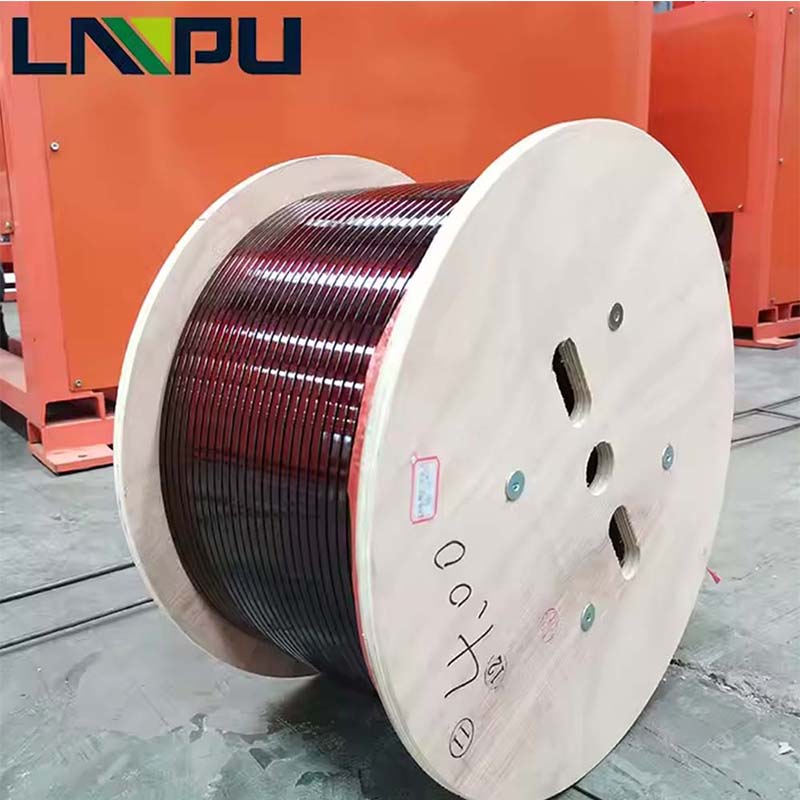
Photovoltaic aluminum winding wire is an electromagnetic wire product with aluminum conductor specifically used for magnetic components such as inductors and transformers in photovoltaic inverters, mainly including two types: enameled aluminum wire and insulated aluminum wire.
Special Requirements for Magnetic Components in Photovoltaic Inverters:
- Outdoor Environment: Inverters are typically installed outdoors and must withstand high temperatures, humidity, and ultraviolet radiation
- High-Frequency Operation: Modern inverters utilize high-frequency switching technology (tens of kHz to hundreds of kHz)
- Long Lifespan: Photovoltaic systems are designed for a lifespan of over 25 years
- High Efficiency: Inverter efficiency must be ≥98%
- Lightweight: Especially important for rooftop photovoltaic systems where weight is critical
II. Application Scenarios Analysis
2.1 Filter Inductor
Photovoltaic inverter output requires a filter inductor:
Technical Requirements:
- Insulation Class: Class F/H
- High Current: Capable of carrying the inverter’s output current
- Low Loss: Reduces copper/aluminum losses
- Good Heat Dissipation
2.2 Boost Inductor
Energy storage inductor in DC-DC boost circuits:
Technical Requirements:
- Insulation Class: Class F
- Good High-Frequency Characteristics
- Strong DC Bias Capability
2.3 Isolation Transformer
Some inverter topologies require transformer isolation:
Technical Requirements:
- Insulation Class: Class F/H
- High Frequency, Low Loss
- Safe Isolation
2.4 Energy Storage Inverter
Bidirectional inverters in energy storage systems:
Technical Requirements:
- Insulation Class: Class F/H
- High Efficiency
- Long Lifespan
III. Technical Feasibility Analysis
3.1 Conductivity
Aluminum has a conductivity of approximately 61% IACS, meaning that for the same cross-sectional area, aluminum’s resistance is about 60% higher than copper’s.
Solutions:
- Increase the conductor cross-sectional area by 1.6 times to achieve the same resistance value as copper wire
- Design the magnetic component window appropriately to accommodate aluminum wire with a larger cross-sectional area
3.2 Thermal Performance
Aluminum has a thermal conductivity of 237 W/(m·K), lower than copper’s 401 W/(m·K).
Heat Dissipation Measures:
- Optimize the heat dissipation design of magnetic components
- Increase the heat dissipation area
- Employ forced air cooling
3.3 Lightweight Advantage
Aluminum has a density of 2.70 g/cm³, approximately 30% of that of copper (8.96 g/cm³). Magnetic components using aluminum winding wire can reduce weight by 50-70%.
3.4 Cost Advantage
The raw material cost of aluminum wire is far lower than that of copper wire, offering a significant advantage for cost-sensitive photovoltaic projects.
3.5 Comparison of Copper and Aluminum Selection
| Considerations | Copper Wire | Aluminum Wire |
|---|---|---|
| Conductivity | 100% IACS | 61% IACS |
| Cost | High | Low (30-40%) |
| Weight | Heavy | Light (30%) |
| High Frequency Loss | Low | Slightly High (can be optimized through design) |
| Connection Method | Conventional Welding | Requires Special Treatment (Ultrasonic Welding/Copper-Aluminum Transition) |
IV. Insulation System
4.1 Insulation Classes
Commonly used insulation classes for photovoltaic aluminum winding wires:
| Insulation Class | Maximum Operating Temperature | Typical Applications |
|---|---|---|
| Class B (130°C) | 130°C | Micro-Inverters |
| Class F (155°C) | 155°C | String Inverters, Centralized Inverters |
| Class H (180°C) | 180°C | High-Temperature Conditions, Energy Storage Inverters |
4.2 Insulation Material Types
Polyester Imide (PEI) Enameled Wire:
- Thermal Class: Class F
- Suitable for string inverters and centralized inverters
- Good heat resistance and electrical properties
Polyamide-Imide (PAI) Enameled Wire:
- Thermal Class: Class H
- Suitable for high-temperature conditions and energy storage inverters
- Excellent mechanical strength and chemical resistance
4.3 Weather Resistance
Outdoor photovoltaic inverters have special requirements for the weather resistance of the winding wires:
Damp Heat Resistance:
- Stable operation in an environment with 95% relative humidity
- High insulation resistance retention rate
High Temperature Resistance:
- Ambient temperature can reach 50-60°C
- Winding temperature can reach 100-150°C
V. Key Manufacturing Processes
5.1 Conductor Preparation
Aluminum Conductor Requirements:
- Purity ≥99.5%
- Conductivity ≥61% IACS
- Smooth surface, free from oxidation and scratches
5.2 Coating Process
Thin Coating Multiple Times:
- Ensure uniform and dense enamel coating
- Avoid excessive enamel coating leading to cracking
Baking and Curing:
- Precise temperature profile control
- Ensure full curing of enamel coating
5.3 Connection Process
The connection between aluminum wire and terminals is a key process:
Ultrasonic Welding:
- Ultrasonic welding of aluminum wire and copper terminals
- Reliable connection, low resistance
Copper-Aluminum Transition Terminals:
- Use dedicated copper-aluminum transition terminals
- Avoid electrochemical corrosion
VI. Quality Control
6.1 Raw Material Inspection
Aluminum Conductor Inspection:
- Purity ≥99.5%
- Conductivity ≥61% IACS
- Wire Diameter Tolerance: ±0.002mm
Insulation Varnish Inspection:
- Breakdown Voltage
- Flexibility
- Enamel coating continuity (spark test)
- Heat Resistance
6.2 Production Process Inspection
| Process | Control Points | Inspection Items |
|---|---|---|
| Drawing | Compression Ratio, Die Condition | Wire Diameter Accuracy, Surface Quality |
| Annealing | Temperature Profile, Protective Atmosphere | Conductivity, Flexibility |
| Coating | Enamel Coating Thickness, Uniformity | Breakdown Voltage, Appearance |
| Baking | Temperature Profile, Time | Enamel Coating Curing Degree, Flexibility |
6.3 Factory Inspection
Photovoltaic aluminum winding wires must undergo strict inspection before leaving the factory:
| Inspection Items | Requirements |
|---|---|
| Conductor Dimensions | Meets tolerance requirements |
| Breakdown Voltage | ≥ Specified Value |
| Flexibility | Passes Bending Test |
| Enamel Coating Continuity | Spark Test No Breakdown |
| Heat Resistance | Passes Thermal Aging Test |
VII. Selection Guide
7.1 Application Scenarios Confirmation
Select according to inverter type and operating conditions:
- Micro-Inverters: Class B/F, low power
- String Inverters: Class F/H, medium power
- Centralized Inverters: Class F/H, high power
- Energy Storage Inverters: Class F/H, bidirectional operation
7.2 Conductor Specifications Selection
Determine wire diameter based on current density and space requirements:
- Current density: 2-4 A/mm²
- Consider skin effect (high-frequency applications)
- Ensure window size meets requirements
7.3 Insulation Class Selection
Select according to operating temperature:
- Class B (130°C): Micro-Inverters
- Class F (155°C): String/Centralized Inverters
- Class H (180°C): High-Temperature Operation, Energy Storage Inverters
7.4 Connection Method Confirmation
- Ultrasonic Welding: Aluminum wire to copper terminal connection
- Copper-Aluminum Transition Terminal: High-current applications
- Mechanical Crimping: Extra-large cross-section aluminum wire
7.5 Certification Requirements
Ensure products meet relevant certification requirements:
- UL: North American market
- TÜV: European market
- IEC: International standards
- RoHS: Environmental requirements
Conclusion
Aluminum winding wire has been successfully applied in photovoltaic inverters due to its lightweight, cost advantages, and good electrical performance. Through reasonable cross-sectional area compensation, insulation design, and heat dissipation optimization, aluminum winding wire magnetic components can achieve performance comparable to copper winding wire while significantly reducing weight and manufacturing costs.
For photovoltaic inverter projects pursuing lightweight and cost-effectiveness, aluminum winding wire is a technical solution worthy of key attention. Partnering with professional aluminum winding wire manufacturers to select appropriate insulation grades, conductor specifications, and connection methods based on specific application requirements is an effective way to ensure product quality and performance.