


Double-coated enameled copper wire is a high-performance category of enameled wire products.
By coating the conductor surface with two layers of insulation with different properties, it achieves an optimized combination of insulation performance.
Compared to single-layer insulation enameled wire, double-coated enameled wire offers significant improvements in voltage resistance, heat resistance, mechanical protection, and reliability.
The core design concept of the double-coating system is to utilize the advantages of both the bottom and top layers—the bottom layer provides good adhesion to the copper conductor and basic insulation, while the top layer provides additional protection such as heat resistance, abrasion resistance, and chemical corrosion resistance.
This composite insulation structure makes double-coated enameled copper wire an ideal choice for demanding applications such as high-voltage motors, frequency converters, and precision instruments.
With the continuous advancement of industrial technology, the performance requirements for winding materials in electrical equipment are increasing.
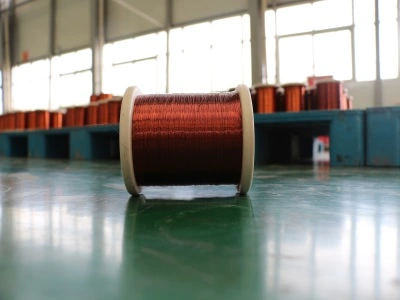
Double-coated enameled copper wire, with its comprehensive performance advantages, is being widely adopted in an increasing number of applications with high reliability requirements.
Chapter 1Technical Principles of Double-Coated Systems Structural Design of Double-Coated Insulation A double-coated enameled copper wire insulation system consists of two layers with different functions: The primer layer is the first insulating varnish directly coated onto the surface of the copper conductor.
The primer is typically made of an insulating material with excellent adhesion, forming a strong chemical bond with the copper conductor surface, ensuring a solid foundation for the entire insulation system.
The topcoat layer is the second insulating varnish coated on top of the primer.
The topcoat is typically made of a material with excellent heat resistance, abrasion resistance, and chemical corrosion resistance, providing additional protection and reinforcement for the insulation system.
The double-coating process requires precise control of the thickness and uniformity of each layer, as well as the bonding force between the two layers, to ensure the formation of a complete and continuous insulation structure.
Advantages of Double-Coated Structure Compared to single-layer insulation, the double-coated system has several advantages: Significantly improved voltage resistance.
The breakdown voltage of double-layer insulation is much higher than the simple sum of the thicknesses of the two insulation layers; the synergistic effect greatly enhances the overall insulation strength.
More flexible thermal class.
By combining primer and topcoat, thermal class can be achieved that is difficult to achieve with a single material.
Mechanical protection is more complete.
The topcoat layer provides additional abrasion and scratch resistance, adapting to harsher working environments.
Overall performance is optimal.
The dual-coat system combines the advantages of the primer and topcoat, achieving optimal performance balance.
Comparison with other insulation structures The comparison between dual-coat enameled wire and other insulation structures is as follows: Single-layer insulation enameled wire has a simple structure and low cost, but limited room for performance improvement.
Triple or quadruple insulation increases insulation strength by increasing insulation thickness, but may lead to decreased flexibility and a significant increase in cost.
The dual-coat system achieves a better balance between performance and cost, making it a high-performance insulation solution with high cost-effectiveness. —
Chapter 2Technical Characteristics of Dual-Coat Enameled Copper Wire Insulation Material Combination Dual-coat enameled copper wire can adopt a variety of material combination schemes: Polyester primer plus polyester imide topcoat.
This is the most common dual-coat combination, taking into account both good adhesion and higher heat resistance.
Polyester primer plus polyimide topcoat.
This combination achieves thermal class temperatures above 200°C, suitable for high-temperature applications.
Polyurethane primer plus polyester topcoat.
This combination improves mechanical strength and heat resistance while maintaining direct solderability.
Key Performance Parameters Key performance parameters for double-coated enameled copper wire include: Total insulation thickness.
The total insulation thickness of a double-coated system is typically comparable to that of a single-layer heavy insulation, with specific values varying depending on materials and processes.
Breakdown voltage.
The breakdown voltage of double-coated enameled wire can be more than 30% higher than that of single-layer insulation.
Thermal class.
Depending on the combination of insulation materials used, it can typically reach 180°C to 220°C.
Flexibility.
High-quality double-coated enameled wire maintains sufficient insulation thickness while still exhibiting good flexibility.
Manufacturing Process Requirements The manufacturing of double-coated enameled wire places higher demands on process control: Coating uniformity.
Both coating layers must be of uniform thickness to avoid localized defects.
Curing process: Each coating layer must undergo proper curing to ensure adhesion to the conductor and bonding between layers.
Online testing: During production, key parameters such as coating thickness and breakdown voltage must be tested online to ensure product quality. —
Chapter 3Typical Application Areas High-Voltage Motors High-voltage motors are one of the most important application areas for double-coated enameled copper wire.
In large-scale industrial facilities such as mine drainage, metallurgical steel rolling, petrochemicals, and water conservancy projects, high-power high-voltage motors are indispensable core power equipment.
The operating voltage of these motors is typically between 3300V and 10000V, placing extremely high demands on winding insulation.
The double-layer composite insulation structure of double-coated enameled copper wire provides ample breakdown voltage margin for high-voltage motors.
Compared to single-layer insulation products, the insulation strength of the double-coating system can be increased by more than 30%, which means that under the same voltage stress, double-coated wire has a higher ampere rating and service life.
Furthermore, the double-coated enameled wire provides additional wear and scratch resistance, protecting against damage during the winding process and ensuring the quality of the finished motor windings.
Variable Frequency Drive System With the deepening of energy conservation and emission reduction policies, variable frequency speed control technology is increasingly widely used in high-power motor systems.
However, the PWM voltage waveform output by the inverter contains a large number of high-frequency harmonic components.
These high-frequency components can cause partial discharge in the motor windings, accelerating insulation aging.
Double-coated enameled copper wire is an ideal solution to address the challenges of variable frequency drives.
Its double-layer composite insulation structure has a higher partial discharge initiation voltage, effectively suppressing the occurrence of discharge phenomena.
Simultaneously, the heat-resistant insulation material used in the topcoat layer can withstand the temperature rise impact from high-frequency switching, maintaining long-term stability of insulation performance.
In industrial equipment with frequent speed adjustments, such as hoisting machinery, conveying equipment, and compressors, double-coated enameled wire provides reliable and durable insulation protection for variable frequency motors.
Precision Measuring Instruments In fields such as metrology, scientific research, and medical diagnosis, the performance of precision measuring instruments directly depends on the stability of their core sensors and signal processing circuits.
As a key component of sensors and actuators, the parameter stability of precision coils determines the overall measurement accuracy.
The composite insulation structure of double-coated enameled copper wire provides excellent durability for precision coils.
Temperature cycling is a crucial factor affecting the long-term stability of precision instruments.
The bottom and top coats of the double-coating system have different coefficients of thermal expansion.
This structural design better adapts to the stress caused by temperature changes, maintaining the stability of coil parameters.
Furthermore, the low dielectric loss characteristics of double-coated wire also help reduce energy loss in high-frequency signal transmission and improve the signal-to-noise ratio.
Rail Transit Equipment Rail transit is a vital infrastructure of the national economy, and the reliability requirements for rail vehicle traction motors and auxiliary electrical equipment are extremely stringent.
Environmental factors such as vibration, shock, temperature fluctuations, and humidity changes during train operation pose severe challenges to the insulation system of electrical equipment.
Double-coated enameled copper wire, with its enhanced insulation structure and excellent comprehensive performance, has become an ideal choice for rail transit electrical equipment.
In high-speed trains, urban rail transit, and railway traction, double-coated wire is widely used in the winding manufacturing of key equipment such as traction motors, auxiliary power supplies, and transformers.
Its double-layer insulation structure not only provides higher electrical strength, but the presence of the composite topcoat layer also significantly improves the winding&39;s vibration resistance and fatigue resistance, ensuring the long-term reliable operation of rail transit equipment in harsh environments. —
Chapter 4Selection Technical Guide Selection Based on Voltage Level Voltage level is the primary consideration in selection: For applications with a rated voltage below 3300V, single-layer heavy-duty insulation wire is usually sufficient.
For applications with a rated voltage between 3300V and 6600V, double-coated wire is a better choice.
For applications above 6600V, triple or quadruple insulation products may be required.
Selection Based on Working Environment The working environment has different requirements for insulation materials: High-temperature environments require the use of double-coating combinations with a higher thermal class, such as polyimide topcoat products.
Chemically corrosive environments require topcoat materials with excellent chemical resistance.
High-vibration environments require dual-coat systems with better mechanical strength.
Selection Based on Reliability Requirements Reliability requirements influence the selection of insulation class: For general industrial applications, standard dual-coat products offer the best cost-performance ratio.
For applications with high reliability requirements, reinforced dual-coat systems are recommended.
For safety-critical applications, in-depth communication with suppliers to customize solutions may be necessary.
Chapter 5Development Trends of Dual-Coat Technology Material Innovation Innovation in dual-coat materials continues: Research and development of new high-performance insulating varnishes is constantly advancing, providing better overall performance.
The introduction of nanocomposite materials brings new performance improvement opportunities to dual-coat systems.
Process Advancements Advances in manufacturing processes improve the quality and stability of dual-coat products: The development of precision coating technology allows for more accurate control of coating thickness.
Advances in online detection technology improve product consistency and reliability.
Application Expansion The application areas of dual-coat technology are constantly expanding: The requirements for insulation performance in new energy vehicle motors are driving the application of dual-coat technology.
The high reliability requirements of smart grid equipment have also promoted the adoption of double-coated enameled wire.
Conclusion: Double-coated enameled copper wire achieves an optimized performance combination through its composite insulation structure, outperforming single-layer insulation products in terms of voltage resistance, heat resistance, mechanical protection, and reliability.
In demanding applications such as high-voltage motors, frequency converters, precision instruments, and rail transportation, double-coated enameled wire, with its enhanced insulation and excellent cost-effectiveness, has become the preferred choice for an increasing number of engineers and purchasing decision-makers.
When selecting a wire, factors such as voltage level, operating environment, and reliability requirements should be comprehensively considered to choose the most suitable combination of double-coating materials and product specifications.
With continuous advancements in material technology and manufacturing processes, double-coated enameled copper wire will play an important role in even more application areas.