

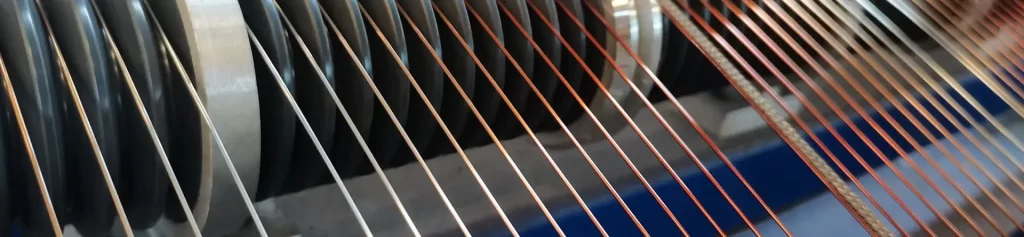
Fiberglass Wire in Electric Vehicle Motors
Introduction
Electric vehicles, as an important component of new energy vehicles, are developing rapidly worldwide. One of the core components of an electric vehicle is the drive motor, and the performance of the motor largely depends on the choice of winding materials.
Traditional enameled wire is widely used in ordinary industrial motors, but in applications like electric vehicle drive motors, which have higher requirements for high temperature resistance, high reliability, and resistance to coolant corrosion, traditional insulation materials often fail to meet the needs. Fiberglass wire, with its excellent high temperature resistance, good insulation properties, and reliable mechanical strength, is increasingly widely used in the field of electric vehicle drive motors.
I. Special Requirements of Electric Vehicle Drive Motors
1.1 Operating Characteristics
High Power Density: Electric vehicles require motors that are small in size, light in weight, and have high output power.
Wide Speed Range: From low-speed climbing to high-speed cruising, potentially covering speeds from zero to 10,000 RPM or higher.
Frequent Start-Stops: Subjecting the motor to more acceleration/deceleration cycles and load variations.
High Reliability: Extremely high requirements for safety and reliability.
1.2 Winding Requirements
High Temperature Resistance: Winding temperatures can exceed 200°C during continuous high-speed or heavy-load operation.
High Insulation Reliability: Insulation materials must withstand continuous vibration stress without fatigue failure.
Coolant Corrosion Resistance: Must be resistant to coolant corrosion in water-cooled or oil-cooled designs.
1.3 Applicability of Fiberglass Conductors
- Thermal class can reach 550°C, far exceeding actual operating temperature requirements
- Inorganic material, non-flammable
- Resistant to coolant corrosion
- Braided structure provides excellent mechanical strength and vibration resistance
II. Technical Characteristics of Fiberglass Conductors
2.1 Basic Properties of Fiberglass
Chemical Composition: Mainly silicon dioxide (SiO₂), content over 99.5%.
Physical Properties:
- Density: approximately 2.5-2.6 g/cm³ (only about 30% of copper)
- Tensile strength: up to 3400 MPa
- Elastic modulus: approximately 70-80 GPa
Thermal Properties: Temperature resistance range of -60°C to +550°C, low coefficient of thermal expansion.
2.2 Structural Forms
- Braided Type: Most common form, mature technology and reliable performance
- Wrapped Type: Insulating paper wrapped then coated with glass fiber yarn
- Silicone Rubber Type: Silicone rubber layer adds moisture-proof and sealing properties
- Stainless Steel Braided Type: Extra mechanical protection and abrasion resistance
2.3 Insulation Performance
- Dielectric Strength: Approximately 20-50kV/mm, stable at high temperatures
- Volume Resistivity: Approximately 10¹⁴Ω·cm
- Dielectric Loss: Low at high frequencies, suitable for variable frequency applications
III. Typical Applications in EV Motors
3.1 Permanent Magnet Synchronous Motors
Selection: Braided or silicone rubber type, thermal class 450°C or 550°C.
Advantages: High temperature resistance protects permanent magnets, excellent heat dissipation reduces temperature rise.
3.2 Induction Motors
Selection: Braided glass fiber conductors.
Advantages: Excellent heat dissipation improves efficiency, mechanical strength adapts to vibration environment.
3.3 Switched Reluctance Motors
Selection: Stainless steel braided type for enhanced impact and wear resistance.
Advantages: Excellent mechanical properties adapt to large torque ripple.
IV. Selection Guidelines
4.1 By Motor Type
| Motor Type | Recommended Wire | Thermal Class | Special Requirements |
|---|---|---|---|
| PMSM | Braided or Silicone Rubber | 450-550°C | High heat dissipation |
| Induction Motor | Braided | 450°C | Vibration resistance |
| SRM | Stainless Steel Braided | 450°C | Impact/wear resistance |
4.2 By Cooling Method
Water-Cooled: Silicone rubber type for moisture-proof sealing.
Oil-Cooled: Braided type for coolant corrosion resistance.
Air-Cooled: Standard braided type.
V. Manufacturing and Quality Control
5.1 Winding Process
- Uniform tension control
- Minimum bending radius: 6× outer diameter
- End reinforcement treatment
5.2 Impregnation and Potting
Insulating varnish impregnation or epoxy resin potting for moisture protection and mechanical strength.
5.3 Quality Inspection
Insulation resistance, withstand voltage, partial discharge, and thermal aging tests.
VI. Application Cases
Case 1: Passenger Vehicle Drive Motor
Silicone rubber glass fiber conductors, thermal class 450°C. Motor efficiency over 96%.
Case 2: Commercial Vehicle Drive Motor
Braided glass fiber conductors, thermal class 450°C. Stable operation under complex conditions.
Case 3: Electric Bus Switched Reluctance Motor
Stainless steel braided conductors. Insulation system remained intact under large torque ripple.
VII. Common Technical Questions
Q1: Difference from ordinary enameled wire?
Enameled wire thermal class is below 200°C; fiberglass wire can reach 550°C, providing significant advantages in high-temperature, high-reliability applications.
Q2: Heat dissipation performance?
Superior to ordinary enameled wire. Braided structure increases contact area with cooling medium.
Q3: Wear in vibration environments?
Proper installation and tension control prevents wear. Stainless steel braided structure further improves wear resistance.
Q4: Required for all EV motors?
Depends on design requirements. High-performance, high-temperature, or high-reliability motors benefit from fiberglass wire.
VIII. Technical Specifications
| Parameter | Specification |
|---|---|
| Conductor Material | Copper, Aluminum |
| Insulation Material | Glass fiber braided, Silicone rubber, Stainless steel braided |
| Thermal Class | 300°C, 450°C, 550°C |
| Rated Voltage | 450/750V |
| Protection Class | IP67 (optional potting) |
| Standards | IEC 60317, UL 1441 |
Conclusion
Fiberglass wire, with its excellent high temperature resistance, good insulation properties, and reliable mechanical strength, shows broad application prospects in electric vehicle drive motors. Select appropriate types and specifications based on motor type, cooling method, and power density requirements.
Our company has 30 years of experience in special conductor manufacturing, providing high-quality fiberglass wire and technical support for EV motor manufacturers.
Contact Information
Email: office@cnlpzz.com
WhatsApp: 0086-19337889070
This article was prepared by Zhengzhou LP Industry Co., Ltd., specializing in the R&D and manufacturing of electrical wires and special conductors for thirty years.