

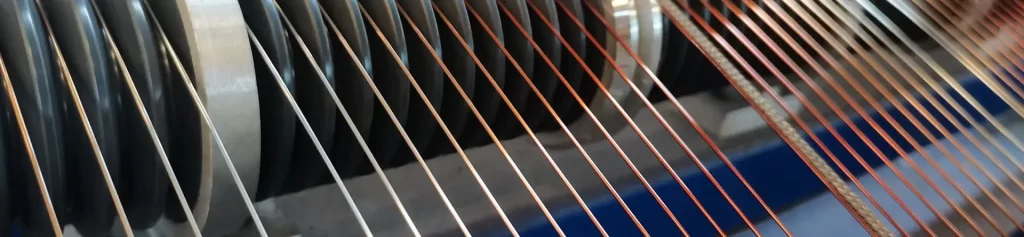
Among the many types of enameled copper wire, UEW and PEW are the two most widely used types, representing the two mainstream insulation systems of polyurethane and polyester, respectively.
UEW and PEW each have their unique technical characteristics and applicable scenarios.
UEW is known for its excellent direct soldering performance and low dielectric loss characteristics, dominating the high-frequency electronics field; PEW, on the other hand, is the preferred choice in the general electrical equipment field due to its good mechanical strength, balanced electrical performance, and lower cost.
Knowing how to correctly choose UEW and PEW to meet different application needs is a core skill that electrical equipment design engineers and procurement decision-makers must master.
This article will systematically compare the differences in technical characteristics between UEW and PEW, deeply analyze their respective application advantages, and provide scientific selection suggestions for different application scenarios. —
Chapter 1Basic Characteristics of UEW and PEW Technical Characteristics of UEW (Polyurethane Enameled Copper Wire) UEW stands for Polyurethane Enameled Wire.
Polyurethane insulation is one of the most important insulation types in the enameled wire industry.
Its core technical characteristics include: Excellent direct soldering performance is the most prominent advantage of UEW.
The polyurethane insulation layer can decompose and fall off on its own at the soldering temperature, eliminating the need for pre-scraping of the enamel coating, allowing for direct soldering.
This characteristic greatly simplifies the coil manufacturing process, reduces production costs, and is particularly suitable for the electronics manufacturing industry that requires automated soldering.
Low dielectric loss is another core advantage of UEW.
The dielectric loss tangent (tanδ) of polyurethane insulation under high-frequency conditions is significantly lower than that of polyester insulation, making it the preferred choice in high-frequency electronics.

At a frequency of 1MHz, the tanδ of high-quality UEW can be as low as below 0.01.
Regarding thermal class, UEW is typically Class B (130°C) or Class F (155°C), with some modified products reaching 180°C.
For applications requiring high heat resistance, UEW products with the appropriate thermal class should be selected.
Technical Characteristics of PEW (Polyester Enameled Copper Wire) PEW stands for Polyester Enameled Wire.
Polyester insulation is the oldest and most widely used type of enameled wire insulation.
Its main technical characteristics include: Excellent mechanical properties are the core advantage of PEW.
Polyester insulation has excellent hardness and adhesion, good wear resistance, and is suitable for high-speed winding processes.
On automated winding machines, PEW exhibits excellent operational stability and product consistency.
Wide thermal class coverage.
Ordinary PEW is Class B (130°C), and through modification, it can reach Class F (155°C) and Class H (180°C), meeting the application requirements of different temperature conditions.
Balanced Electrical Performance.
PEW exhibits a balanced insulation strength and electrical performance with no significant weaknesses, making it the best-performing general-purpose wire.
Significant Cost Advantage.
Compared to UEW and modified heat-resistant wire, ordinary PEW is more cost-effective and economically superior. —
Chapter 2Key Performance Parameter Comparison Insulation Performance Comparison Insulation performance is the core indicator for measuring the electrical reliability of wire: In terms of breakdown voltage, PEW and UEW have essentially the same breakdown voltage level under the same insulation thickness conditions, both meeting the insulation requirements of most low-voltage electrical equipment.
In terms of insulation resistance, both materials have excellent insulation resistance characteristics and are stable under normal storage and use conditions.
In terms of voltage resistance performance, both PEW and UEW can withstand conventional voltage resistance tests, including standard test items such as inter-turn voltage resistance and voltage resistance to ground.
Direct Soldering Performance Comparison Direct soldering performance is the most significant advantage of UEW over PEW: UEW has excellent direct soldering performance.
At soldering temperatures of 260-300°C, the insulation layer of UEW can self-decompose and detach within seconds, forming a bright solder joint.
This is the core reason for the widespread use of UEW in the electronics manufacturing industry.
PEW lacks direct soldering performance.
The polyester insulation cannot detach on its own at normal soldering temperatures and must be removed by scraping or chemical stripping before soldering.
This process increases production costs and time.
For applications requiring simplified soldering processes or automated soldering, UEW is the inevitable choice.
High-Frequency Performance Comparison High-frequency electrical performance is another significant advantage of UEW over PEW: In terms of dielectric loss, UEW has significantly lower dielectric loss than PEW under high-frequency conditions.
Taking a frequency of 1MHz as an example, the tanδ of UEW is approximately 0.008-0.012, while that of PEW is approximately 0.02-0.04.
This means that in high-frequency applications, the power loss of UEW is only one-quarter to one-fifth of that of PEW.
In terms of frequency applicability, UEW is suitable for high-frequency applications of several MHz or even tens of MHz, while PEW is typically only suitable for low-frequency applications at the kHz level.
In high-frequency electronics fields such as switching power supplies, communication equipment, and RF circuits, UEW is the ideal choice.
Mechanical Performance Comparison Mechanical performance is an area where PEW has an advantage over UEW: In terms of abrasion resistance, PEW&39;s polyester insulation has higher hardness and excellent abrasion resistance, performing stably in high-speed winding and automated equipment.
UEW&39;s polyurethane insulation is relatively soft, and may suffer enamel coating damage during high-speed winding.
In terms of winding process adaptability, PEW&39;s pay-off performance and tension characteristics are more stable, suitable for long-term continuous automated production.
UEW requires more precise tension control during high-speed winding.
Thermal Resistance Comparison In terms of thermal class, the two materials have different application ranges: PEW&39;s thermal class covers B (130°C) to H (180°C), and higher grades can be achieved through modification.
UEW&39;s thermal class is usually B (130°C) or F (155°C), with relatively few products reaching 180°C, and the cost is higher.
In high-temperature applications, PEW offers a wider range of product choices and better cost advantages. —
Chapter 3Application Area Analysis Typical Application Areas of UEW UEW, with its unique direct-soldering performance and low dielectric loss characteristics, has irreplaceable advantages in the following areas: Consumer electronics manufacturing is UEW&39;s largest application market.
In power modules of consumer electronics products such as smartphone chargers, laptop adapters, and small switching power supplies, high-frequency transformers and inductors are almost entirely wound with UEW.
Direct-soldering performance makes automated integrated winding and soldering production possible, significantly improving production efficiency.
The communication equipment field has stringent requirements for high-frequency performance, making UEW an inevitable choice.
High-frequency magnetic components in communication infrastructure such as 5G base stations, fiber optic communication equipment, and network switches all rely on the low-loss characteristics of UEW to achieve efficient power conversion.
The automotive electronics field&39;s dual requirements for reliability and process efficiency make UEW the preferred choice.
Automotive electronic products such as on-board chargers and motor drives need to operate stably in harsh temperature and vibration environments while pursuing cost-effectiveness.
Typical Application Areas of PEW Due to its excellent mechanical properties, balanced electrical performance, and cost advantages, PEW dominates the following areas: Industrial motors are the largest application market for PEW.
From small fan motors to large industrial drive motors, the vast majority of industrial motors are wound with PEW.
PEW&39;s excellent mechanical properties and process adaptability make it an ideal choice for automated motor production.
Power Transformers Although high-voltage large transformers use higher-grade insulation materials, PEW is still widely used in medium and low-voltage power distribution transformers and special transformers.
Household appliance motors, such as air conditioner compressors, washing machine motors, refrigerator motors, and other appliance motors, also extensively use PEW winding. —
Chapter 4Selection Technical Guide Selection Based on Welding Process The requirements of the welding process are the primary consideration in selection: For applications requiring direct welding or automated winding welding, UEW must be selected.
PEW cannot be directly welded and must be pre-treated with an enamel coating before welding.
For applications with no special requirements for welding processes but prioritizing cost-effectiveness, PEW is a suitable choice.
Without considering the advantages of direct welding, PEW offers a better overall cost-performance ratio.
Selection Based on Operating Frequency The operating frequency is a key factor in selecting the appropriate model for high-frequency applications: For applications with operating frequencies above 1MHz, UEW must be selected.
PEW&39;s dielectric loss is too high at high frequencies, leading to severe power loss and temperature rise issues.
For applications with operating frequencies in the kHz range, other factors can be considered.
If direct welding performance is also required, choose UEW; if cost is a concern and direct welding is not necessary, PEW can be chosen.
For power frequency (50Hz/60Hz) applications, such as power frequency transformers and large motors, PEW can be selected directly, without the need for the more expensive UEW.
Selection Based on Heat Resistance Requirements The thermal class is an important reference factor in selection: For applications with operating temperatures below 130°C, both UEW and PEW can be selected.
For operating temperatures between 130-155°C, F-grade PEW or F-grade UEW can be selected, but it is necessary to confirm whether the supplier has the corresponding thermal class product.
For operating temperatures exceeding 155°C, especially applications reaching 180°C and above, it is recommended to choose H-grade PEW or other modified heat-resistant enameled wires, as the selection range for UEW is narrower.
Selection Based on Cost Budget Cost is a crucial factor influencing selection decisions: In general applications without special performance requirements, PEW is the most cost-effective choice, typically 15-25% cheaper than UEW of the same specifications.
For applications requiring special performance characteristics of UEW (direct soldering or high frequency), PEW should not be chosen solely for cost reasons, as this may lead to process problems or substandard performance.
For high-volume standard products, negotiate a more competitive price with the supplier. —
Chapter 5Comprehensive Comparison and Selection Recommendations Performance Comparison Overview | Performance Indicators | UEW | PEW | Advantages | |———|—–|—–|——–| | Direct Soldering Performance | Excellent | None | UEW | | High Frequency Performance | Excellent | Average | UEW | | Mechanical Performance | Average | Excellent | PEW | | thermal class | 130-155°C | 130-180°C | PEW | | Cost | Higher | Lower | PEW | | Applicable Scope | High Frequency/Direct Soldering | General | – | Selection Decision Tree When facing specific application needs, the following decision logic can be used for selection: First step, is direct soldering or automated soldering required?
If yes, choose UEW.
Second step, is the operating frequency above 1MHz?
If yes, choose UEW.
Third step, does the operating temperature exceed 155°C?
If so, choose H-grade PEW or EIW, or other heat-resistant enameled wires.
Fourth step: Is cost-effectiveness a priority and are there no special performance requirements?
If so, choose PEW.
Selection Recommendations for Special Application Scenarios There are some special application scenarios that require attention: High-frequency heating equipment.
Induction heating equipment operating at frequencies of several hundred kHz should choose UEW to obtain low dielectric loss.
Precision measuring instruments.
Precision electronic instruments with strict requirements for dielectric loss should prioritize UEW.
Power tool motors.
High-speed power tool motors have high mechanical strength requirements, so PEW is recommended.
High-power industrial motors.
High requirements for reliability and durability make PEW a safer choice. —
ConclusionUEW and PEW, as two mainstream types of enameled copper wire, each have their unique performance advantages and application positioning.
UEW excels in direct soldering performance and low dielectric loss, making it the first choice for high-frequency electronics manufacturing and automated welding processes; PEW, with its excellent mechanical properties and balanced electrical characteristics, has become a mainstay in the field of general electrical equipment.
When making product selection decisions, factors such as welding process, operating frequency, heat resistance requirements, and cost budget should be comprehensively considered to choose the product most suitable for the specific application.
For complex applications that face multiple performance requirements simultaneously, it may be necessary to communicate in depth with suppliers to seek customized solutions.