


Foil coil winding is an important process in transformer manufacturing, using copper or aluminum foil as conductor material wound to form transformer windings. Compared with traditional round wire windings, foil coil windings have significant advantages including high current carrying capacity, high mechanical strength, excellent heat dissipation, and compact space usage. They are widely used in power transformers, special transformers, and large power reactors.
As the core material for foil coil windings, copper foil selection directly affects the transformer’s electrical performance, mechanical strength, and operational reliability. This article systematically analyzes the technical specifications, selection parameters, and quality control points of copper foil materials.
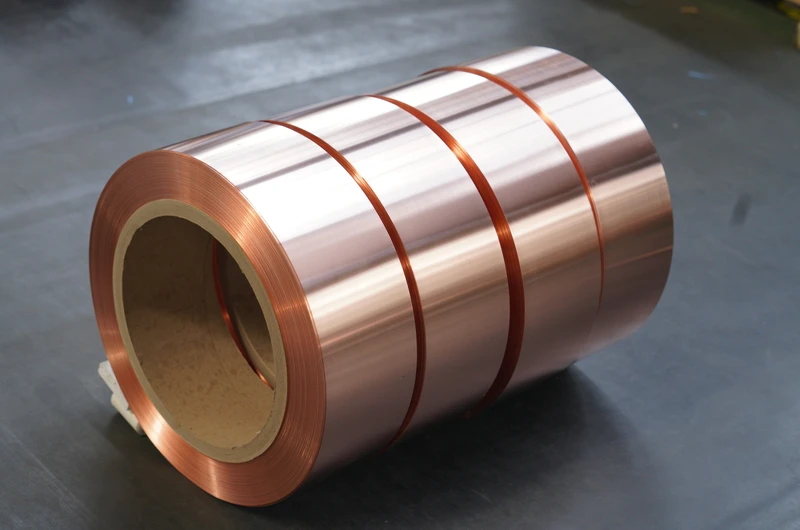
I. Technical Characteristics of Foil Coil Windings and Copper Foil Requirements
1.1 Working Principle
Foil coil windings are formed by alternately winding copper foil (or aluminum foil) with insulating materials. Features include:
- High current capacity: Wide copper foil can carry large currents
- High mechanical strength: Integral winding structure, good axial mechanical strength
- Excellent heat dissipation: Oil channels can be designed for superior cooling
- Compact size: Space-saving design saves core window space
1.2 Types of Foil Coil Windings
| Type | Foil Thickness | Typical Application | Insulation |
|---|---|---|---|
| Standard Foil | 0.5-2.0mm | Power Transformers | Paper/Resin |
| High Voltage Foil | 0.3-1.5mm | Voltage Transformers | Multi-layer |
| High Current Foil | 1.0-3.0mm | Reactors/Large Transformers | Oil Immersed |
1.3 Core Selection Considerations
| Technical Points | Requirements |
|---|---|
| Thickness Accuracy | Tolerance within ±3% |
| Surface Quality | Smooth, defect-free |
| Conductivity | IACS≥101% |
| Tensile Strength | 200-280 MPa |
| Elongation | ≥15% |
II. Technical Specifications of Copper Foil Materials
2.1 Recommended Grades
| Grade | Purity | Conductivity | Tensile Strength | Elongation | Application |
|---|---|---|---|---|---|
| C11000 (ETP) | ≥99.90% | ≥101% IACS | 200-280 MPa | ≥15% | Standard Foil Coil |
| C10100 (OFC) | ≥99.99% | ≥101.5% IACS | 190-260 MPa | ≥20% | High-Performance |
| C10200 (TPA) | ≥99.95% | ≥101% IACS | 195-265 MPa | ≥18% | Precision Applications |
2.2 Key Performance Parameters
Electrical: Conductivity IACS≥101% (annealed), Resistivity 0.01724 Ω·mm²/m (20°C)
Dimensions: Thickness 0.3-3.0mm, Tolerance ±0.02mm (high precision), Width 20-600mm
Mechanical: Tensile strength 200-280 MPa, Elongation ≥15-25%, Hardness 35-65 HV, Surface roughness Ra≤0.8μm
III. Foil Winding Process and Copper Foil Matching
3.1 Winding Process Requirements
- Tension control: Uniform winding tension, typically 10-20 N/mm²
- Speed control: Winding speed affects density, typically 20-50 m/min
- Alignment accuracy: Foil edges must be aligned precisely, deviation ≤0.5mm
3.2 Insulation System Design
- Interlayer insulation: Insulating paper (Nomex, cable paper) or resin film
- Oil channel design: Axial or radial oil channels for high current windings
- End insulation: Enhanced insulation at winding ends
3.3 Annealing Process
| Temper | Temperature Range | Application |
|---|---|---|
| O (Soft) | 400-650°C | Complex shapes, high elongation needs |
| H22 | 300-400°C | Standard foil coil |
| H24 | 250-350°C | High tension winding |
IV. Industry Standards and Certifications
Standards: IEC 60325, IEC 60076, GB/T 5231, ASTM B152, JIS H3100
Certifications: ISO 9001, UL, RoHS/REACH, SGS
V. Quality Inspection and Control
5.1 Inspection Items
| Inspection | Method | Standard |
|---|---|---|
| Chemical Composition | Spectroscopy | Cu≥99.90% |
| Mechanical Properties | Tensile Test | Strength and elongation meet standards |
| Thickness Tolerance | Precision Gauge | ±0.02mm |
| Surface Quality | Visual | No scratches, inclusions, oxidation |
| Conductivity | Eddy Current | IACS≥101% |
| Width Tolerance | Caliper | ±0.3mm |
5.2 Common Defects and Prevention
| Defect | Expression | Prevention |
|---|---|---|
| Thickness variation | Variation along coil | Optimize rolling process |
| Surface scratches | Mechanical damage | Careful handling |
| Oxidation | Discoloration | Sealed storage |
| Edge cracks | Edge cracks | Control slitting process |
VI. Supplier Selection Recommendations
- Full-process production line (melting → hot rolling → cold rolling → annealing → slitting)
- Thickness control accuracy: ±0.02mm
- Width range: 20-600mm in stock
- Complete testing capabilities
- ISO 9001/14001/45001 certified
- Monthly capacity: ≥200 tons
- Standard delivery: 7-10 days
- Custom delivery: 15-20 days
VII. Product Specifications
| Grade | Thickness | Width | Temper | Conductivity |
|---|---|---|---|---|
| C11000 | 0.3-3.0mm | 20-600mm | O/H22/H24 | ≥101% IACS |
| C10100 | 0.3-2.5mm | 20-500mm | O/H22 | ≥101.5% IACS |
| C10200 | 0.3-3.0mm | 20-600mm | O/H24 | ≥101% IACS |
Conclusion
The selection of copper foil for transformer foil coil windings requires comprehensive consideration of winding type, winding process, insulation matching, and cost-effectiveness.
Our company has 30 years of experience exporting electrical wire and metal foil. We provide C11000/C10100/C10200 series copper foil for transformer foil coil windings with customized sizes and global sample shipping.
Contact:
Email: office@cnlpzz.com
WhatsApp: 0086-19337889070
The technical parameters described are general reference values. Please consult our technical team for specific selections based on your transformer design requirements.