

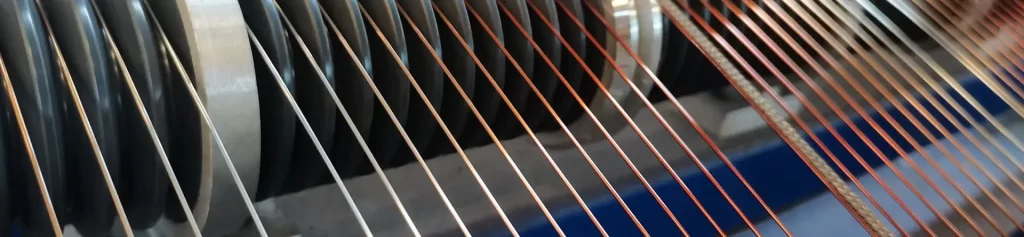
IntroductionHeat-resistant enameled copper wire is a key basic material in modern electrical equipment manufacturing.
The “200-grade” in 200-grade heat-resistant enameled copper wire refers to its thermal class reaching 200°C, allowing for long-term stable operation at 200°C without significant deterioration in insulation performance and mechanical properties.
The thermal class of 200-grade heat-resistant enameled copper wire falls between H-grade (180°C) and C-grade (220°C), offering a 20°C higher temperature safety margin compared to H-grade and superior cost-effectiveness compared to C-grade.
This technical positioning makes it an ideal choice for many high-temperature applications. —
Chapter 1Thermal Class System and Technical Positioning Definition of Thermal Class The thermal class is represented by the temperature index, measured in °C.
According to IEC and NEMA standards, the thermal class of enameled wire is classified sequentially from 130°C (Class B) to 155°C (Class F), 180°C (Class H), 200°C, and 220°C (Class C).
Class 200 thermal class wire requires testing and certification by an authoritative organization, undergoing thousands of hours of continuous thermal aging testing at 200°C to verify that the insulation life is not significantly shortened.
Technical Positioning of Class 200 Compared to 180°C (Class H) products, Class 200 products have a 20°C higher maximum allowable operating temperature.
This means the insulation system has a greater temperature safety margin in high-temperature environments, ages more slowly, and has a longer service life.
Compared to 220°C (Class C) products, Class 200 products generally offer better cost-effectiveness.
Class C insulation materials such as polyimide are more expensive, while Class 200 achieves a better balance between performance and cost through optimized formulation. —
Chapter 2Technical Characteristics and Insulation System Insulation System Types The insulation system of Grade 200 heat-resistant enameled copper wire mainly includes: Polyimide insulation is currently the most common insulation type for Grade 200 enameled copper wire.
Polyimide is a high-performance organic polymer material with a heat resistance range from -200°C to +400°C, making it one of the best heat-resistant insulation materials in commercial applications.
Polyamide-imide insulation combines the advantages of polyamide and polyimide, exhibiting excellent heat resistance, abrasion resistance, and chemical corrosion resistance.
Composite insulation systems combine multiple insulation materials, such as a bottom layer of polyester imide plus an outer layer of polyimide, which can combine good mechanical properties with excellent heat resistance.
Key Performance Parameters Grade 200 heat-resistant enameled copper wire must meet the following requirements: In terms of heat resistance temperature, it must pass a 200°C heat aging test to verify its reliability under long-term operation at 200°C.

Regarding breakdown voltage, the insulation layer must possess sufficient electrical strength, typically requiring a breakdown voltage not lower than a specific threshold.
Flexibility and adhesion must be balanced under high-temperature conditions; the insulation layer must prevent cracking or peeling while maintaining good adhesion to the copper conductor. —
Chapter 3Standards and Specifications Classification International Standards System 200-class heat-resistant enameled copper wire must comply with the following international standards: IEC 60317 is a winding wire standard developed by the International Electrotechnical Commission, specifying the technical requirements and test methods for different thermal classes.
NEMA MW 1000 is a magnet wire standard developed by the American Electrical Manufacturers Association, which has a wide influence in the North American market.
GB/T 7673 is a Chinese national standard specification for winding wires, corresponding to the IEC standard.
Scope of 200-grade heat-resistant enameled copper wire covers a range from fine to thick conductors: Wire diameters extend from approximately 0.02mm ultra-fine wires to several mm thick conductors, with common specifications including 0.1mm, 0.2mm, 0.5mm, and 1.0mm.
Insulation thickness is classified according to NEMA standards as single-layer insulation, heavy-duty insulation, triple-layer insulation, and quadruple-layer insulation. 200-grade products typically offer heavy-duty insulation or higher. —
Chapter 4Typical Application Areas High-Temperature Industrial Electrical Equipment Motors for high-temperature pumps, compressors, fans, and other equipment in the petrochemical industry often operate at temperatures exceeding 180°C, making 200-grade motors ideal for these high-temperature conditions.
Motors for high-temperature electric furnaces and smelting equipment in the metallurgical industry also require 200-grade products to cope with extreme operating temperatures.
High-temperature transmission equipment in the glass kiln, cement kiln, and other building materials industries is also an important application area for 200-grade products.
Aerospace and Military Equipment: Electrical equipment surrounding aero-engines needs to operate in harsh environments with high temperatures, high vibrations, and high altitudes.
Electronic equipment for satellites and spacecraft must withstand severe vibrations during launch and extreme temperature changes during orbital operation.
Electrical systems in military equipment typically require stable operation over a wide temperature range of -55°C to +200°C.
Rail Transit and New Energy Vehicles: The traction motors and auxiliary motors in rail transit operate in complex environments, with some conditions involving high temperatures.
The thermal management systems and battery charging/discharging protection systems of new energy vehicles involve high-temperature environments, making Class 200 products uniquely valuable. —
Chapter 5Selection Technical Guide Selection Based on Operating Temperature: If the equipment&39;s operating temperature is between 180°C and 200°C, Class 200 products are the best choice, providing sufficient safety margin.
If the operating temperature is close to or reaches 200°C, it is recommended to prioritize Class C (220°C) products.
For applications operating at temperatures between 150°C and 180°C, Class 200 products can be selected if high reliability and service life are required.
Selection based on standards and specifications: Export products must meet the standards of the destination market.
For the North American market, NEMA MW 1000 is required; for the European market, IEC 60317 is required.
Industrial supporting products typically only need to meet general IEC or GB standards.
Aerospace and military equipment require more stringent special standards.
When selecting suppliers for Class 200 heat-resistant enameled copper wire, suppliers must possess a complete quality management system certification, such as ISO 9001, and have a thermal class test report issued by an authoritative institution. —
Conclusion: Class 200 heat-resistant enameled copper wire, with its excellent heat resistance, reliable insulation properties, and reasonable cost advantages, has become a key material for manufacturing electrical equipment under high-temperature conditions.
In many fields such as petrochemicals, aerospace, rail transportation, and medical equipment, Class 200 products play an irreplaceable role.
When selecting a product, factors such as operating temperature, standards and specifications, and supplier qualifications should be considered to choose the most suitable 200-grade heat-resistant enameled copper wire product.