

Paper Covered Wire Thickness and Its Impact on Performance
Introduction
As the core winding material for oil-immersed transformers and power equipment, the thickness of paper-covered wire directly determines the electrical, mechanical, and thermal performance of the insulation system. Scientifically and rationally selecting the paper-covered wire thickness is a key design aspect to ensure the long-term safe operation of the transformer.
This paper systematically analyzes the relationship between paper-covered wire thickness and various performance indicators, exploring it in depth from three dimensions: electrical, thermal, and mechanical performance. It also combines the selection requirements for different voltage levels to provide theoretical basis and practical guidance for engineering selection.
I. Composition of Paper Covered Wire Thickness
1.1 Basic Concepts of Thickness
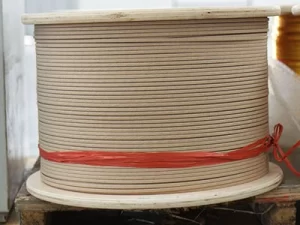
The total thickness of paper-covered wire consists of two parts: the conductor diameter and the thickness of the insulating paper layer. The thickness of the insulating paper layer is usually measured by the number of paper layers, with the standard thickness of each layer of cable paper being approximately 0.05-0.12mm.
The selection of paper-covered wire thickness needs to comprehensively consider factors such as voltage level, insulation requirements, heat dissipation conditions, and economic efficiency. In practical engineering, designers need to find the optimal balance between electrical performance, thermal performance, and economy while ensuring insulation reliability.
1.2 Insulation Paper Thickness Specifications
| Paper Thickness | Application Scope |
|---|---|
| 0.05mm | Precision Instrument Winding |
| 0.08mm | Distribution Transformer Winding |
| 0.12mm | Power Transformer Winding |
| 0.15mm | High Voltage Transformer Winding |
| 0.20mm and Above | Special High Voltage Applications |
Thinner insulation paper has better flexibility and is suitable for high-speed winding machine processing; thicker insulation paper has higher mechanical strength, but the winding difficulty increases accordingly.
1.3 Influence of Paper Tape Width
The paper tape width is usually 10-35mm. Narrower paper tapes (such as 10-15mm) have high overlap coverage and good insulation uniformity, suitable for round wire wrapping. Wider paper tapes (such as 25-35mm) have high wrapping efficiency, but overlap control is more difficult.
The overlap rate is usually required to be not less than 30% of the paper tape width.
II. Influence of Thickness on Electrical Performance
2.1 Relationship between Dielectric Strength and Thickness
The dielectric strength of insulating paper is about 40-80kV/mm, but actual performance is affected by factors including paper density, moisture content, and operating temperature.
Empirical Formula: In a uniform electric field, the breakdown voltage is approximately proportional to the thickness. However, as thickness increases to a certain extent, dielectric strength will saturate due to increased internal defects.
| Insulation Thickness | Reference Breakdown Voltage |
|---|---|
| 0.5mm | 20-30kV |
| 1.0mm | 40-55kV |
| 2.0mm | 70-100kV |
| 3.0mm | 100-140kV |
2.2 Partial Discharge Characteristics
Increasing insulation thickness increases the partial discharge initiation voltage. However, excessively thick insulation will increase internal temperature, which may lead to decreased insulation performance.
Design Principle: Minimize insulation thickness to improve heat dissipation while meeting breakdown voltage requirements.
2.3 Electric Field Distribution Optimization
The maximum electric field strength usually occurs on the conductor surface. High-voltage windings often use capacitive shielding structures to uniformly distribute the electric field.
III. Influence of Thickness on Thermal Performance
3.1 Relationship between Thermal Conductivity and Thickness
The thermal conductivity of insulating paper is approximately 0.2-0.25 W/(m·K), much lower than metallic conductors. For every 0.5mm increase in insulation thickness, winding temperature rise may increase by 3-5°C.
3.2 Influence of Temperature Distribution
For every 10°C increase in winding temperature, the insulation aging rate approximately doubles. This is the “10°C rule” for transformer insulation aging.
Factors to consider: load current, cooling method, ambient temperature, and allowable temperature rise limit.
3.3 Design of Heat Dissipation Oil Channels
High-voltage windings usually require longitudinal and transverse oil channels. Oil channel width should generally be not less than 4-6mm.
IV. Influence of Thickness on Mechanical Properties
4.1 Tensile Strength and Flexibility
As paper layer thickness increases, conductor flexibility decreases accordingly. Excessive thickness can make winding complex structures (such as tangled windings) difficult.
4.2 Short-Circuit Electrodynamic Capability
Appropriate insulation thickness enhances short-circuit resistance. However, excessively thick insulation increases winding weight, which also increases electrodynamic forces during short circuits.
4.3 Vibration and Shock Resistance
Multi-layer thin paper wrapping provides better density and vibration resistance than single-layer thick paper wrapping. Each layer acts as a barrier to prevent defect propagation.
V. Thickness Selection for Different Voltage Levels
| Voltage Level | Recommended Thickness | Paper Layers |
|---|---|---|
| 6-10kV | 0.45-0.75mm | 2-3 layers |
| 35kV | 1.0-1.5mm | 4-5 layers |
| 66-110kV | 2.0-3.0mm | 6-8 layers |
| 220kV and above | 3.0mm or more | 10+ layers |
VI. Technical Points for Thickness Selection
6.1 Design Principles
- Meet electrical strength requirements: Breakdown voltage not less than 3-5 times rated voltage
- Meet heat dissipation requirements
- Meet mechanical strength requirements
- Economic considerations
6.2 Selection Process
Determine voltage level → Calculate electric field distribution → Initially select thickness → Verify thermal performance → Verify mechanical performance → Optimize and adjust
6.3 Common Misconceptions
- Thicker insulation is not always better
- Oil channel design cannot be ignored
- Electric field distribution uniformity is more important than thickness alone
VII. Quality Inspection and Control
7.1 Thickness Inspection Methods
- Vernier caliper method: For routine inspections
- Micrometer method: For precision measurements (accuracy to 0.01mm)
- Microscope method: For observing paper layer structure
7.2 Thickness Uniformity Control
- Overlap rate: Not less than 30%
- Thinnest point: Not less than 90% of design value
7.3 Storage and Transportation
- Moisture prevention: Relative humidity not exceeding 70%
- Temperature: -10°C to +40°C
- Pressure and dust prevention
Conclusion
The thickness of paper-insulated conductor is a key parameter affecting transformer insulation system performance. Reasonable selection requires comprehensive consideration of electrical, thermal, mechanical performance, and economic factors.
Our company has extensive experience in paper-insulated conductor production and can provide customers with selection consultation and technical support services.
Contact Information
Email: office@cnlpzz.com
WhatsApp: 0086-19337889070
This article was compiled by Zhengzhou LP Industry Co., Ltd., specializing in the research and manufacturing of magnetic wires and special conductors for thirty years.