

Fiberglass Covered Wire in Industrial Furnaces: Technical Characteristics and Application Analysis
Introduction
Industrial furnaces, as core equipment in the heat treatment industry, are widely used in processes such as metal heat treatment, glass melting, and ceramic sintering. In these high-temperature operating environments, electrically insulated wires face harsh working conditions. Fiberglass covered wires, with their excellent high temperature resistance, good chemical stability, and reliable mechanical strength, have become an ideal electrical insulation solution for industrial furnace heating systems.
I. Characteristics of the Working Environment of Industrial Furnaces
Industrial furnaces can be classified according to their uses into heat treatment furnaces (600-1300°C), melting furnaces (1400-1800°C), sintering furnaces (1200-1600°C), and chemical reaction furnaces.
The working environment of industrial furnaces has the following characteristics:
Large Temperature Gradient: The wires may withstand temperature differences ranging from 300°C to several hundred degrees Celsius.
Intense Thermal Radiation: The high-temperature furnace body continuously radiates infrared radiation, creating additional heat loads on surrounding electrical components.
Chemical Corrosion: The furnace atmosphere may contain corrosive media such as sulfides and chlorides, accelerating the aging of conductor insulation.
Mechanical Stress: Conductors are subjected to cyclic stress during thermal expansion and contraction, which can easily lead to fatigue damage.
II. Technical Characteristics of Glass Fiber Coated Conductors
2.1 Basic Properties of Glass Fiber Insulation Materials
| Performance Indicators | Parameters |
|---|---|
| Main Components | Silicon Dioxide (SiO₂) ≥99.5% |
| Temperature Range | -60°C to +550°C |
| Thermal Conductivity | Approx. 1.0 W/(m·K) |
| Volume Resistivity | Approx. 10¹⁴ Ω·cm |
| Chemical Stability | Excellent, resistant to most acid and alkali corrosion |
2.2 Structural Forms of Glass Fiber Coated Conductors
Braided Type: Glass fiber filaments are woven into the outer layer of the conductor, offering excellent flexibility and abrasion resistance, with a weaving density of 80-100%.
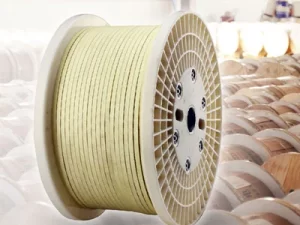
Wrapped Type: Fiberglass tape is wrapped around the conductor surface at a certain angle to form a continuous and dense insulation layer.
Impregnated Type: Fiberglass braids are impregnated with high-temperature-resistant insulating varnish to improve moisture resistance and electrical strength.
2.3 Comparison with Other High Temperature Insulation Materials
| Insulation Type | Temperature Range | Advantages | Limitations |
|---|---|---|---|
| Glass Fiber | -60°C to +550°C | High temperature resistance, corrosion resistance, high strength | Moderate flexibility |
| Mica Wrapping | -60°C to +500°C | High temperature resistance, flame retardant | Relatively brittle |
| Ceramic Coating | Up to +1000°C | Ultra-high temperature resistance | High brittleness |
| Polyimide | -190°C to +400°C | Good flexibility | Limited temperature resistance |
Glass fiber coated conductors have significant advantages in terms of thermal class and overall performance.
III. Typical Applications
3.1 Heating Element Lead Wires
The resistance heating elements of industrial furnaces need to introduce current into the furnace through conductors. The connection point between the heating element and the power supply has the highest temperature, and fiberglass-coated wire is typically used as the lead wire.
Application Requirements: The lead wire should have a thermal class similar to that of the heating element, the fiberglass coating should be complete and continuous, and the ends should be sealed.
3.2 Furnace Door Opening Device Cable
The furnace door opening and closing mechanism of industrial furnaces is located on the side of the furnace body, where the operating temperature is relatively low, but it still needs to withstand the radiant heat of the furnace body. Fiberglass-coated wire is suitable for the electrical connection of such auxiliary equipment.
Selection Recommendation: Furnace door cables should preferably be products with a temperature resistance of 200-300°C and good flexibility.
3.3 Temperature Sensor Lead Wire
Temperature sensors such as thermocouples need to lead measurement signals from inside the furnace cavity to the control cabinet. Fiberglass-coated wire can be used as the outer sheath material for thermocouple compensation wires.
Technical Requirements: The lead wire must have good shielding performance and anti-interference ability, and withstand the instantaneous high-temperature impact at the installation location.
IV. Selection Technical Guidelines
4.1 Thermal Class Selection
| Furnace Type | Operating Temperature | Recommended Thermal Class |
|---|---|---|
| Low-Temperature Heat Treatment Furnace | Below 600°C | 300°C |
| Ordinary Heat Treatment Furnace | 600-900°C | 450°C |
| High-Temperature Heat Treatment Furnace | 900-1300°C | 550°C |
| Smelting Furnace | Above 1300°C | Special Schemes |
When selecting the conductor thermal class, a safety margin of at least 50°C should be allowed.
4.2 Specifications Size Selection
Conductor cross-sectional area selection should consider: current load (ensuring temperature rise does not exceed allowable values), voltage rating (for high-voltage applications, select products with appropriate insulation strength), and mechanical strength (for moving parts, select specifications with good flexibility).
4.3 Special Performance Requirements
Flame Retardant Performance: Select flame-retardant or fire-resistant products according to the usage environment.
Moisture Proof Performance: Impregnated products are recommended for humid environments or intermittent operation furnaces.
Corrosion Resistance Performance: Products with a higher protection level are required for furnaces containing corrosive atmospheres.
V. Installation and Maintenance Precautions
5.1 Installation Points
- Bending Radius: The minimum bending radius should not be less than 6 times the outer diameter of the conductor.
- Fixing Method: The spacing between fixing points should be reasonably arranged to avoid excessive sag of the conductor under its own weight when hot.
- Sealing Treatment: When the conductor passes through the wall or crosses the furnace wall, a high-temperature resistance sleeve should be used for sealing protection.
- Wiring Process: The wiring terminals should be made of a material that matches the thermal class of the conductor.
5.2 Maintenance and Inspection
Regularly check the insulation layer surface for cracks or peeling; check the conductor for deformation, discoloration, or other signs of overheating; and check the connection points for tightness. Replace any abnormalities promptly.
VI. Industry Application Cases
Case 1: Automotive Parts Heat Treatment Production Line
Application Background: Continuous carburizing annealing furnace, operating temperature 850°C, furnace atmosphere is a controllable carburizing atmosphere.
Selection: 550°C grade glass fiber braided wire is used as the heating element lead wire.
Application Results: Continuous operation for 3 years, wire performance is stable and reliable.
Case 2: Special Steel Vacuum Quenching Furnace
Application Background: Operating temperature 1300°C, requires thermocouple signal and heating element power supply from the furnace cavity.
Selection: Heating element lead wire uses special ceramic fiber composite wire, thermocouple lead wire uses glass fiber shielded compensation wire.
Application Results: Meets vacuum high temperature environment requirements, equipment operates stably.
Case 3: Glass Melting Furnace
Application Background: Glass melting furnace temperature 1450°C, furnace structure is a tank furnace type.
Selection: 550°C heat-resistant glass fiber wire is used as the furnace temperature monitoring point lead wire.
Application Results: No insulation failure was observed during long-term use in high-temperature areas near the molten glass surface.
VII. Product Technical Specifications
| Technical Parameters | Specifications |
|---|---|
| Conductor Material | Pure Copper (Nickel-plated or Copper-plated) |
| Insulation Material | Fiberglass Braided/Wrapped |
| Thermal Class | 300°C / 450°C / 550°C |
| Conductor Cross-sectional Area | 0.5-25mm² |
| Rated Voltage | 450/750V |
| Standards | IEC 60317, NEMA MW 1000 |
| Product Certifications | ISO9001, UL, RoHS |
VIII. Common Technical Questions
Q1: What is the highest temperature that fiberglass-coated conductors can withstand?
Glass fiber itself has a temperature resistance limit exceeding 1000°C, but in practical applications, the conductor is limited by the conductor material (copper melting point 1083°C) and the insulating varnish/adhesive. The continuous operating temperature of conventional glass fiber-coated conductors is -60°C to +550°C, with short-term temperature resistance up to +700°C.
Q2: How to choose between glass fiber-coated conductors and mica conductors?
Glass fiber-coated conductors have better flexibility and are suitable for applications requiring flexible wiring; mica conductors have excellent temperature resistance but are more brittle and suitable for fixed installations.
Q3: Can conductor insulation layer damage be repaired on-site?
Minor damage can be locally repaired using high-temperature-resistant insulating varnish, but it is recommended to replace the entire conductor or use a repair sleeve for repair.
Q4: What factors affect the service life of glass fiber-coated conductors?
The main factors include: operating temperature and duration, number of thermal cycles, chemically corrosive atmosphere, mechanical vibration and wear, and installation bending radius. Under normal conditions, the expected service life is 5-15 years.
Conclusion
Fiberglass-coated conductors for industrial furnaces are a key material for ensuring the safe and reliable operation of electrical systems in thermal processing equipment. Their excellent high-temperature resistance, good chemical stability, and reliable mechanical strength make them an ideal choice for industrial furnace heating systems, power transmission, and temperature measurement applications.
When selecting conductors, the thermal class, specifications, dimensions, and protection rating should be rationally determined based on the specific operating temperature, ambient atmosphere, and mechanical requirements. Standardized installation procedures and regular maintenance inspections are also important measures to ensure the long-term stable operation of the conductors.
Our company has thirty years of experience in manufacturing electrical and special conductors and can provide industrial furnace customers with selection consultation, technical solutions, and customized product services.
Contact Information
Email: office@cnlpzz.com
WhatsApp: 0086-19337889070
This article was compiled by Zhengzhou LP Industry Co., Ltd., which has focused on the research and development and manufacturing of electrical and special conductors for thirty years.